 News
News

Industrial Curtain Walls for Warehouse Partitions | DERFLEX
Industrial Curtain Walls: Using PVC Tarps for Warehouse Partitions
Reinforced PVC tarp panels can turn a large warehouse into cleaner, more controllable work zones without committing every layout change to a permanent wall.
This guide explains material selection, clear-window layouts, track and fixed mounting, bottom sealing, access openings, dust and airflow control, temperature zoning, safety checks and the information a buyer should send before requesting a quotation.
Yes—PVC tarps can be engineered into industrial curtain walls for warehouse partitions. The best systems use reinforced PVC-coated polyester for the opaque body, optional clear PVC vision panels, welded or reinforced edges, suitable access openings, and a mounting/sealing method selected for the actual airflow, traffic and facility structure.
What Is an Industrial Curtain Wall?
An industrial curtain wall is a flexible partition used to divide factories, warehouses and service areas into functional zones. Unlike drywall or sheet-metal construction, a curtain wall can be fixed, retractable, relocated or replaced in sections as operations change.
Flexible space separation
Create storage zones, production cells, maintenance bays, packing areas or temporary project spaces while preserving the ability to reconfigure the facility later.
Containment by purpose
A properly detailed PVC curtain can help control dust migration, visual exposure, water spray and unwanted air exchange. The sealing level should match the process rather than being assumed from the fabric alone.
Access without a full wall
Sliding tracks, strip-door openings, zipper entrances and overlapping panels can preserve worker or vehicle access without opening an entire partition every time.
“PVC curtain wall,” “warehouse divider curtain,” “industrial partition curtain,” “vinyl curtain wall” and “PVC tarp partition” often describe closely related solutions. The critical distinction is not the label—it is the construction, movement, sealing and safety requirement.
A Warehouse Partition Is More Than a Sheet of PVC
High-ranking warehouse curtain solutions emphasize the complete system: material, perimeter reinforcement, track or static mounting, access, floor detail, vision panels and specialty options. That is the right way to specify a project.
For most tarp-style warehouse walls, the body is a woven polyester reinforcement coated with PVC. The textile carries structural load while the PVC surface adds cleanability, water resistance and weldability. Clear PVC can be welded into viewing bands where line-of-sight is important.
- Top edge: track rollers, grommets, sleeves, webbing or a fixed rail connection.
- Side edges: overlaps, hook-and-loop, magnetic closures, zippers or fixed attachment.
- Bottom edge: weighted hem, floor sweep, tie-down or free-hanging detail depending on movement and floor condition.
- Access: strip curtain, zipper door, sliding section or dedicated opening sized around traffic.
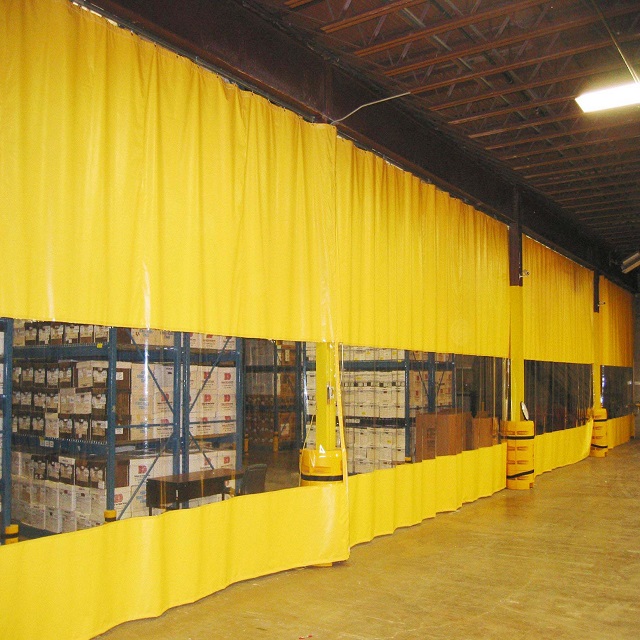
Choose the Curtain Material Around the Job to Be Done
The best warehouse partition specification starts with the containment objective, traffic pattern and installation environment, then selects material weight, transparency, reinforcement and finish.
| Material direction | Best fit | Why buyers use it | What to confirm before ordering |
|---|---|---|---|
| Reinforced PVC-coated polyester | General warehouse partitions, factory zoning, dust barriers, wash areas, repeated-use curtain walls | Strong woven base, cleanable surface, compatible with heat welding, hems, webbing, eyelets and fabricated panels | Weight, base-fabric strength, surface finish, panel width, seam layout, reinforcement and required test documents |
| Clear flexible PVC | Vision panels, observation windows and traffic visibility | Preserves line-of-sight while maintaining a flexible barrier | Thickness, clarity, low-temperature behavior, scratch exposure, welding compatibility and anti-static need |
| Insulated composite curtain | Temperature-difference zones, conditioned work areas and some cold-room separation projects | Reduces conductive heat transfer compared with a single-layer tarp wall | Required temperature difference, insulation construction, door frequency, perimeter sealing and condensation management |
| PVC strip curtain opening | High-frequency pedestrian or forklift passage through a larger partition | Allows traffic to pass while reducing the amount of time the full curtain wall is open | Strip width/thickness, overlap, temperature, traffic type, visibility and mounting height |
Important: sound control, fire performance, food-contact/clean-area requirements and anti-static behavior should be specified as separate performance requirements. A standard single-layer tarp should not be assumed to provide acoustic, fire-rated or ESD performance unless the exact construction and documentation are confirmed.
Where PVC Curtain Walls Work Best in Warehouses
Flexible partitions are most useful where a facility needs separation but cannot justify—or does not want—the permanence, disruption and inflexibility of a conventional wall.
Dust & process separation
Separate sanding, cutting, packaging, maintenance or storage areas. For negative-pressure containment, coordinate curtain leakage, make-up air and extraction rather than treating the curtain as an airtight wall.
Temperature zoning
Reduce uncontrolled air mixing between conditioned and non-conditioned areas. For large temperature differences, consider insulated curtains and minimize frequent full-height openings.
Warehouse workflow
Create temporary staging zones, inspection cells, returns areas or controlled-access storage without permanently changing the floor plan.
Wash-down & splash control
PVC surfaces are easy to wipe and can handle wet environments better than many porous materials. System details should still account for floor drainage and chemical exposure.
Machine & visual isolation
Opaque panels can screen equipment and reduce visual distraction. Add clear PVC viewing bands where supervision or vehicle visibility is required.
Seasonal reconfiguration
Track-mounted or modular partitions can be opened, relocated or removed when production volume, tenants or workflows change.
Example Heavy-Duty PVC Curtain Fabric Specification
DERFLEX currently publishes the following direction for its heavy-duty PVC curtain fabric. Treat these as a starting point for material selection, not a universal requirement for every partition project.
Ask for the base-fabric construction, tensile and tear direction, coating system, surface finish, seam method, reinforcement plan, required fire-test documentation and sample. The finished partition fails at interfaces and stress points long before a datasheet number becomes useful in isolation.
Fixed, Sliding or Modular: Which Curtain Wall Layout Fits?
Layout affects usability as much as material choice. Choose the movement strategy before finalizing panel size, overlap and reinforcement.
Fixed partition
Best for: long-term separation with limited need to open the wall.
Fixed panels can use top grommets, a frame, tensioned edges or dedicated rail attachment. This is often the simplest route when access is provided through a separate door opening.
Sliding track curtain
Best for: zones that must open fully or partially for equipment and layout changes.
Track selection must consider curtain weight, suspension spacing, roof or beam structure, curves, stacking space and the operational force needed to move large panels.
Modular panel wall
Best for: facilities that expect future changes or want replaceable sections.
Individual panels can be connected with overlaps, hook-and-loop, zippers or other joining details so damaged or outdated sections do not require replacing the entire wall.
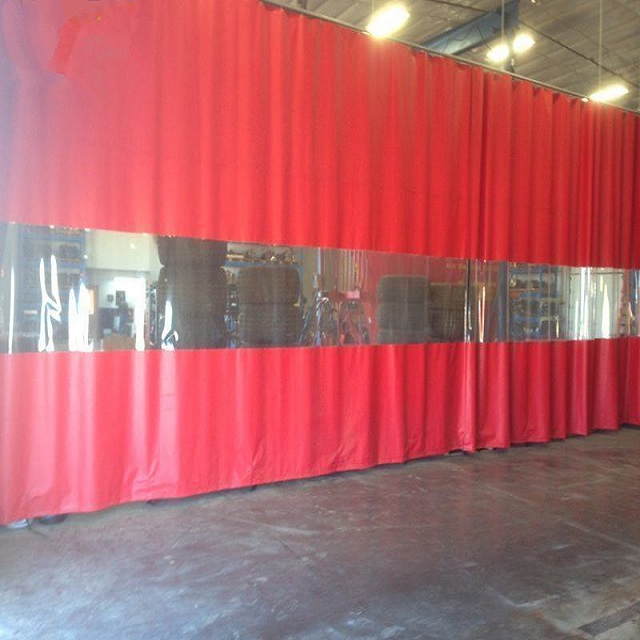
Details that change real-world performance
- Vision windows: place them at useful eye or forklift-operator height, not simply at the center of the panel.
- Bottom sweep: useful for uneven floors, but must not create a trip or snag hazard.
- Weighted hem: helps the curtain hang straighter where floor fastening is not practical.
- Overlaps: help reduce leakage while preserving flexibility; overlap direction should follow airflow where relevant.
- Valance or top filler: closes the gap between track and roof/ceiling when upper containment matters.
- Access opening: design around actual pallet, forklift and pedestrian traffic—not only the nominal doorway width.
PVC Curtain Wall vs Permanent Wall vs Strip Curtain
These three solutions solve different problems. The best choice depends on rigidity, movement, traffic and containment requirements.
| Decision factor | PVC industrial curtain wall | Permanent wall | PVC strip curtain |
|---|---|---|---|
| Reconfiguration | High; especially with track or modular panels | Low; demolition or construction normally required | High at openings, but not ideal as a full opaque enclosure |
| Installation disruption | Usually lower than rigid construction | Highest | Low |
| Visual privacy | Good with opaque reinforced PVC; windows can be added selectively | High | Low to moderate |
| Frequent traffic | Use a dedicated opening or retractable section | Requires doors | Very good for continuous passage |
| Environmental sealing | Depends heavily on perimeter, seams and openings | Potentially highest when designed as a sealed wall | Limited because strips must overlap and move |
| Future layout changes | Well suited | Poor | Well suited for doorways |
Five Checks Before You Hang a Full-Height Warehouse Curtain
A curtain wall changes airflow, egress, visibility and sometimes the way fire-protection systems interact with the space. Final design should be reviewed against local building and fire requirements.
1. Sprinklers and smoke movement
Do not create an unreviewed barrier that interferes with required sprinkler coverage, smoke movement or fire detection.
2. Egress and access
Maintain required exit paths. Curtain openings, zipper doors and strip-door sections must not create a hidden or obstructed route.
3. Fire-performance documentation
Specify the test method and accepted documentation required by the project or authority. “Flame retardant” without a standard, construction and report is not a complete specification.
4. Air pressure and ventilation
Large curtains can billow, move or load the track when pressure differs across zones. Coordinate with exhaust, make-up air and vehicle-door operation.
5. Traffic visibility
Add clear sections, warning markings or dedicated crossing points where forklifts and pedestrians approach the partition from opposite sides.
How to Specify a Warehouse Curtain Wall for Quotation
A good RFQ reduces assumptions. Send the supplier enough information to design the panel layout, material direction and access details before discussing price.
Measure the zone
Provide finished wall width, finished height, ceiling/beam height, floor slope and any columns, ducts or obstructions.
State the containment objective
Dust, visual separation, wash-down splash, temperature zoning, process isolation or a combination of these.
Describe traffic
Pedestrian only, pallet jacks, forklifts, overhead equipment or occasional full-width access.
Define movement
Fixed wall, sliding curtain, split center opening, stacking direction or removable modular sections.
Add visibility and doors
Mark vision-panel height, zipper doors, strip-door walk-throughs and equipment openings directly on a sketch.
List environment
Indoor/outdoor exposure, temperature range, UV, water, oils, cleaners, abrasion, dust type and pressure differences.
State compliance needs
Provide the exact fire, anti-static, food-area or other documentation required by the end user or local authority.
Choose supply scope
Roll goods, cut panels, finished welded curtains, replacement sections, hardware coordination, OEM packaging or repeat B2B program.
Industrial Curtain Wall Applications
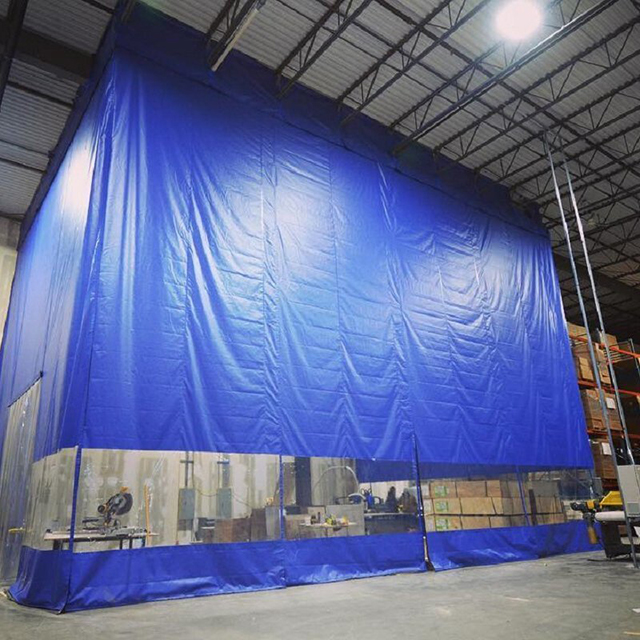
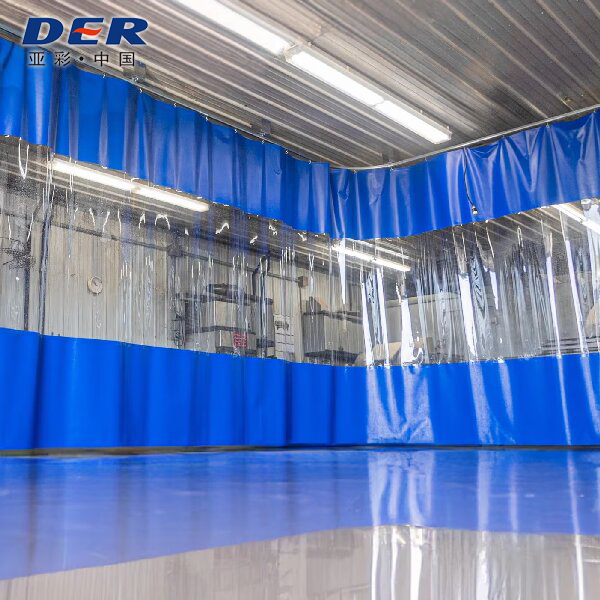
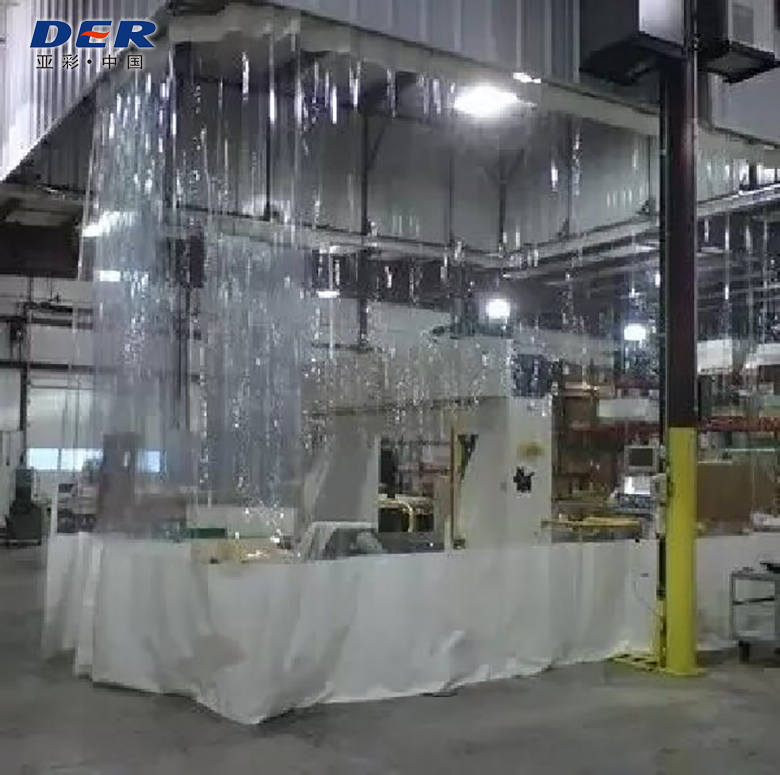
Real application images help buyers understand scale, visibility and layout—and provide stronger image-search context than generic fabric-only photography.
Why Buyers Source the Fabric and Fabrication Direction from DERFLEX
DERFLEX approaches warehouse partitions from the coated-fabric side: material structure, roll-goods consistency, welding and reinforcement compatibility, custom panel construction and repeat OEM supply.
Material-level selection
Choose reinforced PVC-coated polyester, clear PVC sections and project-specific surface or functional directions rather than being limited to one preconfigured curtain kit.
Finished panel capability
Discuss welded hems, reinforced edges, clear windows, eyelets, sleeves, access openings, overlaps and other fabrication details around a drawing.
OEM & repeat programs
Converters, distributors and industrial curtain brands can discuss roll goods, private-label packing, recurring specifications and replacement-panel supply.
For B2B projects, the most useful question is not “Which curtain is cheapest?” but “Which construction can be repeated consistently across the next order, replacement section and expansion phase?”
Continue Your Warehouse Curtain Specification
These internal resources cover adjacent materials, finished curtain directions, dust control and warehouse tarp applications.
Industrial Curtain Wall FAQ
Short answers are written to match common buyer questions and help search engines extract clear definitions and selection logic.
Can PVC tarps be used as warehouse partition walls?
Yes. Reinforced PVC-coated polyester tarps can be fabricated into fixed, sliding or modular industrial curtain walls. The system should include suitable seams, edge reinforcement, clear windows or access openings when needed, and a mounting method designed for the curtain size and site conditions.
What is the best material for an industrial curtain wall?
For many warehouse and factory partitions, reinforced PVC-coated polyester is a practical starting point because it combines textile strength with a cleanable, water-resistant PVC surface and good compatibility with welded fabrication. Clear PVC, insulated composites or specialty materials can be added where the application requires them.
How thick should a warehouse divider curtain be?
There is no single correct thickness or GSM. Curtain height, panel width, traffic, abrasion, movement, reinforcement, fire requirements, temperature and installation method all affect the specification. Compare complete construction data rather than approving a curtain from weight alone.
Can warehouse curtains help control dust?
Yes, they can reduce dust migration when the panel layout, side overlap, top gap, floor detail and access openings are designed for containment. Where exhaust or negative pressure is used, the curtain must be coordinated with airflow and make-up air.
Are industrial PVC curtain walls fire retardant?
Fire-retardant material options can be specified, but buyers should request the exact test standard and report required for the project. A generic “FR” label is not a substitute for matching the correct construction and documentation to local requirements.
What information should I send for a curtain wall quotation?
Send finished width and height, photos or drawings of the support structure, fixed or sliding layout, access openings, clear-window position, environment, dust or temperature objective, required test documentation, color, quantity and whether you need roll goods or finished fabricated panels.
Planning a Warehouse Partition Project?
Send DERFLEX your dimensions, photos or drawing, containment objective, access requirements and target material performance. We can discuss reinforced PVC curtain fabric, clear vision panels, fabricated curtain sections and OEM supply around the actual work zone.