Air-Tight Welded Body
Heat-welded seams and carefully formed end details help reduce leakage points that can waste fan output before fresh air reaches the working zone.



 Finished Ventilation Duct Product
A finished, collapsible air-forcing duct engineered to carry fresh air from a ventilation fan toward active work zones in tunnels, mines and underground construction projects.
DERFLEX supplies project-configured layflat duct sections with selectable diameter, length, coupling, suspension layout, color and performance treatment. The product is delivered as a fabricated ventilation duct—not as a roll of fabric—so buyers can specify the complete connection and installation format required for the jobsite.
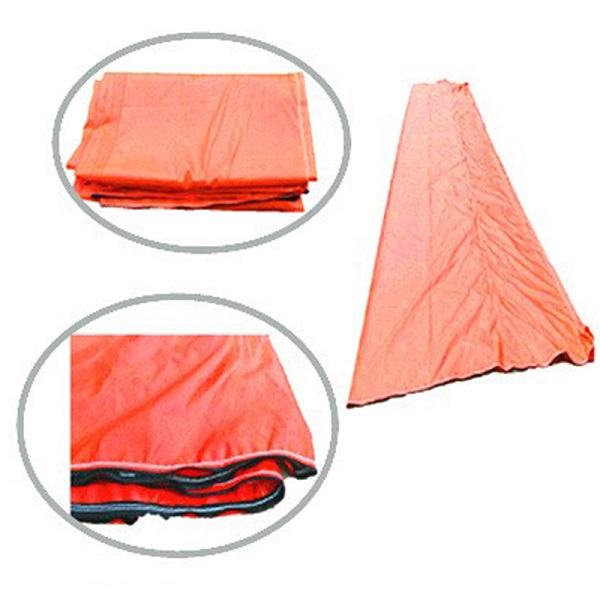
A layflat positive-pressure ventilation duct is a flexible tube without a continuous internal wire helix. When connected to a suitable forcing fan, the fan inflates the duct and pushes fresh air along the tunnel or underground heading. When the airflow stops, the duct body can collapse substantially flat, which reduces transport and storage volume.
This configuration is normally selected where the ventilation objective is to deliver outside air toward workers, machines or the advancing face. It is distinct from a spiral-reinforced suction duct, which requires a structural helix to prevent collapse under negative pressure. Choosing the correct airflow mode is essential: a layflat positive-pressure duct should be matched to a blowing-air system rather than treated as a universal suction hose.
Reliable underground airflow depends on more than the coated textile. Seam construction, section geometry, couplings, suspension and installation discipline all influence leakage, friction, pressure stability and service life.
Heat-welded seams and carefully formed end details help reduce leakage points that can waste fan output before fresh air reaches the working zone.
A smooth inner surface and correctly tensioned installation help control turbulence and friction losses over extended duct routes.
Single or double suspension fins, patches, grommets or project-specific hardware can be selected according to diameter and installation load.
Zippers, hook-and-loop cuffs, steel rings, sleeves or eyelet systems allow the duct line to be extended, repositioned and repaired.
Flame-retardant, antistatic, cold-resistant or other treatments can be discussed where the operating environment and local rules require them.
Layflat sections can be folded for shipment and storage, supporting temporary works, remote sites and ventilation routes that move with the project.
The table covers the principal key-attribute fields commonly requested for tunnel and mine layflat duct procurement, including the diameter range, pressure class, fabric adhesion, antistatic value, connection and suspension details. Final values remain subject to the selected construction and confirmed test requirement.
| Product name | Layflat Positive-Pressure Ventilation Duct | Finished flexible air-forcing duct; not a fabric roll. |
|---|---|---|
| Industry / application | Mining, tunneling, machinery and underground construction | Suitable for fresh-air supply in mine drifts, tunnel headings, metro works, hydropower galleries and similar projects. |
| Airflow mode | Positive pressure / blowing air | The duct inflates during fan operation; select a spiral-reinforced duct for suction or negative-pressure service. |
| Diameter / model range | 300–3000 mm | Diameter should be calculated from required airflow, allowable air velocity, route length and fan performance. |
| Section length | 5, 10, 20, 30, 50, 100, 200 or 300 m | Standard and custom section lengths can be discussed; handling and repair strategy should be considered for very long sections. |
| Body material | Reinforced PVC-coated polyester construction | Fabric grade and weight are selected according to pressure, diameter, abrasion exposure and project standard. |
| Wind-pressure resistance | Typical project range: 3000–10000 Pa | The required class must be confirmed against fan shut-off pressure, transients, diameter and safety margin. |
| Fabric adhesion strength | Typical selectable range: 60–100 N/50 mm | Actual value depends on the selected fabric grade and test method; include the required method in the enquiry. |
| Antistatic option | Surface resistance ≤3 × 10⁸ Ω, when specified | Antistatic performance is optional and must be stated in the purchase specification with the required test method. |
| Flame-retardant options | DIN 4102 B1 / EN 13501 / NFPA 701 / DIN 75200 options | Availability depends on the selected construction. Specify the exact standard, classification and documentation required before quotation. |
| Temperature guideline | Typical material range: approximately −30°C to +70°C | Confirm continuous temperature, cold-flex requirement and proximity to heat sources for the final product selection. |
| Color | Yellow, orange, black or custom | High-visibility colors are commonly used underground; custom color is subject to quantity and formulation. |
| Suspension | Single or double suspension fin / reinforced patch | A common reference is single suspension below 1800 mm diameter and double suspension at or above 1800 mm, subject to design. |
| Grommet spacing | Typical 750 mm | Spacing and hardware can be adjusted according to section weight, diameter, suspension cable and installation method. |
| Sealing sleeve | Typical 150–250 mm | End construction is coordinated with the selected coupling system. |
| Coupling choices | Zipper, hook-and-loop, steel ring or eyelet | Select for installation speed, leakage control, repair access and compatibility with existing duct sections. |
| Processing service | Cutting, heat welding and finished duct fabrication | Sections can be supplied with fabricated ends, suspension details and accessories according to approved drawings. |
| Brand / origin | DERFLEX / China | Company and product marking can be discussed for OEM or project identification requirements. |
| Packing | Folded sections, protective wrapping, pallet or project packing | Packing method is matched to section size, shipment mode and site handling plan. |
A forcing system uses fan pressure to inflate the layflat line and move fresh air forward. Proper sizing and installation help retain useful pressure throughout the route.
Choose a fan that can provide the required volume after accounting for duct friction, leakage, bends and project length.
Connect the first section securely to the fan transition so the airflow enters without an avoidable restriction or loose seal.
Support the duct at consistent intervals, avoid sharp edges and maintain alignment to reduce deformation and pressure loss.
Position the outlet according to the ventilation plan and extend the line as the heading advances or the work zone changes.
The products can look similar in photographs, but they serve different pressure conditions.
The same finished duct concept can be adapted to different project environments, but pressure, fire behavior, static control, diameter and installation details should be matched to each site.
Fresh-air delivery to headings, equipment zones and temporary work areas in changing mine layouts.
Ventilation support during excavation, lining, maintenance and other enclosed construction stages.
Flexible air routes for stations, access shafts and advancing underground sections.
Temporary or project-stage fresh-air supply in tunnels, chambers and underground power works.
Long, extendable duct lines coordinated with tunnel boring operations and advancing faces.
Temporary positive-pressure ventilation where a portable, collapsible air route is more practical than rigid ductwork.
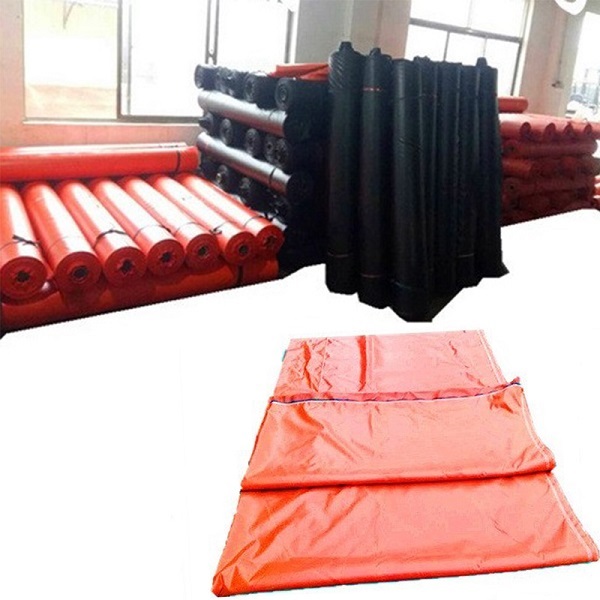
Images below are sourced from the DERFLEX website and show finished ventilation duct sections and underground installation references.
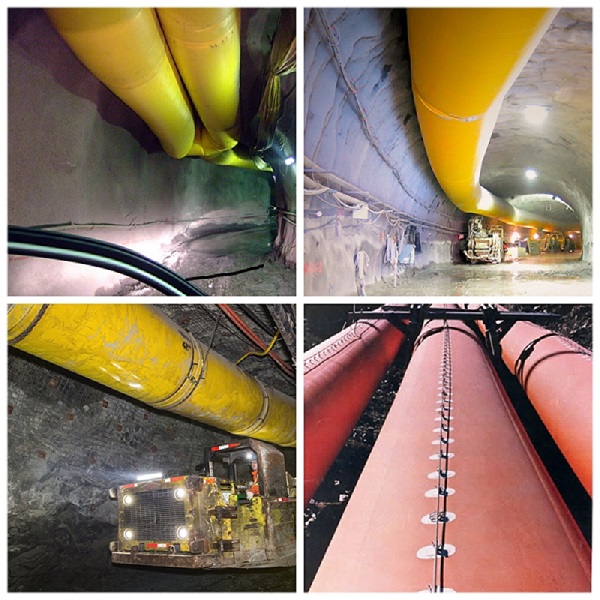
Even a well-made duct can underperform when it is undersized, poorly supported or repeatedly dragged over sharp surfaces. The design review should therefore include both the product specification and the actual installation route.
Long runs require attention to fan pressure, couplings and leakage accumulation. A series of small leaks can substantially reduce the air volume delivered at the face. Bends should be gradual where possible, and the duct should be supported so it remains open and aligned under operating pressure.
Ventilation routes often move as excavation advances. Section , lengths and coupling choice should make that movement manageable. Shorter sections can simplify isolated replacement, while longer sections can reduce the number of joints. The best choice depends on the site’s handling resources and leakage-control priorities.
Cleaning should use methods compatible with PVC-coated construction. Avoid aggressive solvents or uncontrolled heat. Before re-use, inspect suspension patches, end cuffs, zippers or rings, welded seams and any areas that have rubbed against supports. Ducts showing significant structural damage should be assessed before being returned to a high-pressure line.
For safety-critical environments, maintenance practice should follow the project ventilation plan, site risk assessment, local mine or tunnel rules and the documented product specification.
A strong enquiry states the operating requirement rather than requesting only a diameter and color. This allows the duct construction and accessories to be matched to the full ventilation system.
Provide the target m³/h or CFM, fan pressure curve, outlet size and operating point. Diameter selection based only on the fan outlet can be misleading over a long run.
State total length, vertical sections, bends, junctions, expected extensions and the distance from the outlet to the working face.
Include temperature, water exposure, abrasion risk, chemicals, dust, vehicle traffic and any special underground hazard classification.
Do not write only “fireproof” or “antistatic.” Identify the required test standard, classification, report language and documentation format.
Balance joint count, leakage, installation speed, repair access and the manpower available to move or extend the line.
Provide the suspension cable or support method, expected spacing and any hardware restrictions so reinforcement can be positioned correctly.
DERFLEX’s background in reinforced coated textiles supports communication between material selection and the needs of a fabricated duct. For buyers, the value is the ability to discuss the finished product in terms of fan pressure, duct size, joints, suspension, site conditions and documentation rather than treating every project as a standard fabric order.
Recommendations can be organized around airflow mode, route length, diameter, pressure class and underground operating conditions.
Couplings, end sleeves, suspension fins, grommet spacing, section length, color and packing can be included in the product discussion.
Required test standards and documents can be identified before order confirmation, helping avoid vague or unsupported compliance language.
These six internal links connect buyers with related finished-duct and technical information.
Clear answers for contractors, mine operators, tunnel ventilation designers, equipment suppliers and distributors.
This page is for a finished layflat positive-pressure ventilation duct. The product can include the fabricated duct body, welded seams, end connection, suspension reinforcement and packing specified for the project. Technical fabric information is relevant to performance, but the quoted item is not merely a roll of material.
Normally no. A layflat duct depends on internal positive pressure to keep its cross-section open. Under suction it can collapse. Negative-pressure or exhaust applications generally require a spiral or wire-reinforced flexible duct designed to resist vacuum.
Diameter should be calculated from required airflow, acceptable air velocity, total route length, friction, leakage, bends and available fan pressure. Provide the fan curve and target airflow so the product discussion is based on the system rather than diameter alone.
A common configurable diameter range is 300–3000 mm. Section lengths may include 5, 10, 20, 30, 50, 100, 200 or 300 m, subject to design, handling requirements and final production confirmation.
Typical choices include zipper, hook-and-loop, steel ring, sleeve or eyelet-based connection formats. Selection should consider leakage, installation speed, compatibility with the fan and existing duct, repair access and the way sections will be extended underground.
Optional flame-retardant and antistatic configurations can be discussed. Buyers should name the exact required standard and documentation rather than use general terms. Antistatic values such as surface resistance at or below 3 × 10⁸ Ω may be available for specified constructions, subject to test confirmation.
Positive-pressure classes in the approximate 3000–10000 Pa range may be configured depending on diameter, fabric grade, seam design and section construction. The final class must be selected against the actual fan pressure and project safety margin.
Use an appropriate pressure-rated construction, limit unnecessary joints, select secure couplings, support the duct correctly, avoid damage from sharp surfaces and repair punctures promptly. Airflow should be checked after each major extension because friction and leakage accumulate with route length.
Send target airflow, fan model and curve, fan outlet size, total route length, number of bends, required diameter if already calculated, temperature, underground conditions, fire or antistatic standard, preferred section length, coupling, suspension, quantity, destination and delivery schedule.
Custom color, identification marking and project or OEM packing can be discussed according to order quantity, technical requirements and production confirmation. Include the artwork, marking position and packing expectation with the enquiry.
Share the system data, required standard and installation method. DERFLEX can organize the quotation around the complete finished layflat positive-pressure ventilation duct rather than a generic fabric specification.