01
Moisture Exclusion
Use a waterproof coated structure and plan seams, overlaps, slope and drainage so the cover does not create uncontrolled water pockets.
 News
News

Chemical-resistant farm covers should be specified around the fertilizer, moisture exposure, cover geometry, seams, reinforcement and handling cycle—not around a generic “chemical-proof” label.
DERFLEX supplies PVC coated polyester roll goods and custom finished fertilizer covers for stockpiles, bunkers, pallets, big bags, warehouse staging and agricultural distribution yards. Chemical compatibility can be reviewed from the fertilizer type or SDS before sampling.
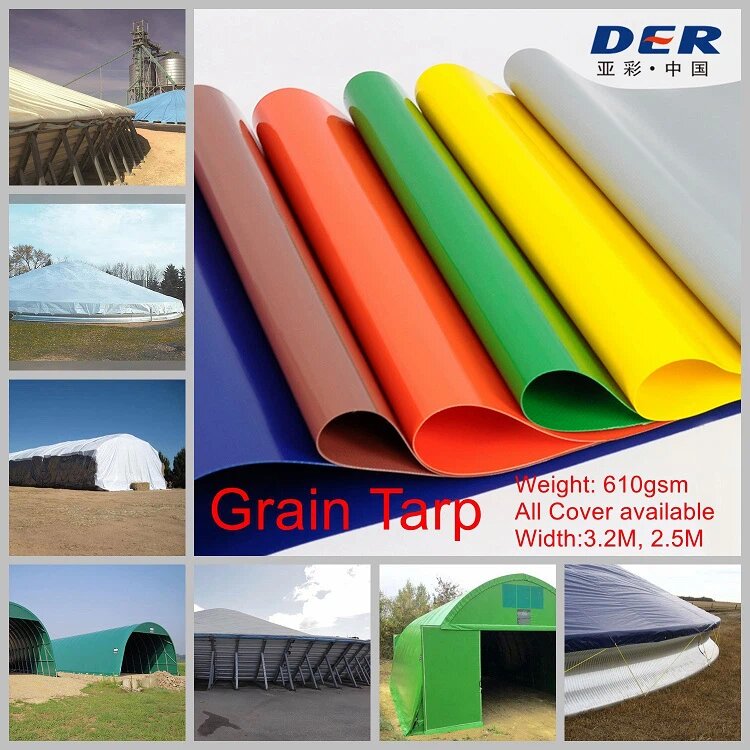
What is a fertilizer storage tarp? A fertilizer storage tarp is a flexible waterproof cover used to reduce rain, surface wetting, dust and weather exposure around dry fertilizer stockpiles, bagged product, big bags and temporary storage areas. For repeated B2B use, PVC coated polyester is often considered because it combines a coated moisture barrier, reinforced textile structure and weldable fabrication.
Important: “chemical resistant” is application-specific. Suitability depends on the fertilizer chemistry, concentration, wet or dry contact, temperature, duration, cleaning method and the complete tarp construction. For regulated fertilizers such as ammonium nitrate, a tarp is only one part of the storage system and does not replace applicable fire-safety or storage rules.
Moisture-sensitive fertilizer may cake, become difficult to handle or pick up contamination when storage protection is weak. At the same time, large tarps are exposed to wind lift, water pooling, abrasion, repeated opening and concentrated loads at grommets or straps. A useful fertilizer storage cover must address both the stored material and the mechanical behavior of the finished tarp.
Use a waterproof coated structure and plan seams, overlaps, slope and drainage so the cover does not create uncontrolled water pockets.
Review the exact fertilizer and contact condition. Dry dust, damp residue, concentrated solution and long-term contact are not equivalent exposures.
Large covers need reinforcement that transfers force through hems, webbing, D-rings, sleeves or other planned attachment details.
Sectional layouts, folds and opening zones can reduce repeated dragging when loaders, conveyors or workers need regular access to the fertilizer.
Start from the storage method, service cycle and dominant failure risk. Final material and finished-cover details should be confirmed against the project.
A cover should not be approved only because the base material is described as PVC or “chemical resistant.” The entire exposure profile should be reviewed before deciding the material direction, especially when the tarp has direct, damp or repeated contact with fertilizer residue.
For broader exposure guidance, see DERFLEX chemical resistant tarps.
The ranges below are planning directions drawn from current DERFLEX fertilizer-cover and tarp material programs. Final values should be confirmed by approved sample, finished size, fixing layout and agreed test method.
| Specification | Typical Direction | Why It Matters |
|---|---|---|
| Material system | PVC coated polyester; PE woven laminated option for selected projects | Influences handling, weldability, tear behavior, weather barrier and project cost. |
| Base fabric | 300D / 500D / 1000D polyester directions for PVC coated programs | Higher-strength constructions may be considered for larger covers and repeated handling. |
| Material weight | Approx. 350–900 gsm depending on application | GSM is one input; yarn, coating, reinforcement and cover geometry also control performance. |
| Roll width | Up to approx. 3.2 m for selected PVC coated constructions | Wider rolls can reduce seam count, while very large finished covers are produced by panel welding. |
| Seam construction | Hot-air or high-frequency welded panels where compatible | Welded seams support a more continuous water barrier for large-format covers. |
| Edge reinforcement | Webbing hem, double layer, rope edge, corner patches or custom zones | Transfers tie-down and wind loads away from isolated hardware points. |
| Hardware | Eyelets, D-rings, webbing loops, sleeves or pockets by design | Attachment choice should match anchor geometry, wind and handling frequency. |
| Surface / color | Gloss, matte, UV-oriented or application-specific finish; custom colors by discussion | Can support cleaning, outdoor exposure, visibility and private-label presentation. |
| Supply form | Roll fabric, cut sheets, fabricated covers or OEM programs | Lets distributors and fabricators buy at the stage that fits their production model. |
| Chemical suitability | Confirm by fertilizer and exposure details | No polymer should be assumed universally resistant to all fertilizer formulations and conditions. |
Need help comparing weight classes? Use the DERFLEX tarp GSM guide before locking the final specification.
Bulk fertilizer piles change the required tarp size because height, slope, walls, conveyors and access zones add fabric travel beyond the plan-view footprint. Large covers also need working allowance for overlap, fastening and practical deployment.
For measurement formulas and finished-size terminology, see the DERFLEX tarp size guide.
Prevent low points where rainwater can accumulate. Ponding adds load and can overload seams, grommets and anchors.
Use reinforced edges and a fixing plan that spreads load instead of relying on a few isolated eyelets.
Keep welded seams away from concentrated abrasion or ridge stress where practical and orient panels for water runoff and folding.
Design modular sections or opening zones when the pile is frequently loaded, sampled or unloaded.
All images below are existing DERFLEX website assets. The hero image is loaded immediately; below-fold images use lazy loading and descriptive alt text for image-search context.
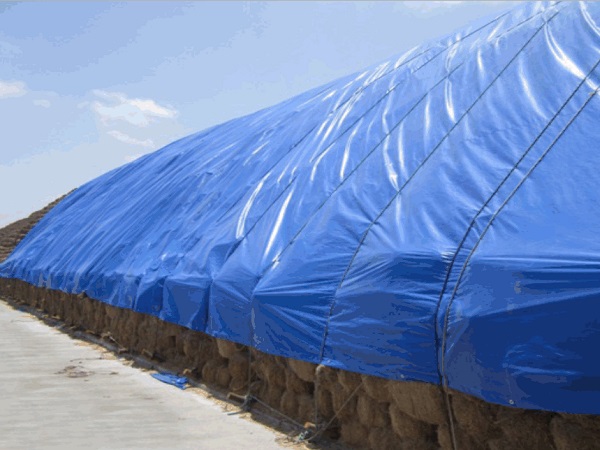
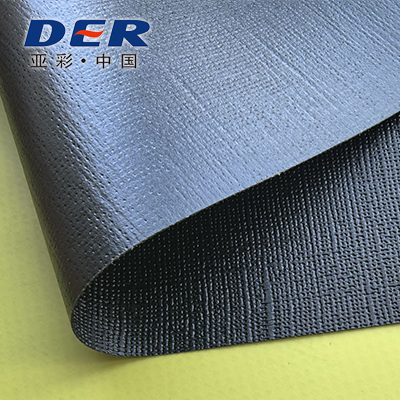
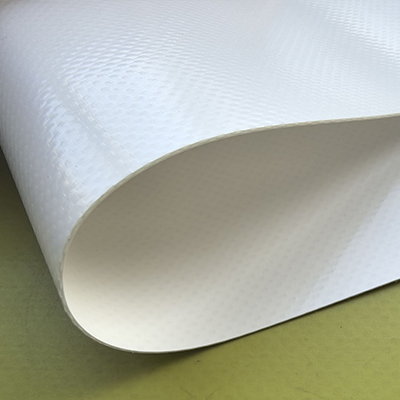
Both materials can be used for agricultural weather covering, but they solve different procurement priorities. Do not select the tarp material by price or GSM alone.
Typical direction: repeated industrial handling, larger fabricated covers, welded panels and reinforced attachment points.
It combines a coated moisture barrier with woven polyester reinforcement and can be fabricated by hot-air or high-frequency welding. For fertilizer use, chemical suitability still needs to be reviewed against the actual product and contact condition.
Explore the base material on DERFLEX PVC tarpaulin.
Typical direction: lighter seasonal coverage, high-area temporary protection and projects where handling weight or budget has priority.
PE can be practical for selected farm-storage programs, but durability depends heavily on grade, UV stabilization, lamination, reinforcement and the way the cover is fixed and handled.
For broader farm material selection, compare the DERFLEX agriculture tarp program.
Ask which fertilizer, concentration, temperature and contact duration the material must tolerate.
Add the real surface path, side drops, overlap and anchor reach; irregular stockpiles need a drawing.
A heavier sheet can still fail when loads concentrate at a few grommets or corners.
Standing water increases dead load and accelerates local stress. Plan slope and drainage before choosing fabric weight.
Fertilizer-specific storage, ventilation, fire safety and environmental rules still apply.
A detailed RFQ helps DERFLEX compare material, fabrication and handling options instead of returning a generic tarp quotation.
Some fertilizer products require specific storage controls that go well beyond weather covering. For example, U.S. OSHA has dedicated ammonium nitrate storage provisions covering ventilation, construction, contamination control and other conditions. A tarp should not be presented as a substitute for an engineered storage building, containment system, fire protection or jurisdiction-specific compliance program.
For regulated fertilizer projects, confirm the fertilizer SDS, local rules and site engineering requirements before selecting the cover. U.S. buyers can review OSHA fertilizer-industry guidance.
DERFLEX can support material supply and custom fabrication for distributors, fertilizer companies, agricultural cooperatives, cover fabricators and private-label buyers.
PVC coated polyester and related tarp-material directions for waterproof cover fabrication.
Panel welding, hems, reinforcement, D-rings, eyelets, webbing and finished-size programs.
Custom color, logo, labels, packaging and repeat supply for agricultural distribution channels.
Material weight, exposure, fertilizer contact, handling and attachment details can be reviewed before sampling.
These six verified DERFLEX pages cover adjacent material, sizing and bulk-storage decisions relevant to fertilizer tarp projects.
Answer-first responses for common procurement, material and storage questions.
For repeated industrial use, PVC coated polyester is a common direction because it combines a waterproof coated surface, reinforced textile base and weldable fabrication. PE woven tarpaulin may suit lighter or cost-sensitive seasonal use. The final choice depends on fertilizer contact, outdoor exposure, cover size, handling cycle and fixing design.
PVC-coated fabric may be suitable for many fertilizer-cover applications, but compatibility should be confirmed for the exact fertilizer and exposure condition. Dry dust, damp residue, concentration, temperature, additives and contact time can change the result. Provide the fertilizer grade or SDS if direct or repeated contact is expected.
Outdoor storage requirements depend on the fertilizer and local rules. A waterproof tarp can help reduce rain and surface-water exposure in permitted temporary storage situations, but it does not replace required building, base, ventilation, fire-safety, environmental or hazardous-material controls. Regulated products such as ammonium nitrate require special attention.
Measure the pile length, width and maximum height, then measure or calculate the real fabric path down each side. Add the functional overlap and reach needed for anchoring. For irregular piles, walls or conveyors, send a top view and side view rather than only the ground footprint.
Higher GSM may help in some applications, but wind performance also depends on base fabric, perimeter reinforcement, anchor spacing, seam placement and the amount of unsupported tarp area. A heavier sheet with weak edge design can still fail.
DERFLEX can discuss large covers made from welded panels or modular sections with project-defined dimensions, reinforced edges, webbing, eyelets, D-rings, sleeves or pockets. Send the pile geometry, wind exposure, access points and intended anchoring method for quotation review.
Send the fertilizer type, storage format, dimensions, climate, contact condition, expected service period, handling frequency, fixing method, quantity, required supply form, branding or packaging requirements and destination. Photos and a simple dimensioned sketch are useful for large or irregular sites.
Send DERFLEX the fertilizer type, pile or pallet dimensions, exposure conditions, fixing method and quantity. We can discuss a practical material and fabrication direction before quotation and sampling.