Agricultural Water Tank Manufacturer | Flexible Farm & Irrigation Water Storage | DERFLEX
Flexible Farm Water Storage · Manufacturer Supply
Flexible Agricultural Water Tanks for Irrigation & Farm Water Storage
DERFLEX manufactures flexible agricultural water tanks and farm water bladders for irrigation reserve,
livestock supply, rainwater collection, seasonal storage and remote agricultural projects.
PVC or TPU coated fabric, tank footprint, capacity, inlet/outlet layout and accessories can be matched to the real field workflow.
The right agricultural water storage tank is not selected by liters alone. Available ground area, refill rate,
irrigation demand, UV exposure, relocation frequency, pump connection and water-contact requirements should be reviewed together.
500–500,000 LExisting DERFLEX flexible tank family reference; final capacity is project-dependent.
PVC / TPUTwo coated-fabric routes for different cost, flexibility and application requirements.
Foldable When EmptyUseful where seasonal storage, transport volume or relocation matters.
Custom ConnectionsValve, inlet, outlet, vent and hose interface can be discussed before fabrication.
Quick Answer
What Is an Agricultural Water Tank?
An agricultural water tank stores water near the point of farm use for irrigation, livestock, rainwater harvesting,
washdown, drought reserve or temporary field supply. Agricultural tanks may be rigid polyethylene, steel, concrete,
lined ponds or flexible coated-fabric systems.
This page focuses on the flexible agricultural water tank: a reinforced PVC or TPU coated-textile
container that folds compactly when empty and expands when filled. It is especially useful when the tank must be moved,
stored seasonally, shipped to remote sites or installed without transporting a rigid vessel of the same volume.
No. Flexible tanks are strong candidates for portable, seasonal, temporary and remote water storage, but a permanent
high-rise steel tank, local molded poly tank or lined reservoir may be more appropriate for other sites. A sound
specification starts with the farm workflow, not with one material being declared universally better.
Procurement Snapshot
Quick Agricultural Water Tank Specification
Use this as an RFQ framework. Values that depend on a project should be confirmed before production rather than assumed.
Specification Item
DERFLEX Direction
What the Buyer Should Confirm
Tank format
Closed flexible bladder / pillow-style or project-matched flexible format
Fixed field position, seasonal deployment, relocation frequency and access requirements
Material
Reinforced PVC coated fabric or TPU coated technical fabric
Water-contact requirement, folding cycle, abrasion exposure, climate and target cost
Capacity
500–500,000 L existing flexible tank family reference
Usable reserve, refill rate, daily farm demand and maximum installed footprint
Fabric thickness
0.75–1.20 mm is an existing DERFLEX flexible-tank reference for selected products
Final thickness must match tank size, geometry, material system and service conditions
Connections
Custom inlet, outlet, valve and accessory layouts available by project
Hose size, pump interface, coupling standard, fill rate, discharge rate and drain position
Color / marking
Project and OEM color / labeling can be discussed
Branding, model identification, farm-use instructions and destination requirements
Accessories
Groundsheet, repair items and connection accessories can be reviewed
Ground condition, distance from maintenance support and deployment frequency
Potable-water use should never be assumed from the words “PVC” or “TPU” alone. If drinking-water contact is required,
state the destination market and required water-contact standard so the exact material, fittings and finished tank can be reviewed.
Selection Matrix
Choose the Tank Around the Farm Use Case
Different agricultural jobs stress the tank in different ways. Capacity is only one part of the selection.
01
Irrigation Buffer Storage
Use the tank as a reserve between a well, tanker, canal, rainwater source or pump system and the irrigation network.
Prioritize outlet flow and pump compatibility.
Confirm daily draw and replenishment rate.
Plan the filled footprint before ordering.
02
Livestock Water Reserve
Suitable as a storage source feeding troughs or a farm distribution line where flexible storage is operationally useful.
Confirm water quality requirement.
Protect valves from animal and vehicle traffic.
Plan cleaning and drainage access.
03
Rainwater Harvesting
Collected rainwater can be transferred into flexible storage for seasonal agricultural use where a foldable system fits the site.
Use pre-filtration appropriate to the source.
Confirm overflow and vent strategy.
Separate collection design from tank design.
04
Remote / Seasonal Farming
Foldable tanks are useful where water storage moves with fields, harvest cycles, temporary workers or seasonal production.
Start with farm demand and replenishment, then check whether the resulting volume physically fits the site.
Avoid selecting a tank from nominal capacity alone.
Practical Starting Formula
For a first sizing discussion:
Required usable storage ≈ peak daily water draw × desired reserve days ? dependable replenishment during that period
Then add an operational buffer appropriate to the project and verify the proposed tank's installed footprint,
maximum fill height, inlet/outlet flow and ground loading conditions.
Five Numbers to Send DERFLEX
Peak water demand per day or per irrigation cycle.
Number of reserve days required.
Expected refill volume or flow during those days.
Maximum available length × width at the site.
Required discharge flow to the irrigation or livestock system.
If a large-capacity system is required, the design conversation should include footprint, filling sequence,
seam layout, fitting reinforcement and ground preparation—not just liters.
Real Product Images
DERFLEX Flexible Water Storage Examples
Actual DERFLEX site imagery is used below so buyers can connect the specification discussion with real flexible containment products.
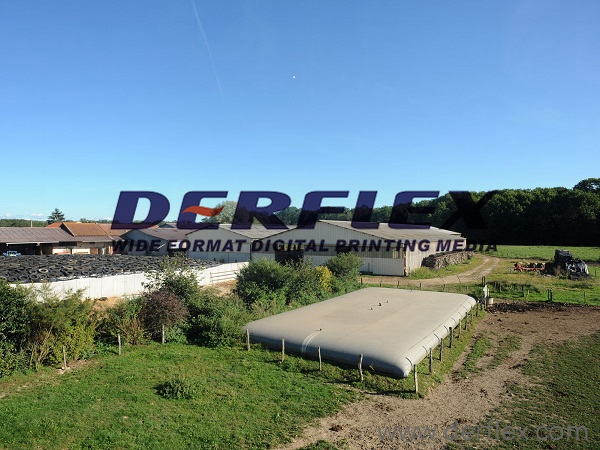
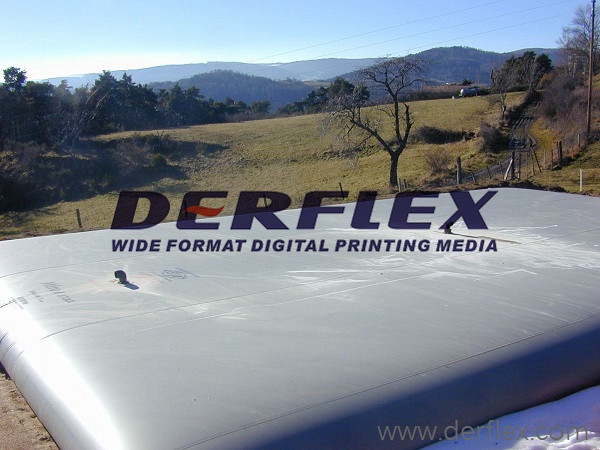
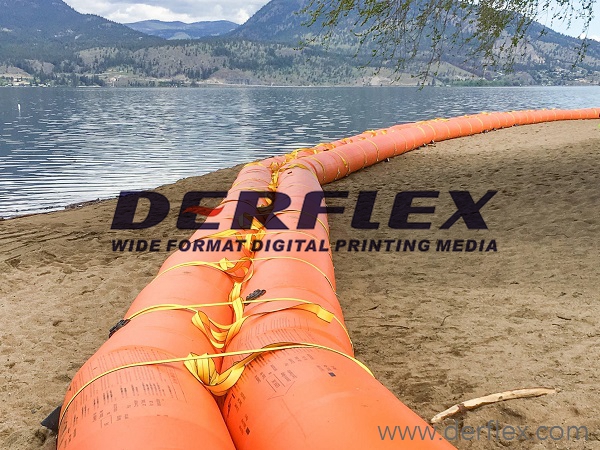
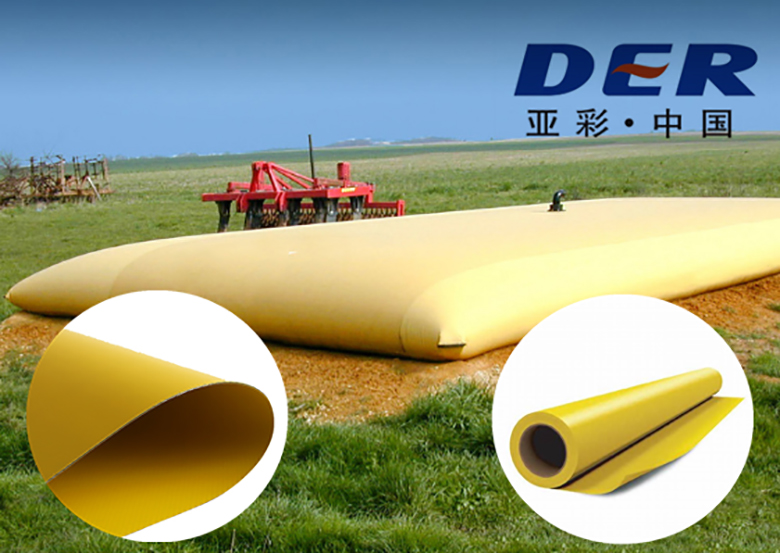
Flexible coated-fabric water storage can be packed compactly when empty and deployed close to the agricultural point of use.Tank geometry, seam construction and connection position should be selected together with capacity.Portable agricultural storage is most valuable when freight volume, relocation and seasonal handling are part of the buying decision.
Material Decision
PVC vs TPU for a Flexible Farm Water Tank
Both are coated technical-fabric routes. The better choice depends on the tank program rather than a generic “premium” label.
Decision Factor
PVC Coated Fabric Direction
TPU Coated Fabric Direction
Commercial position
Commonly used for cost-conscious irrigation, construction and general flexible water storage programs.
Useful for specialized programs where a different flexibility, folding or water-contact requirement must be evaluated.
Fabrication
Good weldability when the selected fabric and process are correctly matched.
Welding route should be validated for the exact TPU construction and finished tank design.
Repeated folding
Can support foldable storage when the formulation and tank design are matched to the duty cycle.
Often evaluated where repeated folding and flexibility are major project variables.
Water contact
General irrigation use can be reviewed; potable claims require exact compliance verification.
Project-specific water-contact requirements can be evaluated; material name alone is not certification.
Best way to specify
Send the water type, temperature, deployment cycle, site condition, required standard, target capacity and connection details before final material approval.
Six Procurement Errors That Create Problems in the Field
1
Buying by Capacity Alone
The filled tank may not fit the field footprint or may block vehicle and irrigation access.
2
Ignoring Ground Condition
Sharp stones, stubble, metal debris and uneven substrates can damage a flexible system without proper preparation.
3
Specifying Only a Valve Size
The fitting must connect to the actual pump, hose and local coupling system, not simply match a nominal diameter.
4
Calling Every Tank “Potable”
Drinking-water suitability depends on the exact material, fittings, finished system and applicable market requirements.
5
Folding the Tank Wet or Dirty
Drain, clean where required, dry and inspect before long-term storage to protect the coating, seams and hygiene condition.
6
No Spare / Repair Plan
Remote agricultural sites should consider matching patch material, seals, caps or other project-specific spare items.
Deployment Guidance
Prepare the Site Before Filling
A flexible tank becomes heavy once filled. The best time to solve ground, access and connection problems is before water enters the tank.
Confirm the full filled footprint and keep the area clear of traffic where possible.
Remove sharp objects, crop stubble, wire, stones and debris from the substrate.
Use the specified groundsheet or protective layer when required by the site.
Position inlet, outlet and drain connections so hoses do not pull or twist the fitting zone.
Confirm pump and hose connections before the tank is full and difficult to reposition.
Inspect seams, fittings and the surrounding ground during initial filling.
Agricultural water management may use both closed flexible tanks and lined storage systems.
The storage format should be selected around the field layout, water source and operating cycle.
Manufacturing Perspective
Why Coated-Fabric Knowledge Matters in a Farm Water Tank
The tank body, welded seams and reinforced fittings behave as one flexible structure.
A supplier should be able to discuss the coated textile and the finished fabrication together.
Base Fabric & Coating
Reinforcement carries tensile load as the tank fills.
Coating creates the liquid barrier and affects flexibility.
UV exposure and climate should be part of the material discussion.
Seam Welding
Welding method must be matched to the selected coated fabric.
Seam layout should account for tank geometry and load paths.
Finished seam quality matters as much as roll-fabric strength.
Fitting Reinforcement
Valves and outlets create local stress concentrations.
Connection zones should be designed for hose and pump handling.
Protected placement reduces accidental impact and side loading.
Repeat-Order Control
Standardize capacity, fabric, fittings and labels for distributor programs.
Approve a reference specification before repeat bulk production.
Keep packaging and accessory kits consistent by model.
A complete RFQ reduces back-and-forth and helps avoid a quotation based on the wrong tank geometry or fittings.
Required usable capacity in liters, cubic meters or gallons.
Water source and intended use: irrigation, livestock, rainwater, washdown or reserve.
Available installation footprint and any height restriction.
Expected outdoor UV exposure and climate / temperature conditions.
Required inlet, outlet, vent, drain and coupling details.
Pump, hose or irrigation-system interface and required flow rate.
How often the tank will be deployed, relocated, folded and stored.
Required water-contact or destination-market compliance, if any.
Quantity, target delivery market, branding and packing requirements.
Send the Farm Workflow, Not Just the Tank Size
DERFLEX can review capacity, flexible PVC / TPU material direction, footprint, connection layout, color,
accessories and OEM requirements around the real agricultural application.
What is the best agricultural water tank for irrigation?
There is no single best tank material for every farm. A flexible coated-fabric tank is a strong option when seasonal deployment,
compact transport, relocation or remote-site storage matters. Rigid polyethylene, steel or lined reservoirs may be better for
permanent installations. Compare usable capacity, footprint, replenishment rate, discharge flow, site access and maintenance before choosing.
How do I calculate the agricultural water tank size I need?
Start with peak daily water demand multiplied by the desired reserve period, subtract dependable replenishment during that period,
then add an appropriate operational buffer. After estimating volume, verify that the proposed tank fits the available footprint and
can deliver the required outlet flow to the irrigation or livestock system.
Can a flexible agricultural water tank be used for livestock water?
It can be used as a storage source for livestock-water systems when the exact tank material, fittings and water-quality requirement are suitable.
Protect connections from animals and vehicle traffic, and confirm any potable or food-contact requirement separately rather than assuming it from the material name.
Is PVC or TPU better for a farm water bladder?
PVC is widely used for cost-conscious general flexible-water programs, while TPU can be evaluated for specialized projects where flexibility,
repeated folding or different water-contact requirements matter. The correct choice depends on the exact fabric construction, service cycle,
temperature, abrasion exposure, welding route and target market requirements.
Can DERFLEX make custom agricultural water tanks?
DERFLEX supports project-matched flexible tank capacity, dimensions, PVC or TPU material direction, connection layout, color,
accessories and OEM / private-label requirements. Final specifications should be confirmed against the farm application and operating conditions.,
What ground is needed under a flexible water tank?
Use a level, stable area free of sharp stones, wire, crop stubble and debris. Ground protection may be required depending on the substrate and tank system.
Confirm the full filled footprint and keep hoses or fittings from being pulled, twisted or driven over.
Can an agricultural water tank store fertilizer or pesticides?
Do not assume a water-tank material is compatible with fertilizers, pesticides or other agricultural chemicals.
The exact liquid composition, concentration and temperature must be reviewed for chemical compatibility before approving a flexible tank for non-water liquids.
Can a flexible farm water tank be stored between seasons?
Yes, foldability is one of the main practical advantages. The tank should be fully drained, cleaned when required, dried, inspected and folded according
to the recommended procedure before storage. Keep it protected from sharp objects, pests, heat sources and damaging loads while packed.