More usable headroom
The flattened vertical dimension creates a larger equipment envelope in low drift or tunnel sections without defaulting to a smaller airflow area.




A flexible oval-chambered air duct engineered for mines, tunnels and underground works where every millimeter of overhead clearance matters. The low-profile cross-section helps preserve useful airflow area while creating more room for loaders, drilling rigs, haulage equipment and service lines.
Conventional round ducting is efficient, but its full diameter can conflict with machinery envelopes in narrow drifts. An oval low-headroom ventilation duct redistributes the cross-section horizontally, allowing the duct to sit closer to the crown or sidewall while maintaining the airflow area required by the ventilation plan.
DERFLEX supplies the oval low-headroom ventilation duct as an assembled product. The duct body is formed from high-strength polyester textile coated with PVC on both sides, then cut, welded and fitted with the specified suspension and coupling components. The finished assembly is designed to connect to a mine or tunnel fan system and distribute fresh air toward the work face.
The oval section is normally maintained by dual external suspension fins or patches together with internal cables, webbing or other shape-control elements. This prevents the duct from simply inflating into a round tube and helps keep the intended low profile under positive pressure.
The product is particularly useful where a round duct would reduce machine clearance, interfere with a conveyor or cable route, or force a larger excavation profile. It can also be considered when an existing tunnel cannot be enlarged but requires improved auxiliary ventilation capacity.
Simple geometry, but consumes more vertical clearance.
Cross-section redistributed to free vertical space.
The value of a low-profile duct comes from the complete system: geometry, suspension, welding, coupling and jobsite serviceability.
The flattened vertical dimension creates a larger equipment envelope in low drift or tunnel sections without defaulting to a smaller airflow area.
Dual suspension and internal shape-control elements stabilize the profile under positive pressure and support consistent alignment.
Hot-air or high-frequency welding can keep primary seams free from stitch holes; sealing sleeves can cover couplings to reduce leakage risk.
Zipper, hook-and-loop, end-ring and eyelet coupling systems can be selected around installation speed, pressure and maintenance practice.
Flame-retardant and anti-static PVC formulations can be developed against the buyer’s specified regulatory or test requirements.
Minor damage can be addressed with compatible repair tape, adhesive, zipper/Velcro repair bands or portable hot-air tools, subject to site procedure.
Final values are confirmed against fan duty, airflow, route length, installation envelope and the required compliance documents.
| Product form | Finished oval flexible ventilation duct assembly for positive-pressure airflow |
|---|---|
| Duct body | Polyester woven or knitted base textile with PVC coating on both sides |
| Common equivalent size | 450–1650 mm; custom width × height geometry available after engineering review |
| Common section length | 5, 10, 20, 30, 50 m; longer continuous sections can be evaluated for handling and shipment |
| Typical colors | Yellow, orange, black; high-visibility or custom colors subject to formulation and quantity |
| Suspension | Double fins or reinforced suspension patches; installation angle and rope layout customizable |
| Internal shape control | Internal steel rope, coated cable, webbing or engineered divider arrangement, selected by profile and pressure |
| Coupling options | Zipper, hook-and-loop, steel/end ring, eyelet lacing, or project-specific interface |
| Sealing sleeve | Commonly 150–400 mm; adjusted to connector and pressure requirement |
| Suspension point spacing | Commonly around 750–800 mm; customized to duct weight, span and support system |
| Safety options | Flame-retardant and anti-static construction available; standard and report scope must be stated in the RFQ |
| Accessories | Elbows, reducers, tees, wyes, adapters, end caps, repair kits, hooks, carabiners and suspension cable |
| Packaging | Folded/rolled sections with protective wrapping; pallet or export packing based on size and shipping method |
The images below are hosted on the DERFLEX website and show flexible ventilation duct products and underground ducting applications.
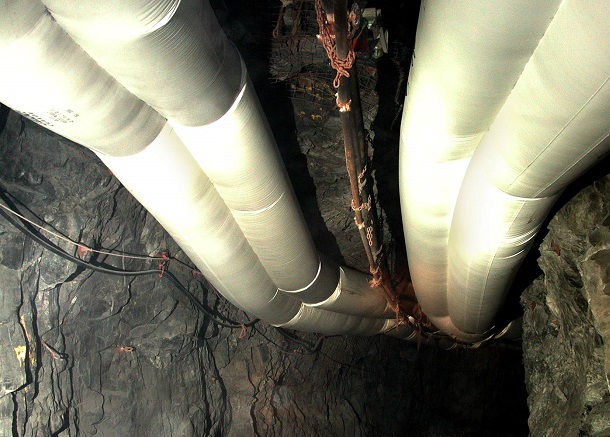
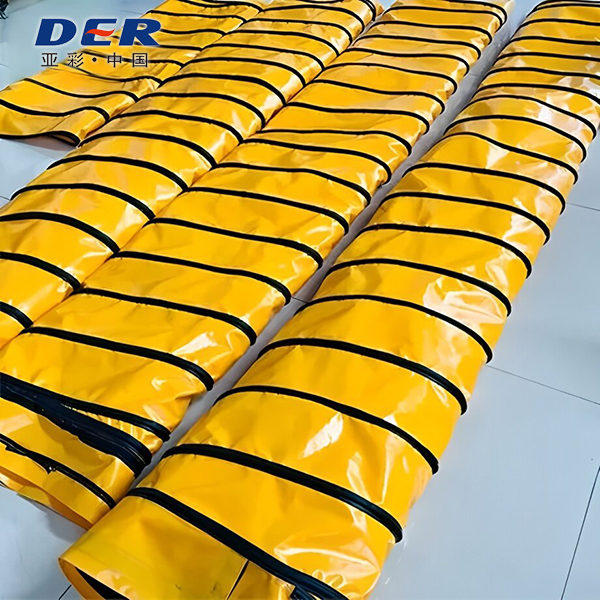
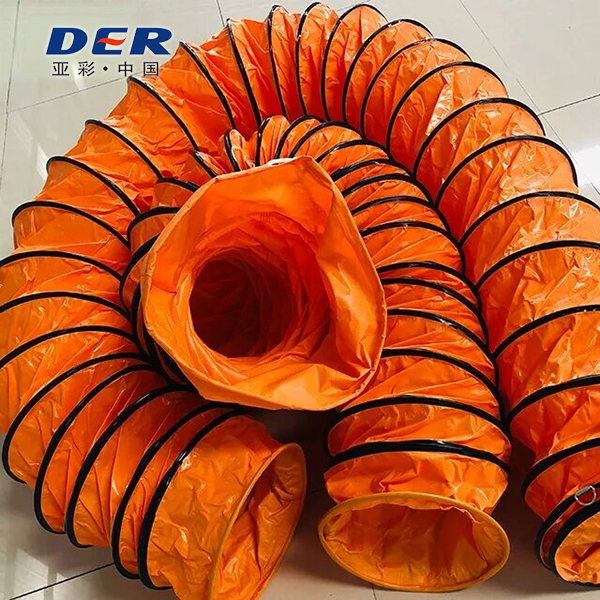
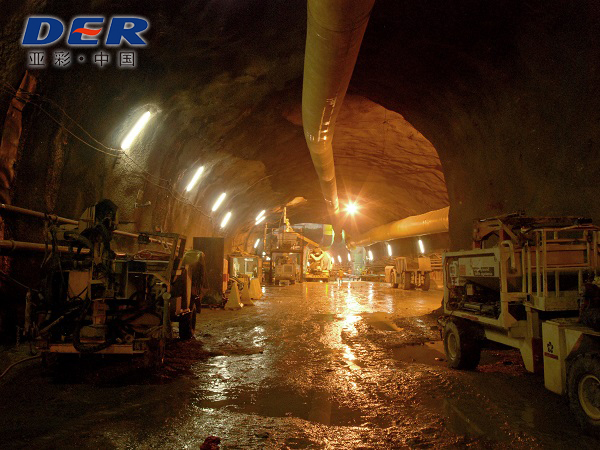
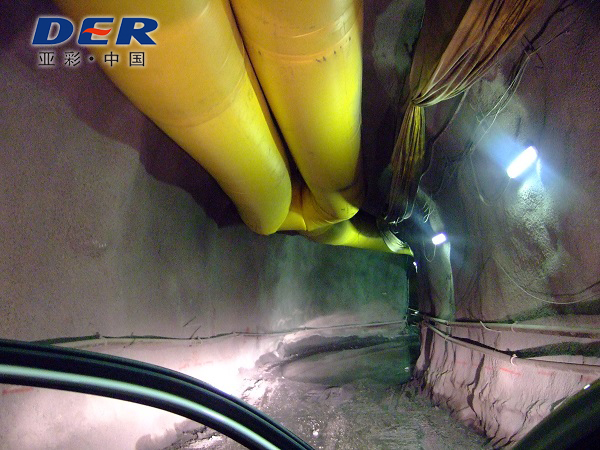
Each duct type solves a different ventilation and installation problem. A project may use more than one type along the same route.
| Selection factor | Oval low-headroom duct | Round layflat duct | Spiral wire-reinforced duct |
|---|---|---|---|
| Primary use | Positive-pressure ventilation where vertical clearance is restricted | Positive-pressure air delivery with simple storage and extension | Positive or negative pressure where self-supporting shape is required |
| Headroom | Best option when the duct must fit close to crown or sidewall | Requires the full inflated round diameter | Round or custom shape; wire helix adds structure but not necessarily clearance |
| Pressure loss | Can be higher than an equivalent round duct; calculate fan duty carefully | Generally favorable geometry when fully inflated and well suspended | Helix and corrugation can increase friction depending on pitch and construction |
| Handling | Foldable, but shape-control and dual suspension require correct installation | Very compact when fan is off; rapid extension along advancing headings | Compressible, but heavier and bulkier due to wire reinforcement |
| Typical decision | Choose when clearance has measurable production or excavation value | Choose for straightforward forced-air tunnel ventilation | Choose for extraction, suction, bends or intermittent collapse risk |
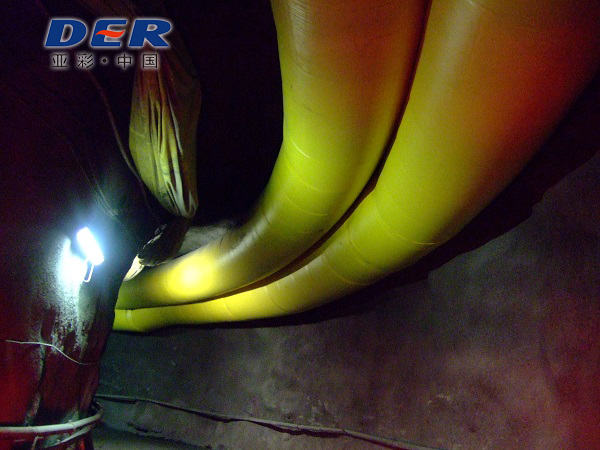
A low-headroom duct only performs as intended when the support system holds the specified width-to-height profile. Before production, the project team should confirm the crown or sidewall support points, suspension cable elevation, equipment clearance envelope and the position of other services.
Install and tension the suspension ropes first, then lift duct sections progressively, connect adjacent sections, close the sealing sleeve and check the internal shape-control components before energizing the fan.
Inspect for twisted sections, sharp bends, over-stretched suspension points, incomplete couplings and contact with rock bolts or machinery. Record static pressure and airflow at the fan and work face so leakage or unexpected friction can be identified early.
Routine inspection should focus on coupling seals, suspension wear, abrasion points and small cuts. Compatible repair materials should be stored near the heading to prevent minor damage from becoming a large leak.
The product is intended for underground and confined-space projects where airflow and clearance must be solved together.
Supports auxiliary fresh-air delivery in development headings while preserving clearance for haul trucks, LHDs, drilling rigs and utility routes.
Suitable for headings with a low crown, restricted service corridor or temporary ventilation route that changes as excavation advances.
Provides flexible air delivery through access tunnels, adits, underground caverns and long civil-engineering passages.
A practical retrofit option where excavation enlargement is difficult and the ventilation route must coexist with operating equipment.
Can be configured for temporary supply ventilation where work zones, cables and machinery leave limited overhead space.
Used as part of a distributed duct network for temporary construction ventilation, maintenance and air-quality management.
Product consistency depends on controlling material, welding, hardware placement and finished-dimension inspection as one manufacturing process.
Airflow duty, space envelope, pressure, length, compliance and coupling requirements are reviewed before construction is fixed.
PVC coating formula, textile strength, surface treatment and color are selected for the intended underground environment.
Panels are cut and welded, then suspension fins, connectors, sleeves and internal controls are positioned to the agreed drawing.
Dimensions, seam continuity, hardware, suspension spacing, connector fit and visible defects are checked before packing.
Sections and accessories are identified for installation sequence; available reports are supplied according to the confirmed order scope.
These related DERFLEX pages cover alternative duct constructions, project categories and material considerations.
Review the broader finished-duct range for mine, tunnel and industrial airflow projects.
Positive pressureA compact round duct solution for forced-air systems and advancing headings.
Positive / negative pressureWire-supported ducting for suction, extraction and shape retention.
Finished productFlexible, extendable duct sections for tunnels, mines and infrastructure projects.
Industrial rangeAir-transfer solutions for confined spaces, mobile ventilation and changing layouts.
Mine and tunnelAdditional information on waterproof, wear-resistant flexible ventilation ducting.
It is a finished flexible air duct whose inflated cross-section is wider and lower than a conventional round tube. The design is used mainly for positive-pressure mine and tunnel ventilation where machinery, cables or the excavation profile limit available height.
Many oval chambered duct systems are designed around an approximate 25% reduction in vertical requirement compared with a similar round arrangement. The actual improvement depends on the selected equivalent area, width-to-height ratio, suspension geometry and installation position.
No. The oval profile can create more perimeter and higher friction than an equivalent round duct. It is selected because clearance can reduce excavation constraints or improve equipment access. The fan and duct size should therefore be checked against the complete pressure-loss calculation.
Yes. Equivalent diameter, finished width and height, section length, connector, suspension angle, internal shape-control system, color and accessories can be reviewed against project drawings and operating requirements.
Zipper and hook-and-loop systems support fast extension, while ring or eyelet systems may suit specific pressure, maintenance or local practice. The best choice depends on fan pressure, installation speed, leakage target, repair method and whether sections are frequently relocated.
Flame-retardant and anti-static options are available. The inquiry should state the exact standard, test method, resistance threshold and documentation required so the material formulation and report scope can be confirmed before production.
Provide airflow, fan pressure or fan curve, total route length, maximum duct height and width, section length, quantity, connector type, suspension arrangement, safety standard, operating environment and delivery destination. A tunnel cross-section drawing is especially useful.
Yes. Project-specific elbows, reducers, branches, adapters, connectors, suspension hardware and repair materials can be supplied with the main duct order after dimensions and interface details are confirmed.
Send DERFLEX the tunnel cross-section, equipment envelope, airflow target, fan data and required safety standard. The team can review a low-headroom configuration, section layout, coupling concept and quotation for the finished duct system.