
Coated Polyester Duct Wall
A high-tenacity polyester base with PVC coating provides flexibility, surface cleanability, seam-welding compatibility and resistance to routine moisture and industrial handling.





|
|
Spiral Wire-Reinforced Ventilation Duct
DERFLEX spiral wire-reinforced ventilation duct is a finished flexible air duct for positive or negative pressure ventilation in mines, tunnels, industrial plants, machinery and temporary airflow systems. Custom diameters, sections, cuffs and performance treatments are available by project.
|
|
||||||||||||||||||||||||||||||||||||||||||||||||||||||||
 Finished Ventilation Duct Systems
Spiral Wire-Reinforced Ventilation DuctA finished, collapsible flexible air duct engineered with continuous helix reinforcement to retain its airflow passage under suction, extraction and demanding temporary ventilation duties. DERFLEX supplies project-configured duct assemblies for mines, tunnels, machinery, factories and mobile ventilation systems. Diameter, section length, wire pitch, coupling, suspension and material treatments can be matched to the operating plan and documented specification. 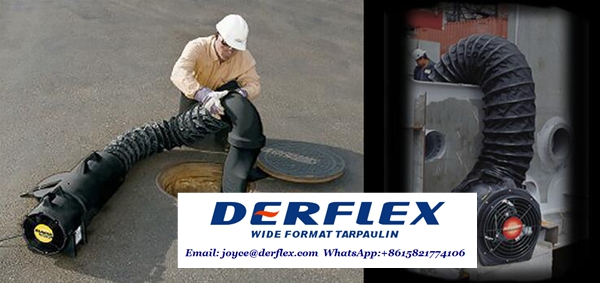
Not a fabric roll
The quoted item includes a formed duct body, spiral reinforcement and specified end connections.
Product Definition
What Is a Spiral Wire-Reinforced Ventilation Duct?A spiral wire-reinforced ventilation duct is a flexible cylindrical air passage built around a continuous spring-steel helix. The wire holds the duct wall open when a fan creates negative pressure, while the flexible coated-textile body allows the assembly to bend, compress for transport and adapt to temporary or changing routes. The distinction matters in underground and industrial ventilation. A layflat duct depends on internal positive pressure to inflate. A spiral-reinforced duct has mechanical support along its length, so the duct can be configured for extraction, suction or combined airflow systems where collapse resistance is required. The pitch and wire diameter influence the balance between flexibility, bend radius, weight and resistance to deformation. DERFLEX treats the duct as a complete engineered product. The body material, wire, wear strip, seam method, suspension points and end connection are selected together so that the finished assembly corresponds to the installation environment rather than being assembled from unrelated components on site.
Construction Logic
Four Components That Determine Field PerformanceThe value of a reinforced duct is created by the interaction of its wall, wire, wear protection and connection details. Coated BodyPVC-coated polyester forms the airtight flexible wall.
Wire SupportHelix reinforcement maintains the open cross-section.
ConnectionSpecified cuffs join sections, fans and fittings.
Coated Polyester Duct WallA high-tenacity polyester base with PVC coating provides flexibility, surface cleanability, seam-welding compatibility and resistance to routine moisture and industrial handling. Continuous Spring-Steel HelixThe wire provides radial support. Tighter pitch can improve shape retention but also increases stiffness and weight; wider pitch increases flexibility but provides less support per unit length. External Wear StripA protective strip can cover the wire path to reduce abrasion where the duct contacts the floor, tunnel wall, machinery or repeated handling points. Coupling and Suspension SystemZippers, hook-and-loop cuffs, rings, clamps or soft cuffs can be matched with single or double suspension details to suit installation speed and airflow direction.
Key Attributes & Configuration
Reference Product SpecificationsThe following range integrates the requested marketplace attributes with the parameters buyers need to define a finished spiral duct. Spiral Wire-Reinforced Ventilation DuctFinished flexible duct assembly for industrial, machinery, mining and tunnel ventilation applications.
300–3000 mm
Reference diameter range
Engineering note: values shown are configuration ranges, not a universal performance guarantee. Static pressure, airflow direction, bend radius, temperature, fire classification and antistatic requirements must be confirmed against the actual fan and site conditions before production.
Performance Priorities
Designed Around Airflow, Handling and Service ConditionsIndustrial buyers should evaluate a duct as part of a ventilation system, not only by fabric weight or diameter. 01
Collapse Resistance Under SuctionThe helix supports the duct wall against inward deformation. Correct wire gauge and pitch are especially important for extraction lines, dust collectors and negative-pressure tunnel ventilation. 02
Controlled Bend BehaviorA reinforced duct can negotiate routes and equipment connections, but excessive compression or sharp bends increase pressure loss. The duct should be installed as open and straight as the site permits. 03
Reduced Handling DamageWear strips and reinforced contact points help protect the duct where the wire path rubs against floors, walls, vehicles or repeated lifting locations. 04
Connection EfficiencyThe cuff affects installation speed, leakage potential, airflow direction and maintenance. It should be selected together with the fan outlet and adjacent duct sections. 05
Transport and StorageThe textile body can be compressed between wire turns, reducing storage volume compared with rigid ducting. Compression ratio varies with wire pitch, fabric stiffness and cuff design. 06
Specification TraceabilityWhere flame resistance or antistatic behavior is required, the order should identify the test standard, sample method and documentation expected rather than relying on a generic label.
Airflow Modes
One Construction, Three System RolesSpiral reinforcement expands the design options beyond positive-pressure-only layflat ducting. Positive-Pressure VentilationFresh or conditioned air is pushed through the duct to a work zone, machine or enclosed area. The reinforcement helps the duct retain a controlled shape during routing and relocation. Negative-Pressure VentilationDust, fumes, smoke or contaminated air is drawn toward an extraction point. The steel helix helps resist collapse when pressure inside the duct falls below ambient pressure. Reversible or Combined DutySome projects require airflow direction changes or coordinated supply and exhaust lines. The complete system—including fan behavior, cuffs and duct construction—must be reviewed for the intended reversal conditions.
Duct Type Comparison
When Should You Choose Spiral Reinforcement?The correct product depends on airflow direction, installation duration, available headroom and handling frequency.
Application Scenarios
Where Finished Wire-Reinforced Ducting Is UsedEach application should be matched to airflow volume, fan pressure, contaminants, temperature and movement conditions. Mine & Tunnel ExtractionFor local exhaust, dust collection and airflow routing where negative pressure may collapse unsupported textile ducting. Portable Fans & MachineryFlexible connection between blowers, extraction units, cooling equipment and temporary air-management systems. Industrial Ventilation RoutesSupply or exhaust ducting for factories, workshops, basements, construction zones and confined work areas. 1
Define the Airflow DirectionState whether the duct supplies air, extracts air or must work with a reversible fan. Negative pressure and reversal influence the reinforcement and connection design. 2
Match Diameter to Fan and Run LengthDiameter should be determined from required airflow, air velocity, total duct length, bends, fittings and acceptable pressure loss—not selected by tunnel size alone. 3
Select Wire Pitch for the RouteA tighter pitch provides more support but creates a stiffer, heavier duct. A wider pitch provides easier movement but may not suit high suction or tight deformation requirements. 4
Identify Abrasion and Contact ZonesTell us whether the duct will be suspended, dragged, laid on the floor or repeatedly relocated. Wear strip placement and local reinforcement can then be planned. 5
Choose the Coupling Around Installation PrioritiesZippers and hook-and-loop cuffs support fast assembly, while rings and clamps may suit robust mechanical connections. The cuff must match airflow direction and the adjacent equipment. 6
Specify Compliance Before SamplingWhere a flame test, antistatic limit or chemical restriction applies, provide the exact standard, acceptance criteria and documentation format so the correct material grade can be proposed.
DERFLEX Supply Approach
From Coated Material to Finished Duct AssemblyDERFLEX combines coated-textile knowledge with custom conversion support for finished industrial flexible products. Fabric structure, coating formulation and optional treatments are reviewed against the duty rather than selected from a generic description. Cutting, welding, reinforcement, cuffs and suspension details are coordinated as one bill of materials. OEM dimensions, colors, markings, packaging and connection details can be evaluated for recurring programs. Critical dimensions, artwork, performance requirements and packing details can be confirmed before bulk production.
Related DERFLEX Resources
Continue Your Ventilation Duct ResearchSix related internal resources connect finished duct selection with material, mining and tunnel ventilation topics.
PVC Flexible Ventilation Duct for Mine and Tunnel
Finished-product and application overview for mine and tunnel airflow.
Flexible Ducting for Mine and Tunnel Ventilation
Compare high-pressure, oval and wire-reinforced ducting formats.
PVC Flexible Ducting Construction
Learn how PVC-coated fabric, helix wire and wear strips work together.
PVC Fabric for Tunnel Ventilation Duct
Material-selection factors for pressure, abrasion, humidity and project life.
PVC Flexible Duct Material
Technical background for coated textile used in flexible air duct bodies.
Mining Ventilation Material Selection
Review wear, flame, antistatic and airflow considerations for underground use.
FAQ
Spiral Wire-Reinforced Duct QuestionsPractical answers for engineers, contractors, distributors and equipment manufacturers. Is this page for a finished ventilation duct or for duct fabric?It is for a finished flexible ventilation duct. The product includes the formed coated-textile body, spiral wire reinforcement, specified wear protection, suspension details and end connections. Fabric-only requirements should be quoted separately. Can spiral wire-reinforced ducting be used for negative pressure?Yes, when the wire gauge, pitch, duct diameter and pressure rating are configured for the suction duty. The helix supports the duct wall against collapse, which is the key difference from a positive-pressure-only layflat duct. What diameter range is available?A 300–3000 mm nominal diameter range is used as the project reference on this page. Final availability depends on pressure, wire reinforcement, section length, handling and production confirmation. How do I choose the wire pitch?Tighter pitch generally provides more support and reduced deformation, while wider pitch improves flexibility and lowers the number of wire turns. Selection should consider negative pressure, duct diameter, bend radius, weight and relocation frequency. Which coupling is suitable for mine or tunnel ventilation?Zipper, hook-and-loop, ring and clamp systems can all be used in appropriate designs. The best choice depends on installation speed, leakage control, fan connection, airflow direction, section replacement and local project practice. Are flame-retardant and antistatic versions available?Optional flame-retardant and antistatic material grades can be reviewed. The inquiry should state the required standard, test method, acceptance value and documentation so DERFLEX can confirm a suitable construction before production. Can the duct be customized for an OEM ventilation fan?Yes. Diameter, section length, cuff geometry, clamp location, color, marking, packaging and logo can be evaluated around the fan outlet and the intended airflow system. What information is needed for a quotation?Please provide airflow direction, fan airflow and static pressure, duct diameter, total run, section length, bends, temperature, transported air or contaminants, installation method, coupling preference and any required fire or antistatic test standard.
Start a Technical Inquiry
Configure the Duct Around Your Fan and Airflow RouteShare your fan data, pressure direction, diameter, length, coupling and site conditions. DERFLEX will review the requested construction and prepare a project quotation based on confirmed specifications.
Recommended RFQ attachment
Fan datasheet, route sketch, duct diameter, section length, photos of the connection and required test standard. Request a Quote from DERFLEX
Product configurations and performance statements are subject to final technical confirmation, approved samples and order specifications.
|
||||||||||||||||||||||||||||||||||||||||||||||||||||||||


