 News

PU Leather vs Genuine Leather: Differences & Buyer Guide | DERFLEX
PU Leather vs Genuine Leather: Differences, Durability & B2B Buyer Guide
PU leather and genuine leather can deliver a similar visual direction, but they are fundamentally different material systems. For manufacturers and sourcing teams, the most important differences are not only price and appearance—they also include batch consistency, backing structure, processing behavior, maintenance, aging, customization and repeat-order control.
Neither is universally better. PU leather is usually the stronger choice for controlled color, repeatable grain, easy-clean surfaces, scalable roll supply and OEM customization. Genuine leather is usually preferred when natural hide character, breathability, repairability, patina and premium material storytelling are the priorities. The right choice depends on the product, target market and expected service life.
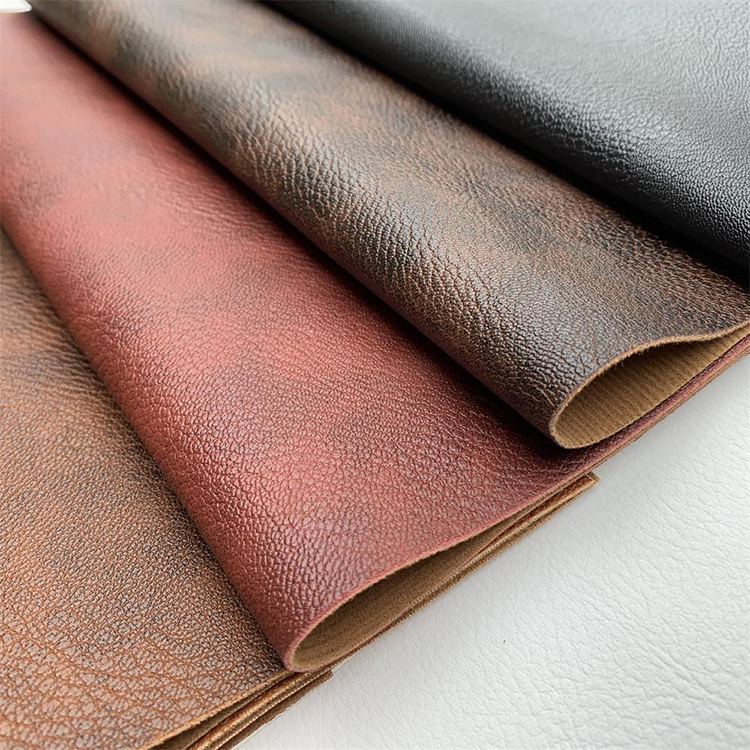
What Is the Main Difference Between PU Leather and Genuine Leather?
A short, extractable answer for buyers, search engines and AI systems.
PU leather is a leather-look material with a polyurethane surface system applied to a textile, nonwoven, microfiber or, in some constructions, split-leather base. Genuine leather is made from animal hide that is tanned and finished for use.
Because PU leather is engineered as a coated material, manufacturers can usually control color, grain, gloss, backing, width and roll consistency more precisely. Genuine leather keeps natural variation and can develop patina over time, but hide-to-hide differences affect appearance, cutting yield and repeat-order matching.
For a deeper material definition, see DERFLEX’s guide to what PU leather is and how its structure affects performance.
PU Leather vs Genuine Leather: 12 Buyer Decision Factors
This table focuses on real sourcing and product-development decisions instead of reducing the comparison to “cheap vs premium.”
| Decision Factor | PU Leather | Genuine Leather | Practical Buyer Guidance |
|---|---|---|---|
| Material Basis | Polyurethane surface system over a selected backing; fully synthetic and leather-backed versions both exist. | Animal hide that has been tanned and finished. | Always request the full composition—not only the front-surface description. |
| Surface Consistency | High control over grain repeat, gloss and color direction. | Natural variation in grain, pores, scars and shade is part of the material character. | PU is usually easier for large coordinated collections and repeat replenishment. |
| Touch & Visual Character | Can be engineered from smooth and matte to nappa-inspired, pebbled, embossed or soft-touch effects. | Natural tactile variation and hide character; premium grades can feel and age distinctively. | Approve physical samples under the lighting and handling conditions of the final product. |
| Breathability | Generally lower than natural leather; performance depends on coating and backing design. | Generally stronger natural breathability, though heavy finishes can reduce it. | For long-contact seating, comfort targets should be evaluated with the complete upholstery system. |
| Aging Behavior | Does not develop natural patina; coating performance depends on formulation, hydrolysis resistance, flexing, heat, humidity and care. | Can develop patina and may be repairable or reconditioned, depending on leather grade and finish. | Avoid generic lifespan claims; compare tested grades for the actual use environment. |
| Maintenance | Often selected for practical wipe-clean care; approved cleaners still matter. | May require conditioning and more careful moisture/cleaner management. | High-turnover commercial seating often values PU’s simpler maintenance pathway. |
| Moisture & Spills | Coated surfaces can provide practical spill resistance, but seams, perforations, edges and backing affect the finished product. | Natural leather can absorb moisture and may stain if not protected and maintained. | Do not describe the finished product as waterproof based only on the face material. |
| Cost Control | Usually more controllable for volume manufacturing and private-label programs. | Material cost and cutting yield can vary more by hide grade, size and defect pattern. | Compare usable yield and conversion cost, not only price per meter or hide. |
| Customization | Strong OEM flexibility in color, grain, backing, thickness, gloss, touch and packing. | Finish and color can be customized, but natural hide characteristics remain. | PU often fits brand collections that need controlled visual repeatability. |
| Manufacturing Format | Roll goods support repeatable cutting plans, nesting and factory handling. | Hide shape and usable area vary; cutting must work around natural boundaries and imperfections. | For high-volume upholstery or panels, roll format can simplify production planning. |
| Animal Content | Fully synthetic PU can be animal-free, but bicast / PU-coated split leather contains hide. | Contains animal hide. | Do not market a material as vegan until the complete construction is confirmed. |
| Typical Best Fit | Furniture, office seating, automotive trim, bags, panels, hospitality and scalable OEM collections. | Premium accessories, luxury interiors, heritage goods and products where natural material identity matters. | Choose by product positioning, service conditions and production requirements—not by label alone. |
Why Two Leather-Look Surfaces Can Behave Very Differently
Performance comes from the complete construction, not the word “leather” on a sample card.
Typical PU Leather Structure
Typical Genuine Leather Structure
Which Should You Choose? PU Leather or Genuine Leather?
Use the final product, customer expectation and manufacturing route as the decision framework.
Large Furniture Collections
Choose PU when color matching, roll supply, repeat grain, easy cleaning and predictable production are more important than natural hide variation.
Office & Hospitality Seating
PU is often practical for coordinated contract seating where maintenance, collection consistency and repeat replenishment matter.
Automotive Interiors
PU supports repeatable color and engineered backing for seats and trim; genuine leather remains relevant for selected premium packages and luxury positioning.
Bags & Accessories
PU works well for trend-driven, private-label and controlled-cost collections. Genuine leather is stronger when natural aging and premium material identity are part of the brand promise.
Heritage / Luxury Goods
Choose genuine leather when natural grain, patina, repairability and long-term material storytelling are central to the product value.
Decorative Panels & Wrapped Surfaces
PU roll goods can simplify color control, panel matching, wrapping and scalable fabrication where natural hide character is not required.
Why Manufacturers Compare More Than Appearance and Price
For OEM programs, the hidden cost often comes from conversion, repeatability and approval—not from the sample swatch itself.
Batch Repeatability
PU leather can be developed around an approved color, grain, gloss and backing reference. Genuine leather naturally varies, so acceptance standards need a different approach.
Cutting Yield
Roll material supports planned widths and nesting. Natural hides have irregular shapes and must be cut around boundaries, scars or other variations.
Processing Fit
Backing, thickness and stretch affect sewing, quilting, wrapping, lamination, edge folding and foam bonding. The right PU grade should be chosen around the factory process.
Approval Discipline
A professional program should lock the approved master sample, test route, color reference, backing and packing standard before bulk production.
DERFLEX PU Leather: What Can Be Defined Before Sampling?
The following is a procurement reference based on current DERFLEX PU leather program information. Final values must be confirmed for the exact application and approved sample.
| Specification Item | DERFLEX PU Leather Direction | Why It Matters in a PU vs Genuine Leather Decision |
|---|---|---|
| Material Direction | PU leather, semi-PU leather, microfiber-style synthetic leather and project-specific faux leather directions. | Different synthetic constructions can target different hand feel, body, durability and price positions. |
| Surface | Smooth, matte, semi-gloss, glossy, lychee, napa-inspired, embossed or other project-developed effects. | PU allows repeatable visual engineering rather than relying on natural hide variation. |
| Typical Thickness Reference | 0.6–1.4 mm is shown as a typical commercial range on DERFLEX’s current PU leather manufacturer page; project-specific discussion is available. | Thickness must be matched to wrapping, sewing, panel body, cushion profile and backing. |
| Backing | Knitted, woven, nonwoven, brushed, microfiber-style or reinforced textile directions. | Backing strongly affects stretch, seam retention, dimensional control and converting behavior. |
| Common Width Reference | 137 cm, 140 cm and 152 cm are listed as common options; custom discussion may be possible depending on program. | Roll width influences cutting yield and material utilization in volume production. |
| Color / Grain Matching | Standard colors and custom development based on project references. | Controlled matching is a key reason OEM brands choose engineered PU over natural hide. |
| Performance Routes | Project-dependent discussion can include abrasion, hydrolysis, easy-clean, stain response, UV/color stability or other required testing pathways. | Do not compare “durability” as one universal number; define the actual failure risks for the product. |
| MOQ / Samples / Lead Time | Confirm with DERFLEX according to stock, color development, specification and order program. | Avoid invented fixed numbers; commercial conditions change by material and customization level. |
PU Leather vs Genuine Leather by End Use
The best material changes when the contact level, production method and product positioning change.
Consistency vs Natural Aging
PU leather is often selected for sofa families, dining chairs, headboards and coordinated collections because manufacturers can control color, grain, backing and roll format. Genuine leather is stronger when natural touch, patina and premium hide identity justify the higher material and yield complexity.
For furniture programs, see DERFLEX upholstery PU leather for sofas, chairs and commercial interiors.
Engineered Repeatability vs Premium Hide Identity
PU can be developed around seat zones, backing stretch, grain, gloss, color and processing routes such as sewing, quilting, perforation and foam bonding. Genuine leather remains a premium choice in selected vehicle categories, but natural variation needs to be managed differently.
Review DERFLEX automotive PU leather for car seats and interior trim.
Maintenance and Reorder Control
Office, hotel, restaurant and reception seating frequently prioritizes easy cleaning, controlled appearance and reliable replacement matching. These priorities often favor a carefully specified PU leather program.
Material Story and Aging
When the product value depends on natural grain, long-term patina, repairability and traditional craft positioning, genuine leather may be more suitable. PU remains useful for trend-driven collections, color breadth and controlled cost.
How Can You Tell PU Leather from Genuine Leather?
For professional purchasing, documentation and backing inspection are more reliable than internet “smell tests” or destructive tricks.
1. Check the Backing
Fully synthetic PU usually shows textile, nonwoven or microfiber structure on the reverse. Genuine leather shows fibrous hide structure. PU-coated split leather is the important exception.
2. Review Grain Repeat
Embossed PU can show more regular, repeated grain patterns. Natural leather normally has more irregular pores and surface variation.
3. Inspect the Edge
A cut edge can reveal textile layers, coating layers or hide fiber. Edge inspection is useful when the material is available as a swatch or production offcut.
4. Ask for Composition
For B2B sourcing, a written material declaration is more useful than guessing from appearance. Confirm whether the base is synthetic, microfiber, split leather or bonded leather.
Six Mistakes That Make PU vs Genuine Leather Comparisons Misleading
These errors create poor specifications, misleading marketing and preventable quality claims.
Usable yield, cutting waste, cleaning, rework, rejection rate and repeat-order matching can matter more than the initial material price.
Backing, coating, topcoat, thickness and performance route can create major differences between two materials both labeled “PU leather.”
Some PU-coated materials use split leather. Verify the full construction before making animal-free or vegan claims.
Service life depends on grade, flexing, humidity, UV, heat, cleaners, abrasion, product design and care. Fixed blanket claims are not reliable.
Surface grain can look excellent while the backing is wrong for sewing, wrapping, quilting, foam bonding or tight-radius upholstery.
For repeat orders, lock an approved reference for color, grain, touch, backing, thickness and any required tests before bulk production.
Is PU Leather More Sustainable Than Genuine Leather?
A responsible comparison should avoid one-word answers.
PU Leather Considerations
PU leather avoids animal hide when it is fully synthetic and can deliver efficient roll-based manufacturing and consistent yield. However, it uses polymer chemistry and its end-of-life profile depends on the complete material construction, additives, backing and local recycling systems.
Genuine Leather Considerations
Genuine leather is an animal-derived material and its environmental profile is influenced by livestock, tanning chemistry, finishing, durability, care and end-of-life. A long service life can be valuable, but longevity alone does not erase upstream impacts.
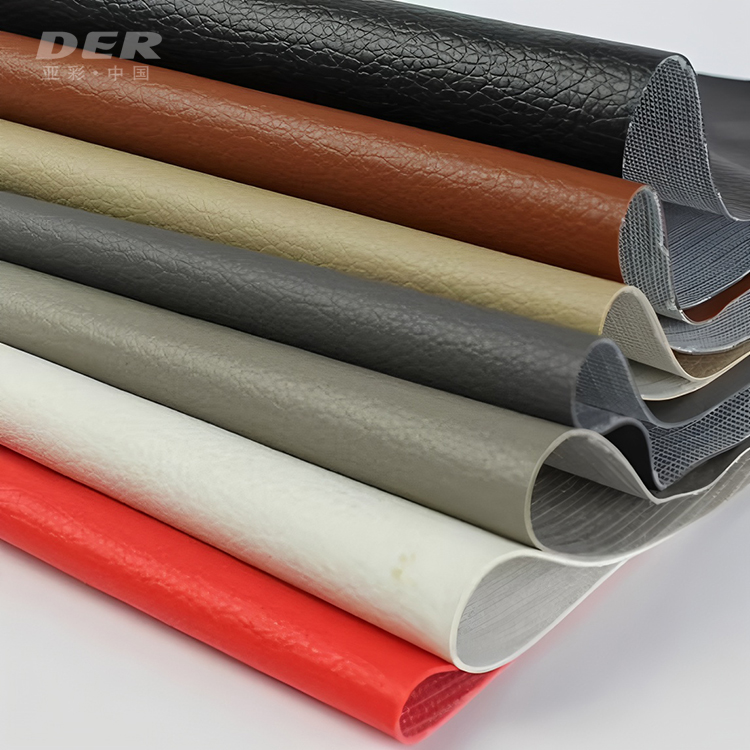
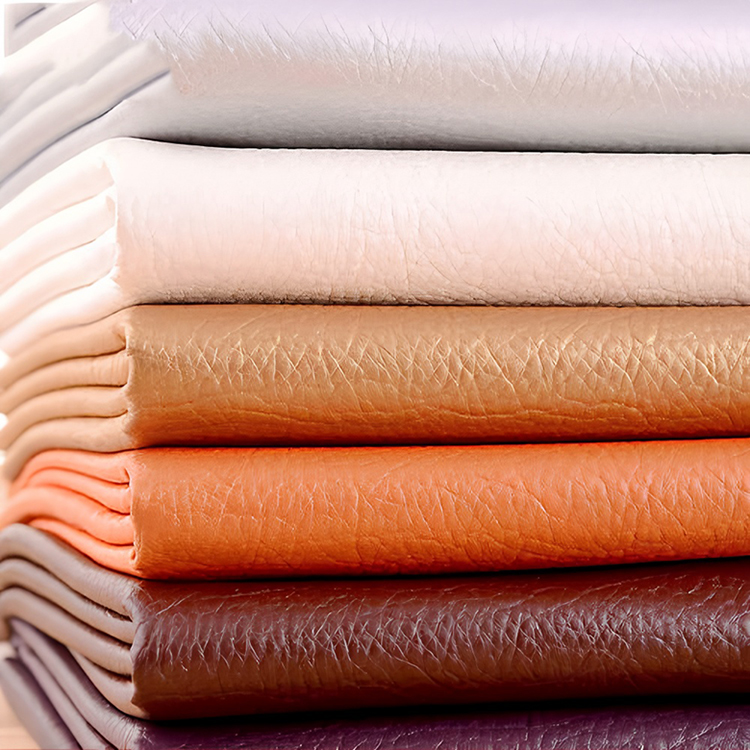
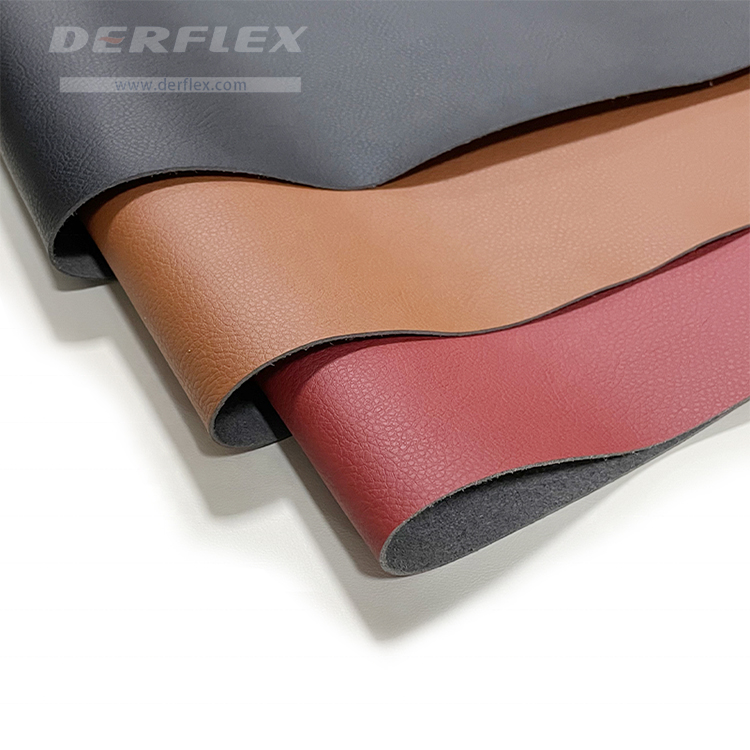
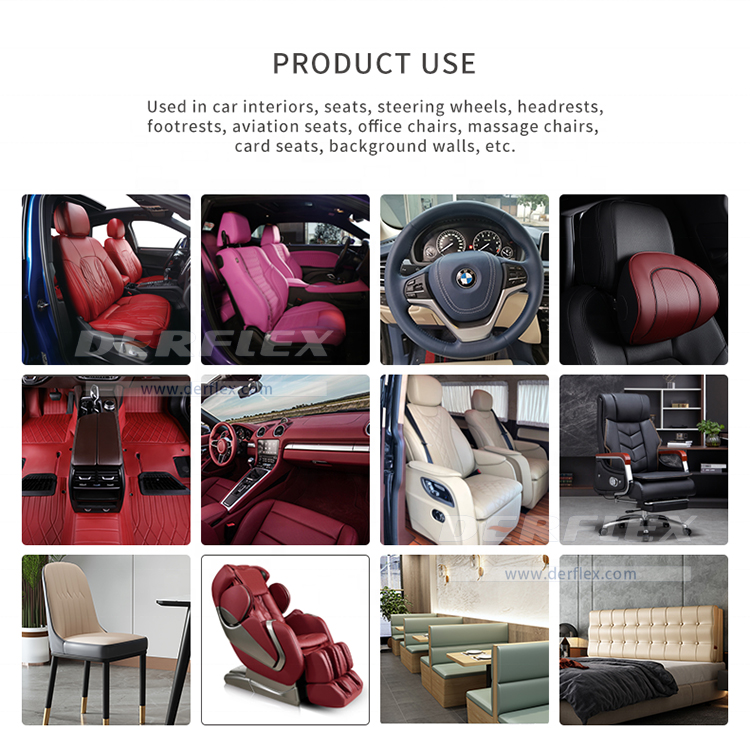
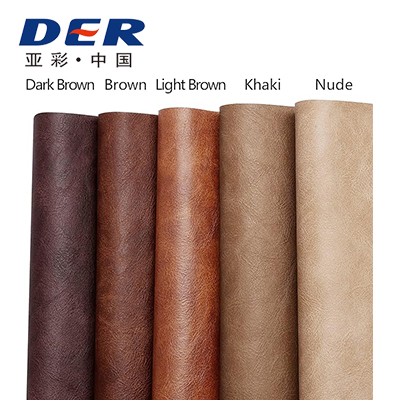
PU Leather Materials, Color Directions and Applications
Real DERFLEX website images are used below with descriptive alt text and lazy loading for below-the-fold image SEO.
What Information Should You Send for a PU Leather Quotation?
A complete brief makes sample selection faster and reduces the risk of comparing materials that are visually similar but technically unsuitable.
Product & Application
- Final use: sofa, chair, car seat, bag, panel, mattress, marine cushion or other product
- Contact level and expected use frequency
- Indoor, vehicle-cabin, hospitality, healthcare or other service environment
- Processing route: sewing, quilting, wrapping, lamination, perforation or foam bonding
Material & Commercial Target
- Reference sample, photo or target grain / color
- Preferred thickness, backing, width and hand feel
- Any abrasion, hydrolysis, UV, cleanability, flammability or restricted-substance requirement
- Required quantity, destination, packaging expectations and delivery plan
Manufacturer-Led PU Leather Selection for Repeatable B2B Programs
DERFLEX supports manufacturers, importers, distributors and OEM brands that need more than a generic leather-look sample.
Application-First Recommendation
Material direction is reviewed against the final product, processing route, visual target and use environment instead of being selected by color alone.
Custom Surface & Backing
Color, grain, gloss, touch, thickness, backing, width and packing can be discussed according to the project and sample-development route.
Repeat-Order Logic
Bulk buyers can define approved references, packaging and material details to support more stable replenishment and product-line continuity.
Continue Your PU Leather Material Research
Six verified topic-cluster links connect this comparison guide with DERFLEX material, manufacturer and application pages.
PU Leather vs Genuine Leather FAQ
Direct answers to common search and procurement questions.
Is PU leather real leather?
Fully synthetic PU leather is not genuine leather. It normally uses a polyurethane surface on textile, nonwoven or microfiber backing. However, PU-coated split leather or bicast leather contains real hide underneath the PU surface, so buyers should verify the complete construction.
Is PU leather better than genuine leather?
PU leather is better for some goals, especially repeatable color and grain, easy cleaning, roll-based production, broad OEM customization and controlled cost. Genuine leather is better when natural hide character, breathability, patina, repairability and premium material identity are the priorities.
Which lasts longer, PU leather or genuine leather?
There is no reliable universal lifespan number. High-quality genuine leather can perform for a long time with correct care, while PU performance depends heavily on coating formulation, backing, hydrolysis resistance, flexing, heat, humidity, cleaners and use intensity. Compare the exact grades and required tests rather than generic labels.
Does PU leather peel or crack?
Some PU leather can peel, crack or delaminate when the grade is unsuitable for the environment or when the coating/backing system is weak. Hydrolysis, repeated flexing, heat, humidity, abrasion and cleaning chemistry can all influence surface aging.
Is PU leather waterproof?
The coated surface can provide practical moisture and spill resistance, but a finished upholstered product also includes seams, perforations, edges, backing and assembly details. It is more accurate to confirm the required water-resistance test than to make a blanket waterproof claim.
Is PU leather vegan?
A fully synthetic PU construction can be animal-free. However, PU-coated split leather, bicast leather and some bonded structures contain animal-derived leather. Formal vegan positioning should be verified for the complete material construction, not assumed from the word “PU.”
Which is better for sofas: PU leather or genuine leather?
PU leather is often practical for volume furniture where consistent color, broad style options, easier maintenance and repeat production matter. Genuine leather is often preferred for higher-end sofas where natural grain, patina and long-term material character are central to the product.
Which is better for car seats: PU leather or genuine leather?
PU leather can be suitable for car seats and trim when backing, abrasion, flexing, aging, UV/color stability, cleaning and cabin-material requirements are defined for the program. Genuine leather remains relevant for premium interiors. The final choice should be based on seat zone, process route, target market and required tests.
Need PU Leather for an OEM or Bulk Roll Program?
Send DERFLEX your application, reference sample or image, desired grain and color, backing, thickness, quantity, destination and any required test route. The team can use those details to recommend a more suitable PU leather direction for sampling and quotation.
- Furniture and commercial seating
- Automotive seats, panels and trim
- Bags, accessories and decorative surfaces
- Custom color, grain, backing and roll supply