Warp / roll direction
Record the warp result independently, including breaking force and elongation where specified.



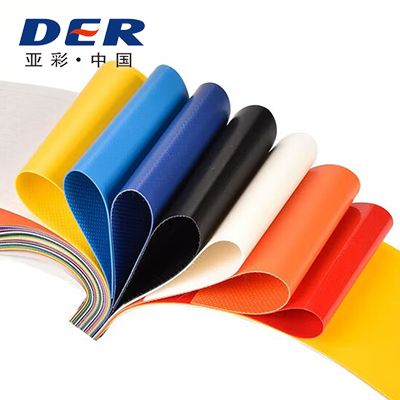
Specify the reinforcement, the coating and the seam as one material system. DERFLEX supplies PVC tent fabric for tent manufacturers, rental-fleet fabricators and commercial shelter buyers, with custom weight, width, colour and surface options.
Compare the polyester base cloth, directional breaking force and weld compatibility before approving bulk rolls. Share your roof or sidewall application, fabrication process and destination requirements to start a grade-specific quotation.
Coated roll material • Custom OEM programmes • Sampling by agreement
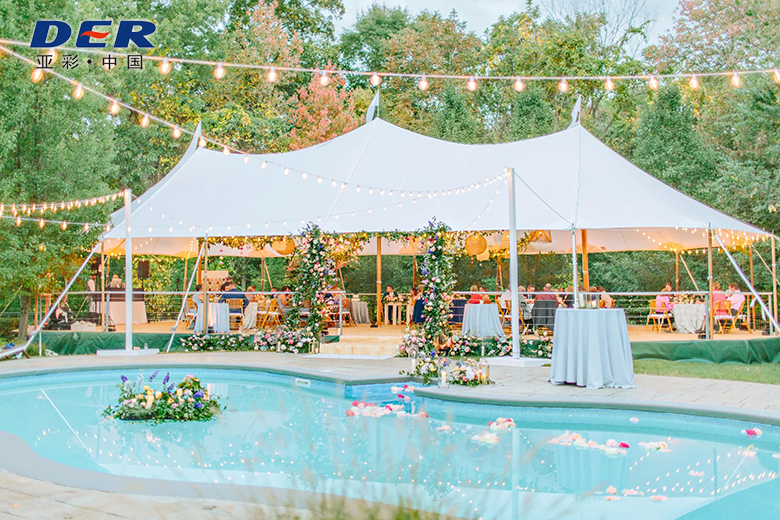
PVC tent fabric is a reinforced textile made with a polyester base cloth and a polyvinyl chloride coating. The woven polyester carries tension; the PVC provides the waterproof surface and supports heat-welded panel construction. The finished material is used for commercial tent roofs, sidewalls and shelter covers.
Buyers also call it vinyl tent material, vinyl-coated polyester or tent tarpaulin fabric. These names describe a material family, not a performance grade. Order by the actual construction and test requirements. For the wider material platform, explore PVC coated polyester fabric.
Two white fabrics with the same GSM can behave differently under tension, during welding and after repeated folding. Compare the components that create that behaviour.

Specify warp and weft yarn denier, weave and thread density. These describe the reinforcement; finished-fabric tensile and tear tests establish its measured performance. Denier alone is insufficient for grade approval.
Agree the coating route, total finished mass and coating adhesion requirements. The PVC barrier, its bond to the scrim and its distribution across the width all matter at folds, seams and reinforced edges.
Glossy, matte and lacquered options serve different appearance and cleaning needs. Acrylic or PVDF treatments are grade-dependent. Confirm whether the specified finish is directly weldable or requires an approved seam preparation.
State whether the panel should transmit daylight or provide blockout. Discuss UV, anti-mildew, cold-flex and flame-performance requirements with the exact construction; a white colour does not establish opacity or fire classification.
The following are published supply directions for quotation. They are not one universal specification, and not every option is available in every combination.
| Specification | Published supply direction | Confirm for your order |
|---|---|---|
| Material | Polyester base cloth with PVC coating on both sides | Exact base construction, coating route and approved sample |
| Finished weight | 650–1050 g/m² in the commercial event-tent range | Nominal GSM, tolerance and suitability for each panel zone |
| Base yarn | 1000D / 1300D polyester options; construction varies by grade | Warp × weft denier, weave and thread density with units |
| Roll width | 1.02–3.2 m in the published standard tent supply range | Usable width after selvedges; availability for the selected construction |
| Roll length | 50 m / 100 m or order-agreed packing | Roll mass, core, length tolerance and handling limits |
| Thickness | Grade-specific; request the proposed data sheet | Finished thickness and measurement method; GSM is not a thickness conversion |
| Colour and opacity | White, coloured and custom-matched programmes; blockout options | Face/reverse colour, gloss and measured light-transmission target where needed |
| Surface finish | Glossy, matte, acrylic or PVDF options by grade | Cleaning guidance, printing compatibility and seam preparation |
| Directional strength | Grade-specific longitudinal / transverse results | Separate warp and weft breaking force, elongation and tear results; see reference below |
| Fabrication | Hot-air and high-frequency welding, subject to material trial | Equipment, finish, overlap, process window and seam acceptance criteria |
| Functional options | UV, anti-mildew and flame-retardant options by specification | Required test route, exact grade, colour and current supporting report |
| OEM roll programme | Custom weight, width, colour, roll label and packaging | Minimum quantity, sampling, production schedule and shipment terms in the quotation |
Supply ranges describe the material portfolio, not stocked availability. Confirm the exact grade and current technical data sheet with DERFLEX before purchasing. Product suitability also depends on the tent design and fabrication process.
DERFLEX publishes this reference in its coated-fabric product information. It provides a starting point for a technical discussion, rather than guaranteed values for every tent material order.
The source also lists a 30 × 30 construction. Confirm the density unit, whether L/W maps to warp/weft on the supplied roll, the current test method, and whether values are typical or guaranteed minima. Tear, coating adhesion and weld strength require separate confirmation in the approved data sheet.
Ask for both directions, the unit and the method. A single “high tensile” number cannot describe how a commercial tent panel will behave.
For a woven base cloth, warp follows the yarns running along the fabric and weft crosses them. Mark the roll direction on the cutting plan and confirm the supplier’s labelling. Keep this orientation traceable through sampling, cutting and seam testing.
Record the warp result independently, including breaking force and elongation where specified.
Record the weft result under the same method and conditioning. Do not assume it equals the warp result.
Use the coated-fabric test methods and buyer checklist to prepare a comparable testing brief.
Yes. Suitable PVC coated polyester grades can be joined by hot-air or HF welding. Confirm the coating, topcoat and machine compatibility on a sample before releasing a bulk cutting plan.
Identify the face and reverse, lacquer type and any required seam preparation. A PVDF-labelled surface is not automatically directly weldable. Use the supplier-approved route for that grade.
Use the intended fabric, reinforcement and overlap. Set and record temperature or HF settings, speed, pressure and cooling conditions. There is no universal welding setting for all vinyl tent material.
Look for incomplete bonding, burn-through, distortion and coating separation. Test trial joints under the agreed procedure after appropriate conditioning; keep appearance and strength acceptance separate.
Check intersections, reinforcement patches, hems and connection zones. If sewing is required, agree the seam and waterproofing detail. A waterproof fabric surface alone does not seal needle holes or poorly formed joints.
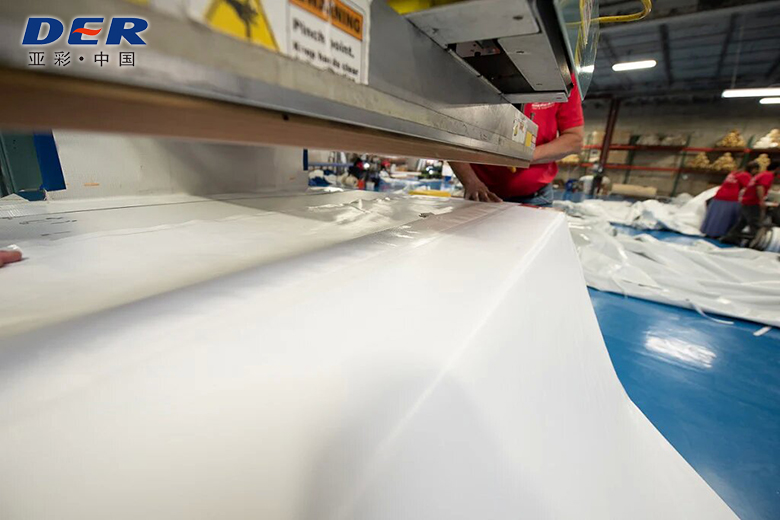
A roof field, a removable wall and a high-wear connection do different jobs. Start with the duty of each panel instead of selecting one weight for the whole tent.
| Tent zone or programme | Material priorities | Before grade approval |
|---|---|---|
| Commercial roof fields | Directional strength, dimensional behaviour, coating integrity and weld compatibility | Confirm design requirements, fabric orientation, trial seams and the roof drainage detail. |
| Rental sidewalls and valances | Manageable handling, appearance, flexibility and cleaning suitability | Compare folded samples, retained fleet colours and the specified edge/connection construction. |
| Warehouse and industrial shelters | Mechanical specification, environmental exposure and documentation | Ask the structure designer to define the required material grade and acceptance criteria. |
| Light-controlled event spaces | Blockout construction, surface appearance and compatible seams | Approve opacity on the full material build; assess seams and fittings for light leakage. |
| Clear window interfaces | Compatible border fabric, joint design and handling | Specify the clear film separately and test its joint with the coated reinforcement. |
Developing a marquee range? Review fabric considerations for event structures. Touring show canopies have additional layout and handling needs covered in the circus tent fabric application guide.
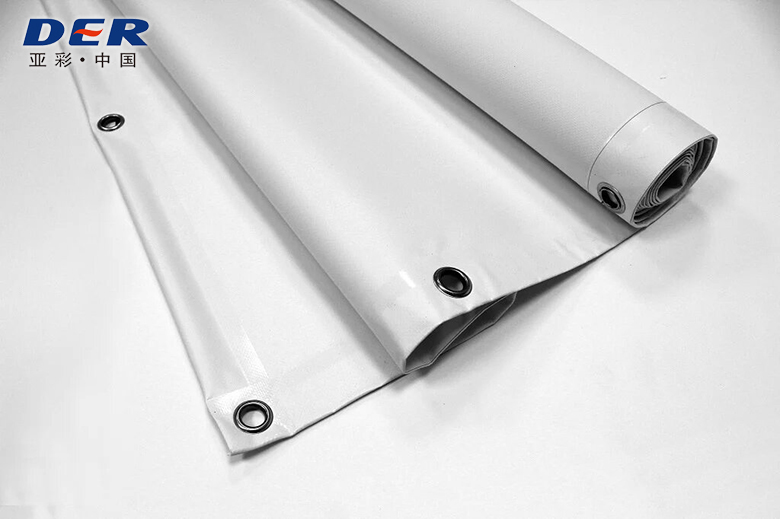
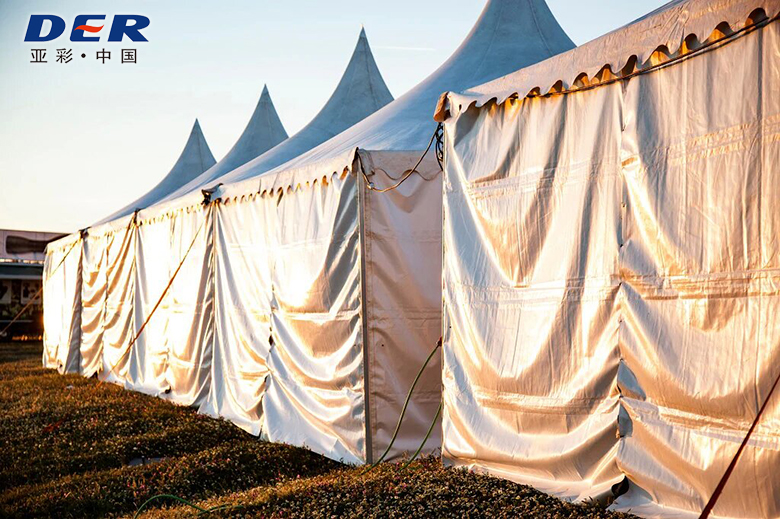
As a PVC tent fabric manufacturer, DERFLEX offers coated-fabric supply and custom OEM options. Make repeatability part of the purchase specification alongside price per square metre.
If your programme also includes industrial covers, the broader PVC tarpaulin material range helps identify related constructions without treating every tarpaulin grade as tent-ready.
A reference sample or existing data sheet is useful, but an application brief is enough to begin the conversation. Include the points below for a more comparable quotation.
For flame-retardant material, name the required standard and ask for a current report covering the proposed construction. Material fire performance does not certify the complete tent.
Use this local worksheet, then copy the text into your quotation request or open it in your email app.
Nothing is submitted by this worksheet. To send your request, use the quotation page or your email app: sales@derflex.com.
Answers to the specification questions that help tent fabricators compare materials and prepare a workable purchase brief.
In commercial tent procurement, vinyl tent material commonly means polyester fabric coated with PVC. The name does not specify the yarn, weave, coating route or performance. Ask for the grade-specific technical sheet and an approved sample; PVC film without textile reinforcement is a different construction.
DERFLEX publishes a 650–1050 g/m² commercial event-tent range, but GSM alone cannot determine suitability. Select the material against the roof or sidewall duty, directional strength, seam design, handling cycle and environmental exposure. The responsible structure designer should define the required performance for load-bearing panels.
Request separate breaking-force and, where required, elongation results for both directions, with specimen width, method and acceptance limits. A published DERFLEX 900 gsm reference lists L/W breaking force of 4000/3800 N/5 cm. Confirm its current construction, L/W-to-warp/weft mapping and reporting basis before using it as an order requirement.
It depends on the selected coating and finish. Some surfaces are directly weldable; others need an approved preparation or a compatible seam design. Confirm the exact grade with DERFLEX, then trial it on your hot-air or HF equipment using the intended overlap and reinforcement. Do not assume one setting works across all finishes.
The PVC coating provides a waterproof material surface. Complete tent weather protection also depends on sound seams, drainage and detailing. Flame-retardant options are available by specification; obtain a current report for the proposed grade and required standard. A fabric report does not establish compliance of the complete tent structure.
DERFLEX offers custom weight, width, colour, finish, roll-label and packaging options. Minimum quantity and price depend on the selected construction, colour or treatment, usable width, volume and packing plan. Send your application, quantity and destination to obtain the current sample arrangements, quotation and production schedule.