Tarpaulin
Camouflage Tarpaulin
DERFLEX manufactures custom camouflage tarpaulin for outdoor covers, equipment protection, shelter and wholesale programs, with PVC or PE structures and OEM finishing.
Description
Camouflage Tarpaulin · OEM / Wholesale / Project Supply

Camouflage Tarpaulin Built Around the Covering Job — Not Just the Pattern

DERFLEX manufactures camouflage tarpaulin for outdoor shelter, equipment protection, transport shielding, hunting and field-use products, industrial cover projects, distributors and private-label programs. PVC-coated polyester and PE-based constructions can be developed around the required weight, size, reinforcement, pattern, surface finish and packing method.

Need a heavy duty camouflage tarpaulin, a lighter foldable cover, roll material for fabrication, or a custom camouflage tarpaulin with grommets and reinforced hems? Send the application first. The correct structure depends on how the tarp will be tensioned, folded, exposed, cleaned and stored.

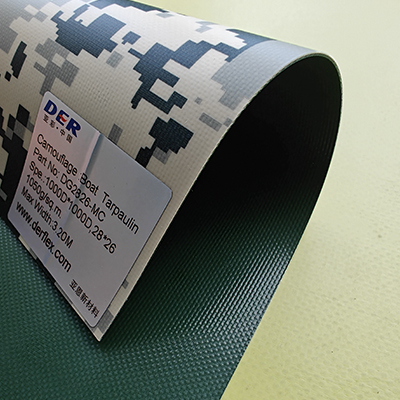
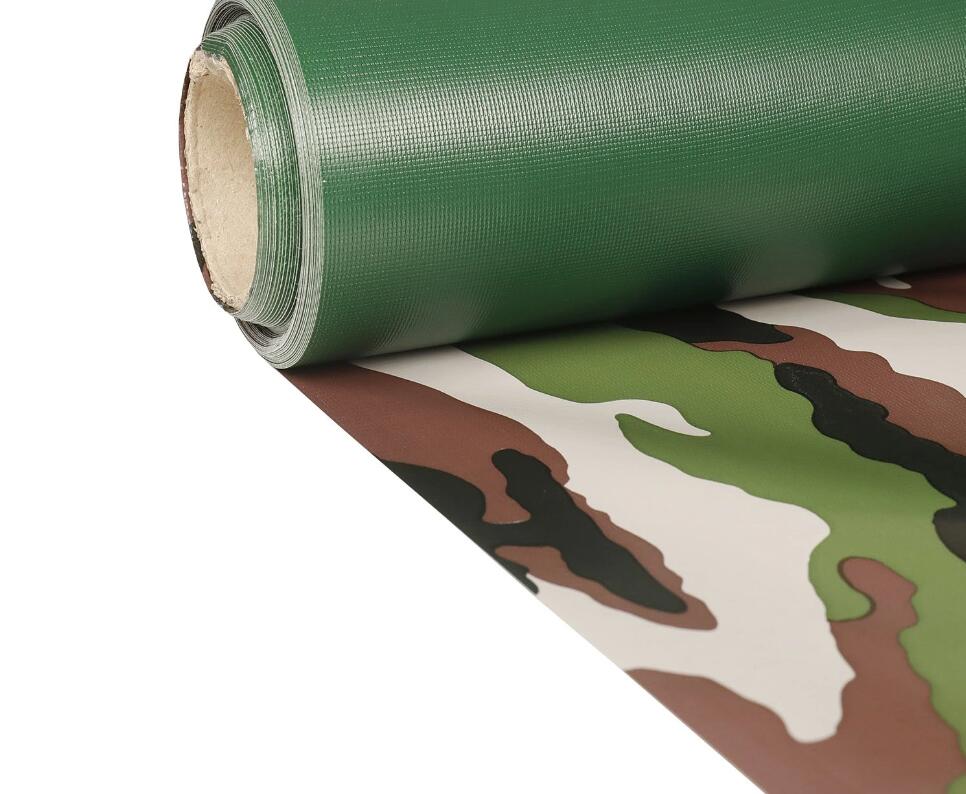
DERFLEX camouflage tarpaulin PVC coated polyester roll
DERFLEX camouflage PVC tarpaulin material. Pattern, weight, reverse-side color, width and finished-cover details can be discussed for the project.
PVC or PE routesChoose by durability, portability and fabrication method.
Custom pattern & sizeWoodland-style, desert-style and buyer-supplied artwork subject to approval.
Rolls or finished tarpsMaterial supply, welded panels or completed covers.
B2B repeat-order focusSampling, specification confirmation and bulk production alignment.
Product Definition

What Is Camouflage Tarpaulin?

Camouflage tarpaulin is a protective tarp or tarp material with a camouflage-pattern surface intended to reduce visual contrast while also providing practical cover performance. Depending on the construction, it may be used for rain protection, temporary shelter, storage, transport, equipment covering, outdoor screening and recreational products.

The camouflage print is only one layer of the buying decision. Base-fabric strength, coating or lamination quality, seam design, grommet layout, edge reinforcement and exposure conditions usually determine whether the finished product works reliably in service.

For specialist optical, infrared, thermal or other signature-management requirements, separate validated test criteria should be specified. A visual camouflage print alone should not be treated as proof of those functions.

Buyer Intent

Why commercial buyers search beyond a standard “camo tarp”

A retail buyer may only compare pattern and size. A distributor, converter, contractor or equipment brand usually has a longer checklist: material consistency, outdoor durability, pattern repeat, packaging, tie-down strength, welding compatibility, sample approval and repeat-order control.

  • Custom camouflage tarpaulin: non-standard dimensions, panel design, eyelet spacing, webbing, rope, D-rings, patches or packing.
  • Camouflage tarpaulin wholesale: planned size sets, carton quantities, private-label packs and repeatable appearance across production lots.
  • Waterproof camouflage tarpaulin: a waterproof material system plus appropriate seams and finished-cover construction for the intended exposure.
  • Heavy duty camouflage tarpaulin: stronger base fabric, higher coating weight where appropriate, reinforcement at stress zones and fabrication matched to tie-down loads.
Choose by application

Three Practical Starting Points for Camouflage Tarp Selection

GSM alone does not define quality. Use the ranges below as inquiry starting points, then confirm the exact fabric, construction and finished-cover design against the real job.

Portable

Light Outdoor Cover

For applications where pack size, handling and easy folding matter more than maximum abrasion resistance.

  • Typical starting point: about 300–450 gsm
  • Camping shelter, seasonal cover, outdoor screen
  • PE or lighter PVC constructions can be evaluated
  • Focus: portability, waterproofing, simple tie-downs
Balanced

General Commercial Tarp

For distributors and project buyers needing a balance of foldability, durability, visual consistency and repeat use.

  • Typical starting point: about 450–650 gsm
  • Equipment cover, hunting blind, field shelter, storage
  • PVC-coated polyester is a common route
  • Focus: welded seams, reinforced hems, grommet quality
Heavy Duty

High-Stress Equipment Cover

For larger covers, frequent handling, stronger tie-down loads or longer outdoor use where reinforcement becomes more important.

  • Typical starting point: about 650–900 gsm
  • Machinery, vehicle, transport and industrial cover projects
  • Higher-strength scrim and reinforced stress zones
  • Focus: tear strength, abrasion zones, welding and anchoring
Material Structure

A Camouflage Tarpaulin Is a Material System

For PVC constructions, performance starts with the textile scrim and continues through the coating, camouflage print, surface finish and fabrication. For PE constructions, the woven core and lamination system are selected differently. The final cover should be specified as a system rather than as a printed sheet.

1. Reinforcement core

Polyester or woven polyolefin provides tensile and dimensional strength. Yarn denier and weave density should match the load and handling cycle.

2. Weather barrier

PVC coating or PE lamination supplies water resistance and surface protection. Formulation may be adjusted for UV, mildew, cold flexibility or other requested properties.

3. Pattern & finish

Camouflage colors, print method, matte/gloss direction and reverse-side appearance are aligned with the commercial or project brief.

Key Performance

What to Specify Before Asking for a Price

A meaningful quotation needs more than dimensions. These are the performance areas that most often change cost, service life and user experience.

Waterproof construction

The base material can be designed as a waterproof barrier, but finished-cover performance also depends on seams, holes, hardware and how water can collect on the installed tarp.

Tensile & tear behavior

For heavy duty camouflage tarpaulin, review base-fabric strength together with eyelet reinforcement and edge design. A stronger sheet can still fail if stress is concentrated at a weak fixing point.

UV and color stability

Outdoor exposure affects both coating and camouflage appearance. State the expected climate, exposure duration and color-stability requirement during development.

Cold flexibility & folding

If tarps will be packed, folded or deployed in low temperatures, flexibility after storage can matter as much as initial tensile data.

Abrasion & contact zones

Vehicle corners, machinery edges and rough ground can create localized wear. Reinforcement patches or different material grades may be more effective than simply increasing overall weight.

Pattern consistency

Wholesale and private-label programs should approve color targets, pattern direction, repeat size and acceptable batch variation before bulk production.

Specification Framework

Custom Camouflage Tarpaulin Specifications

The following values are practical development ranges and published DERFLEX references. Final production specifications should be confirmed on the approved sample and order sheet.

Parameter Available / Reference Direction Why It Matters
Material route PVC-coated / laminated polyester; PE woven + laminated constructions Determines durability, weight, foldability, welding method and cost position.
Typical weight Approx. 300–900 gsm for many camouflage-cover programs; other constructions can be discussed Use application stress and handling needs to select weight rather than choosing GSM alone.
Published PVC reference 1000D × 1000D, 20 × 20 weave, 450 gsm A useful benchmark for comparing a specific published DERFLEX construction.
Published breaking strength 2233 N/5 cm warp; 2037 N/5 cm weft (reference model) Helps evaluate load-bearing fabric behavior before finished-cover reinforcement is added.
Published tear strength 333 N warp; 296 N weft (reference model) Relevant to puncture growth, edge stress and repeated handling.
Published adhesion 80 N/5 cm (reference model) Indicates coating-to-base-fabric bonding on the referenced construction.
Published temperature range -30°C to +70°C (reference model) Temperature exposure should be matched to the exact formulation ordered.
Pattern options Woodland-style, jungle-style, desert-style, digital-style, muted custom colorways, buyer-supplied artwork Pattern repeat, color tolerance and artwork rights should be confirmed before production.
Surface direction Matte, semi-matte, glossy or project-specific finish depending on construction Changes appearance, cleanability and handling feel.
Finished size Custom panels and finished tarps; larger covers can be fabricated by welding Finished size affects seam map, fold plan, reinforcement and packing.
Edge / hardware Hem, rope-in-hem, webbing, eyelets/grommets, corner patches, straps, D-rings subject to design Fixation details are often the first failure point in a tarp system.
Performance options UV-oriented, anti-mildew, cold-flexible, flame-retardant or other formulations subject to specification and validation Request the exact test method or market requirement before production.
Supply format Roll goods, welded panels, finished covers, OEM / private-label programs Lets converters, distributors and end-use buyers source at the right production stage.

Reference values are not blanket guarantees for every camouflage tarpaulin. Ask DERFLEX to confirm the applicable test data for the exact material code and finished-cover configuration you intend to purchase.

Material Choice

PVC vs PE Camouflage Tarpaulin

Both constructions can be useful. The better choice depends on whether your project prioritizes repeated use and fabrication flexibility or low weight and economical cover performance.

Often selected for repeated-use & heavy-duty programs

PVC-Coated Polyester

  • Good route for weldable finished covers and reinforced assemblies.
  • Broad weight range for equipment covers, shelters and transport applications.
  • Surface formulation can be adjusted for UV, mildew, cold and flame-retardant requirements where specified.
  • Suitable when abrasion resistance, repeat use and stronger hardware integration are priorities.
Often selected for portable & cost-sensitive programs

PE Woven / Laminated

  • Lower-weight constructions can be easier to fold, pack and distribute.
  • Useful for seasonal outdoor cover, lightweight shelter and general-purpose protection.
  • Rope hems, aluminum eyelets and corner reinforcement can be incorporated depending on the product.
  • A practical route when portability and price position matter more than a PVC heavy-duty structure.
Applications

Where Camouflage Tarpaulin Is Commonly Specified

The same camouflage appearance can sit on very different material systems. Define the use environment before selecting construction.

Outdoor Shelters & Rain Covers

Temporary overhead cover, shade, campsite shelter and field-use weather protection where low-contrast appearance is preferred.

Hunting Blinds & Screen Walls

Fabricated panels and covers for outdoor brands, distributors and recreational-use products.

Vehicle & Equipment Covers

Machinery, trailers, generators and stored equipment where weather protection and subdued appearance are both required.

Transport & Cargo Shielding

Custom covers for logistics or field transport, with tie-down layout matched to load and movement.

Industrial & Project Screening

Temporary zoning, outdoor storage screening and project barriers where bright standard tarp colors are undesirable.

Wholesale & Private Label

Planned size ranges, packaged tarps, accessory kits and OEM camouflage tarpaulin programs for importers and distributors.

Fabrication & Customization

What a Custom Camouflage Tarpaulin Manufacturer Should Be Able to Control

The commercial value of a camouflage tarp program is often decided after the material leaves the coating line. Finished-cover details need the same discipline as the fabric itself.

Pattern & artworkStandard visual directions or buyer-approved custom artwork, with color target and repeat alignment.
Finished dimensionsStandard sizes, custom rectangular panels or project-specific covers based on drawings.
Seam mapPanel placement and welding direction planned around width, appearance and stress.
Edge reinforcementFolded hem, rope-in-hem, webbing or additional reinforcement where required.
Fixing hardwareGrommets/eyelets, D-rings, straps, buckles and spacing aligned to installation.
Corner detailsPatches or reinforcement zones for high-load points and repeated tie-down use.
Labels & packagingSize label, carton mark, private-label packaging, folded pack or buyer-defined packing logic.
Sample controlsConfirm print, hand feel, construction, hardware and pack format before bulk run.
Important for custom camouflage artwork: buyers should confirm they have the right to use supplied patterns, logos and graphics. If a project requires regulated, government-specific, infrared/NIR, thermal or other specialist camouflage performance, provide the applicable specification and test method rather than relying on visual pattern terminology.
Sampling to Bulk

A More Reliable Way to Source Camouflage Tarpaulin Wholesale

Price comparison works best after suppliers are quoting the same construction. DERFLEX recommends locking the job definition first, then moving through sample and production controls.

Define the use

Share application, dimensions, expected exposure, handling frequency and quantity.

Select structure

Choose PVC or PE route, target GSM, pattern direction and performance options.

Approve details

Confirm artwork, surface, hem, grommets, reinforcement, labels and packing.

Evaluate sample

Check visual consistency, handling, fabrication and relevant test data before bulk approval.

Control repeat orders

Retain agreed material code, color/pattern references and finished-cover specifications.

DERFLEX Manufacturing Context

Built for Buyers Who Need a Repeatable Supply Program

DERFLEX focuses on coated and laminated industrial fabrics and publishes more than 20 years of manufacturing experience. For camouflage tarpaulin projects, that matters most when the buyer needs to move from a sample to a repeatable material or finished-cover specification rather than simply buying a one-off stock sheet.

The practical advantage is the ability to discuss the project at multiple levels: base fabric, coating/lamination, print direction, finishing, fabrication and packing. This is especially relevant to importers, distributors, outdoor product brands, tarp converters, equipment suppliers and project contractors.

Material-first support

Start with the load, exposure and handling cycle before choosing the final GSM or finish.

OEM flexibility

Custom size, pattern, edge design, hardware, label and export packing can be discussed.

Reference testing

Published DERFLEX material data can be used as a starting point; exact order data should be confirmed by product code.

Global B2B workflow

Sampling, specification confirmation and repeat-order documentation support international procurement programs.

Procurement Guide

How to Compare Camouflage Tarpaulin Suppliers More Effectively

A low quotation is difficult to evaluate if the construction, print, reinforcement and packing are not aligned. Use the same checklist with each camouflage tarpaulin supplier.

Ask every supplier the same questions

  1. Is the quoted material PVC coated, PVC laminated or PE laminated?
  2. What are the base fabric denier, weave/density and finished GSM?
  3. Is the camouflage print one-sided or two-sided, and what is the reverse color?
  4. What is the seam method and maximum practical panel width?
  5. How are edges, corners and grommet zones reinforced?
  6. Which test data applies to the exact material code being quoted?
  7. What will be approved for color/pattern consistency before bulk production?

Send these details for a faster, cleaner quote

  1. Finished size or roll width/length.
  2. Estimated quantity and repeat-order plan.
  3. Outdoor use condition, climate and expected handling frequency.
  4. Target weight or current sample specification, if available.
  5. Pattern reference or artwork file and color expectation.
  6. Grommet spacing, webbing, rope, D-rings, straps or other hardware.
  7. Packaging, labeling, carton mark and destination market requirements.
FAQ

Camouflage Tarpaulin FAQ

What material is camouflage tarpaulin made from?

Common constructions include PVC-coated or PVC-laminated polyester and PE woven fabric laminated on both sides. PVC is often chosen for stronger, weldable and repeat-use covers; PE can be suitable where lighter weight and economical general-purpose protection are priorities.

Can DERFLEX make custom camouflage tarpaulin?

Yes. Custom projects can include dimensions, material weight, camouflage artwork, surface finish, reverse-side color, hems, rope, webbing, grommet spacing, reinforcement, labels and packaging. Final feasibility depends on the exact design and quantity.

What is the difference between a regular camouflage tarp and a heavy duty camouflage tarpaulin?

A heavy-duty configuration normally uses a stronger material structure and more robust reinforcement at seams, edges, corners and fixing points. The correct design depends on wind exposure, tie-down loads, abrasion, handling frequency and expected service conditions—not GSM alone.

Is camouflage tarpaulin waterproof?

PVC-coated and PE-laminated tarp materials can provide a waterproof barrier. For a finished cover, overall water protection also depends on welding or sewing, eyelet penetrations, panel layout and installation. Tell the supplier if waterproofing is a critical acceptance requirement.

Can I order camouflage tarpaulin wholesale with private-label packaging?

DERFLEX can discuss wholesale and OEM programs with planned size assortments, labels, carton marks, folded packs and other private-label packaging requirements. Providing the target market and expected order volume early helps define a workable packing system.

Can you print a custom camouflage pattern?

Custom artwork and color directions can be evaluated. Buyers should provide production-ready artwork where possible and confirm they have rights to use the supplied design. For specialist NIR, infrared, thermal or regulated camouflage specifications, separate test criteria must be supplied and validated.

Request a Project Review

Tell DERFLEX How the Camouflage Tarpaulin Will Be Used

Send size, quantity, application, target material weight, pattern reference, grommet or reinforcement requirement and packaging needs. DERFLEX can use that information to recommend a more appropriate material and fabrication direction for quotation.

Copyright © 2015 DERFLEX ( PVC tarpaulin manufacturer )All Rights Reserved.