

Custom Heavy Duty Tarps Made to Your Drawing
Need a custom size heavy duty tarp that fits an actual machine, transport load or industrial frame? DERFLEX reviews flat patterns and fitted-cover drawings to define finished dimensions, panel seams, reinforced hems, grommet and D-ring positions, material direction and approval criteria. Source a custom PVC tarp, semi-finished panel or coated fabric roll with the supply scope made explicit before quotation—so a made-to-measure tarpaulin can be discussed as a buildable specification, not just a length × width.
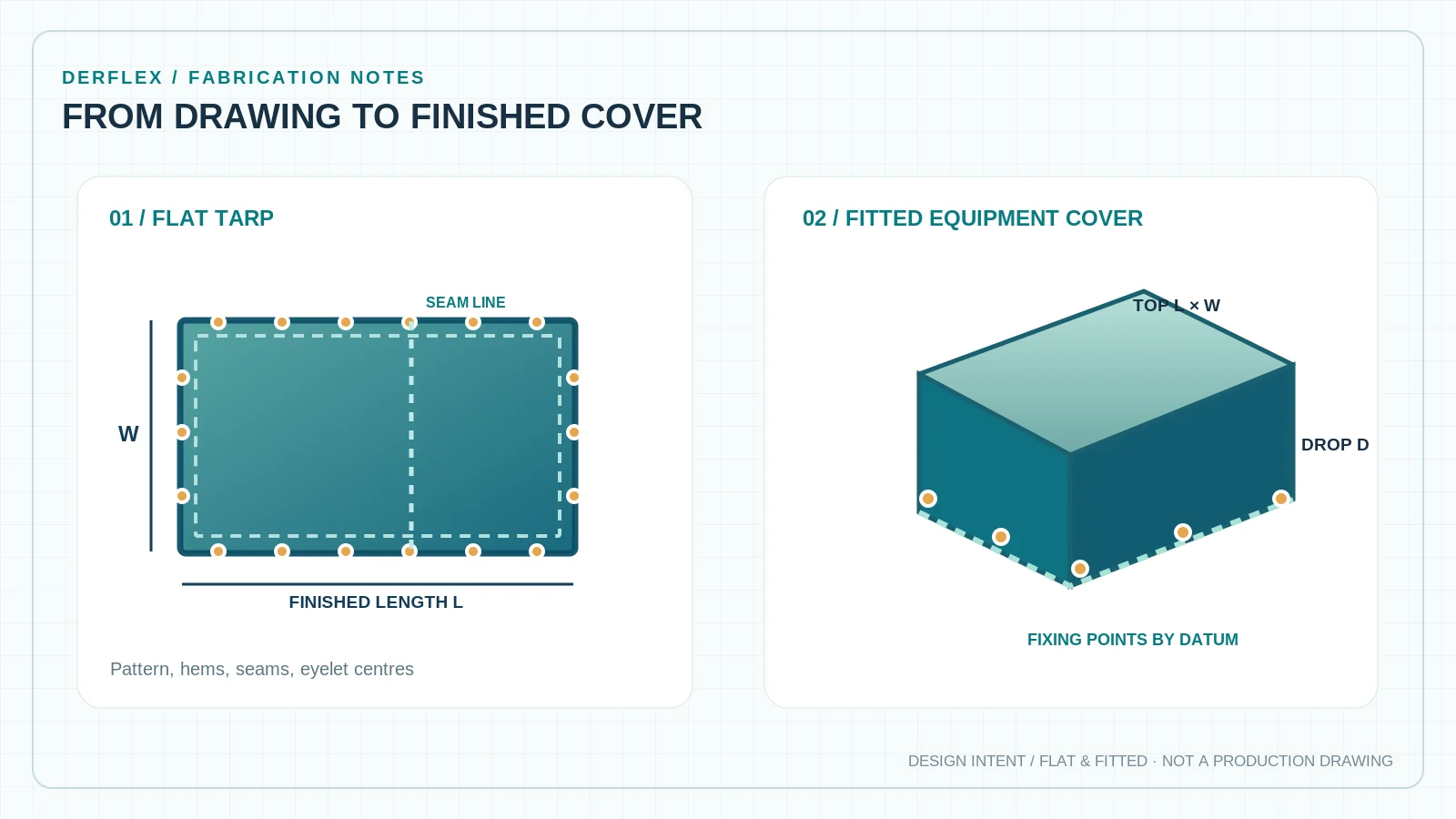
What is a custom heavy duty tarp?
A custom heavy duty tarp is a protective cover whose finished geometry, material, joints, perimeter and fastening layout are defined for a specific duty rather than selected from a stock-size chart.
Quick answer: A drawing-based tarp order should establish finished size, service conditions, fabric selection, seam locations, reinforced edges, anchor-point coordinates and sample acceptance. The drawing—not a generic “heavy duty” label—should connect all of these requirements.
Custom size protective sheets
Rectangular, trapezoidal or irregular covers with defined outer dimensions, corner radii, perimeter hems and grommets. Suitable for covered stock, construction material or general industrial sheeting.
Machinery and box-shaped covers
Top panel plus front, back and side drops. These require equipment clearance, separate face dimensions, corner joins, access zones and orientation markings in addition to the top footprint.
Panels, rolls and OEM programs
Buy coated fabric rolls for in-house fabrication, pre-cut and joined panels for local assembly, or finished custom tarps with agreed hardware, labeling and packing.
For fabric and performance choices across the wider category, see heavy duty tarp materials and industrial applications. This page concentrates on the conversion specification: the details that determine whether the final cover will actually fit and attach.
Two drawing types. Different dimensions. One approved outcome.
Choose a flat pattern for sheet-type tarps, or a top-and-side elevation set for fitted covers. A sketch or photos can start the enquiry; dimensioned views should govern production after approval.
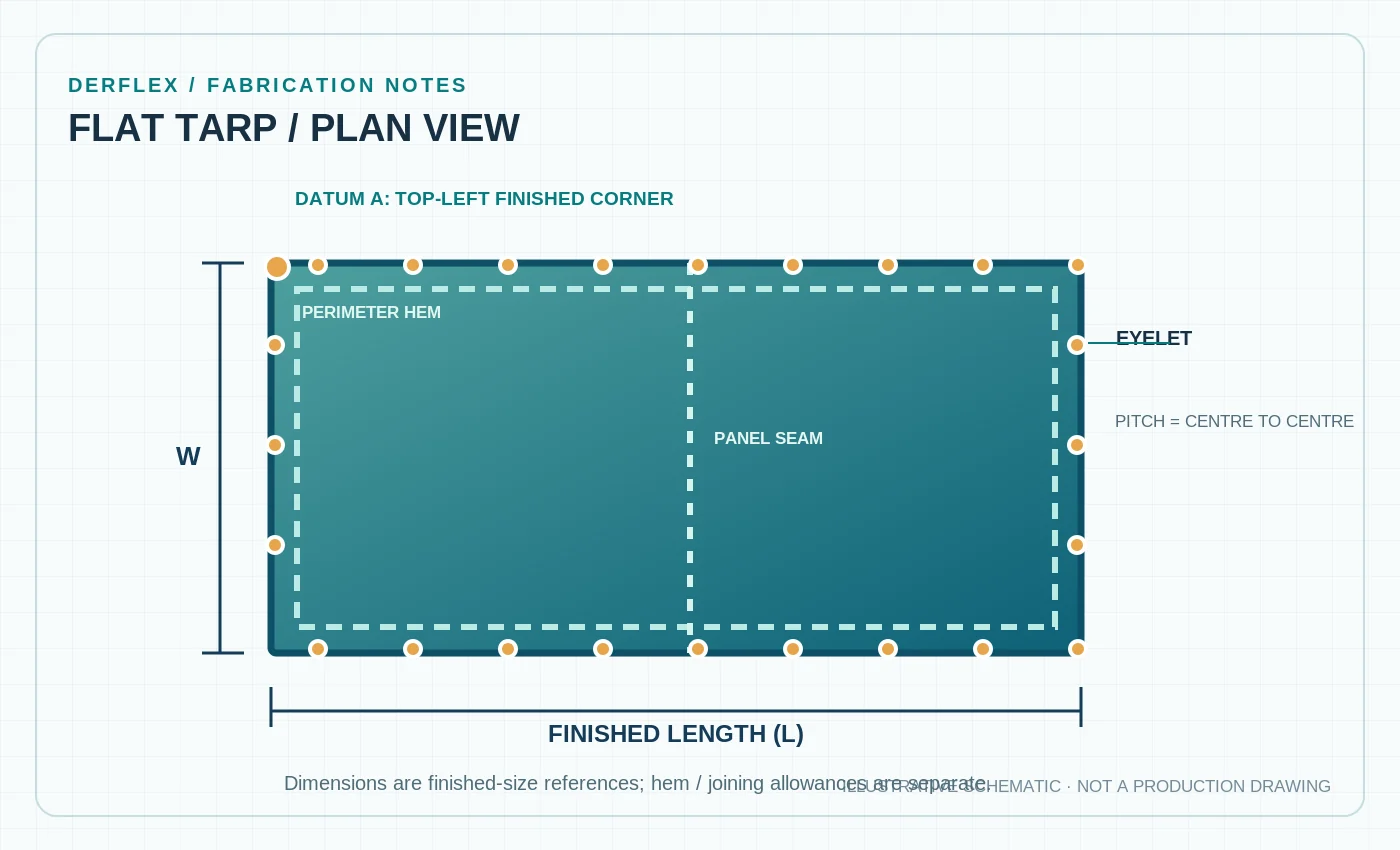
Flat plan / top view
State whether dimensions are for the relaxed finished tarp, the area to be covered, or a pre-cut blank. Give the first fixing-point offset from datum A and all exceptional intervals rather than saying only “eyelets all around.” Include the direction in which water should run off.
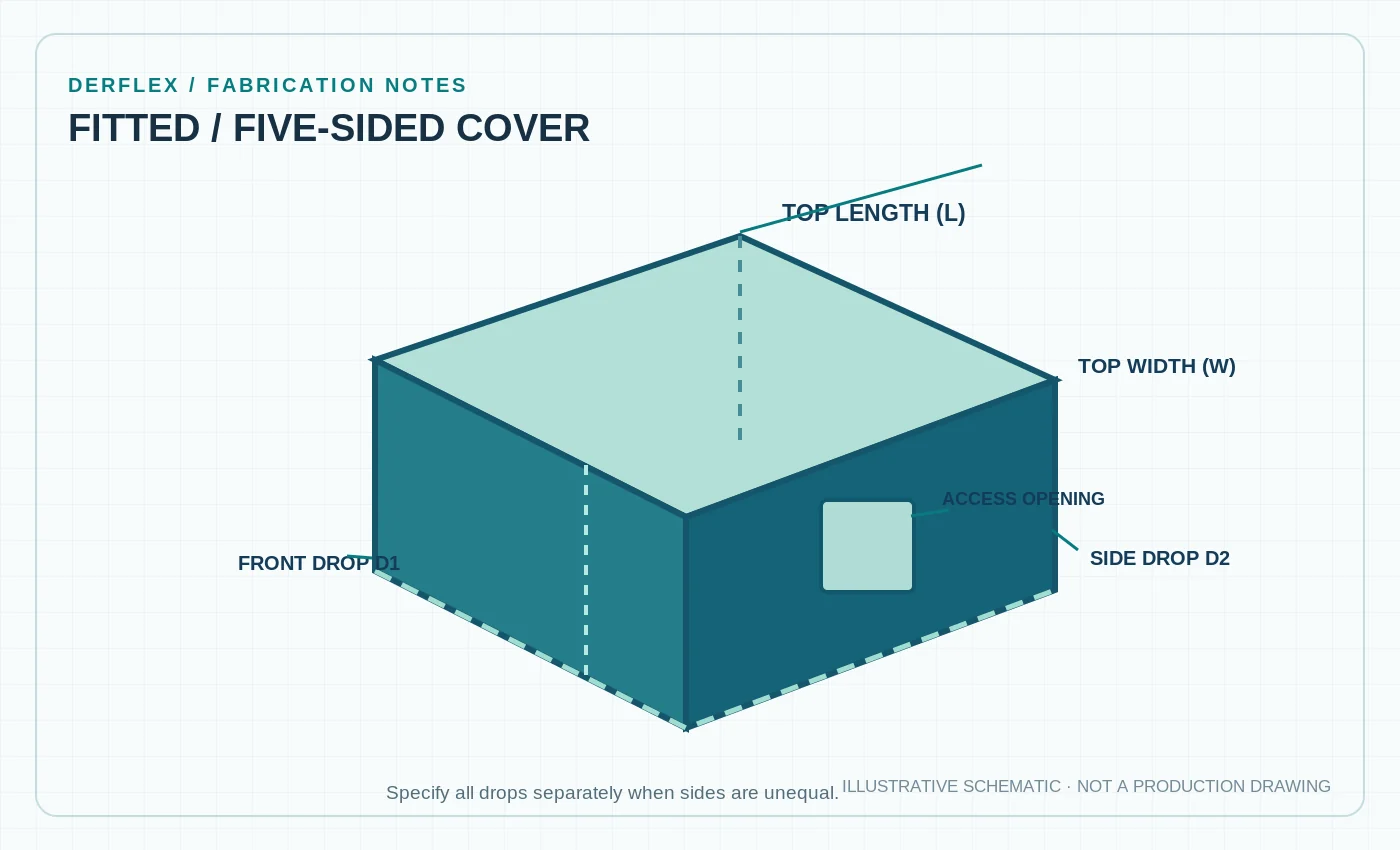
Fitted / isometric and elevations
Show the object's actual footprint and the intended cover footprint separately. Add clearance around protruding handles, pipes or controls, and identify which sides need a door, zipper, window or ventilation. Large or asymmetric shapes should also include front, side and rear views.
Measure the installed need—then specify the finished cover
A made to measure heavy duty tarp can be precisely cut and still be wrong for the job if the opening, drop, overlap, clearance or fastening datum was misunderstood.
| Drawing field | What the buyer specifies | What must be checked before approval |
|---|---|---|
| Finished length & width | Outer dimensions after fabric joining, hems and finishing, with units. | Measurement condition (laid flat and relaxed, or fitted on a defined reference). |
| Top size and four drops | Top L × W and front / back / left / right vertical coverage. | Unequal side drops, slopes, raised edges and asymmetric attachments. |
| Allowance & clearance | Functional overlap for tying, doors, water run-off and equipment movement. | Keep functional clearance separate from manufacturing seam allowance. |
| Curves & corners | Corner radius, diagonal, sloped edge, notch or separate fitted segment. | Reference datum and any shape that cannot be described by L × W alone. |
| Fixing-point datum | Grommet or D-ring centres from a fixed corner or reference edge. | First/last offset, anchor alignment, hardware hole size and pulling direction. |
| Tolerance & revision | Required finished dimensional tolerance, drawing date and version. | Agree a feasible tolerance by material and construction before sampling. |
For a more general measuring walkthrough, review DERFLEX’s made-to-measure tarpaulin guide. For an irregular cover, photographs and an old sample are valuable references, but a controlled drawing should record the final agreement.
Finished size vs. cut size
Finished size is the completed cover after hems and seams. Cut size is the blank or panel dimension used during conversion. Folded hems and welded overlaps affect how one relates to the other, so these measurements must never share a label without clarification.
How much drop do I need?
Measure from the top edge or highest coverage point to the required fixing or protection line, then decide the functional overlap. There is no universal extra allowance: a pulled-flat sheet, draped cover and close-fitting machinery enclosure each needs a different construction.
Panel seams, reinforced hems and hardware belong on the same drawing
For heavy duty tarp fabrication, a correct footprint does not automatically create a strong or weather-suitable finished product. Stress concentrations, panel joins, water-shedding direction and fixing interfaces need to be reviewed together.
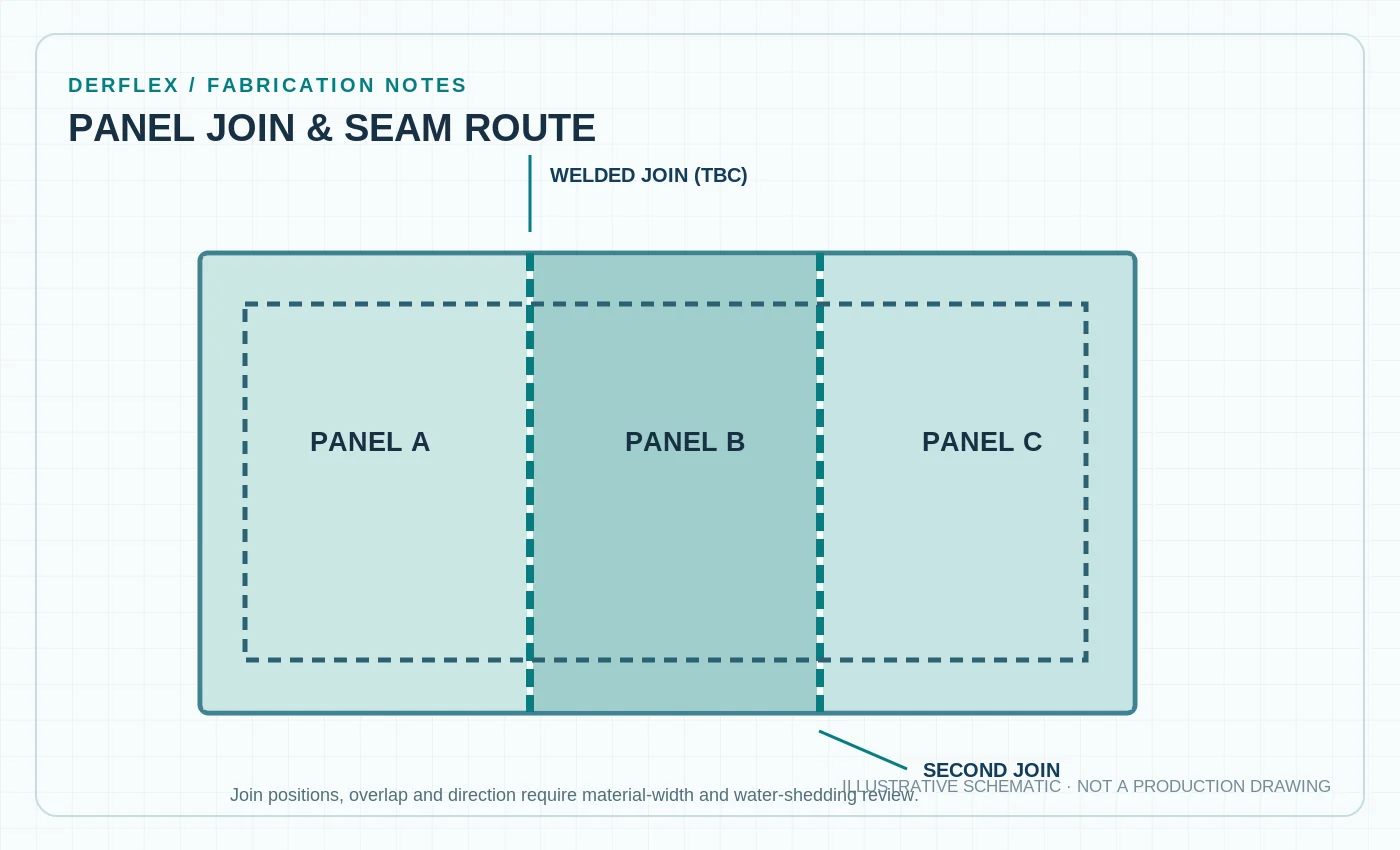
Seam position & panel orientation
A very wide cover can require multiple PVC-coated textile panels. Set join direction and location before fabrication, and decide whether a visible seam may cross a door, eyelet row, high-abrasion point or expected water path. Weld suitability and seam verification depend on the approved coated material and joining process.
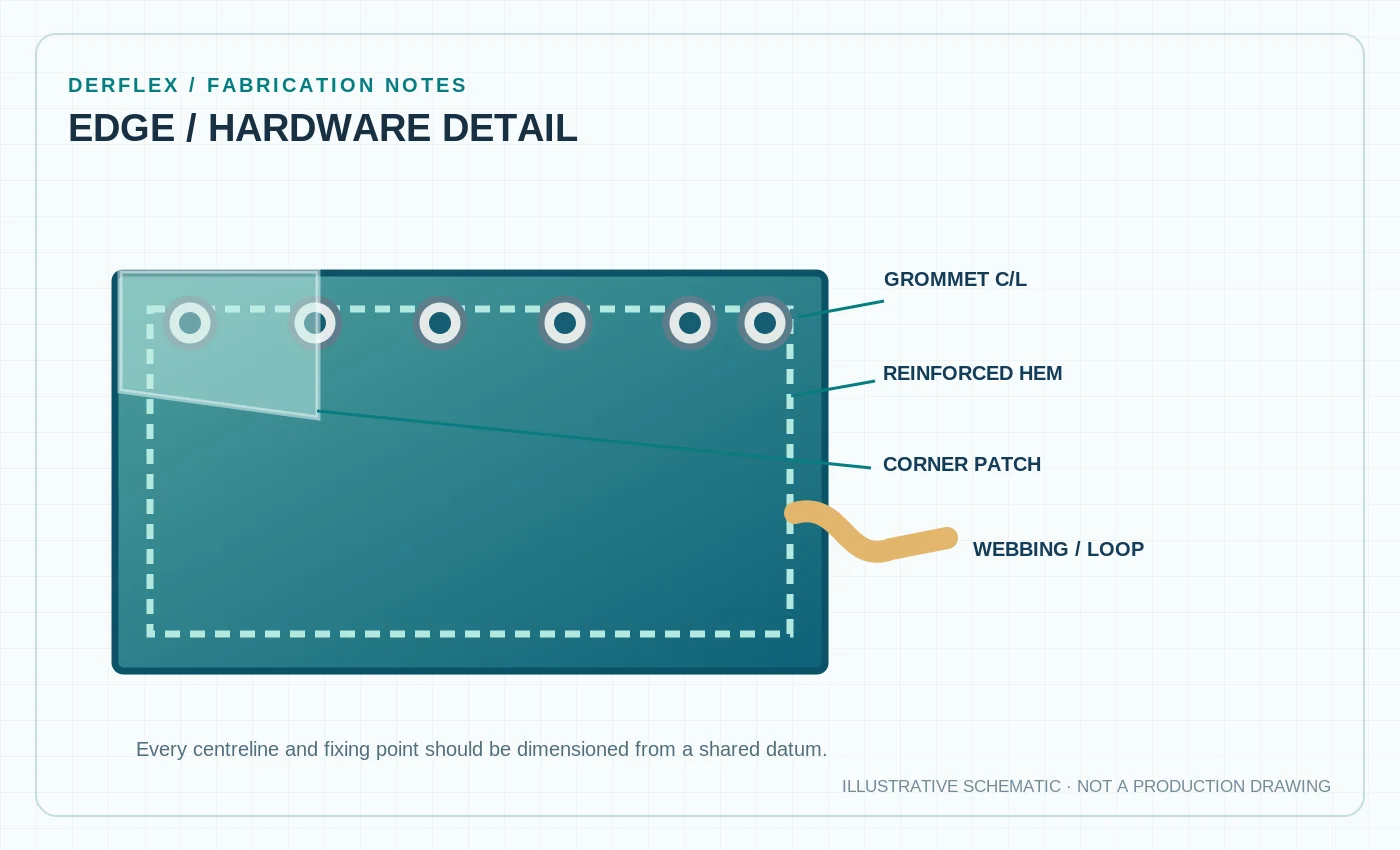
Perimeter reinforcement & fixing map
Eyelets, metal rings, straps, webbing, rope-in-hem and patches perform different jobs. Mark the tension direction and show how load enters the reinforcement—not simply the number of grommets. Match hardware material and size to the buyer’s hooks, ropes or structural anchors. A cover is not a certified lifting device.
Welded or sewn hems
Select the construction based on material, weather exposure, mechanical loads and sample checks. A stitch route can create water paths unless specifically managed.
Wear pads & corners
Identify abrasive contact surfaces, repeated folding lines and high-pull corners for local reinforcement rather than increasing every square metre of fabric without purpose.
Flaps, sleeves & openings
Plan service access, drainage, ventilation and removable closure positions; an otherwise waterproof panel may not make a fully sealed cover at these interfaces.
For transport-specific load geometry and tie-down design, see custom truck tarpaulins. For general protection and large equipment, compare industrial tarp solutions.
Specify the fabric grade and the finished cover separately
DERFLEX’s coated textile supply background is relevant to custom covers, but one material option cannot represent every fabricated tarp. Match the material build and the finishing plan to the duty profile.
| Specification area | Procurement options to discuss | Decision basis |
|---|---|---|
| Material family | PVC coated polyester or applicable PVC laminated textile; alternative materials by application review. | Water exposure, abrasion, repeated handling, tear behaviour and weldability. |
| Fabric mass / build | Applicable grade, target g/m² (GSM), woven base and coating structure. | Do not equate higher GSM with better assembled cover performance. Confirm a named grade and sample. |
| Color / finish | Standard or specified color, matte/gloss finish and branding direction. | Approved reference swatch, visibility, cleanability and repeat-order color requirements. |
| Performance evidence | Project-specified UV, FR, low-temperature or mechanical testing where available. | Request the matching grade’s actual report and applicable standard; avoid general claims for all materials. |
| Conversion scope | Roll material, cut blanks, joined panels or finished heavy duty PVC tarps. | Define who provides accessories, installation, supporting frames, fixings and final fitting. |
| Commercial details | Quantity by size, labels, packing, destination and required delivery window. | Material utilization, seam length, reinforcement labour, hardware count and logistics. |
Materials can be explored in the PVC tarpaulin range and PVC coated fabrics section. The precise construction, fabric-width availability, test document, MOQ and lead time must be confirmed against the order—not inferred from a generic product category.
Different jobs need different fabrication decisions
Start with the working environment and load direction. Then decide if the cover should be a flat pattern, a fitted assembly or a pre-joined panel for another fabricator.
| Use case | Preferred drawing focus | What can go wrong if ignored |
|---|---|---|
| Stationary industrial equipment | Five-sided geometry, door access, vents, protrusions and bottom hold-down. | Blocked service access, condensation, abrasion on sharp edges or poor fit. |
| Fleet cargo / transport | Top footprint, front/rear drops, tie-down line, reinforcement and moving-load edges. | Wind flutter, rubbing and anchor misalignment; vehicle safety is a separate assessment. |
| Site / construction sheet | Finished perimeter, corner patches, joining plan and drainage slope. | Ponding, seam leakage or tearing at overloaded anchor points. |
| OEM replacement tarp | Existing fixture dimensions, old-cover reference, hole centres and sample revision. | A nominally matching rectangle that cannot be fitted to the original hardware. |
| Fabricator panels | Panel width, material orientation, welding edges and packing/label IDs. | Excess rework, mismatched panels and difficult on-site assembly. |
From a marked drawing to a repeatable approved sample
A good drawing protects both procurement and fabrication. Each approval step should close a specific ambiguity before the next production decision.
Application & drawing intake
Review photos, object geometry, finished dimensions, use environment, anchor map, order quantities and required performance evidence.
Feasibility & material match
Check material grade, available fabric width, join method, panel efficiency, finishing route and whether the supply scope is roll, panel or cover.
Construction proposal
Agree a plan for seams, hems, patches, access points, print positions, hardware coordinates, tolerance and a named drawing revision.
Sample / first article
Where the design merits it, inspect a physical sample or trial item against the drawing, workmanship expectations and intended installation.
Production reference
Record the approved fabric reference, dimensions, hardware layout, sample details, inspection basis, labels and packaging before repeat runs.
Final check & shipment
Review agreed critical-to-quality items, quantities, appearance, package marks and documents relevant to the specific purchase order.
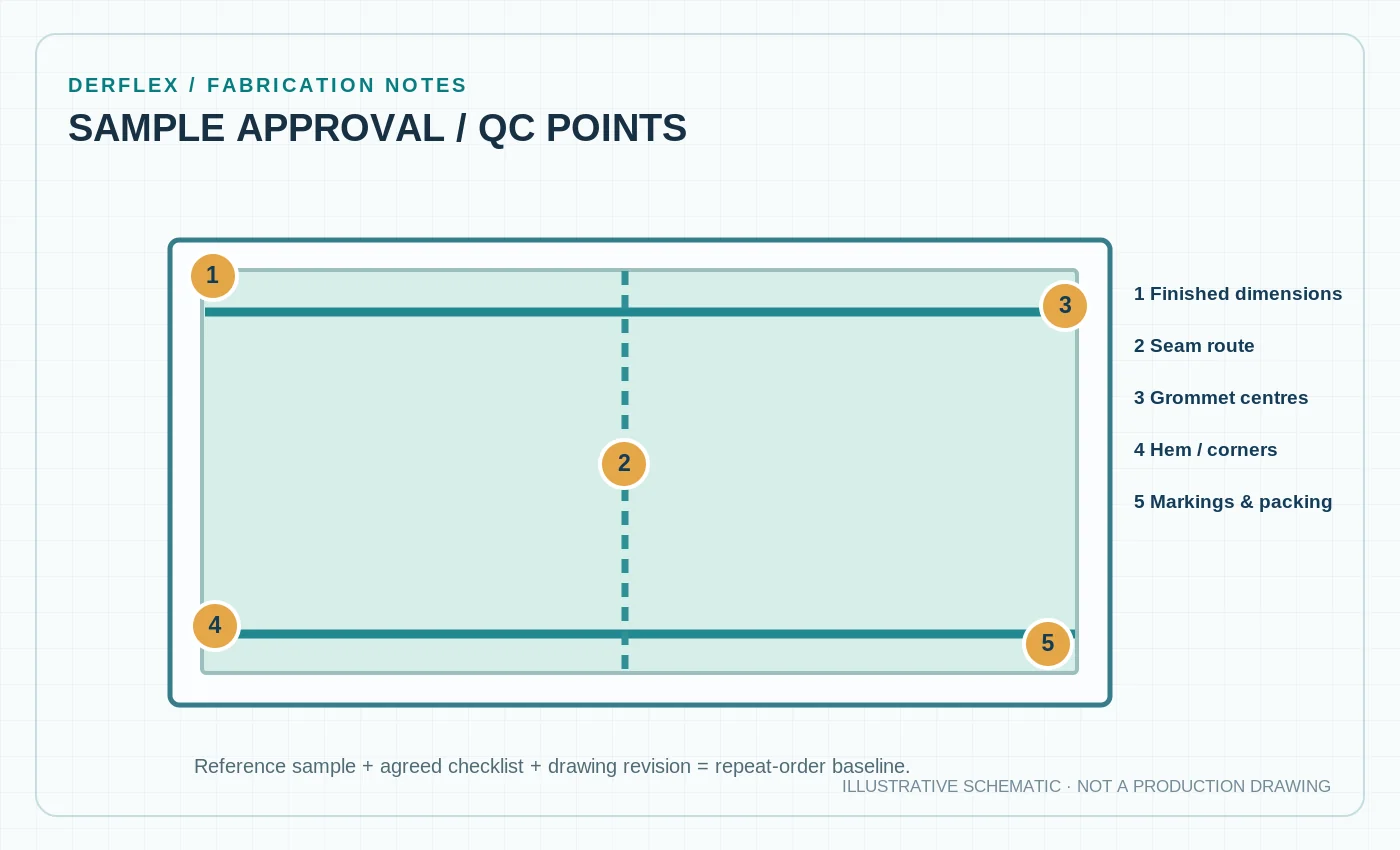
What should actually be checked?
- Finished size in the agreed measurement condition and tolerance
- Fabric identity, color and surface against approved sample
- Panel and seam placement against the latest drawing revision
- Hem construction, corner reinforcement and high-wear details
- Grommet and D-ring type, centres, quantity and fixing orientation
- Visual workmanship, print marks, size labels and packing quantities
Record any deviation and buyer-approved changes before treating the sample as the repeat-order reference. Relevant mechanical or fire tests require documented methods and material-specific reports.
A clearer RFQ creates a more comparable custom tarp quotation
You do not need a production-ready CAD model to start. An annotated photo, sketch or worn-out cover can establish the idea; the final quote and sample should use confirmed dimensions and construction details.
Information to send DERFLEX
- Use and exposure conditions
- Finished L × W and all drops
- Dimensioned sketch or CAD file
- Reference photos / old sample
- Quantity and size assortment
- Material or duty preference
- Seams, hems and corner zones
- Fixing-point / D-ring map
- Access / ventilation details
- Color, print, label and packing
- Destination and required tests
- Target order or delivery window
What changes the quotation?
Price is not determined by square metres alone. The material construction, usable roll width, number and length of joins, cutting complexity, extra reinforcements, hardware types and spacing, sample iterations, order mix, branding and shipping format can materially change the fabrication cost.
For multi-size programs, provide a size-and-quantity sheet and identify repeated tooling or placement patterns. DERFLEX can then discuss a quotation basis aligned with the approved drawing rather than an arbitrary “standard size.”
Important: do not infer weather-load resistance, lifting capacity or regulatory compliance from the fabric GSM alone. Installation, supporting structure and certification are separate matters where applicable.
Need a custom tarp that fits the real job?
Send the finished dimensions, a drawing or marked photo, quantities, duty requirements and fixing locations. Ask for a practical material-and-fabrication review covering the supply scope, sample basis and required documentation.
- Flat tarps, fitted covers and custom PVC panel programs
- Seam maps, reinforced edges, grommets and D-rings by design
- OEM labeling and repeat-order specifications as agreed
Use the Description field to reference your drawing number and finished-size requirements. Confirm the best method for sending large attachments with the sales team.
Frequently asked questions about custom heavy duty tarps
Practical details that matter before a made-to-measure tarp is approved for production.
Can DERFLEX make a heavy duty tarp from my drawing?
DERFLEX can review a dimensioned drawing, annotated photo, template or reference cover for a custom PVC tarp enquiry. Final feasibility depends on the fabric construction, panel layout, fastening design, order requirements and approved sample.
Should I provide cut size or finished size?
Specify the finished dimensions after hems, folds and joins. If cut dimensions are also supplied, label them separately. For fitted covers, show the top dimensions, each side drop and any overlap or access opening.
How should I dimension grommets and D-rings?
Mark the centre of each fixing point from a defined datum edge or corner. Identify hardware type, inside opening, reinforcement, spacing, rows and attachment direction. Do not rely on a generic spacing when the frame has fixed anchor points.
Can a custom heavy duty tarp have welded seams and reinforced hems?
PVC coated polyester can be fabricated with suitable welded joins and reinforced edge constructions, subject to the chosen material and design. Sewing, webbing, corner patches and accessory options should be agreed on the fabrication drawing and sample.
Are custom PVC tarps automatically waterproof and flame retardant?
No. PVC coated fabric may provide a waterproof material barrier, but a finished cover also depends on joins, openings and installation. Flame-retardant compliance applies only to a documented tested grade and relevant test method; it is not inherent to every custom tarp.
What must be approved before a repeat bulk order?
Approve the material reference, color, relaxed finished dimensions and tolerances, seam route, edge construction, hardware coordinates, sample workmanship, labels and packing. Keep a drawing revision and inspection criteria as the repeat-order reference.