Main air-transfer sections
Round layflat duct for positive pressure, wire-reinforced spiral duct for suction or bidirectional duty, and oval or low-profile constructions where clearance is restricted.



 Finished ventilation products · project customization
Configure the duct line as a coordinated system—not a collection of unrelated parts. DERFLEX supplies finished flexible tunnel ventilation ducting together with transitions, directional fittings, fan connections, suspension hardware and field-repair accessories for mining, tunneling and underground construction projects.
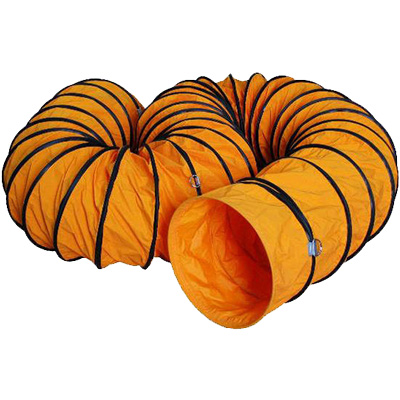
A tunnel ventilation design may look simple on a drawing, yet installation often depends on dozens of details: fan outlet size, changing tunnel clearance, branch routes, bends, coupling compatibility, hanging points and the ability to replace a damaged section without rebuilding the line.
DERFLEX approaches a custom tunnel ventilation duct order as a matched package. Straight sections, special fittings and accessories are reviewed together so that dimensions, fabric construction, connection method and suspension arrangement follow the same project logic. This reduces avoidable adaptation work at the jobsite and gives procurement teams a clearer bill of materials.
The product is fabricated from PVC-coated technical textile with welded seams. For forced-air lines, layflat ducting provides compact transport and fast extension. For suction or combined positive/negative pressure, a continuous steel-wire helix can be incorporated to resist collapse. Optional formulations can be discussed for flame retardancy, anti-static behavior, cold conditions, abrasion exposure and high-visibility requirements.
Final material grade, pressure rating and compliance documents should be confirmed against the project specification, fan curve, local regulations and the approved sample or technical data sheet.
The supply scope can be as narrow as a replacement fitting or as broad as a scheduled duct package for a full excavation stage.
Round layflat duct for positive pressure, wire-reinforced spiral duct for suction or bidirectional duty, and oval or low-profile constructions where clearance is restricted.
Fan adaptors, inlet or discharge adaptors and mixed-size transition pieces can be fabricated around the equipment flange, outlet diameter and preferred coupling method.
Smooth-radius elbows, tees, wyes, laterals and branch pieces route airflow around tunnel geometry or divide supply to separate working zones.
Zipper, steel ring, clip, grommet, hook-and-loop and custom connection options can be combined with welded suspension tabs, hooks, ropes and reinforcing strips.
Patch fabric, repair tape, compatible adhesive, spare connectors, section labels and packing marks support field maintenance and staged underground delivery.
Accessory geometry is finalized from diameter, bend angle, branch direction, coupling type and available installation space.
Connects flexible duct to fan outlets or inlet assemblies with project-defined ends.
Transitions between duct sizes while keeping the connection sequence clear for installers.
Routes the duct around tunnel walls, equipment zones or changes in alignment.
Creates branches for multiple work faces, headings or temporary ventilation points.
Provides an angled branch connection where a conventional tee would create a tight turn.
Links low-headroom ducting with standard round duct or fan equipment.
Provides a defined end connection or localized discharge arrangement.
Includes agreed hooks, straps, rope interfaces, patches, tape, adhesive or spare clips.
The ranges below are typical inquiry references rather than a universal rating. Final values are established for the selected construction and approved project requirement.
| Finished product | Flexible tunnel ventilation duct, fittings and accessory package |
|---|---|
| Primary construction | PVC-coated high-tenacity polyester textile; welded fabrication |
| Pressure configuration | Positive-pressure layflat duct; negative-pressure or combined-duty spiral wire-reinforced duct |
| Typical diameter | 300–2,000 mm; smaller or larger project sizes can be reviewed |
| Section length | 5 m, 10 m, 20 m or project-defined; selected long sections available after engineering review |
| Fabric weight options | Common project range approximately 500–900 gsm, selected by pressure, diameter, handling and durability requirements |
| Connection methods | Zipper, steel ring and clip, grommet/lacing, hook-and-loop or custom interface |
| Suspension | Welded hanging fin or reinforced tabs with eyelets/hooks; single or dual suspension layout |
| Accessory shapes | Fan adaptor, reducer, elbow, tee, wye, lateral, transition, discharge adaptor and custom fabricated shape |
| Performance options | Flame-retardant, anti-static, abrasion-resistant, cold-resistant and high-visibility variants subject to specification and testing |
| Color | Yellow, orange, black, green or custom color subject to formulation and order requirements |
| Support | Drawing review, connection matching, sample confirmation, packing list coordination and online technical communication |
A structured approval sequence helps prevent mismatched diameters, incompatible couplings and unclear section identification.
Share airflow objective, positive/negative pressure mode, fan data and underground operating conditions.
Provide the straight runs, bends, branches, clearance restrictions and planned excavation stages.
Confirm fan outlet dimensions, coupling sequence, suspension hardware and accessory geometry.
Review drawing, material option, reference sample, markings and project-specific packing method.
Check dimensions, welded seams, connector placement and package labels before shipment.
Custom duct packages can support fresh-air delivery, extraction or staged temporary ventilation where the route evolves with construction progress.
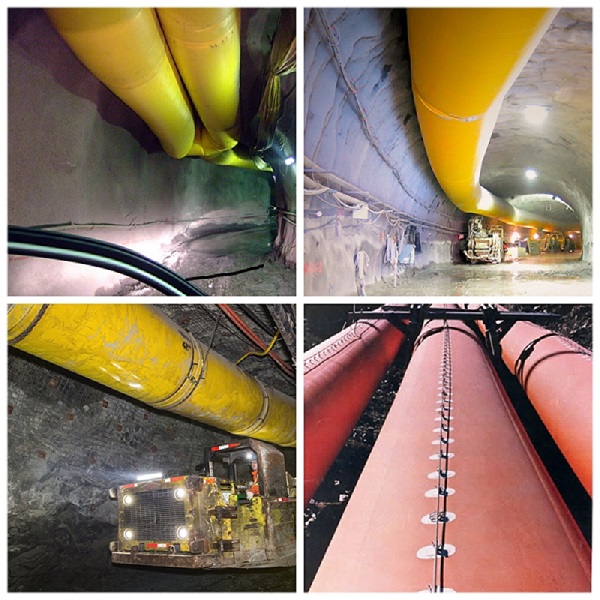
Extendable duct lines for excavation faces, drilling, blasting and spoil-removal stages.
Fresh-air distribution or extraction in headings, drifts, stopes and temporary work zones.
Ventilation around shafts, cross passages, cable tunnels and confined civil works.
Large-diameter temporary ventilation for access tunnels and underground chambers.
Localized air supply, fume removal or connection to portable and axial fans.
Collapsible ducting and spare fittings for planned contingencies or short-duration work.
Providing the following information helps the DERFLEX team identify the appropriate finished duct type, accessory list and connection sequence without relying on assumptions.
Explore the duct configurations most closely related to custom tunnel ventilation packages.
DERFLEX combines coated-textile knowledge with finished-product fabrication, helping buyers keep material, welding and connection decisions aligned.
Technical textile selection and finished duct fabrication can be discussed within the same project review.
Accessories can be dimensioned around fan outlets, branch routes and selected coupling systems.
Approved section codes, colors and packing marks can support staged orders and replacement requirements.
Drawing review, sample discussion and export documentation support are available for overseas projects.
Answers below explain the purchasing and specification issues most likely to affect a finished duct package.
It is for finished duct products and accessories. DERFLEX can discuss fabricated duct sections, fittings, couplings, suspension details, repair materials and project packing. Material-only supply can be handled separately when required.
Yes. A project may combine layflat forced-air sections with spiral wire-reinforced suction or exhaust sections. Each configuration should be matched to the operating pressure, diameter, fan and route.
Common options include fan adaptors, reducers, 45°, 65° and 90° elbows, tees, wyes, laterals, discharge adaptors, oval-to-round transitions, special branch pieces, suspension components and repair kits.
Diameter should be calculated from the required airflow, total duct length, allowable pressure loss, leakage expectation, fan curve, bends and site clearance. A ventilation engineer or qualified project designer should confirm the system design.
They can be specified for selected constructions. The required standard, test method and acceptance document should be stated in the inquiry so the material and testing route can be confirmed before production.
Often yes, provided the existing diameter, connector construction and interface dimensions are supplied. Photos, samples or a dimensioned drawing are useful when compatibility is critical.
Section numbers, diameter, direction, branch code, project name or other agreed markings can be added. Packaging can also be arranged by installation stage or tunnel zone.
Please provide duct type, diameter, section length, total quantity, pressure mode, fan interface, fittings list, connection preference, suspension method, safety specification, color and destination. A route sketch i, s recommended for complex systems.
Send DERFLEX the fan data, route sketch and accessory list. The team can review the finished duct configuration, connection sequence, custom fittings and packing requirements for your tunnel or underground project.