
Fresh-Air Supply
For positive pressure, a layflat or lightly reinforced duct can inflate under airflow and deliver air with low storage volume. It is useful where portability, fast extension and simple suspension are priorities.





|
|
Portable Industrial Blower Duct
Portable industrial blower duct for fresh-air supply, fume extraction, drying and confined-space ventilation. Finished PVC flexible duct with custom diameter, length, couplings, flame-retardant and antistatic options from DERFLEX.
|
|
||||||||||||||||||||||||||||||
Finished Ventilation Product
Portable Industrial Blower DuctA collapsible, jobsite-ready flexible duct for connecting portable axial blowers, exhaust fans and temporary air-moving equipment to the exact area where fresh air, extraction or drying airflow is required. DERFLEX supplies the completed duct assembly—not only coated textile—including the duct body, seams, reinforcement, couplings, suspension points and optional storage solution. 300–3000 mmProject-reference custom diameter range
5–20 m+Typical section lengths, customized by deployment
Supply / ExhaustConstruction selected for airflow direction
Fast DeploymentCollapsible format with practical connectors
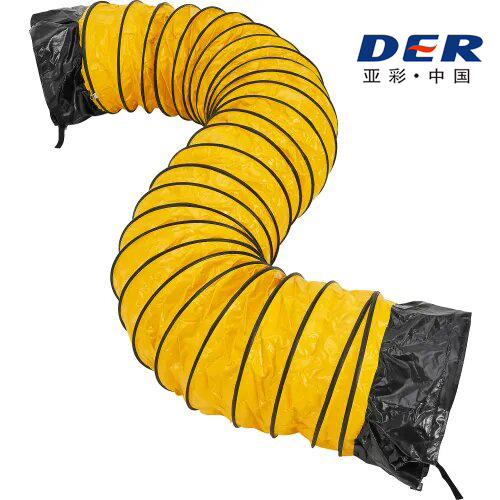
Product Definition
What Is a Portable Industrial Blower Duct?A portable industrial blower duct is a flexible airflow conduit used to extend the reach of a portable fan or blower. The blower remains in a practical and accessible location while the duct carries air into—or extracts air from—a tank, manhole, basement, workshop bay, tunnel heading, vessel, utility chamber or temporary enclosure. The assembly typically combines a PVC-coated polyester body with welded or sewn seams, connection cuffs and either a layflat structure or a steel-wire helix. The correct construction depends on whether the system is pushing air, pulling air or alternating between both modes. Why buyers specify a finished duct instead of fabric aloneAirflow performance is influenced by more than the coated textile. Diameter consistency, seam quality, helix pitch, coupling fit, suspension layout and bend behavior all affect leakage, pressure loss, handling and service life. DERFLEX therefore develops the duct as a complete component matched to the buyer’s blower and operating method.
Airflow Direction Matters
Select the Duct Structure Before You Select the ColorThe first engineering decision is whether the blower pushes air through the duct, extracts air through it, or must support both operating modes. Fresh-Air SupplyFor positive pressure, a layflat or lightly reinforced duct can inflate under airflow and deliver air with low storage volume. It is useful where portability, fast extension and simple suspension are priorities. Fume or Dust ExtractionNegative pressure can collapse an unsupported tube. A continuous helix or closely spaced support structure helps keep the airway open while the blower removes smoke, vapor, dust-laden air or process heat. Reversible VentilationWhere crews may alternate between supply and exhaust, a wire-reinforced design is generally the safer specification. Couplings, seams and blower interface should be reviewed for both airflow directions.
Available Constructions
Three Practical Product FormatsDERFLEX can adjust the finished duct architecture to portable blowers, temporary ventilation layouts and project-specific risk controls. Layflat Positive-Pressure DuctCollapses nearly flat when the blower is off, reducing storage space and transport weight. Best suited to forced-air supply where suction resistance is not required. Spiral Wire-Reinforced DuctA helical wire supports the round bore during extraction, bending and frequent repositioning. External wear strips can protect high-contact areas and cover the wire path. Flame-Retardant or Conductive DuctFor mines, tunnels, maintenance shutdowns or potentially hazardous areas, the duct body can be configured with specified flame-retardant or antistatic characteristics.
Technical Configuration
Portable Blower Duct Specification RangeThe table combines finished-product parameters with project-reference material attributes. Final values are confirmed against diameter, airflow direction, pressure, coupling and requested test method.
Specification notice: figures shown are selection references rather than universal guarantees. Confirm the final data sheet, sample, test standard and complete ventilation-system suitability before procurement or site use.
Where It Is Used
Applications for Mobile Air Supply and ExtractionA portable duct allows one blower platform to serve changing work locations without installing permanent rigid pipe. Confined-Space EntryRoutes fresh air toward manholes, tanks, utility chambers and access shafts. The complete entry procedure and atmosphere monitoring remain the responsibility of the site safety team. Welding and FabricationPositions extraction closer to temporary welding, grinding or coating work, helping move process fumes toward a designated discharge or filtration system. Construction and RenovationSupports temporary airflow in basements, crawl spaces, interior fit-outs and areas where dust, heat or coating odors need controlled movement. Shipyard and Vessel WorkExtends blower reach into compartments and maintenance zones where rigid ducts are difficult to move or install. Mining and TunnelingProvides a portable branch or temporary ventilation line for underground work areas, equipment service and short-term air-routing requirements. Drying and Equipment CoolingDirects high-volume air toward wet floors, machinery, cable spaces or temporary enclosures during maintenance and restoration work.
Engineering Starting Point
Estimate the Required Air VolumeFor a simple space-air-change estimate, buyers often start with room volume and the target number of air changes per hour. Required airflow (m³/h) = Space volume (m³) × Target air changes per hour
Example: a 240 m³ work area at 10 air changes per hour starts at 2400 m³/h before accounting for duct friction, bends, leakage, filters and actual contaminant-control requirements. This is a planning example only. Confined-space and hazardous-fume ventilation must be designed and verified by qualified personnel under applicable local rules.
Procurement Checklist
Six Details That Prevent a Mismatched Duct
Connection and Handling
Details That Improve Jobsite UsabilityPortable ventilation equipment is moved, extended and stored repeatedly. Small design decisions can reduce setup time and avoid premature damage. Blower-Matched Inlet CuffThe connection section can be dimensioned for direct clamping, ring attachment, zipper sleeve or an adapter. A close, stable fit helps reduce leakage and accidental separation. Protected Helix and Wear ZonesBlack wear strips or reinforced contact bands can cover wire paths and protect areas dragged across floors, scaffold edges or access openings. Section-to-Section CouplingLong routes are easier to manage as modular sections. Zippers with sleeves, rings, straps or clamps can balance deployment speed and leakage control. Suspension LayoutHooks, eyelets, tabs or webbing loops can be spaced for horizontal suspension, vertical drops or temporary routing around equipment. Identification and Direction MarksPrinted size, section number, airflow arrow, buyer code and inspection information can simplify fleet control and replacement ordering. Storage and TransportCompressed storage sacks, carry straps and cartons can be designed around the crew size, service vehicle and frequency of deployment. 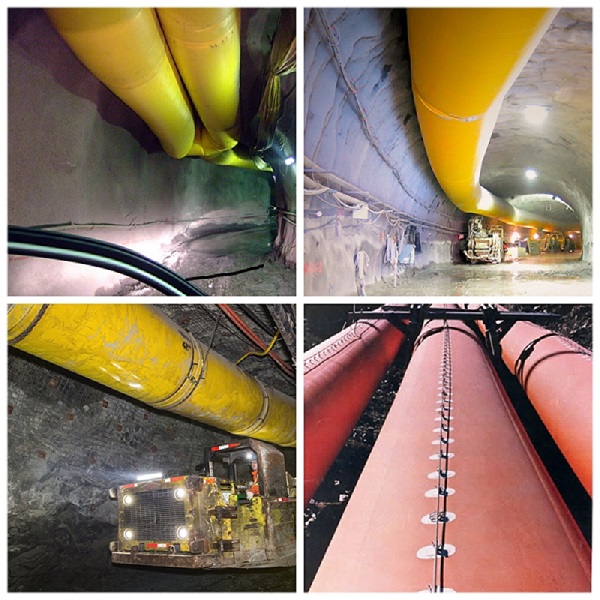
Manufacturing Approach
From Coated Textile to Completed Duct AssemblyDERFLEX combines coated-fabric manufacturing knowledge with finished-product construction. This allows material weight, flexibility, reinforcement, seam method and surface properties to be reviewed together instead of being purchased as disconnected components. Quality planning can include incoming textile checks, dimension control, seam inspection, coupling verification, visual examination, packing review and agreed sample or pressure testing. The exact inspection plan is established according to the order and intended application.
Why DERFLEX
A Practical Supplier for OEM and Project Duct ProgramsDERFLEX supports buyers who need repeatable duct construction, application-specific options and coordinated export supply rather than an off-the-shelf hose with no configuration review. Material + Product IntegrationCoated textile, reinforcement, seam and connector can be developed as one system, supporting better alignment between performance targets and finished-product handling. Custom Program SupportDiameter, length, color, logo, cuff, suspension, storage bag, carton marks and private-label presentation can be adjusted for distributors, equipment brands and contractors. Clear Pre-Production ConfirmationDrawings, reference samples and specification sheets can be reviewed before bulk production, reducing ambiguity around connection dimensions and construction details.
Related Ventilation Solutions
Continue Your Product SelectionThese related pages help buyers compare pressure mode, geometry and safety-oriented configurations within the DERFLEX ventilation duct range.
FAQ
Portable Industrial Blower Duct QuestionsAnswers focused on buyer selection, system compatibility and finished-product configuration. Is this page for a completed duct or only PVC duct fabric?It is for a completed portable industrial blower duct. The supplied product can include the duct body, welded or sewn seams, wire reinforcement where required, end cuffs, couplings, suspension points, identification and packing. Can one duct be used for both blowing and extraction?Yes, but it normally needs a wire-reinforced or otherwise supported structure so it does not collapse under negative pressure. The blower’s performance and the full routing should be checked in both directions. How do I match the duct to my portable blower?Provide the blower outlet diameter, shape, cuff length, any flange or guard interference, and your preferred attachment method. A photo and dimensioned sketch are useful for confirming the connection. What duct length should I order?Choose the shortest practical route that reaches the work zone, then allow for bends and positioning. Longer ducts and sharp bends increase pressure loss. Modular sections can be easier to deploy and replace than one very long section. Can DERFLEX make flame-retardant or antistatic blower ducting?Optional flame-retardant and antistatic configurations are available. The requested test method, limit, grounding design and final product construction must be agreed before production; a conductive duct alone does not make the entire ventilation system suitable for a hazardous location. Which coupling is fastest for temporary ventilation?Belt-and-buckle, clamp cuffs and zipper systems are common fast-deployment choices. The best option depends on leakage tolerance, crew gloves, section diameter and compatibility with existing ducts. Can the duct be branded for an equipment company or distributor?Yes. DERFLEX can support custom color, printed logo, part number, airflow arrow, section identification, storage bag and private-label carton information, subject to the confirmed order specification. What information is needed for a quotation?Please provide diameter, section length, airflow direction, blower interface, estimated airflow or pressure, environment, temperature, coupling, suspension, color, quantity, requested standards and destination. Configure a Duct That Fits Your BlowerSend the blower outlet dimensions, airflow direction, required route and work environment. DERFLEX will review an appropriate finished-duct structure, connection and specification for quotation.
Product information is provided for procurement discussion. Final suitability, testing, regulatory compliance and safe op, eration depend on the confirmed product configuration and the complete ventilation system used at the site.
|
||||||||||||||||||||||||||||||


