Low-Charging Surface
Designed to reduce the amount of charge generated by contact and separation. This property should be evaluated separately from resistance, particularly after cleaning, flexing and environmental exposure.



Custom PVC coated tarpaulin developed to reduce charge accumulation in equipment covers, curtain systems, temporary enclosures, ventilation ducts and OEM protective products.
DERFLEX helps industrial buyers specify the electrical behavior, fabric weight, mechanical strength, flame-retardant option, color and finished construction required for the intended operating environment. Resistance targets and compliance claims are confirmed against an agreed test method before production.
An anti static PVC tarp is a flexible composite made from a load-bearing polyester fabric and a PVC coating formulated or surface-treated to limit electrostatic charge accumulation. Depending on the required function, the material may be designed as a low-charging surface, a static-dissipative sheet, or a conductive system that transfers charge through an engineered path to ground.
This is different from an ordinary waterproof vinyl tarp. A standard tarp is selected mainly by weight, strength, weather resistance and fabrication. A static-control tarp must also be defined by measurable electrical behavior, environmental conditioning and the way the finished cover, curtain or enclosure is bonded to the grounding system.
DERFLEX supplies anti static PVC coated fabric for industrial buyers, converters, curtain fabricators, ventilation duct manufacturers, equipment-cover producers and OEM brands. The material can be supplied in rolls or converted into custom shapes with welded seams, webbing, eyelets, zippers, hook-and-loop closures and grounding points.
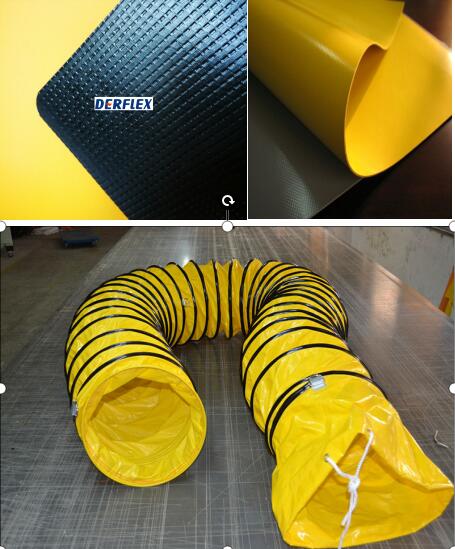
Buyers should identify the required electrical function instead of using “anti-static” as a broad description. Resistance classification and low-charging behavior are related, but they are not the same measurement.
Designed to reduce the amount of charge generated by contact and separation. This property should be evaluated separately from resistance, particularly after cleaning, flexing and environmental exposure.
Allows charge to move in a controlled manner rather than remaining localized. For ESD projects, the target range, electrode arrangement, voltage and conditioning procedure should be written into the specification.
Uses a sufficiently conductive formulation, grid or reinforcement to move charge toward a verified ground point. The finished product must preserve electrical continuity through seams, hardware and installation.
| Material description | Common surface resistance classification* | What the buyer should confirm |
|---|---|---|
| Conductive | Less than 1 × 10⁴ Ω | Ground connection, continuity across the finished product and controlled discharge rate. |
| Static dissipative | At least 1 × 10⁴ Ω and less than 1 × 10¹¹ Ω | Target range, test method, sample conditioning, measurement direction and acceptance limits. |
| Insulative | At least 1 × 10¹¹ Ω | Whether the material is unsuitable for the intended ESD control path even if it is waterproof. |
*Classification values are included as a procurement reference. The accepted standard, test apparatus, humidity, temperature and conditioning time must be agreed for the actual order. Low-charging performance cannot be inferred only from resistance.
Stable performance depends on more than an additive. The base fabric, PVC formulation, surface treatment, weldability, reinforcement and grounding details must work together.
Configuration is adjusted to the electrical target and mechanical duty of the finished product.
Useful where a low-charging or dissipative surface is needed. Buyers should request data after abrasion, cleaning and aging because surface performance can change with wear or contamination.
Static-control additives are incorporated into the PVC formulation. The design can support more durable performance, but it still requires verification under the agreed conditions.
A visible conductive pattern or integrated path can be used for curtain and enclosure systems that must be intentionally grounded. Seam and hardware continuity become part of the design review.
The following values describe common sourcing options, not a single universal datasheet. A confirmed specification is issued after DERFLEX reviews the application, target electrical behavior and fabrication requirements.
| Parameter | Common configurable option | Selection note |
|---|---|---|
| Material structure | PVC coated high-tenacity polyester | Knife-coated or laminated construction selected for strength, flexibility and cost target. |
| Common weight range | 610–1200 gsm | Lighter or heavier constructions can be reviewed for curtains, ducts, covers and reinforced panels. |
| Base fabric | Commonly 1000D × 1000D polyester | Yarn denier and thread density are adjusted for tensile, tear and flexing requirements. |
| Electrical property | Low-charging, dissipative or conductive target | Must include resistance range, test method, conditioning and acceptance criteria. |
| Roll width | Project-dependent standard and wide-width options | Choose width to reduce seams and fabrication waste; finished panels can be heat welded wider. |
| Temperature performance | Standard or cold-resistant PVC formulation | State minimum service and handling temperature; low-temperature flexibility is a separate requirement. |
| Flame retardancy | Optional project-specific FR grade | Anti-static performance and flame retardancy are independent; request the exact test standard needed. |
| Surface | Matte or gloss; optional lacquer | Cleaning method, abrasion, printing and outdoor exposure influence the surface selection. |
| Color | Black, gray, white, yellow, blue, green or custom color | Color does not prove electrical performance. Approve both color and test data. |
| Fabrication | Heat welding, HF welding or sewing with sealed seams | Finished products can include hems, webbing, eyelets, D-rings, straps, zippers and grounding tabs. |
| Supply format | Rolls, cut sheets, finished tarps, curtains, enclosures or ducts | OEM packaging, labels and repeat-order specifications can be arranged. |
The correct configuration varies by industry. Electronics protection may prioritize controlled dissipation and cleanliness, while mine ventilation may require flex fatigue, flame-retardant performance and a verified ground path.
Equipment covers, temporary work-zone curtains and protective barriers around ESD-sensitive assembly processes.
Custom covers and containment curtains used around servers, cabinets, testing equipment and service zones.
Flexible partitions and enclosure panels where visibility, cleanability and static-control behavior are specified.
Flexible duct and partition fabric for underground airflow systems, subject to the required FR and static tests.
Temporary screens, machine covers and material-handling barriers where friction and separation may generate charge.
Protective curtains and covers around web handling, film converting and roll-processing equipment.
Custom protective enclosures where static control, chemical splash resistance and cleaning compatibility are reviewed together.
Reusable fitted covers for machines, test systems and electrical equipment during storage, service or transportation.
Roll material and fabricated components for curtain manufacturers, cover producers and private-label industrial brands.
A practical RFQ should describe the electrical, mechanical, environmental and fabrication requirements of the finished product—not only the term “anti-static tarp.”
State whether the concern is ESD-sensitive electronics, charge nuisance, combustible dust, vapor or another process condition.
Define surface or point-to-point resistance, voltage, electrode, temperature, humidity and sample conditioning.
Explain how the cover, curtain or duct will be bonded and how continuity is preserved across seams and hardware.
Provide dimensions, wind or pressure, tension, abrasion, flex cycles, folding frequency and attachment points.
Name the flame test or local requirement separately. Anti-static material is not automatically flame retardant.
List detergents, solvents, disinfectants and cleaning frequency so surface durability can be assessed.
Check color, hand feel, weldability, resistance and finished grounding details before bulk production.
State whether the order needs a certificate of analysis, inspection report, retained sample or third-party testing.
This comparison helps buyers match the product structure to the actual job instead of choosing by appearance.
| Selection factor | Anti static PVC tarp | Standard vinyl tarp | ESD conductive-grid curtain |
|---|---|---|---|
| Primary purpose | Flexible covering plus specified charge-control behavior | Water, dust, weather and general equipment protection | Visible enclosure or partition with an intentional grounded grid |
| Electrical definition | Project-defined low-charging, dissipative or conductive target | Usually not specified | Conductive pattern and grounding system are central to the design |
| Opacity | Normally opaque; custom colors available | Opaque or clear, depending on material | Often clear with a printed conductive grid |
| Heavy-duty fabrication | Suitable for reinforced hems, fitted covers, ducts and welded panels | Widely available for general tarps and covers | Best suited to curtains, partitions and clean-zone enclosures |
| Grounding | Required when the approved design relies on a ground path | Not normally part of the product | Usually required for the conductive grid to function as intended |
| Best sourcing question | “What resistance and finished construction can you verify?” | “What weight, strength and weather resistance do I need?” | “How is the grid bonded to ground and kept continuous?” |
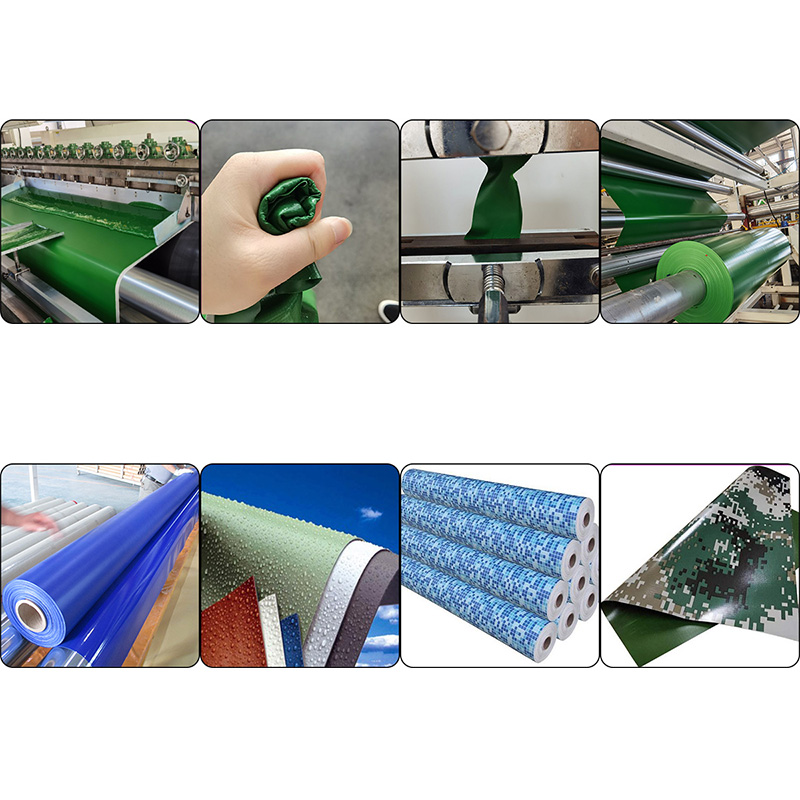
DERFLEX combines PVC coated fabric production experience with application-focused conversion support. Rather than limiting buyers to a small list of retail sizes, the project can be configured around equipment dimensions, installation method, operating environment and repeat-order requirements.
Material weight, polyester scrim, coating formulation, electrical target, surface finish, color, width, roll length, flame-retardant grade, low-temperature formula, UV package and printing can be reviewed as part of the material specification.
DERFLEX can support heat-welded panels, reinforced hems, webbing, eyelets, D-rings, buckles, straps, zippers, hook-and-loop closures, transparent windows, access flaps, labels and dedicated grounding tabs.
Buyers may request an agreed inspection plan covering dimensions, weight, appearance, mechanical properties and electrical resistance. Third-party testing should be stated before production when it is a contract requirement.
These six related pages support material comparison, finished-product design and industrial procurement.
Practical answers for engineers, purchasing teams, converters and industrial cover manufacturers.
“Anti-static” is often used broadly for material intended to reduce charge buildup. An ESD tarp should be defined more precisely by measurable resistance, low-charging behavior, grounding design and the applicable ESD control requirements. For sensitive projects, use the electrical specification rather than relying only on the product name.
There is no single value for every application. Conductive and static-dissipative materials occupy different resistance ranges, and low-charging behavior is a separate property. State the intended standard, test method, conditioning, target range and acceptance limit in the RFQ.
Grounding is required when the design depends on moving charge through the tarp to earth. Conductive-grid curtains and many dissipative systems need a verified path through tabs, hardware or conductive tape. Grounding details should be reviewed as part of the finished product, not added as an afterthought.
No. Static control and flame retardancy are separate properties. Request the required flame test and classification independently, then confirm that the combined formulation still meets the approved electrical and mechanical targets.
Yes. DERFLEX can review fitted equipment covers, machine enclosures, curtains, panels and ventilation ducts with custom dimensions, reinforced edges, closures, access openings and grounding features. A drawing or dimension sheet is recommended.
It can. Abrasion, dirt, plasticizer migration, cleaning chemicals, humidity and repeated folding may affect some static-control surfaces. For critical use, define durability testing after cleaning or abrasion and include periodic in-service verification in the maintenance plan.
Provide the application, dimensions, quantity, roll or finished-product format, target resistance, test method, grounding approach, material weight, color, flame-retardant requirement, temperature range, chemical exposure, attachment hardware, artwork and required quality documents.
Send DERFLEX your application, target resistance, drawing and operating conditions. The team can recommend a material and fabrication route for sample review before bulk production.
Product performance is subject to the approved specification, sample, test method, manufacturing tolerance, installation and service conditions. Buyers are responsible for confirming regulatory and site-safety suitability.