News
Company News

Inflatable Pool Size Guide | Dimensions, Capacity & OEM Planning

Update:2026/7/18 22:57:38 Views:
Dimensions · Capacity · Usable Space

Inflatable Pool Size Guide

Choose a pool by the space people can actually use—not by the outside length alone. Compare compact kids pools, family pools, adult lounge formats and large inflatable-ring pools by footprint, water depth, capacity, structure and intended users.

Quick answer

What inflatable pool size should you choose?

For supervised children’s splashing, compact pools around 4–6 ft (1.2–1.8 m) are easier to place, empty and store. A typical family pool for mixed adult-and-child use often falls around 8–10 ft (2.4–3.0 m) in its longest dimension. Adult lounge designs need similar or larger outside dimensions because wide walls, seats and backrests reduce the usable basin. Inflatable-ring above-ground pools commonly begin around 8–10 ft diameter and can extend to 15–18 ft for households that have enough level ground, water supply, filtration and safe access control.

The right choice is the smallest size that comfortably fits the intended users while leaving sufficient setup clearance and a practical route for inflation, filling, drainage, cleaning and seasonal storage.

1. Measure the siteRecord level ground, obstacles, drainage direction, power access and manufacturer-required clearance.
2. Define the usersSpecify adults, children, mixed family use, seated lounging or active water play.
3. Check real capacityUse the fill line and internal basin geometry—not the carton’s outside dimensions alone.
4. Plan after-use handlingMore water means longer filling, heavier ground loading, slower drainage and a larger dry storage package.
Reference selection table

Inflatable Pool Size Chart

Use these ranges to frame a purchase or OEM brief. Final capacity depends on the internal floor, wall taper, seats, air chambers and stated fill line.

Pool category Typical outside size Typical water height Planning capacity Common user fit Best use case
Mini / toddler splash pool 3–4.5 ft round or 36–54 in long
0.9–1.4 m
4–8 in
10–20 cm
15–60 gal
55–225 L
One or two small children under continuous close adult supervision Very compact patios, short splash sessions and easy daily emptying
Kids paddling pool 4–6 ft round or 5–6 × 3–4 ft
1.2–1.8 m / 1.5–1.8 × 0.9–1.2 m
7–12 in
18–30 cm
40–140 gal
150–530 L
Two to three children, subject to product age and capacity guidance Backyard splashing, themed play and compact seasonal retail products
Compact family pool 6–8 ft long or 6–8 ft round
1.8–2.4 m
10–16 in
25–41 cm
100–250 gal
380–950 L
One adult with two children, or several children with room to sit Small gardens, patios and low-volume family pool ranges
Standard rectangular family pool 8–10 × 5–6 ft
2.4–3.0 × 1.5–1.8 m
12–20 in
30–51 cm
180–450 gal
680–1,700 L
Two adults plus two to four children, depending on usable interior area Shared cooling, sitting, family play and mainstream e-commerce programs
Adult lounge / seated pool 8–11 × 6–8 ft
2.4–3.4 × 1.8–2.4 m
12–22 in
30–56 cm
180–500 gal
680–1,900 L
Two to four seated adults, or a mixed family group Benches, corner seats, backrests, cup holders and patio-focused collections
Large low-wall family pool 10–12 × 6–8 ft
3.0–3.7 × 1.8–2.4 m
16–24 in
41–61 cm
350–850 gal
1,325–3,220 L
Large family groups where the product’s verified capacity allows Whole-family seasonal ranges, club retail and high-value online listings
Inflatable-ring above-ground pool 8–12 ft diameter
2.4–3.7 m
18–30 in usable water depth
46–76 cm
500–1,900 gal
1,900–7,200 L
Family recreation with pump and maintenance planning Level yards with dedicated setup space, filtration and controlled access
XL inflatable-ring pool 15–18 ft diameter
4.6–5.5 m
30–42 in usable water depth
76–107 cm
3,000–7,000+ gal
11,350–26,500+ L
Several users, subject to verified capacity, local requirements and active supervision Larger yards, stronger ground preparation, filtration, ladder and barrier planning
Custom reinforced / commercial concept Project-specific; commonly 3–8 m or larger Defined by intended use and engineering review Calculated from approved internal geometry Event, rental, water-play or temporary containment programs Reinforced materials, documented loads, repair planning and product-specific testing

Reference ranges are for early planning only and are not universal age, user-capacity or safety claims. Always follow the finished product’s approved instructions, fill line, age grading, maximum occupancy and destination-market requirements.

Choose by construction

Three Size Systems That Should Not Be Mixed

A “10-foot inflatable pool” can describe very different products. First identify the construction, then compare dimensions and capacity.

Low-Wall Multi-Chamber Pool

Stacked air chambers create soft walls around a shallow or medium-depth basin.

  • Usually rectangular, round or oval
  • Outside length includes thick inflated walls
  • Often drained and stored after short seasonal use
Compare usable inner length and width

Inflatable-Ring Above-Ground Pool

An inflated top ring rises while water pressure supports the soft pool wall.

  • Commonly specified by diameter and wall height
  • Capacity often stated at a partial fill percentage
  • Usually needs filtration and more structured maintenance
Compare diameter, fill percentage and pump flow

Seated or Reinforced Custom Pool

Benches, backrests, drop-stitch panels or reinforced wall zones change the volume calculation.

  • Seats reduce both water volume and floor area
  • Reinforced structures may support larger formats
  • Claims should be verified on the production sample
Compare drawing dimensions after every chamber inflates
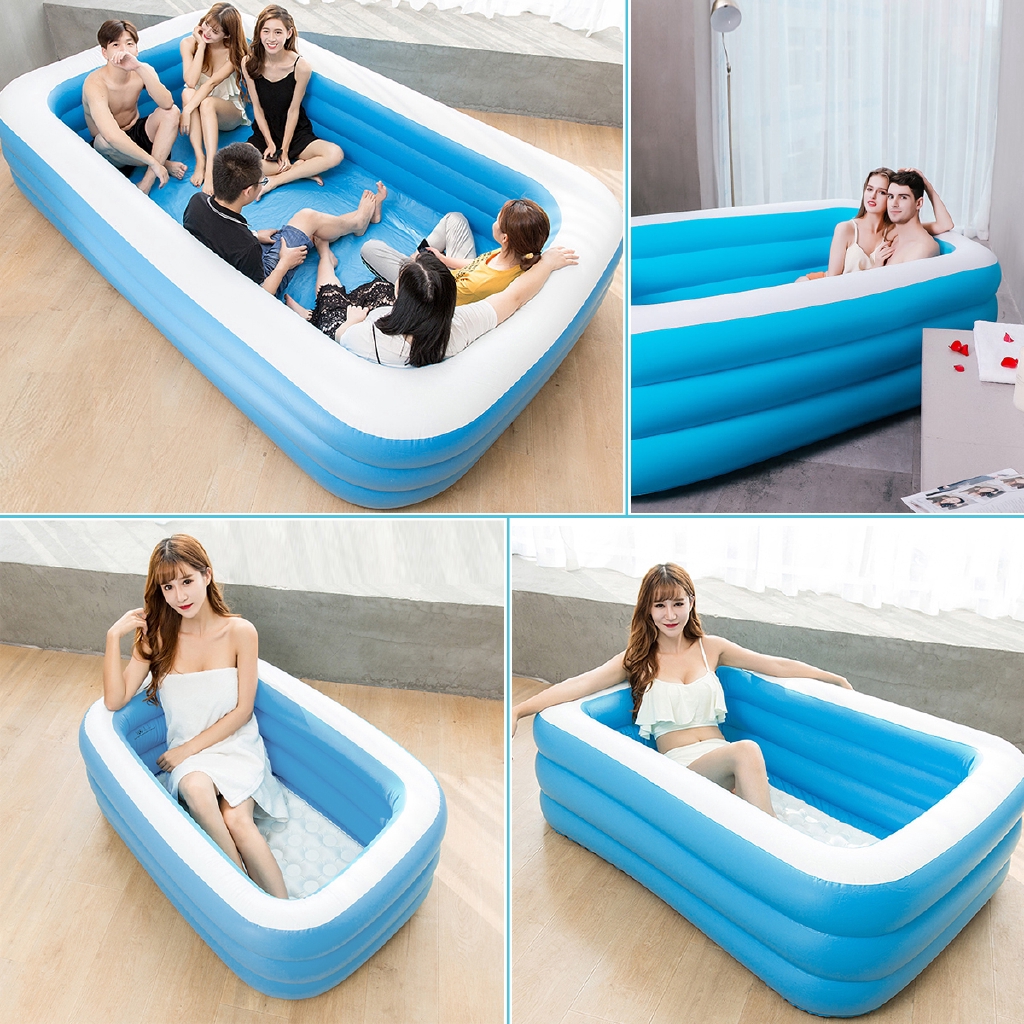
Blue and white inflatable pool size and usable space reference
DERFLEX website product reference. In custom development, external footprint, internal basin and inflated wall dimensions should be recorded separately.
Measure before buying

How to Measure the Space Correctly

Start with the available level surface, not the largest pool that fits between two boundaries. A usable setup area must also accommodate inflation, valves, drainage, cleaning and safe movement around the product.

1
Measure clear ground areaRecord the shortest length and width after excluding walls, planting, steps, furniture, sharp objects and low overhead features.
2
Add operational clearanceFollow the product maker’s placement instructions. Where space allows, buyers often reserve working room for entry, supervision, valves and cleaning tools.
3
Find the drainage routeConfirm where hundreds or thousands of liters can be released without flooding buildings, neighboring property or unstable ground.
4
Check ground loadingOne liter of water weighs approximately one kilogram. Large pools should not be placed on decks, balconies or elevated surfaces without qualified structural confirmation.
5
Plan the dry storage volumeThicker, larger and reinforced pools create a heavier folded package and need enough space to dry fully before storage.
Interactive planning tool

Inflatable Pool Water Capacity Calculator

Estimate volume from approximate internal dimensions. Use the stated fill height—not the full outside wall height.

Enter internal pool dimensions

The fill factor compensates for rounded corners, tapered walls, inflated seats and a fill line below the top edge. Use 70–85% for an early estimate, then replace it with measured sample data.

User-fit decisions

Size the Pool Around the Activity

The same footprint can feel generous or crowded depending on posture, seats, age mix and how much open water the design preserves.

For supervised kids’ play

Prioritize age-appropriate depth, soft edges, easy emptying and a floor area that supports the intended activity without encouraging overcrowding.

For mixed family use

Use internal dimensions to confirm that adults can sit without consuming the entire basin and children retain a clear play area under close supervision.

For adult lounging

Seat height, backrest angle and leg room matter more than headline length. A 10-foot pool with four corner seats may offer less open water than an 8-foot open-basin model.

For active games

Choose a wider open floor and avoid layouts where valves, drains, slides or basketball features create congested movement zones.

For large ring pools

Plan water treatment, pump size, cover, ladder, barriers, drainage and seasonal care at the same time as diameter and depth.

For e-commerce products

Publish both external and usable dimensions, realistic capacity, packed size and included accessories so buyers can assess fit before ordering.

For brands, importers and distributors

Build an OEM Size Specification That Can Be Tested

A strong product brief connects size language to drawings, water volume, user experience, material architecture, packaging and inspection.

01 · FOOTPRINT

State outside dimensions

Record inflated length, width or diameter, total wall height and the tolerance applied to the finished sample.

02 · USABLE BASIN

State internal dimensions

Measure the open water area after walls, seats, benches, backrests and play modules are fully inflated.

03 · WATER LOAD

Define the fill line

Specify maximum intended water height and verify capacity through a controlled prototype water-fill check.

04 · USER CLAIM

Describe the user mix

“Six people” is incomplete. Define the intended adult-to-child mix, seating arrangement and applicable age guidance.

05 · STRUCTURE

Match chambers to size

Review wall width, chamber count, valve location, drain reinforcement and stress concentration around corners and accessories.

06 · PACKING

Control shipping cube

Confirm folded dimensions, dry weight, carton size, pump or cover bundle and the way the product is refolded after use.

07 · MATERIAL

Do not choose by thickness alone

Pool size, water pressure, welding method, base reinforcement, coating adhesion and repeated folding should be reviewed together.

08 · VALIDATION

Test the production sample

Check dimensions, inflation symmetry, air retention, water holding, drainage, seam appearance, user space and packaging before bulk approval.

09 · LABELING

Align claims with the market

Warnings, age grading, capacity, chemical information, instructions and compliance documentation depend on the destination market and final configuration.

DERFLEX textured inflatable pool material sample
DERFLEX material and project support

Pool Size Changes the Material Conversation

DERFLEX works with weldable PVC, reinforced PVC coated textile and selected TPU material directions for inflatable and water-related products. A compact seasonal pool, an adult lounge pool and a larger reinforced concept should not automatically use the same material structure.

Project discussions can cover material weight or thickness, base textile, coating or film structure, surface texture, color, printing, welding compatibility, reinforced zones, roll width and sample testing. The practical selection is made after reviewing pool dimensions, wall height, air-chamber layout, water load, folding frequency, target market and production method.

DERFLEX’s established capability is technical coated and laminated material manufacturing. Depending on the project, support may include material supply, specification development, sampling and finished-product production coordination. Exact scope, documentation and commercial terms are confirmed in the quotation.

PVC coated polyester Selected TPU structures HF / hot-air welding review Custom color & finish Reinforced zones OEM roll supply
Questions buyers ask

Inflatable Pool Size Guide FAQ

Answers for household buyers, private-label brands, importers, distributors and product development teams.

What size inflatable pool is suitable for two adults and two children?

A rectangular pool around 8–10 ft (2.4–3.0 m) long and 5–6 ft (1.5–1.8 m) wide is a common starting range, but the usable internal basin matters more than the outside size. Check wall thickness, seats, intended water depth and the finished product’s verified occupancy claim before choosing.

How much space should I leave around an inflatable pool?

Use the clearance stated in the product instructions and local requirements. The setup area should also leave practical room for adult supervision, entry and exit, valves, drainage, a pump or filter, cleaning and safe movement without sharp objects nearby.

Why is the usable inside area smaller than the advertised pool size?

Advertised dimensions normally describe the fully inflated external footprint. Wide air chambers, tapered walls, seats, backrests and play features reduce the internal floor area. Ask for both external and internal dimensions when user space is important.

How do I estimate the gallons in an inflatable pool?

Use internal length × internal width × average water depth for a rectangular pool, then convert cubic volume into gallons or liters and apply a shape/fill factor. Round pools use the internal diameter. The calculator on this page provides a planning estimate, but a measured prototype water-fill test is more reliable.

Is a round or rectangular inflatable pool more space-efficient?

Rectangular pools often align efficiently with narrow patios and provide more straight-line floor area. Round pools distribute wall forces evenly and fit open yards well. The better choice depends on the available site, user activity, wall design, storage and product positioning.

Does a larger pool always need thicker material?

Not automatically. Larger pools create more water load and wall stress, but thickness is only one factor. Base-textile reinforcement, coating adhesion, seam width, chamber layout, valves, floor abrasion and the welding process all influence performance.

Can DERFLEX support custom inflatable pool dimensions?

Custom size, shape, color, surface, material direction, reinforced zones, printed appearance and OEM packaging can be discussed by project. Please provide outside dimensions, target internal area, wall height, user group, chamber layout, welding method, destination market and estimated quantity for a more useful review.

!

Water safety is not determined by pool size

Small inflatable pools can still present drowning and hygiene risks. Children require continuous, close and distraction-free adult supervision in and around water. Follow the finished product’s instructions, age grading, fill line, maintenance guidance and local barrier requirements. Empty and clean small unfiltered kiddie pools as directed; larger pools require appropriate filtration and water treatment according to the manufacturer’s instructions.

Start with a measurable brief

Planning a Custom Inflatable Pool Size?

Send the intended users, outside and inside dimensions, wall height, water depth, chamber layout, material preference, artwork, packaging and destination market. DERFLEX can review a practical material and development direction for sampling and quotation.

Consulting Services
+86-021-54361792 / 54361798
Email
sales@derflex.com