
Polyethylene (PE)
Woven PE fabric with laminated surfaces. Lightweight, waterproof and cost-conscious for broad general use.
Most visible in temporary covers


Polyethylene, PVC-coated polyester, canvas and mesh are the four materials buyers encounter most often—but their popularity comes from very different performance and cost priorities.
This practical guide explains where each material fits, why “vinyl tarp” usually refers to PVC-coated fabric, and how distributors, contractors, fleet operators and industrial buyers can choose a tarpaulin structure without overspecifying or underprotecting the application.
PE wins on volume and affordability; PVC-coated polyester wins on demanding, repeat-use industrial performance.
The ranking below reflects general market visibility and procurement frequency, not a universal performance hierarchy.
Woven PE fabric with laminated surfaces. Lightweight, waterproof and cost-conscious for broad general use.
Most visible in temporary coversPolyester reinforcement with PVC coating or lamination. Strong, weldable and configurable for industrial service.
Most visible in heavy-duty B2B useCotton or blended woven fabric. Breathable and abrasion-friendly, but typically water-resistant rather than fully waterproof.
Most visible in breathable coversOpen woven or knitted material designed to pass air and some light while providing shade or partial containment.
Most visible in shade and debris controlTPU, PU, silicone, fluoropolymer and functional PVC grades for air-holding, cold, chemicals, fire or regulated applications.
Most visible in engineered projects“Vinyl tarp” and “PVC tarp” are commonly used as overlapping market terms. In professional sourcing, confirm the base fabric, coating method, total weight and performance standard rather than relying on the name alone.
Buyers often ask, “What is a tarp made of?” as though the answer were a single polymer. In reality, most modern tarpaulins combine a load-bearing textile with a protective surface layer. The textile carries tensile and tear loads; the coating or lamination supplies water resistance, cleanability, color, printability and weather protection.
The same nominal material can therefore perform very differently. Two PVC tarpaulins may use different polyester deniers, weave densities, coating weights, plasticizer systems, lacquers or UV packages. Two PE tarps may differ in tape quality, weave count and lamination thickness. Material name is only the starting point.
A PVC-coated polyester tarp uses polyester yarn as the reinforcing core and PVC as the protective barrier. A PE tarp typically uses woven HDPE tapes with LDPE lamination on both faces.
Use this table as a first screening tool. Final specifications should be confirmed against the application, climate and fabrication method.
| Selection Factor | PE Tarpaulin | PVC-Coated Polyester | Canvas | Mesh |
|---|---|---|---|---|
| Typical purchase reason | Low cost and easy handling | Durability, waterproofing and fabrication | Breathability and surface protection | Airflow, shade and reduced wind pressure |
| Water barrier | High | High | Limited | Open |
| Breathability | Low | Low | High | High |
| Heavy-duty reuse | Moderate | Strong | Moderate | Application-based |
| Heat or HF welding | Possible with suitable PE equipment | Well suited to hot-air; HF depends on structure | Normally sewn | Depends on coating and construction |
| Typical weight feel | Light | Medium to heavy | Medium to heavy | Light to medium |
| Common applications | Temporary cover, landscaping, packaging | Truck, tent, industrial cover, curtain, shelter | Machinery, transport, painting, moisture-sensitive goods | Dump trucks, shade, privacy, wind and debris control |
| Common buying risk | Underspecified weave or UV package | Choosing by GSM without strength or adhesion data | Expecting full waterproofing in prolonged rain | Choosing the wrong openness or edge reinforcement |
| Relative initial cost | Lower | Medium–Higher | Medium | Varies |
Each material family solves a different procurement problem. The most useful comparison starts with that problem, not with a generic claim that one material is “best.”
PE tarpaulin is generally made from woven polyethylene tapes laminated on both sides. Its combination of low weight, water resistance, broad availability and economical pricing makes it a high-volume choice for temporary roofs, landscaping, seasonal agriculture, pallet protection, DIY projects and short-term construction coverage.
Its practical advantage is speed: it is easy to transport, unfold and replace. The trade-off is that lightweight grades may be more vulnerable to puncture, edge tear, flutter fatigue and long UV exposure. Professional buyers should therefore ask for finished weight, fabric weave, lamination quality, UV treatment and reinforced-edge construction rather than buying on color or nominal thickness alone.
PVC-coated polyester—often marketed as vinyl tarpaulin—combines a high-tenacity woven polyester core with a continuous PVC surface. The reinforcement supplies dimensional stability and mechanical strength; the coating supplies waterproofing, abrasion resistance, cleanability and compatibility with welding and custom fabrication.
It is widely selected for truck covers, side curtains, industrial equipment covers, tents, awnings, warehouse dividers, agricultural covers and custom OEM products because the material can be engineered around the job. Buyers can discuss GSM, denier, weave density, width, color, lacquer, UV stability, flame-retardant direction, anti-mildew treatment, cold resistance, printing and surface texture. The result is usually a higher initial cost than lightweight PE, but potentially better repeat-use economics when the application is demanding.
Canvas tarpaulin is made from cotton, polyester-cotton blends or other tightly woven fibers. Its key advantage is breathability: moisture vapor can move through the fabric more readily than through coated plastic tarps. This can reduce condensation around machinery, timber, some agricultural loads and moisture-sensitive items.
Canvas also has a softer hand and may be preferable when the covered surface should not be rubbed by a stiff plastic sheet. However, treated canvas is usually water-resistant rather than fully waterproof. It can absorb water, become heavier when wet, require drying before storage and need periodic treatment. Buyers should not use “heavy canvas” as a substitute for waterproof specification where standing water or continuous rain is expected.
Mesh tarps are designed with controlled openings. Instead of creating a solid barrier, they allow part of the wind and light to pass through. This makes them useful for dump-truck covers, trailer containment, privacy screens, shade structures, fencing, debris control and work zones where a solid sheet may balloon or overload the fastening system.
The most important specification is not simply “mesh.” Buyers should confirm openness, yarn structure, coated or uncoated construction, shade factor, tensile strength and edge reinforcement. A material that works as a sunshade may not be suitable for containing loose aggregate at road speed, and a highly open mesh will not protect against rain.
Some projects require a technical textile rather than a conventional cover sheet. TPU-coated fabrics may be considered for flexible tanks, inflatable structures or applications requiring good low-temperature flexibility. PU-coated fabrics can offer lighter, more textile-like behavior in selected uses. Silicone-coated or fluoropolymer materials may be used for heat, chemical or architectural requirements.
Functional PVC grades can also be formulated or finished for anti-static, anti-mildew, UV-stabilized, flame-retardant, blackout, printable or cold-resistant performance. These properties should be tied to an agreed test method and sample approval. A label such as “FR tarp” or “UV tarp” is not sufficient without the target standard, test condition and intended end market.
A more reliable buying decision comes from identifying what would make the cover fail in the real application.
Check the sheet, seams, overlaps, penetrations and edge design. A waterp, roof roll can still leak after poor sewing or welding.
Confirm tear strength, reinforcement fabric and high-stress details where grommets, straps or corners transfer load.
Match the formulation and surface finish to the actual exposure period, climate, color and maintenance conditions.
Truck corners, machinery edges and wind-driven movement can wear coating quickly unless contact points are protected.
Where trapped vapor is a concern, consider ventilation, breathable canvas, spacing or a cover design that avoids direct sealing.
Frequent folding, rolling and installation can favor flexible reinforced PVC; occasional light use may favor lower-weight PE.
These are practical starting points. Exact material construction, reinforcement and compliance should be confirmed before production.
Light or medium PE is often considered when the priority is fast deployment, lower cost and limited service duration.
Starting route: PERepeated handling, wind, road abrasion and welded fabrication normally favor reinforced PVC-coated polyester.
Starting route: PVC-coated polyesterPE may suit seasonal programs; reusable heavy-duty programs may justify PVC depending on handling and storage method.
Starting route: PE or PVCBreathable canvas may reduce trapped moisture, provided the application does not require a complete rain barrier.
Starting route: CanvasMesh can reduce wind pressure while helping contain debris; solid PVC may be used where rain protection is also required.
Starting route: Mesh or PVCPVC-coated polyester is commonly used because width, color, surface, welding and project performance can be customized.
Starting route: PVC-coated polyesterMesh provides a controllable balance of shade, visibility, airflow and wind-load reduction.
Starting route: MeshAirtight PVC or TPU-coated fabric may be required, with seam testing and compatibility confirmed by sample.
Starting route: Specialty coated fabricOfficial DERFLEX imagery shows coated tarpaulin roll options and the variety of downstream applications supported by flexible PVC fabric.
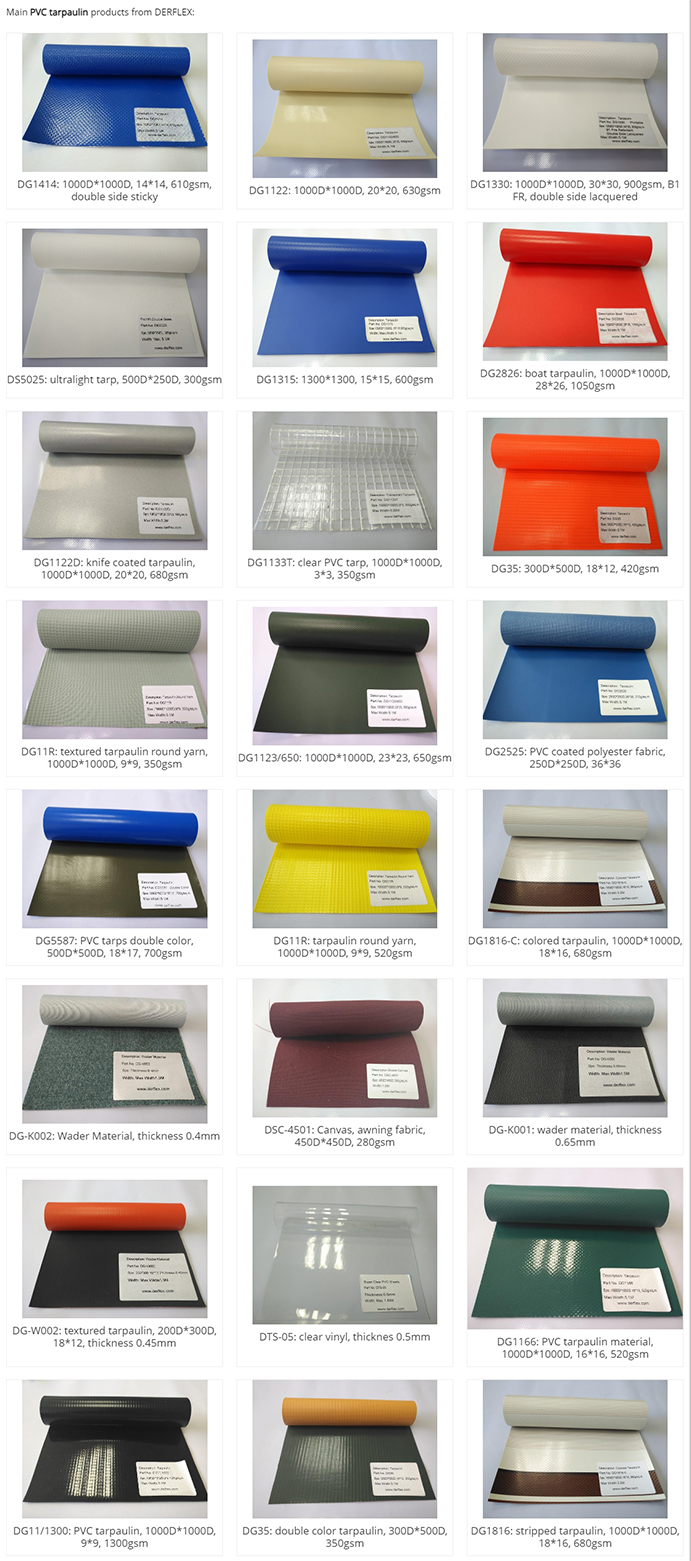
Color, weight, yarn structure, surface and functional treatment can be discussed according to application and production feasibility.
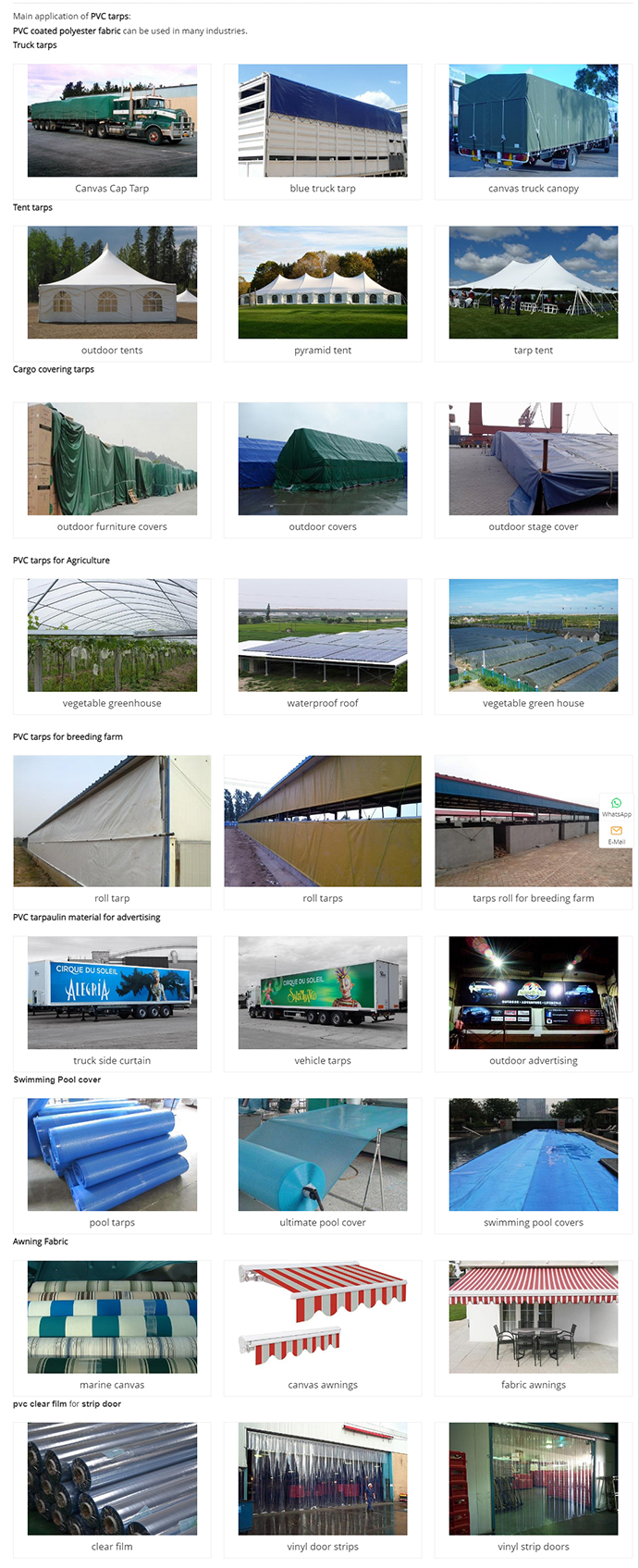
Transport, tents, cargo covers, agriculture, pools, awnings, strip doors and other industrial or commercial uses require different material logic.
Material recommendations can be discussed around handling frequency, exposure, fabrication and service requirements.
DERFLEX supports discussion of GSM, base fabric, width, color, finish and optional functional treatments.
Supply formats can include roll goods, panels or fabricated covers depending on project and order requirements.
Samples, specification records, inspection and packaging coordination help improve consistency across B2B programs.
A clear inquiry reduces back-and-forth and helps the supplier compare feasible material routes rather than quoting an arbitrary stock grade.
Describe the covered object, indoor or outdoor location, climate, movement, wind, abrasion, chemicals and expected exposure.
State whether you need roll goods, cut sheets, welded panels, finished tarps, private-label packaging or a complete OEM product.
Provide roll width or finished size, cut-size versus finished-size definition, seam allowance and acceptable dimensional tolerance.
Share any reference sample, target GSM, thickness, denier, weave density, color, surface finish or existing specification sheet.
List waterproofing, tensile, tear, adhesion, UV, cold, mildew, FR, anti-static, abrasion or other priorities with test methods where available.
Specify hot-air welding, high-frequency welding, sewing, hems, webbing, eyelets, D-rings, straps, ropes and high-stress reinforcement.
Identify the destination market and any applicable project, chemical, environmental or fire-performance documentation requirements.
Include sample quantity, trial order, annual forecast, target delivery window, packaging preference and destination port or country.
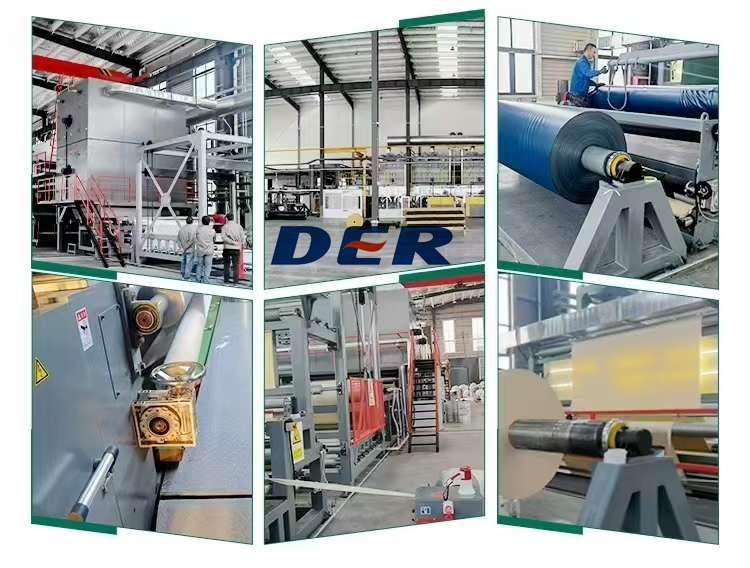
Coating, lamination, roll handling and material inspection are part of the production route behind custom tarpaulin supply.
DERFLEX has worked with coated flexible materials since 1998 and supplies PVC tarpaulin fabric for transport, tents, construction, agriculture, industrial protection and custom fabrication. The company’s value for professional buyers is not a claim that one material fits every job; it is the ability to discuss how base fabric, coating route, surface finish and finished construction should be matched to the end use.
For PVC-coated polyester programs, DERFLEX can discuss custom material weight, width, color, roll length, lacquer, UV resistance, anti-mildew direction, flame-retardant requirements, welding compatibility, packaging and private-label needs. Final recommendations remain subject to technical review, sample confirmation and agreed production specifications.
This approach is especially useful for importers, distributors, tarp fabricators, fleet suppliers, tent manufacturers, agricultural suppliers and industrial users who need a stable specification rather than a one-time retail sheet.
These six related pages cover material manufacturing, performance differences and application-specific sourcing.
Factory-based supply for PVC tarpaulins, industrial covers and OEM finished tarp programs.
02 · ProductWaterproof PVC-coated polyester rolls and custom heavy-duty tarpaulin solutions.
03 · TechnicalCoating routes, fabric structures and functional PVC textile options for industrial use.
04 · ComparisonA focused comparison of cost, durability, handling, fabrication and application fit.
05 · ComparisonCompare breathable canvas protection with waterproof PVC-vinyl tarp construction.
06 · Outdoor PerformanceMaterial and specification considerations for prolonged sunlight and outdoor weather exposure.
Clear answers for buyers comparing tarp materials before requesting samples or quotations.
The most popular tarpaulin materials are polyethylene (PE), PVC-coated polyester—often called vinyl tarp material—canvas and mesh. PE is common for economical temporary coverage, PVC-coated polyester for reusable waterproof industrial applications, canvas for breathable protection, and mesh for shade, airflow or debris containment.
In everyday market language, “vinyl tarp” usually refers to PVC-coated or PVC-laminated polyester fabric. Because sellers may use the terms differently, professional buyers should confirm the base fabric, coating method, total weight, thickness and test data.
Both laminated PE and PVC-coated polyester can provide a waterproof sheet. PVC-coated polyester is often preferred for heavy-duty fabricated covers because it supports strong welded seams and reinforced construction. The finished product must still be designed and fabricated correctly to prevent leakage.
PVC-coated polyester is commonly considered for long-term, repeat-use outdoor applications because its reinforced structure can provide strong tear, abrasion and weather resistance. The exact outdoor performance depends on coating formulation, UV stabilization, color, exposure and maintenance.
Canvas is useful when breathability, moisture-vapor movement and softer surface contact matter more than a complete waterproof barrier. It may suit machinery, timber or moisture-sensitive goods, but it should not be assumed to remain waterproof under prolonged rain or standing water.
DERFLEX can discuss custom PVC tarpaulin weight, base fabric, width, color, finish, UV direction, anti-mildew treatment, flame-retardant requirements, roll length, fabrication and packaging. Feasibility and final performance should be confirmed through technical review, samples and agreed specifications.
Send DERFLEX your application, dimensions, exposure conditions, expected service life, fabrication method, target quantity and destination market. The team can discuss a suitable material direction for sampling and quotation.