News
Company News

PVC vs PP Super Clear Film: Clarity, Shrinkage, UV & Weatherability | DERFLEX

Update:2026/9/27 18:08:29 Views:
Transparent Film Material Comparison

PVC vs PP Super Clear Film: Clarity, Shrinkage, UV Resistance & Weatherability

PVC and polypropylene can both be supplied as clear film, but they are optimized for very different jobs. This guide compares flexible super-clear PVC with PP film—especially CPP and BOPP—through the factors that matter most to industrial buyers: low shrinkage, dimensional stability, softness or stiffness, UV exposure, outdoor aging, optics and converting method.

Quick Answer

Which is better: PVC or PP clear film?

Neither material is universally better. Super-clear flexible PVC is usually the more natural starting point for transparent curtains, tent windows, marine panels, industrial partitions and thick flexible panels because its softness can be adjusted and suitable grades can be welded, sewn and formulated for outdoor exposure.

PP film is usually the more natural starting point for thin packaging, labels, overwrap and high-speed converting where low density, gloss, moisture resistance and controlled stiffness are valuable. BOPP and CPP should not be treated as the same film.

Critical distinction: “low shrinkage” is not a permanent property of the resin name. Orientation, thickness, annealing, production tension, conditioning and test temperature can change dimensional movement. A buyer should compare actual grades using the same test method and the same MD/TD directions.
PVC vs PP clear film low shrink clear film UV resistant clear film BOPP vs PVC film CPP vs PVC film outdoor transparent film
Side-by-Side Buyer Comparison

PVC vs PP Clear Film Comparison Table

Use this as a first screening tool. Final selection must be based on the exact PVC formulation or PP structure, thickness, surface treatment, test method and finished-product environment.

Selection FactorSuper Clear PVC FilmPP Clear Film (CPP / BOPP)Buyer Interpretation
Optical clarityHigh-clarity and super-clear flexible grades are available, including thicker transparent gauges for visual panels.BOPP can provide very high clarity and gloss in thin films; CPP can also be clear but is generally selected for a different converting role.Compare haze and transmission at the same thickness. “Clear” alone is not a specification.
Low shrinkageCan be engineered for low dimensional change through formulation and process control. DERFLEX has a premium low-shrink PVC direction that can target below 0.2% under its specified reference conditions.BOPP is intentionally oriented and can show thermal relaxation/shrinkage when heated; CPP has less biaxial-orientation memory but still needs grade-specific testing.Do not declare a winner without temperature, time, MD/TD and conditioning.
Dimensional stabilityDepends strongly on plasticizer system, thickness, temperature and calendering history. Low-shrink grades can be useful for outdoor flexible windows.BOPP is comparatively stiff and dimensionally controlled at normal use conditions, but heat can release orientation stress. CPP behaves differently.Define whether “stability” means room-temperature flatness, heat exposure, print registration or long-term outdoor size retention.
Softness / stiffnessVery wide range. Flexible PVC can be formulated from relatively firm to very soft, drapable film.PP is generally stiffer than soft PVC. BOPP is especially crisp; CPP is more flexible but does not behave like plasticized PVC.For hanging curtains and soft windows, feel and drape can be decisive.
UV exposureOutdoor grades can use UV stabilizers and other additives. Clear PVC still requires the right formulation to control yellowing, embrittlement and optical loss.PP also needs a suitable stabilization package for prolonged sunlight; ordinary packaging PP should not be assumed to be an outdoor grade.UV blocking and weatherability are different specifications.
Outdoor weatherabilityStrong application direction for clear curtains, enclosures and flexible windows when the correct outdoor grade is specified.Special outdoor PP grades exist, but mainstream CPP/BOPP use is concentrated in packaging, labels and laminates rather than thick outdoor flexible windows.Match weathering data to sunlight, heat, cold, humidity, cleaning and installation stress.
RF/HF weldingSuitable flexible PVC is widely used for high-frequency welding and fabrication.PP is not normally selected for HF-welded soft products; heat-seal structures, coatings or dedicated seal layers may be needed.Converting equipment can decide the material before price does.
Printing / bondingBroad printable and bondable film families are available with appropriate inks, adhesives and treatment.PP has relatively low surface energy and often relies on corona treatment, primer or a designed topcoat for reliable printing/bonding.Ask for dyne/surface-treatment direction when ink anchorage matters.
Density / yieldHeavier per unit volume than PP; flexible formulation also changes density.PP is a low-density polymer, which can provide more area per kilogram at the same thickness.Compare cost per square meter and converting yield, not only price per kilogram.
Common useClear curtains, tent windows, partitions, flexible glazing, covers, table protection, OEM transparent panels.Packaging, labels, overwrap, stationery, lamination and high-speed converting.The end product should drive the material family.
Do Not Compare “PP” as One Film

CPP and BOPP Behave Differently

One of the biggest sourcing errors is comparing PVC against a generic “PP film.” For a meaningful PVC vs PP decision, first identify whether the polypropylene is cast or biaxially oriented.

CPP · Cast Polypropylene

CPP is cast without the same two-direction orientation used for BOPP. It is often selected where heat sealing, flexibility, lamination or packaging conversion is important.

  • More flexible than BOPP
  • Common as a sealable packaging layer
  • Lower orientation-related thermal memory than BOPP
  • Still much less drapable than soft PVC in many comparable gauges

BOPP · Biaxially Oriented PP

BOPP is stretched in both machine and transverse directions to improve stiffness, tensile behavior, clarity and converting performance.

  • High gloss and thin-film clarity direction
  • Strong stiffness-to-weight ratio
  • Good print-registration potential after correct treatment
  • Heat can release orientation stress and create shrinkage

For a broader material-family view, see DERFLEX’s PVC, EVA, PP and TPU clear film comparison.

Engineering Focus

Six Performance Differences That Matter in Real Production

1

Thermal Shrinkage: test the film, not the polymer name

PVC film can carry thermal memory from calendering and tension history. PP can carry orientation stress—especially BOPP. Both can move dimensionally when exposed to heat, but for different reasons.

A credible low-shrink requirement should state the initial dimension, conditioning, temperature, exposure time, cooling method and measurement direction.

Dimensional change (%) = (L0 − L1) ÷ L0 × 100
2

Dimensional Stability: define what “stable” means

A packaging printer may mean stable web registration at converting temperature. A tent-window fabricator may mean low size change after days of sun and heat. A label converter may mean edge control after lamination.

These are different engineering problems. Specify the service condition before choosing a material.

3

Softness & Hardness: do not compare unlike metrics

Flexible PVC can be tuned over a broad softness range with formulation. PP is more naturally stiff, and BOPP gains additional stiffness from orientation.

For flexible PVC, buyers may discuss softness or Shore hardness. For PP, modulus, thickness and orientation often describe handling more meaningfully than trying to force both materials into one “hardness” number.

4

UV Resistance: blocking UV is not the same as surviving UV

A film can block a high percentage of UV reaching whatever sits behind it and still age poorly itself. Outdoor weatherability should assess the film’s own retention of clarity, color, flexibility and mechanical properties after exposure.

Ask suppliers for the test method, exposure source, hours/cycles, specimen thickness and retained-property criteria.

5

Outdoor Performance: heat, cold and cleaning matter too

Direct sunlight is only one stress. Clear outdoor panels also experience temperature cycling, wind movement, moisture, cleaning agents, creasing, edge stress and sometimes contact with oils or exhaust.

For long-term flexible outdoor panels, a correctly stabilized PVC grade is often easier to engineer around than commodity PP packaging film.

6

Clarity: thin-film gloss and thick-gauge transparency are different

BOPP can look exceptionally clear and glossy in thin packaging gauges. Super-clear PVC is commonly selected when the clear material must also be thick, soft, rollable and fabricatable into a window or protective panel.

Compare haze, light transmission, color tone, surface defects and visual distortion at the same thickness and against the same background.

Application Decision Matrix

Which Clear Film Should You Evaluate First?

These are starting directions rather than universal prescriptions. The final grade should be approved by sample testing on the real converting equipment.

Tent / patio windowsStart with outdoor-grade super-clear PVC because flexibility, welding, thickness range and weathering control are central.
Industrial clear curtainsStart with flexible PVC. Confirm softness, cold flexibility, shrinkage, surface tack and cleaning exposure.
Labels on rigid containersStart with BOPP or other treated PP label stock where thin-film clarity, stiffness and moisture resistance matter.
Heat-sealable packagingEvaluate CPP or a designed PP seal structure. Confirm seal temperature, COF, print/lamination requirements and line speed.
Thick transparent protective panelFlexible PVC is generally more practical than thin packaging PP when drape, rolling or welding is required.
Mono-material PP packagingPP can align better with a PP-based package design. Confirm label, adhesive and recycling-stream requirements for the target market.
Repeated folding / premium flexible filmConsider TPU as a third option if abrasion, elastic recovery or PVC-free positioning is more important than PP-style packaging efficiency.
Unknown applicationDo not quote from “PVC vs PP” alone. Define thickness, movement, heat, UV, conversion and expected service life first.
Low-Shrink Specification

How to Specify “Low Shrinkage” So Suppliers Quote the Same Thing

A statement such as “shrinkage below 0.5%” is incomplete unless the test condition is fixed. Use the same protocol for PVC and PP samples before making a purchase decision.

Define the sample

Record material grade, thickness, width direction, production lot and whether the specimen is taken from MD or TD.

Condition before measuring

Allow samples to reach the agreed laboratory condition so results are not driven by recent winding or temperature history.

Set heat / exposure condition

State temperature, time and whether the test is dry heat, water bath, UV aging or another defined exposure.

Measure MD and TD separately

Oriented films can behave differently across directions. Reporting one combined value can hide the real risk.

Cool and re-measure consistently

Use the same cooling and measurement procedure for every candidate grade before calculating dimensional change.

Approve a finished-product test

Repeat the check after printing, lamination, welding or installation, because conversion can add new stresses.

Outdoor Material Selection

UV Resistance and Weatherability: Five Questions to Ask

01 · Exposure

How much sun?

Specify indoor, indirect daylight, seasonal outdoor or continuous outdoor exposure. Latitude, orientation and shade affect the real stress.

02 · Optical target

What must stay clear?

Define allowable haze increase, yellowing, color shift or loss of transparency instead of simply requesting “anti-UV.”

03 · Mechanical target

What must stay flexible?

Outdoor aging can change stiffness, elongation, crack resistance and fold behavior. Decide which retained property is critical.

04 · Temperature

What heat and cold cycles occur?

Clear panels can become much hotter than ambient air in direct sun. Cold nights can then create a large cycle in the same day.

05 · Cleaning

What touches the film?

Detergent, alcohol, grease, salt spray, oils or aggressive cleaners can change surface and optical performance.

06 · Test evidence

Which method supports the claim?

Request the actual test method, film thickness and pass/fail criteria. A marketing phrase is not a weathering specification.

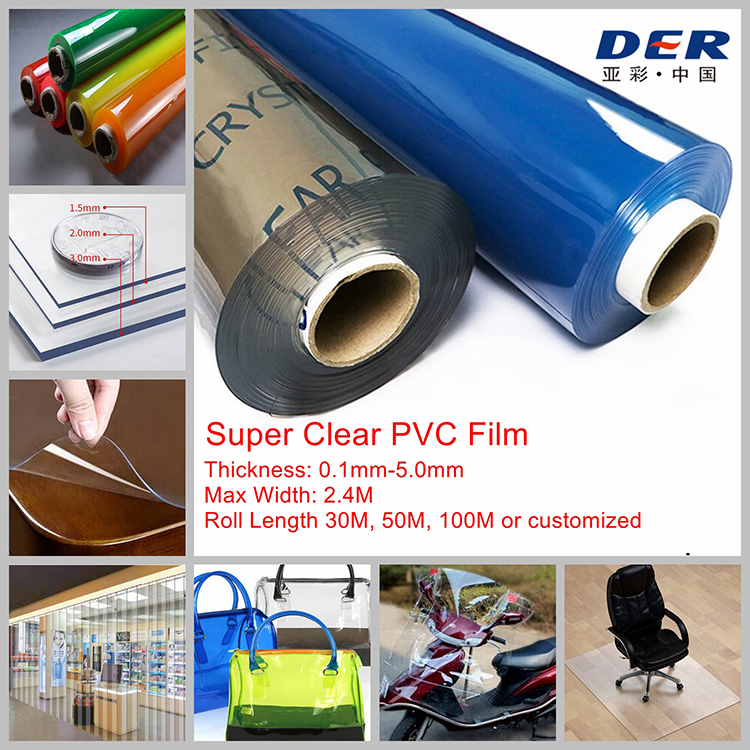
Real DERFLEX Material Images

Clear Film Surface, Gauge and Flexibility Matter

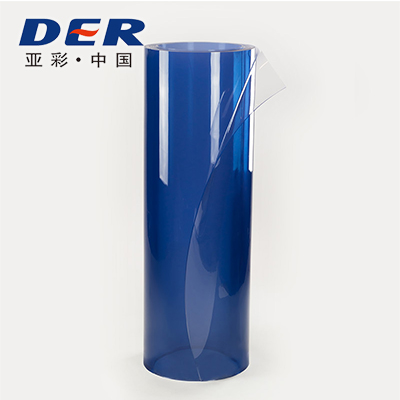
Product photography should show what buyers actually compare: optical quality, roll surface, thickness direction, color tone and how the film bends or drapes.

Sample Approval Protocol

Seven Checks Before Approving PVC or PP Clear Film for Bulk Production

Optical inspection

Compare haze, transmission, tint, gloss, gel points, scratches and visual distortion against an approved reference.

Thickness & flatness

Check gauge tolerance, edge profile, roll telescoping, curl and whether the film lies flat after unwinding.

Dimensional change

Measure thermal or aging-related change in MD and TD using the agreed project condition.

Converting trial

Run the real printing, corona, lamination, heat sealing, welding, cutting or sewing process.

Environmental exposure

Test the relevant combination of UV, heat, cold, humidity, water, oils and cleaning agents.

Finished assembly

Evaluate seams, adhesive edges, laminate curl, print registration and the whole construction—not only raw film.

Golden sample

Keep an approved production-representative sample with measurable acceptance points for repeat-order control.

Procurement Risk Control

Common Mistakes When Comparing PVC and PP Clear Film

1. Treating CPP and BOPP as the same filmOrientation changes stiffness, shrinkage, sealing behavior and converting performance.
2. Comparing different thicknessesA thin BOPP sample and a thick PVC sample can look and feel completely different even before resin chemistry is considered.
3. Asking only for “UV resistant”Define optical retention, mechanical retention, test method and exposure target.
4. Using UV-block percentage as a weatherability claimBlocking radiation through the film does not automatically prove that the film itself will retain clarity outdoors.
5. Comparing price per kilogram onlyPP’s lower density can change area yield. Compare cost per usable square meter, waste rate and converting efficiency.
6. Ignoring the converting methodHF welding, heat sealing, printing and lamination may require completely different surface and seal structures.
7. Calling “softness” a single numberFlexible PVC and oriented PP are commonly characterized with different mechanical metrics.
8. Approving raw film but not the finished productHeat, adhesive, tension and fabrication can introduce shrinkage or curl that raw-film inspection never reveals.
DERFLEX Material Direction

When Low-Shrink Outdoor Clarity Is the Priority

Outdoor Super-Clear PVC

DERFLEX already supplies a dedicated PVC super clear film direction for outdoor use with multiple UV-aging grades. A premium grade is described with a low-shrink target below 0.2% under its specified reference conditions.

For procurement, treat that value as a grade-specific target—not a universal PVC property. Confirm the exact thickness, UV grade, test condition, temperature and acceptance criteria before bulk approval.

Where PP Fits

PP remains an important option for clear packaging, labels, overwrap and other thin-film structures. For outdoor or low-shrink projects, specify whether the material is CPP or BOPP and ask for the exact stabilization and thermal-shrink data.

If the project requires a thick, soft, weldable window material, PP should not be substituted only because a thin BOPP sample appears clearer or stiffer.

Buyer RFQ Checklist

What to Send for a Useful PVC vs PP Film Recommendation

A useful quotation starts with the finished product and test target, not only the polymer name. Include the following information so the supplier can compare realistic grades.

Finished product and application
PVC / CPP / BOPP preference, if specified
Target thickness and tolerance
Required roll width and roll format
Clear / super clear / tint / surface finish
Required softness, stiffness or drape
Shrinkage limit + test temperature/time
Outdoor exposure / UV-aging target
Printing, sealing, welding or lamination method
Operating temperature and cleaning environment
Required compliance or test documentation
Sample quantity and expected bulk volume
FAQ

PVC vs PP Clear Film — Frequently Asked Questions

Which has lower shrinkage, PVC or PP clear film?

There is no universal answer. Low shrinkage depends on grade and processing history. Flexible PVC can be produced in low-shrink grades, while BOPP can shrink when heat releases orientation stress. CPP is less affected by biaxial-orientation memory than BOPP but still requires grade-specific testing. Compare both materials under the same temperature, time, thickness and MD/TD test conditions.

Is PP clear film more dimensionally stable than PVC?

BOPP is often selected for stiffness and dimensional control in thin packaging and label applications, especially at normal converting conditions. Flexible PVC stability depends more strongly on formulation, plasticizer level, thickness and temperature. For outdoor flexible windows, a dedicated low-shrink PVC grade may still be the better fit because dimensional control must be balanced with softness and weldability.

Which film is softer: PVC or PP?

Flexible PVC can be made much softer and more drapable than ordinary PP film. PP is naturally more rigid, and BOPP becomes crisper because of biaxial orientation. CPP is more flexible than BOPP but is still a different handling class from soft plasticized PVC.

Which is better for UV and outdoor exposure?

Neither resin should be judged by polymer name alone. Both need the correct outdoor-grade stabilization. Flexible PVC is widely used for transparent outdoor curtains and windows because it combines clarity, thick-gauge availability, softness and fabrication. Ordinary CPP or BOPP packaging film should not automatically be treated as a long-term outdoor film.

Is BOPP clearer than super-clear PVC?

BOPP can deliver excellent clarity and gloss in thin film. Super-clear PVC can also deliver high transparency, particularly where the material must be thicker, flexible and rollable. A fair optical comparison requires the same thickness and the same measurements for haze, light transmission, color tone and visual distortion.

Can PP replace PVC for transparent tent windows or patio curtains?

Usually not as a direct drop-in substitution. Those products commonly need thick flexible sheet behavior, drape, fold resistance and welding or sewing. PP films are more often optimized for packaging, labels and laminates. If a PVC-free flexible window is required, TPU or another engineered transparent film may be a more relevant material family to evaluate.

What should I test before ordering bulk clear film?

Approve optical appearance, thickness tolerance, roll flatness, dimensional change, converting compatibility, environmental exposure and the finished assembly. Keep a production-representative approved sample and record the acceptance method for repeat orders.

Need a Low-Shrink Clear Film for Outdoor or Industrial Use?

Send DERFLEX the application, film type, thickness, width, shrinkage target, test condition, UV/outdoor requirement, softness or stiffness target, processing method and quantity. The goal is to compare actual grades—not generic resin names.

Consulting Services
+86-021-54361792 / 54361798
Email
sales@derflex.com