



Tarp vs Tent Footprint:
Which Ground Cover Should You Choose?
Choose a model-matched footprint for a predictable outline and compatible attachments. Choose a general-purpose tarp when adaptable use and replacement cost matter—and you can keep its edges correctly contained. The useful comparison is fit, finished weight and the path rainwater takes around your tent.
Purpose, fit and weight
Quick answer: A tent footprint is a protective groundsheet shaped for a particular tent. A tarp is a broader-purpose sheet that may need folding or cutting to fit. Either can reduce direct floor contact with dirt and abrasion; neither corrects a poor campsite or guarantees protection from standing water.
Compare the job before the label
In a groundsheet vs tarp discussion, “groundsheet” describes the role of the layer. “Footprint” usually describes a tent-specific version. A generic tarp becomes a groundsheet when used beneath a tent, but its eyelets and standard rectangle do not establish compatibility with that tent.
The layer is intended to take some wear that would otherwise reach the tent floor. It must still be checked for grit, punctures and folds. A tough sheet with a stone trapped on top can leave the tent exposed to the very abrasion you wanted to avoid.
Separate floor protection from roof cover
An overhead tarp needs a pitched shape, clearance and a route for rain to drain away. An under-tent sheet needs a suitable floor outline and a flat surface. The sizing logic changes with the task. Use the camping tarp setup guide for the broader shelter choice, or explore waterproof overhead tarp shelters when you need rain cover above the tent.
| Decision | Model-matched footprint | General-purpose tarp |
|---|---|---|
| Floor fit | Shaped for the stated model and capacity; verify its revision. | Check the actual outline; folding adds layers and cutting changes the edge. |
| Carried weight | May avoid surplus fabric; compare the complete packed item. | Depends on construction and usable area. An oversized sheet adds bulk. |
| Rain collection | A correct pitch keeps the intended edges sheltered. | Exposed edges can catch water and spread it beneath the floor. |
| Other uses | Optimized for its tent; other uses depend on shape and attachments. | May cover gear or another shelter, subject to suitable material and fixing. |
| Attachment system | Can include matching clips, straps or pole interfaces. | Eyelets alone do not reproduce a tent’s pole or fly connections. |
| Purchase decision | Useful where fast alignment and model compatibility matter. | Useful where adjustable coverage and material choice justify the handling. |
On smaller screens, swipe the table or focus it and use the arrow keys.
Weigh the entire item
Compare finished mass, packed volume and the work needed to fit it. Folding a large tarp does not remove its surplus weight. Denier, thickness and “heavy duty” are also different descriptions; none gives a complete measure of abrasion performance.
A transparent mass example
A hypothetical 2.10 × 1.30 m sheet has an area of 2.73 m². At an assumed 70 g/m² it contains about 191 g of sheet material; at 180 g/m², about 491 g. These are arithmetic examples, excluding hems, straps and bag—not DERFLEX product specifications.
Keeping exposed edges from collecting rain
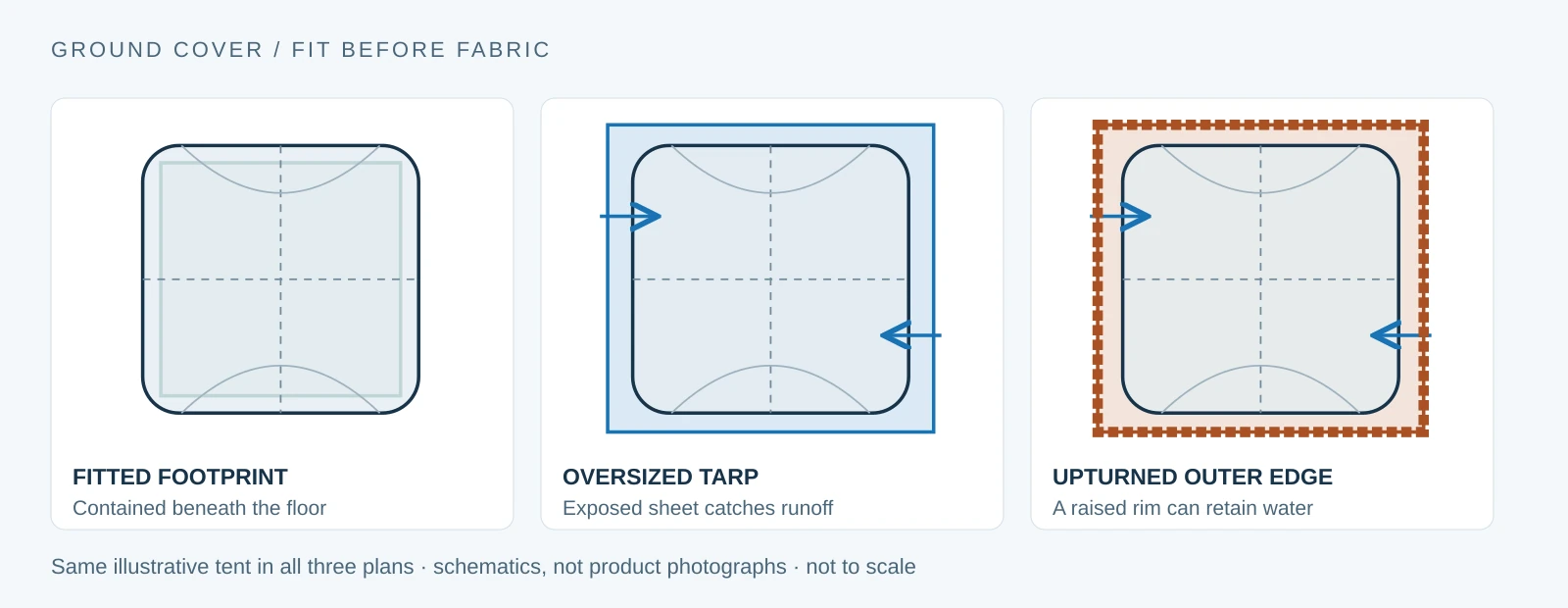
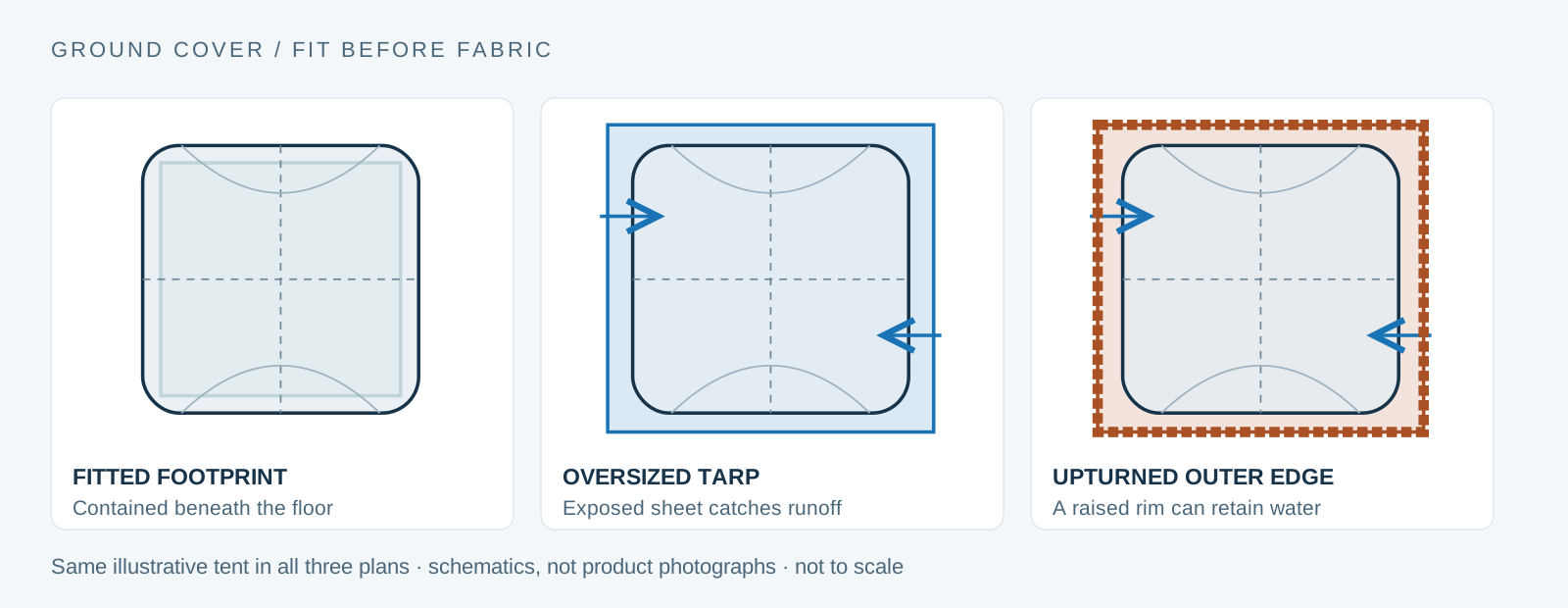
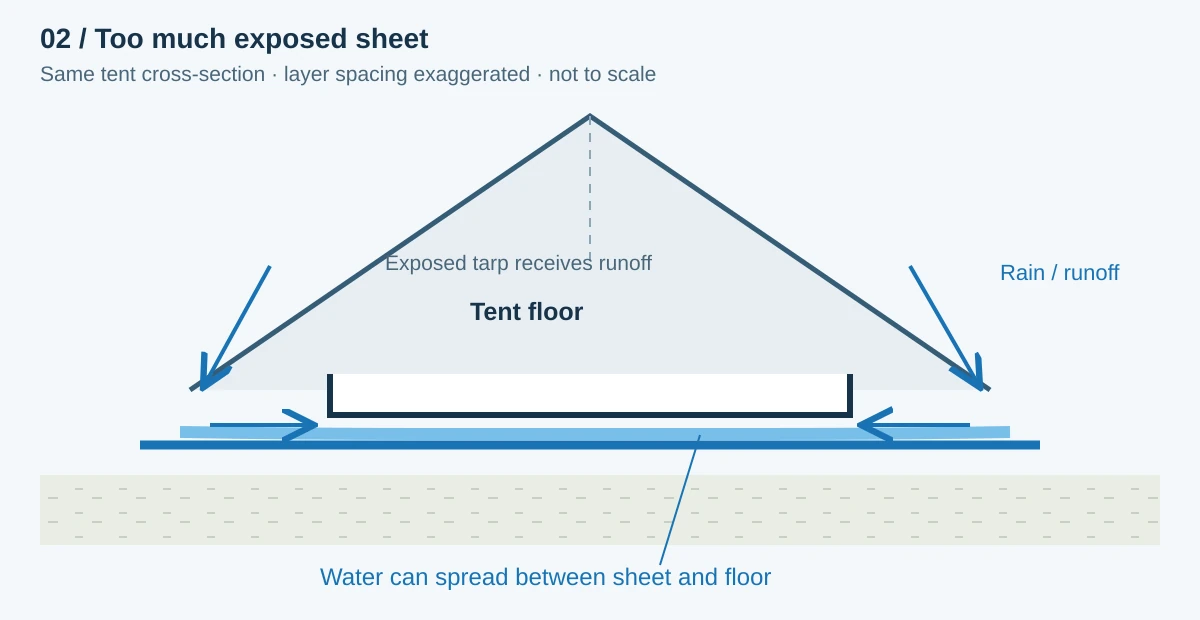
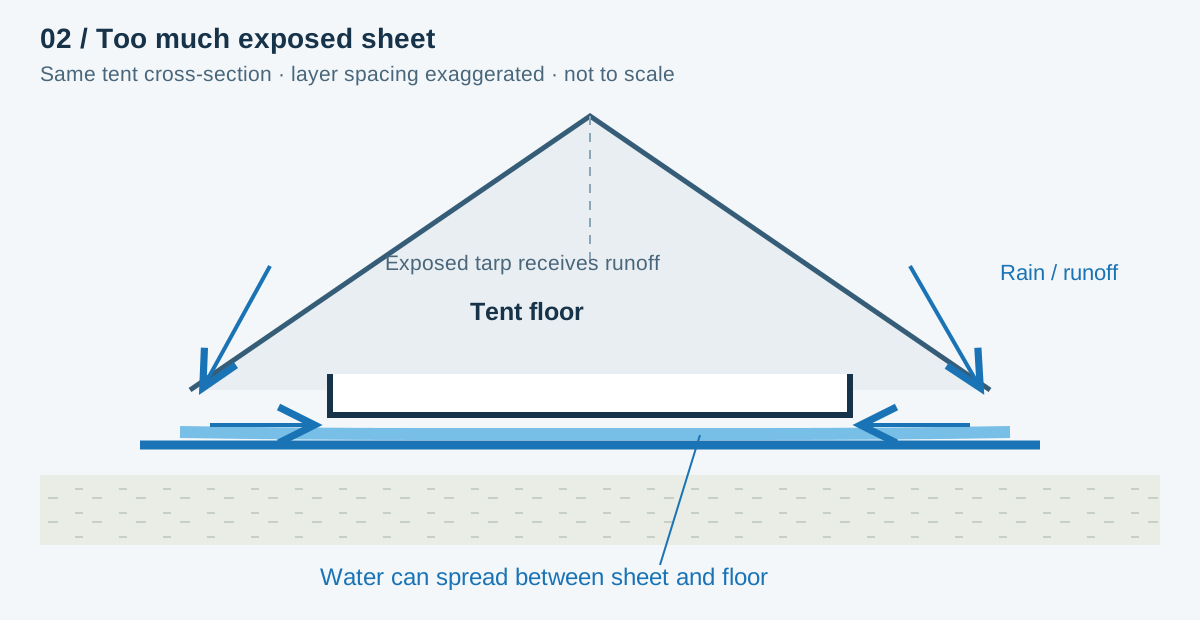
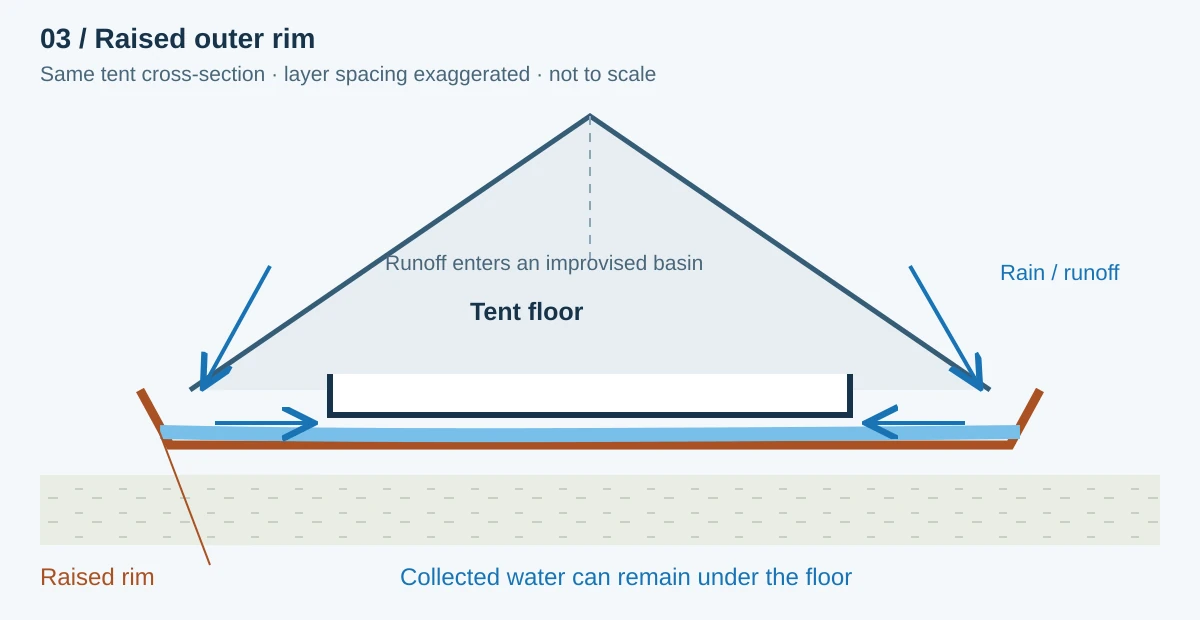
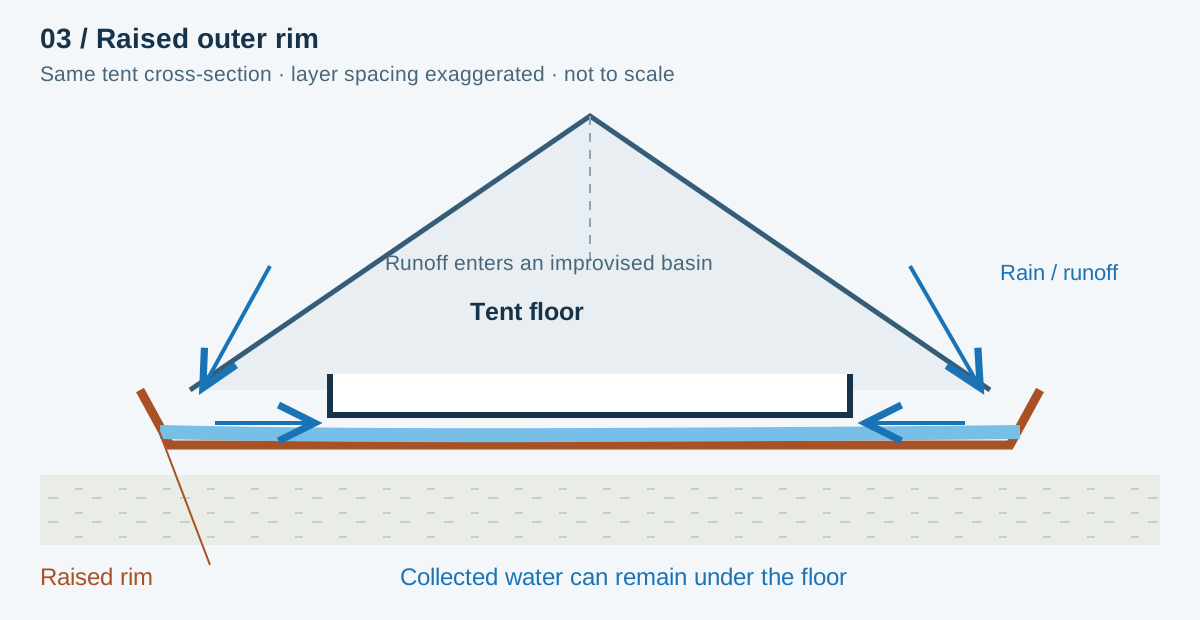
These three cross-sections keep the tent geometry unchanged. Only the separate groundsheet changes. The arrows illustrate possible runoff paths; they are not a water-pressure test or a promise that every campsite drains this way.
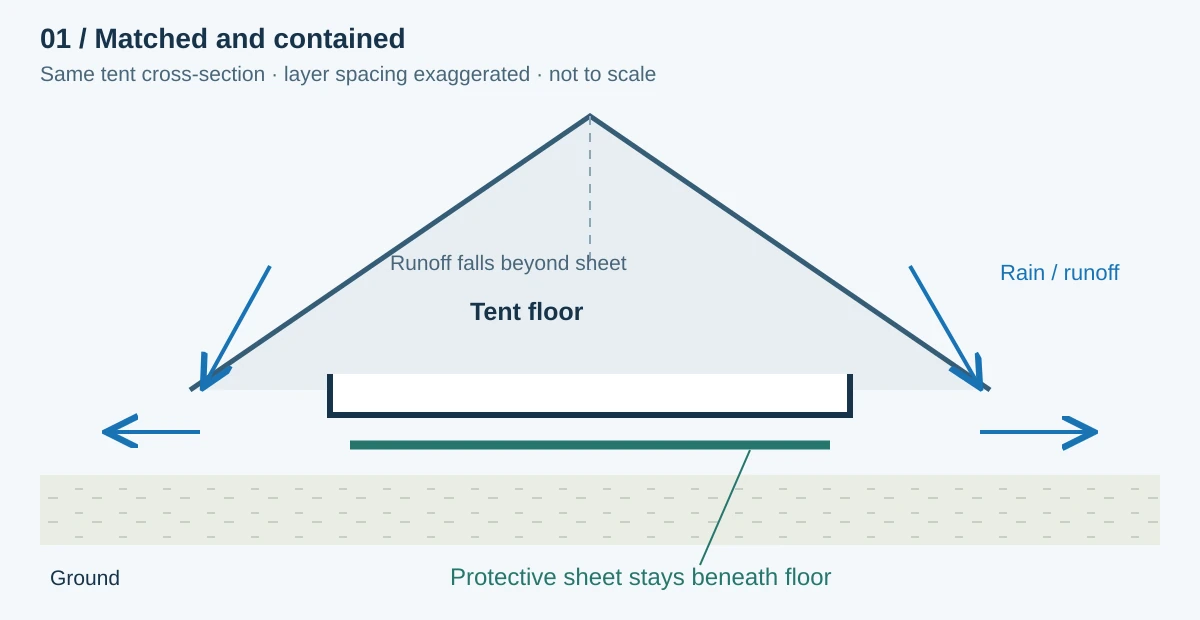
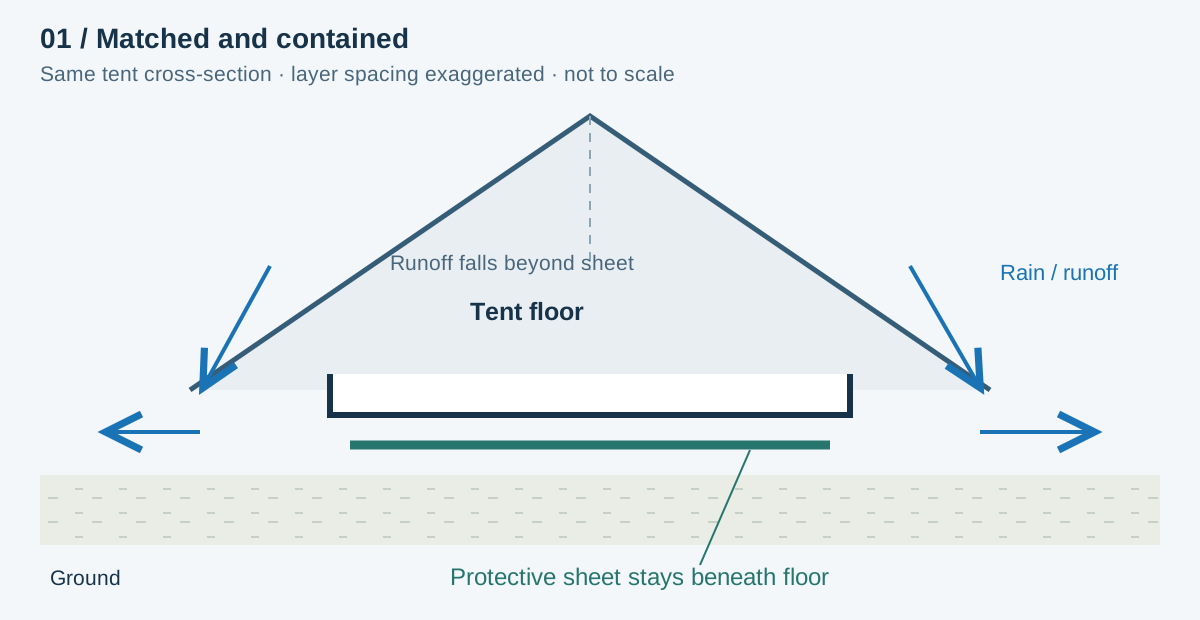
A matched sheet protects the contact area
The protective sheet lies beneath the floor with its outer edge inside the intended perimeter. Rain leaving the fly falls beyond the sheet rather than onto a broad collecting surface. The tent’s built-in floor and the separate protective sheet remain distinct layers.
Containment reduces one avoidable water path. It does not stop groundwater, uphill flow or puddles from reaching the underside. Choose an established pitch with sensible natural drainage and check the floor and fly instructions.
An oversized tarp can become a collector
Here the sheet extends beyond the floor and into the fly’s runoff zone. Rain lands on that exposed area and can spread across the sheet beneath the tent. Water lying between two layers may remain there even when the material itself has no visible tear.
Reposition the tent, contain the sheet, or choose a better-sized ground cover. A larger waterproof area under the tent is not automatically more useful protection.
Turning the outer edge upward can make a basin
A raised perimeter outside the tent can receive runoff and retain it. This is the wrong way to hide a surplus edge. For a conventional flat protective sheet, tuck the surplus underneath so it stays flat and sheltered; check that the fold has not formed a channel.
This warning concerns the separate, improvised sheet shown here. A tent’s designed bathtub floor, or a dedicated raised groundsheet system, has its own construction and installation instructions.
Check for an intentional vestibule design. Some original footprints cover a sheltered vestibule as well as the inner floor. Use that model’s intended coverage and pitch rather than trimming every original accessory to a generic rule. Hilleberg’s footprint descriptions show that coverage varies between tent families.
What tarp under-tent size should you choose?
For a simple floor-only protector, start from the actual pitched floor outline and keep the deployed sheet inside it, following the tent maker’s guidance. There is no universal inset that fits every model, floor tension or attachment system. A “two-person” label is not a dimension.
Measure in the right order
- Pitch the tent as instructed and identify the floor edge, rather than the outer rainfly edge.
- Record length, head-end width and foot-end width. Mark tapered sides, curved corners and doors on a sketch.
- Set the intended protective outline. Check it under the fully pitched tent before cutting or approving a sample.
- Record the finished sheet size separately from raw cut dimensions, hem allowances and any outward-reaching straps.
Use the camping tarp size and material guide for broader setup planning. The finished-size measuring guide explains why nominal stock sizes and usable dimensions can differ.
Example only: A 220 × 140 cm rectangular floor paired with a 210 × 130 cm sheet leaves 5 cm at each edge when centered. That illustrates subtraction; it does not prescribe a 5 cm allowance for your tent.
Rectangular dimension check
Compare a centered, flat rectangle in centimetres. This tool does not validate a tent model, floor taper, rainfly, folds or attachments.
Cost, durability and model compatibility
Count adjustment and replacement effort
A generic tarp can be economical when you already own a suitable one. Add the cost of edge finishing, repeated folding, carrying surplus material and replacing a damaged sheet. A dedicated footprint can justify its price through repeatable fit and fewer setup decisions. Compare actual quotations or current retail items rather than assuming a fixed price gap.
For repeated campsite use, inspect the edges, corner reinforcement, cleanability and repair route. For walking trips, those requirements must also fit the pack budget. The strongest-looking or thickest material may be an awkward choice to carry.
Match the model, year and attachment purpose
Check the tent name, capacity and design revision. A new footprint with an old model name can still have different geometry. NEMO explicitly identifies model-generation limits on its Dagger OSMO footprint.
A sheet suitable for abrasion protection is not automatically suitable for supporting poles in a fly-only pitch. If the footprint supplies structural connection points for that setup, use the tent maker’s specified accessory and method. Big Agnes discusses these distinctions in its footprint compatibility guidance.
For transported camping equipment: Evaluate PVC camping tarp materials against the actual cleaning, packing and handling requirements. Calculate finished mass before choosing a robust coated fabric for a walking trip; the material name alone does not establish a lightweight product.
Tent footprint alternatives and when they make sense
| Your situation | Option worth considering | Check before choosing |
|---|---|---|
| Frequent use of one tent | A compatible model-specific footprint. | Current model revision, finished fit, corner interfaces and replacement supply. |
| Car camping with an existing tarp | A suitable tarp with a contained deployed outline. | Surplus folds, exposed edges, dirty contact surfaces and packed bulk. |
| Low carried-weight target | A purpose-sold lightweight groundsheet fabric or film. | Finished mass, puncture and tear behavior, edge handling and repair method. |
| An unusual or discontinued floor shape | A measured custom protector or carefully adapted sheet. | Floor template, both end widths, usable area, attachment purpose and trial fit. |
| Occasional use on a suitable established site | Assess whether to carry a separate protector. | Tent maker’s advice, floor condition and the abrasion risk you are willing to accept. |
Building wrap, household plastic and generic groundsheet films vary in construction. Check their actual properties rather than treating a familiar trade name as proof of waterproofness or durability. Cutting a woven tarp can expose or weaken its perimeter; suitable finishing depends on the construction. When adapting an item, test the fit before making an irreversible cut.
Before you pitch, cut or order
At the campsite
Use an established pitch with sensible drainage and remove loose sharp debris where permitted. Lay the sheet flat, pitch the tent, then inspect every edge. Recheck after the tent is tensioned or moved. Keep dirty groundsheet surfaces away from the tent fabric when packing, and dry both items before storage.
If water appears, inspect where it entered: exposed sheet edge, uphill flow, a damaged floor, a seam or condensation. Adding a larger sheet without finding the path may leave the original problem unresolved. A thin groundsheet also does not replace a sleeping pad selected for ground insulation.
For a repeatable custom fit
Provide a dimensioned floor outline, model and revision, quantity, use frequency, preferred material or weight target, attachment purpose and packed-size target. Ask for a sample laid flat and then checked on the intended tent. Approval should cover the complete outline, corners, finishing and connection positions.
DERFLEX’s drawing-based custom tarp guide explains how finished dimensions and revision control can be recorded. Exact groundsheet material, cutting and connector feasibility require review for the proposed design.
Tarp vs tent footprint FAQ
Do I need a footprint for my tent?
A footprint is useful when abrasion, dirt or frequent pitching could wear the tent floor. It is not automatically essential for every trip. Check the tent maker’s instructions, campsite conditions and carried-weight budget. An intact tent floor, sensible site selection and removal of sharp debris remain necessary.
Can I use a tarp as a tent footprint?
Yes, a suitable tarp can serve as an under-tent groundsheet if its deployed shape stays within the intended protected area and it lies flat. Tuck surplus underneath rather than turning the outer edge upward. Check material condition, packed weight and any model-specific attachment requirements before use.
Should a tarp be smaller than a tent?
For an ordinary sheet protecting only the inner tent floor, keep the deployed sheet slightly inside that floor perimeter so exposed edges do not collect rain. Follow the tent maker’s dimensions. Purpose-designed footprints may also cover sheltered vestibules; those designs should be used according to their own instructions.
What size tarp should go under a tent?
Measure the fully pitched floor outline, including both end widths on a tapered tent. Choose a deployed groundsheet outline contained within the area specified by the tent maker. Do not use the rainfly dimensions or sleeping capacity as the floor size, and distinguish finished sheet dimensions from cut size.
What are practical tent footprint alternatives?
Options include a trimmed or securely tucked tarp, a suitable lightweight groundsheet fabric, and purpose-sold groundsheet film. Compare puncture behavior, edge durability, water resistance, packed mass and repair method. A household plastic sheet or building wrap should not be assumed equivalent to a tested tent accessory.
Will a footprint stop water or condensation inside the tent?
It can add a protective layer, but it cannot guarantee a dry tent. Runoff collected by exposed edges, standing water, damaged coatings, seams and pressure on wet ground can still cause problems. A sheet under the floor also does not remove humid air inside the tent; ventilation and rainfly setup need separate attention.
Need a ground cover shaped for your tent range?
For a camping brand, rental fleet or campsite program, start with the floor outline and handling target. Send DERFLEX your drawing or marked photo, tent model, quantity and intended use so the material and fabrication scope can be reviewed.
This guide helps you choose an approach. Custom tent groundsheet development needs its own drawing, material and sample confirmation.
Manufacturer references
For model-specific coverage and compatibility, consult your tent maker’s current instructions. The manufacturer references linked above describe their own products and do not certify DERFLEX materials.