
What must the material resist?
Rain, UV exposure, low temperature, abrasion, repeated folding, mildew risk, fire-performance requirements or contact with rough cargo can change the material route.



DERFLEX supports buyers who need more than a stock tarp: select the PVC coated fabric, define the finished geometry, then build the seam, reinforcement, hardware, branding and packing around the real job.
Suitable for distributors, tarp converters, fleet operators, truck body builders, construction suppliers, agricultural programs, industrial equipment companies and private-label buyers. Final specifications should be confirmed against the application, drawing, sample and agreed test requirements.
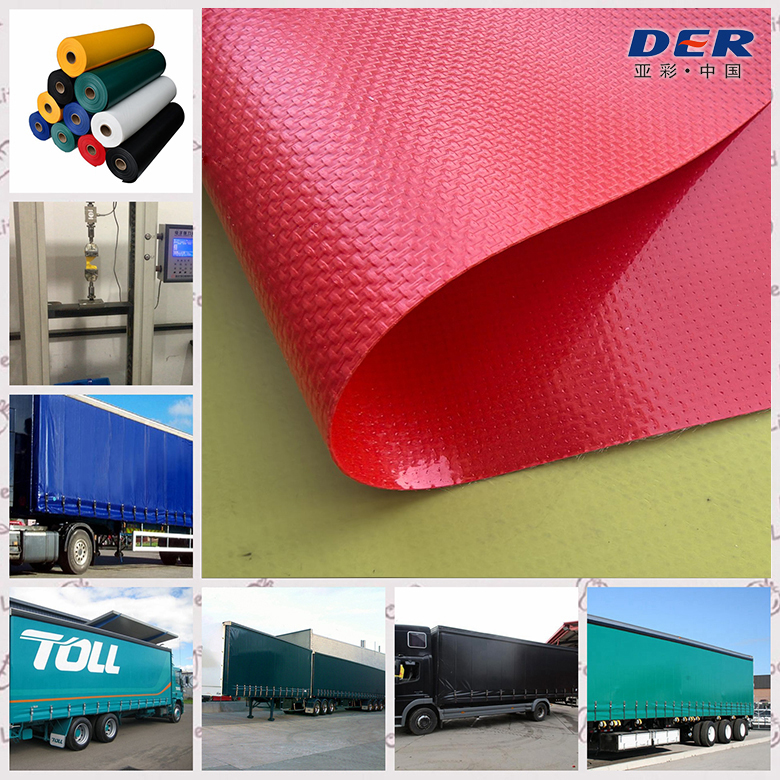
A tarpaulin fabricator takes flexible sheet material and converts it into a usable cover, curtain, panel, enclosure or load-protection component. For industrial PVC tarpaulins, that conversion can involve cutting, heat welding, high-frequency sealing where suitable, industrial sewing, reinforced hems, webbing, corner patches, eyelets, D-rings, ropes, straps, pockets, printing and shipment-specific packing.
The fabrication decision starts before the first cut. A truck cover that experiences wind flutter and tie-down tension needs a different edge strategy from a static machinery cover. A removable warehouse curtain may need frequent handling and cleanability. A construction cover may place more value on abrasion resistance and strong anchor zones. An agricultural cover may need outdoor weathering, flexibility and practical handling across a large footprint.
For B2B sourcing, the fabricator also needs to understand how the product will be supplied. Some customers want roll goods because they complete conversion locally. Others want wide welded panels to reduce in-house labor. A finished-goods program may require every tarp to arrive with the same hem width, grommet spacing, reinforcement pattern, logo placement, labels and export packaging. DERFLEX can discuss these supply routes as part of one specification process.
A useful RFQ describes the working conditions and attachment logic, not only the outside dimensions.
Rain, UV exposure, low temperature, abrasion, repeated folding, mildew risk, fire-performance requirements or contact with rough cargo can change the material route.
Flat sheets, fitted box covers, drops, flaps, sleeves, access panels and irregular shapes require different cut plans and seam placement.
Grommets, rope lines, D-rings, pockets, buckles and frame contact areas concentrate stress. Those zones should be designed before reinforcement is added.
For wholesale, fleet or OEM programs, controlled dimensions, approved colors, finishing details, labels and packing matter as much as the first sample.
Each stage can affect fit, appearance, field handling and repeat-order consistency. The exact process depends on the approved material and finished product design.
Application, finished dimensions, quantity, destination, service conditions and installation method.
PVC-coated polyester structure, weight, yarn, surface, color and performance direction.
Panel orientation, seam allowance, width utilization and repeatable dimensional logic.
Heat welding, HF sealing or sewing selected according to material, geometry and use.
Hems, webbing, patches, stress-zone build-up and edge finishing as required.
Eyelets, D-rings, ropes, straps, pockets and other attachment details by design.
Dimensions, workmanship, appearance, accessory placement, labels and shipment preparation.
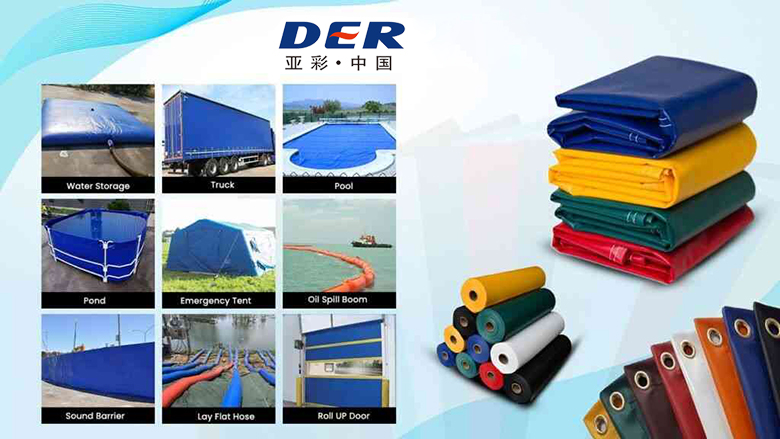
A tarpaulin program does not have to be purchased in only one format. Depending on your plant capability and freight strategy, the supply can be discussed as coated fabric rolls, cut panels, welded semi-finished pieces or completed tarps with attachment hardware and branding.
For many industrial PVC tarp programs, DERFLEX works with coated polyester materials across different weights, fabric constructions and finishing routes. The table below is intended as an RFQ framework.
| Specification Area | Common Direction | Why the Fabricator Needs It |
|---|---|---|
| Base Material | PVC coated or laminated polyester tarpaulin selected by application. | Influences tensile support, tear behavior, weldability, handling and outdoor durability. |
| Weight / Fabric Build | Typical DERFLEX tarp programs may be discussed around 300–1200gsm and 500D–2000D, subject to the approved construction. | Heavier is not automatically better; the fabric build should balance strength, flexibility, conversion method and cost. |
| Finished Size & Shape | Rectangular sheets, fitted covers, drops, flaps, sleeves, openings or drawing-based shapes. | Determines panel layout, seam position, material consumption and production tolerances. |
| Joining Method | Hot-air / heat welding, high-frequency welding where suitable, sewing or mixed construction. | Joint method should match material, water-management need, geometry and load path. |
| Edge Construction | Folded hems, welded hems, webbing reinforcement, rope-in-hem or custom edge details. | Edges often receive more tension and handling than the center panel. |
| Stress Reinforcement | Corner patches, wear strips, local multi-layer reinforcement and anchor-zone build-up. | Helps distribute stress around tie-down points, frame contact and repeated pull zones. |
| Hardware | Eyelets, D-rings, buckles, ropes, straps, pockets or customer-specified attachment components. | Hardware spacing and orientation affect installation, load transfer and user convenience. |
| Surface & Performance | Color, matte/gloss finish, UV-stabilized direction, anti-mildew, anti-cold, anti-static or FR options where required. | Performance additions should be selected for the real exposure and verified against required standards. |
| Branding | Logo printing, marks, labels, private-label presentation and carton information. | Important for distributor programs, fleets and OEM replacement products. |
| Packing | Folded or rolled format, individual packing, cartons, palletization and export marks. | Finished size, handling method and distribution model influence the packing route. |
The right sourcing route depends on what your own factory, warehouse or field team is equipped to do.
Choose this route when you already cut, weld, sew and install hardware locally.
Move selected conversion steps upstream while keeping final assembly or field fitting in your market.
Specify the complete finished product for distribution, fleet use, project delivery or private label.
A general-purpose rectangle is not the only use case. Industrial buyers often need a fabricator to adapt material and construction to a particular operating problem.
Wind movement, repeated handling and tie-down stress make seam placement, edge reinforcement and abrasion control important.
Custom shapes can include access flaps, sleeves, fitted corners and local reinforcement around sharp or protruding components.
Weather exposure, rough surfaces and temporary fastening usually drive material strength, edge finishing and anchor spacing decisions.
Large-format outdoor covers may prioritize UV stability, water management, flexible handling and repeatable attachment around the perimeter.
Load containment and deployment method determine whether solid PVC, mesh or a combined design is more practical.
Frequent opening, cleaning, hanging hardware and dimensional stability matter for flexible dividers and enclosure panels.
Drawing-based fabrication can support project-specific footprints, openings, attachment points and brand or identification marks.
Product consistency, packing, labels and a controlled bill of construction help distributors scale a repeatable assortment.
Price per piece is only one part of the decision. The larger risk is a product that fits the drawing but fails at the seam, anchor zone or repeat-order stage.
A short brief can be enough to start, but a precise quotation becomes easier when the supplier can see how the tarp will be used. A drawing is ideal; photos with measurements or an existing sample can also help clarify the construction.
These six pages help buyers move from the fabrication question into tarp material, heavy-duty construction, industrial supply and transport-specific sourcing.
Answers are intentionally specification-led so buyers can move from a search query to a usable RFQ.
A tarpaulin fabricator converts roll material into finished or semi-finished covers. Work can include measuring or drawing, review, cutting, welding, sewing, hemming, reinforcement, grommets, D-rings, straps, printing and packing. The exact process depends on the material and application.
DERFLEX can discuss custom-size PVC tarp programs for industrial, transport, construction, agriculture, warehousing and OEM applications. Share the finished dimensions, quantity and use conditions so the material and finishing route can be reviewed.
Buy rolls when your own facility handles cutting and fabrication efficiently. Choose semi-finished panels when you want to reduce selected conversion steps. Finished tarps are practical when you need ready-to-sell or ready-to-install products with controlled seams, reinforcement and hardware.
Helpful inputs include application, dimensions or drawing, quantity, preferred material or weight, color, exposure conditions, seam requirements, reinforcement, hardware spacing, logo needs, packing and destination. A photo or existing sample can also help.
Yes, these are common fabrication elements. Their spacing and reinforcement should be designed around the way the tarp will be tensioned and installed. Hardware should not be treated as a cosmetic add-on because it can define the load path through the tarp.
OEM requirements can include custom size, material structure, color, logo, labels, packaging and repeat-order construction control. Final details should be confirmed during sample approval and technical agreement before bulk production.
Send the application, size, quantity and any known material, reinforcement or hardware requirements. DERFLEX can review whether the most practical supply route is roll goods, fabricated panels or finished custom tarpaulins.