


Architectural PVC Membrane Fabric Supplier for Tensile Roofing, Canopies, Façades, and Project-Based OEM Development
DERFLEX supplies architectural PVC membrane fabric for buyers who need more than a basic coated textile. We support tensile structure fabricators, membrane roof contractors, designers, EPC teams, distributors, converters, and private-label buyers looking for a reliable architectural membrane manufacturer that understands project requirements, commercial repeatability, technical selection, and long-term outdoor performance. Whether the brief is a stadium edge canopy, transport hub walkway cover, commercial entrance structure, shade system, exhibition roof, or landmark tensile membrane application, the material decision affects structural behavior, visual result, lead-time control, maintenance expectations, and downstream fabrication efficiency.
When professional buyers search for an architectural PVC membrane fabric supplier, they are rarely looking for an interchangeable commodity. They are usually comparing project fit. They want to know whether the membrane fabric can deliver the right strength range, coating structure, fire-performance pathway, weldability, translucency, surface cleanliness, and supply consistency for the target market. They also want to know whether the supplier can support custom architectural membrane requirements without turning every quotation into a vague, slow, or risky process. DERFLEX approaches this category from a specification-first perspective: define the application, align the structure, control the quality, confirm the details, and then scale the supply in a commercially realistic way.
What serious buyers are actually evaluating when they specify this material
Architectural PVC membrane fabric is a high-strength flexible composite normally built from a polyester base fabric with a PVC coating and, depending on the performance target, an added protective finish such as acrylic lacquer or PVDF surface treatment. In practical architectural use, it becomes the working skin of a tensile structure. Instead of behaving like a traditional rigid roof panel, wall board, or heavy cladding product, it carries loads through tension and works together with steel, cable, edge detailing, and structural engineering logic. That is why this category is discussed not only as a fabric, but as an architectural membrane material, tensile membrane fabric, or structural membrane solution.
For specifiers, the importance of the material is not only that it is lightweight or waterproof. The real value lies in how efficiently it turns structural concepts into buildable surfaces. A properly selected architectural PVC membrane can support large-span coverage with less dead load than many conventional roofing systems, while still providing weather protection, clean geometry, flexible shape control, and strong visual identity. This is one reason PVC coated polyester remains widely used in tensile architecture: it is commercially practical, fabrication-friendly, available in multiple performance levels, and suitable for a broad range of projects that need a balance between aesthetics and cost discipline.
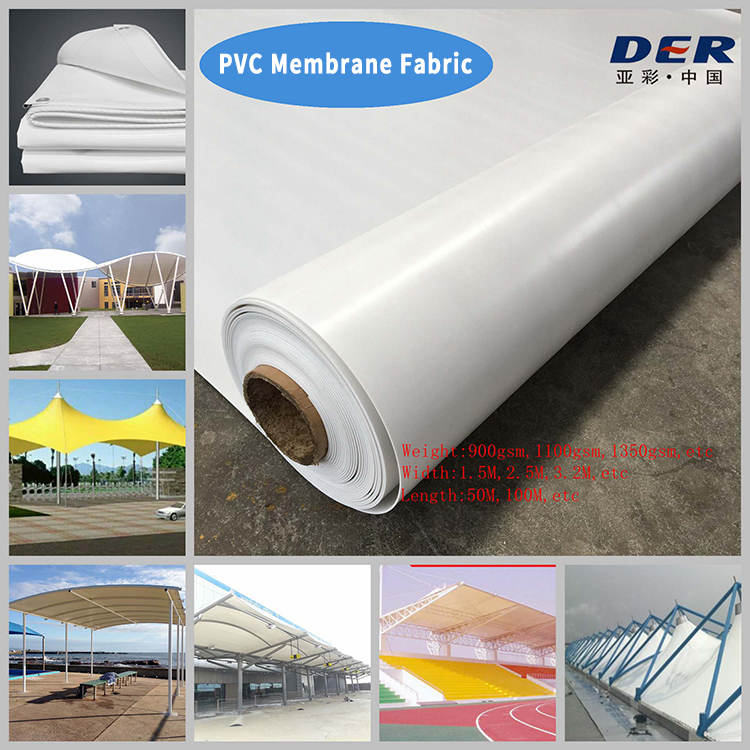
From a buyer’s perspective, the phrase architectural PVC membrane fabric supplier usually implies several possible supply models. One buyer may need membrane roll goods for local conversion and welding. Another may need a direct factory partner capable of supporting a private-label architectural membrane line. A third buyer may be sourcing for a single project and need help comparing PVC, PVDF, PTFE, and ETFE directions before deciding whether PVC coated fabric is the right fit. These use cases are related, but they are not identical. A supplier that understands this difference can usually give faster, more relevant technical guidance and produce quotations that are easier to approve internally.
The term also covers several adjacent search behaviors. Some visitors search for a tensile membrane manufacturer, some for a PVC coated polyester membrane supplier, some for an architectural fabric manufacturer, and others for a membrane roof fabric supplier. In all cases, the purchasing logic is similar: can the material meet the intended lifespan, fire pathway, visual requirement, fabrication process, and budget envelope without creating unnecessary risk for the project team?
Why buyers search for a supplier, not just a product name
Architectural membrane sourcing is usually a high-consequence decision. The material sits in public view, interacts with structure, and has to perform outdoors for years. That means supplier choice affects more than material price. It affects sample accuracy, production stability, inspection confidence, lead-time credibility, and post-order coordination.
Need a practical recommendation instead of a generic sample card?
Send your project type, target width, expected lifespan, fire requirement, surface preference, color, and planned fabrication method. DERFLEX can recommend a more suitable architectural PVC membrane construction for tensile structures, canopies, façades, or membrane roof projects.
What makes a competitive architectural PVC membrane fabric worth specifying
A strong architectural membrane program should help buyers think beyond catalog language. The most useful way to compare membrane fabrics is to ask what each feature does in real projects: does it improve weldability, preserve appearance, extend service life, simplify fabrication, support fire compliance, or reduce maintenance risk? The right answer depends on the structure type and commercial target, but the following performance areas are central to most evaluations.
High strength with practical flexibility
Architectural PVC membrane fabric must resist sustained tension while remaining workable during cutting, folding, transport, and welding. A membrane that looks strong on paper but becomes awkward in fabrication can slow production and create downstream fitting issues. Buyers therefore compare both load-bearing capacity and handling behavior. In many real-world projects, the preferred material is not the one with the most extreme headline number, but the one with the best balance between strength, flexibility, and fabrication efficiency.
Waterproof and weather-stable outdoor performance
Rain, UV exposure, wind, dirt accumulation, and temperature variation all affect how a membrane roof or canopy performs over time. A professional architectural membrane manufacturer needs to think beyond initial installation. The material has to stay stable under outdoor use, not only in a showroom presentation. Good waterproof behavior, reliable coating adhesion, and surface durability are central to long-term project value.
Surface finish options for cleaner visual results
In membrane architecture, appearance is not a decorative afterthought. Surface finish affects how the project ages in public view. Buyers often compare standard lacquered PVC, PVDF topcoat options, and other finish pathways based on self-cleaning behavior, dirt resistance, gloss level, and maintenance expectation. A cleaner surface can help preserve the design intent and reduce complaints after handover.
Fire-performance pathway for project approval
Architectural projects are often governed by tender documents, consultant requirements, or jurisdiction-specific standards. That means a supplier must be able to discuss likely fire classifications and testing direction early in the process. Buyers do not want to discover late in the quotation stage that the chosen material pathway does not fit the project’s approval logic.
Weldability and fabrication compatibility
A tensile membrane supplier is also indirectly supporting the converter or fabricator. If the membrane is difficult to weld, inconsistent in coating, or unstable at the edges, even a strong material may create labor inefficiency or rework. Fabrication compatibility is therefore a commercial issue, not only a workshop issue. Better process fit can shorten production cycles and improve installed quality.
OEM and custom development for repeat business
Many buyers are not purchasing for one-off use. They are building a product line, supporting distributor inventory, or aligning future projects under a repeatable membrane program. This is where OEM capability matters. Custom color, weight, width, translucency, packaging, labeling, and technical alignment can turn a raw material order into a more stable long-term supply relationship.
Comparing multiple membrane directions for a current project?
DERFLEX can help buyers compare PVC coated polyester, PVDF surface options, and adjacent architectural membrane structures according to application, budget, and target service-life expectations.
Typical specification framework for architectural PVC membrane fabric supply
Every project should be confirmed against its own structural design, local code pathway, and fabrication method. Still, buyers benefit from a practical baseline. The table below is not a rigid promise for every construction; it is a sourcing framework that helps architects, membrane fabricators, distributors, and procurement teams discuss specification in concrete terms instead of vague marketing language.
| Property | Typical Direction | Why It Matters |
|---|---|---|
| Base Structure | High-tenacity polyester with PVC coating | Provides the core strength, flexibility, and fabrication compatibility used in many tensile membrane projects. |
| Typical Weight Range | 650–1350 g/m² | Helps align the membrane with structural demand, handling expectation, and target durability level. |
| Tensile Strength | Approx. 3000–8000 N / 5cm | Supports structural performance, load distribution, and engineering confidence in tensioned applications. |
| Surface Options | PVC lacquered or PVC with PVDF-oriented finish | Affects dirt resistance, maintenance behavior, and long-term visual cleanliness. |
| Fire Direction | B1, M2, NFPA 701, DIN 4102 pathways often requested | Important for consultant approval, local compliance, and project bidding requirements. |
| Operating Temperature | Approx. -30°C to +70°C depending on structure | Useful for projects exposed to seasonal variation and demanding outdoor environments. |
| Color / Appearance | White, off-white, custom shades, translucency options | Shapes architectural identity, daylight behavior, and brand or design alignment. |
| Roll / Fabrication Supply | Roll goods for welding, cutting, and local conversion | Supports membrane workshops, project fabricators, and OEM conversion partners. |
| Service Life Direction | Typically project- and finish-dependent | Helps buyers decide whether standard PVC, upgraded surface treatment, or an alternative material direction is more suitable. |
How to read these numbers intelligently
Specification values should not be compared in isolation. Higher weight does not automatically mean better project value, and a higher-strength membrane may still be the wrong choice if the structure needs easier handling, different translucency, or a cleaner surface finish. The right specification is the one that matches engineering logic, expected service environment, fabrication capability, visual target, and commercial plan. This is why experienced buyers send more than a single keyword inquiry. They send a project brief.
What to include in an inquiry
Useful inquiry details include application type, structure size, target weight, fire standard, color preference, surface finish direction, width requirement, climate exposure, installation region, order quantity, and whether the material will be sold as roll goods or fabricated into finished membrane components. Better input usually produces better pricing speed and better technical relevance.
Where architectural PVC membrane fabric creates real value
Architectural membrane projects succeed when the material is selected according to use condition rather than generic category labels. The same membrane family may appear in multiple environments, but each application emphasizes a different balance of performance priorities such as span efficiency, light behavior, weather exposure, public appearance, installation speed, or maintenance expectations.
Stadium and sports venue canopies
Sports-related structures often need large-span coverage, strong visual identity, and dependable outdoor durability. Buyers in this segment usually compare tensile strength, seam confidence, fire direction, and long-term appearance because these structures remain highly visible and are often exposed to heavy use and public scrutiny.
Airport, station, and transport hub roofs
Transport projects often value lightweight structural efficiency, weather protection, and smoother passenger circulation. Architectural PVC membrane fabric can support entrance canopies, walkway covers, and larger roof elements where reduced dead load and modern form language are important.
Commercial entrance structures and retail canopies
Retail, hospitality, and mixed-use developments often want a material that looks modern without pushing the budget toward ultra-premium membrane categories. PVC membrane remains a strong option where buyers need a commercially sensible balance between image, waterproofing, and fabrication practicality.
Exhibition halls and event structures
Temporary and semi-permanent event architecture values speed, adaptability, and visually strong surfaces. Membrane fabric provides a flexible route for eye-catching structures while still offering a more engineered look than purely decorative covering materials.
Public plazas, walkways, and landscape shading
Urban landscape projects often need shading and weather protection without overwhelming the site with bulky permanent construction. Architectural membrane systems help achieve lighter visual impact while supporting functional shelter in civic spaces.
Façade accents and iconic architectural forms
Some projects use membrane not only as shelter but as a defining design element. In these cases, material cleanliness, color consistency, tension behavior, and curve control become especially important because the membrane contributes directly to the project’s architectural identity.
Not sure whether your project should use standard PVC, upgraded surface finish, or another membrane family?
Share your application and target market. DERFLEX can help narrow the material direction before you spend time on unsuitable samples or incomplete quotations.
Why buyers choose DERFLEX as an architectural membrane manufacturer and supplier
When buyers evaluate membrane suppliers, they are trying to reduce uncertainty. A membrane order usually sits inside a larger chain of decisions that may involve engineering review, consultant communication, sample approval, fabrication sequencing, import planning, or brand positioning. A supplier that only sends a price sheet without helping clarify the specification rarely creates long-term value. DERFLEX is positioned for buyers who want a more structured discussion.
First, manufacturing orientation matters. Buyers searching for an architectural membrane manufacturer often do so because they want better control over coating direction, fabric selection, finish options, inspection consistency, and production planning than a stock-only trading model can provide. Factory-based supply usually supports better repeatability when colors, weights, widths, and technical details must stay aligned across ongoing orders.
Second, project communication matters. Architectural membrane materials are not sold in a vacuum. A buyer may need to compare several project scenarios: standard commercial canopy, upgraded public infrastructure, budget-sensitive landmark feature, or OEM distribution line for local fabricators. The most helpful supplier is one that can translate use condition into a practical membrane recommendation rather than simply pushing the most expensive option.
Third, quality control matters. In this category, buyers worry about more than visible defects. They care about strength consistency, coating uniformity, weldability, fire pathway alignment, and long-term outdoor behavior. DERFLEX focuses on the logic that serious buyers actually ask about: can the material be specified clearly, sampled consistently, inspected intelligently, and reordered with confidence?
Fourth, customization capability matters. Some customers need a membrane roof fabric supplier for project orders. Others need an OEM partner for a broader architectural fabric business. Custom color, fabric weight, finish, packaging, and branding support help move the relationship from one order to repeatable commercial cooperation.
What buyers usually want confirmed
- A clear technical conversation instead of a vague “all-purpose” membrane offer.
- Roll goods suitable for real fabrication, welding, and project conversion workflows.
- More confidence in lead time, sample-to-order consistency, and export supply discipline.
- Support for custom architectural fabric programs, not just standard stock colors.
- Better visibility on fire direction, finish options, and likely service-life pathway.
- A supplier relationship that can scale from trial order to regular project support.
Quality, lead time, and certification are linked
Buyers sometimes treat these as separate issues, but in real projects they interact. A membrane with unclear specification is harder to test. A membrane with unstable quality is harder to reorder. A membrane program with late technical confirmation often creates delivery pressure. DERFLEX helps organize these factors earlier so the supply path becomes easier to manage.
Ready to discuss a project or OEM program?
Whether you need roll goods for a membrane workshop, custom architectural fabric for distribution, or a specification recommendation for a current project, DERFLEX is ready to review the requirement.
How architectural PVC membrane compares with other common membrane directions
Buyers often ask whether they should stay with PVC coated polyester or move toward PVDF-upgraded surfaces, PTFE fiberglass systems, or ETFE film solutions. There is no universal winner. Each material family solves a different type of project problem. The most practical procurement approach is to identify which decision factor matters most: budget, expected lifespan, image level, structural concept, maintenance requirement, or fabrication pathway.
| Material Direction | Typical Strengths | Typical Trade-Offs | Best Fit |
|---|---|---|---|
| PVC Coated Polyester | Cost-effective, weldable, flexible, waterproof, commercially scalable, broad application fit | Not always the premium longest-life option in landmark architecture | Commercial canopies, transport structures, event architecture, public shading, broad tensile project supply |
| PVC with PVDF-Oriented Surface | Cleaner surface behavior, improved dirt resistance, stronger long-term appearance | Higher cost than standard PVC structures | Projects where visual maintenance and surface cleanliness matter more |
| PTFE Fiberglass | Premium lifespan, high fire resistance, strong landmark-project positioning | Higher cost, different fabrication and project economics | Major civic, stadium, airport, and flagship architecture with long-life priorities |
| ETFE Film | Very light, highly transparent, distinctive for cushion systems and daylight-intensive designs | Different structural logic, not a direct substitute for every tensile fabric use case | Atriums, stadium enclosures, transparent roofing concepts, advanced façade systems |
For many buyers, architectural PVC membrane remains the best first option because it sits in the most commercially useful middle ground. It is more engineered and project-capable than lightweight generic fabric systems, but more accessible and easier to scale than ultra-premium membrane families. That is why it continues to dominate many tensile membrane categories worldwide.
A representative project-sourcing scenario for architectural PVC membrane fabric
Regional transit plaza canopy program with custom finish requirements
A typical buyer scenario looks like this: a contractor or membrane fabricator is bidding for a regional transport or civic plaza project that includes multiple entrance canopies and covered walkway sections. The design intent calls for a clean bright surface, reliable waterproofing, a modern light-structure appearance, and a fabric system that can be fabricated efficiently under a fixed project schedule. The buyer does not want to over-specify into a premium membrane family if the project economics do not support it, but also does not want a low-grade fabric that will look tired too quickly in public view.
In this situation, the inquiry usually focuses on a PVC coated polyester membrane with a stronger surface-finish direction, clearly defined fire-performance pathway, and specification support for fabrication. The buyer wants sample clarity, not just a brochure. They need to know whether the membrane can be welded efficiently, whether the surface behavior suits a public-facing project, what color range can be discussed, and how quickly production can be aligned once the consultant signs off. They may also need packaging logic suitable for project sequencing rather than generic warehouse dispatch.
The value of the supplier in this case is not only production. It is decision support. A capable architectural membrane supplier helps the customer identify the right weight band, finish logic, and compliance direction early enough to reduce approval friction. That improves the buyer’s internal workflow, reduces the risk of sample mismatch, and makes delivery planning easier. This is the kind of project environment where DERFLEX is intended to add value: not just by offering membrane fabric, but by helping the buyer turn a design requirement into a workable, orderable material solution.
Have a similar canopy, façade, or membrane roof project in discussion?
Send the drawings, expected usage conditions, or even a rough summary of the project. DERFLEX can help convert an early concept into a more precise architectural membrane specification path.
Useful DERFLEX pages closely related to this topic
To support deeper comparison and stronger internal site relevance, the following pages are directly connected to architectural PVC membrane fabric, tensile architecture, and adjacent membrane material sourcing topics.
Architectural PVC Membrane
A direct supporting page for buyers comparing core architectural PVC membrane positioning, major application directions, and tensile structure suitability.
Tensile Membrane Fabric
Useful for buyers who want a simpler tensile membrane overview focused on project use, material direction, and basic product understanding.
Membranes for Tensile Architecture
Helpful when comparing the broader membrane family used in tensile architecture and understanding why PVC coated polyester remains widely specified.
Tensile Architecture Fabric
A strong adjacent page for buyers evaluating tensile architecture fabric supplier and manufacturer positioning with technical and application context.
Architectural Membrane Materials
Useful for buyers comparing architectural membrane material options, customization logic, global standards, and project-oriented selection criteria.
Membrane Roofs
Relevant for users moving from membrane material sourcing into end-use roof applications such as stadiums, airports, commercial complexes, and public structures.
Frequently asked questions about architectural PVC membrane fabric supply
1. What is architectural PVC membrane fabric used for?
It is commonly used for tensile roofs, canopies, entrance structures, covered walkways, façades, stadium shading, transport infrastructure, exhibition structures, and other lightweight architectural applications where weather protection and visual impact are both important.
2. Why is PVC coated polyester still widely used in tensile architecture?
Because it offers a strong combination of cost-effectiveness, waterproof performance, flexibility, weldability, and wide commercial availability. For many projects, it remains the most practical balance between performance and budget.
3. Can DERFLEX provide OEM or custom architectural membrane supply?
Yes. DERFLEX can discuss custom weight, width, color, finish, packaging, labeling, and project-oriented supply requirements. This is useful for both single-project sourcing and repeat-order OEM programs.
4. What information should buyers provide when requesting a quote?
The most useful details include project type, target specification, width, fire standard, color preference, finish expectation, estimated quantity, destination market, and whether the membrane will be supplied in roll form or for a defined fabrication process.
5. How does lead time usually work for architectural membrane fabric?
Lead time depends on whether the structure is standard or custom, the color and finish requirements, order quantity, testing needs, and production scheduling. Earlier confirmation of key technical details usually leads to smoother delivery.
6. Can the material support international fire or performance expectations?
For many projects, the membrane can be aligned with commonly requested fire-performance pathways such as B1, M2, NFPA 701, and DIN 4102, subject to the exact specification and project verification process.
Need architectural PVC membrane fabric for a current bid, project package, or OEM program?
DERFLEX is ready to discuss your application, specification target, expected order volume, and timing. Share the details and we can help move your inquiry from a broad search term to a more precise supply solution.