


 Biogas Membrane Material Guide
What Membrane Material Is Used for Biodigester Covers?
Most professional biodigester covers use reinforced, gas-tight technical membranes rather than ordinary waterproof sheets. For biogas digesters, the most widely specified solution is high-tenacity polyester fabric coated with PVC, often upgraded with PVDF or advanced lacquered surfaces for exposed outdoor cover layers.
DERFLEX supplies PVC/PVDF coated polyester membrane fabric for biodigester covers, anaerobic digester covers, biogas storage domes, lagoon covers and double membrane gas holder systems where gas retention, weather resistance, weldability and long-term stability are critical.
- Material: PVC/PVDF coated polyester membrane
- Use: biodigester covers and biogas storage
- Function: methane containment and odor control
- Supply: custom GSM, width, color and OEM rolls
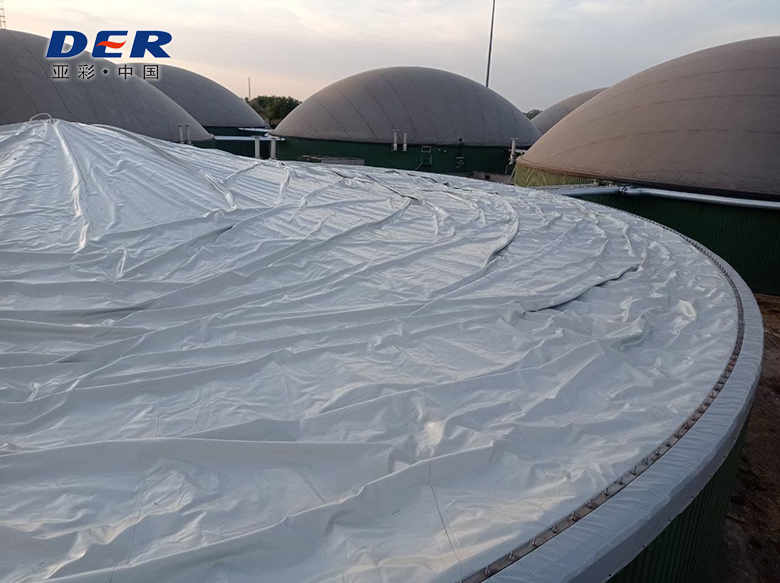
Short Answer: Use a Gas-Tight Reinforced Coated Fabric
For engineered biodigester covers, the recommended material is not a simple plastic film. It is a reinforced coated membrane system: high-strength polyester textile provides tensile stability, while PVC or PVC/PVDF coating provides gas tightness, chemical resistance, weather protection and weldable seams.
Why the Material Choice Matters
A biodigester cover works in a difficult environment. It must help keep methane-rich biogas inside, reduce odor emission, protect the anaerobic process from oxygen intrusion, resist moisture and H₂S, and survive UV, rain, wind, temperature cycling and installation tension.
That is why DERFLEX focuses on the whole material structure: base fabric strength, coating adhesion, gas permeability direction, PVDF weather surface options, seam weldability, dimensional stability and custom engineering for the tank or lagoon design.
Typical Biodigester Cover Membrane Structure
The best membrane material depends on the cover position, pressure, gas composition, climate load and welding method. A professional biogas membrane normally includes these layers.
PVDF / UV Surface
For exposed outer covers, a PVDF or upgraded weather surface improves UV resistance, clean appearance retention and outdoor aging performance.
Gas-Tight PVC Coating
Special PVC coating formulations help reduce gas permeability and resist methane, CO₂, moisture, ammonia and H₂S-containing biogas environments.
High-Tenacity Polyester
Reinforced woven polyester provides tensile strength, tear resistance and dimensional stability under pressure, wind load and membrane tension.
Weldable Back Coating
A stable inner coating layer supports high-frequency welding, hot-air welding and prefabricated panel production for gas-tight seam construction.
DERFLEX Biodigester Cover Membrane Specification Range
The following specification framework helps EPC contractors, fabricators and biogas system builders define a practical membrane grade before detailed engineering confirmation.
| Parameter | Recommended DERFLEX Direction | Why It Matters for Biodigester Covers |
|---|---|---|
| Material System | PVC coated polyester membrane; PVC/PVDF surface option for exposed cover layers | Balances gas tightness, strength, welding performance and long-term outdoor durability. |
| Common Weight | 900–1500 g/m² customizable according to pressure, diameter and climate load | Higher weight and reinforcement may be needed for larger tanks, stronger wind or higher tension zones. |
| Base Fabric | High-tenacity polyester woven reinforcement | Provides dimensional stability, tensile strength and tear resistance. |
| Gas Barrier | Low-permeability PVC coating formulation for biogas conditions | Helps retain methane, reduce odor loss and support safe biogas collection. |
| Chemical Resistance | Formulation direction for moisture, organic acids, H₂S and ammonia exposure | Digesters contain corrosive gases and condensate that can shorten service life if material is not matched. |
| Surface Treatment | UV-resistant, anti-aging, optional PVDF, optional anti-mildew and anti-wicking directions | Improves resistance to sunlight, rain, biofilm, humidity and temperature cycling. |
| Welding Method | HF/RF welding, hot-air welding and hot-wedge welding compatibility can be matched | Strong seams are essential for gas tightness, installation efficiency and long-term cover reliability. |
| Supply Form | Roll goods, custom roll width, OEM packaging or prefabricated panel support | Supports membrane fabricators, gas holder manufacturers and EPC project workflows. |
PVC, PVDF, TPU, LDPE, PP and EPDM: Which Material Is Used?
Different cover designs can use different membranes. For most reinforced biodigester cover systems, PVC coated polyester is the standard foundation, while PVDF is commonly selected for stronger outdoor surface performance.
| Material | Typical Use in Biogas Covers | Strengths | Selection Notes |
|---|---|---|---|
| PVC Coated Polyester | Mainstream material for single membrane covers, double membrane covers and gas holder fabric | Reinforced, weldable, gas-tight direction, customizable, strong commercial value | Requires correct formulation for H₂S, UV, FR and aging requirements. |
| PVC/PVDF Membrane | Outer weather membrane or premium exposed cover surface | Better UV resistance, dirt resistance, surface durability and long-term appearance | Higher cost than standard PVC; best used where climate exposure is demanding. |
| TPU Coated Fabric | Selected for special flexibility or project-specific chemical/abrasion requirements | Good flexibility and performance potential for specialized applications | Not always the most economical choice for large biodigester cover programs. |
| LDPE / PP Geomembrane | Liners, inner membranes or lagoon-related applications in some designs | Good chemical resistance and cost-effective lining use | Usually not reinforced like PVC/PES fabric, so dimensional stability and load transfer must be engineered carefully. |
| EPDM | Liners or certain flexible cover applications | Good weather and rubber-like flexibility | Welding and fabrication logic differs from thermoplastic PVC systems; not always ideal for HF welded gas holder production. |
What a Good Biodigester Cover Membrane Must Do
A professional cover membrane is selected by performance, not only by thickness or price. These are the factors DERFLEX prioritizes for biogas projects.
Gas Tightness
Low gas permeability helps reduce methane loss, odor escape and energy recovery inefficiency.
H₂S Resistance
Coating formulation must resist corrosive biogas components, condensate and humid digestion environments.
UV & Weather Resistance
Outer membranes must withstand sun, rain, wind, snow load and temperature fluctuations.
Weldable Seam Strength
HF, hot-air or wedge welding compatibility supports strong, repeatable and sealed panel fabrication.
Mechanical Strength
Polyester reinforcement improves tensile strength, tear resistance and dimensional stability under tension.
Custom Engineering
GSM, coating, surface finish, color, roll width, FR grade and packaging can be adjusted for project needs.
Where DERFLEX Membrane Material Is Used
DERFLEX supplies material support for multiple biodigester and biogas storage configurations.
Single Membrane Biodigester Cover
A cost-effective cover for tanks, lagoons and manure digestion systems where gas collection and odor control are needed.
- Reinforced PVC membrane
- Central column or tensioned cover design
- Custom geometry and roll width
Double Membrane Gas Holder
Uses an inner gas membrane and an outer weather membrane to support gas storage, pressure stability and shape control.
- Inner gas-tight membrane
- Outer PVDF weather membrane
- Bottom or sealing membrane options
Lagoon & Wastewater Covers
For agricultural, municipal and industrial facilities needing odor reduction, rainwater control and biogas recovery.
- Floating or tensioned cover concepts
- Custom penetrations and access zones
- Roll material or prefabrication support
How to Choose the Right Membrane Material
To select the correct biodigester cover membrane, define the operating conditions before choosing a fabric weight. DERFLEX recommends confirming the following information:
- Cover type: single membrane, double membrane, floating cover, gas holder or lagoon cover
- Gas composition: methane, CO₂, H₂S, ammonia, moisture and condensate exposure
- Tank or lagoon size: diameter, shape, anchoring method and penetration details
- Pressure behavior: operating pressure, pressure fluctuation and relief valve setting
- Climate load: UV intensity, wind load, snow load, rainfall and temperature range
- Fabrication method: HF/RF welding, hot-air welding, wedge welding or prefabricated panels
Why DERFLEX Is Suitable for Biodigester Cover Projects
DERFLEX is a manufacturing-oriented supplier of PVC coated fabrics and engineered flexible materials. For biodigester cover buyers, the advantage is not only a fabric roll, but also material matching, OEM customization and stable export supply.
- Gas-tight PVC/PVDF coated polyester membrane direction
- Custom GSM, thickness, color, width and coating structure
- Welding compatibility support for fabricators and EPC contractors
- Batch quality checks for weight, thickness, tensile, tear, adhesion and surface quality
- Factory-direct supply for repeat biogas cover and gas holder projects
- Export-ready packaging, documentation and communication support
From Material Selection to Project Supply
DERFLEX helps engineers, installers and membrane fabricators define a practical material specification for gas-tight biodigester cover production.
Confirm Project Data
Share tank size, cover type, gas pressure, climate load, membrane position and expected service conditions.
Select Material Grade
DERFLEX recommends PVC, PVC/PVDF or other coating directions based on gas contact and outdoor exposure.
Test Welding & Samples
Material samples can be evaluated for weldability, seam strength, surface behavior and fabrication workflow.
Supply for Production
DERFLEX provides roll goods or project supply support with stable packaging, batch consistency and documentation.
Case Scenario: Replacing an Aging Biodigester Cover
A wastewater or agricultural biogas operator may see odor leakage, lower methane recovery, cracking surface, weak seams or rising maintenance cost. In this situation, DERFLEX can help the EPC team compare the old membrane weight, coating condition, gas pressure and tank geometry, then recommend a reinforced PVC/PVDF membrane structure for better gas containment, weather resistance and weldable fabrication.
- Improve gas retention and odor control
- Match membrane grade to local climate
- Support prefabricated panels or roll supply
- Reduce long-term replacement risk
Related DERFLEX Biogas Membrane Pages
Use these related pages to support material selection, comparison and project specification.
Biodigester Cover Membrane FAQ
Answers to common technical and purchasing questions about membrane materials for biodigester covers.
What membrane material is most commonly used for biodigester covers?
The most common engineered material is reinforced PVC coated polyester fabric. For exposed outer covers, a PVC/PVDF membrane or upgraded lacquered surface may be selected for stronger UV and weather resistance.
Is ordinary waterproof tarpaulin suitable for a biodigester cover?
No. A biodigester cover should be gas-tight, chemically resistant, weldable and dimensionally stable. Ordinary waterproof tarpaulin may not provide sufficient methane retention, H₂S resistance, seam reliability or long-term outdoor performance.
What is the difference between inner and outer membrane materials?
The inner membrane focuses on gas tightness, chemical resistance and flexibility. The outer membrane focuses on weather protection, UV resistance, wind/snow load behavior and long-term outdoor durability. Double membrane systems often require different material directions for each layer.
Can DERFLEX customize membrane weight and color?
Yes. DERFLEX can customize GSM, thickness, coating structure, color, roll width, surface treatment, flame-retardant direction and packaging according to project drawings, tank size, pressure and installation method.
Which welding methods are used for biodigester cover membrane?
Common fabrication methods include high-frequency welding, hot-air welding and hot-wedge welding. The correct method depends on the membrane coating, panel design, seam requirement and fabricator equipment.
What information should I provide for a quotation?
Please provide cover type, tank or lagoon dimensions, membrane position, gas composition, operating pressure, climate condition, expected membrane weight, welding method, color preference, quantity and delivery requirements.
Need a Gas-Tight Membrane Material for Biodigester Covers?
Send DERFLEX your tank size, gas pressure, cover type, climate load and welding method. Our team will recommend a suitable PVC/PVDF coated polyester membrane structure and quotation plan for your biogas project.