News
Industry News

Vinyl Tarp Weight Chart | 10 oz–40 oz, Mil & Denier Guide | DERFLEX

Update:2026/8/26 18:33:35 Views:
Vinyl Tarp Specification Guide

Vinyl Tarp Weight Chart: 10 oz to 40 oz, Mil & Denier Compared

A 10 oz vinyl tarp, 22 oz vinyl tarp and 1000D vinyl tarp do not describe the same property. Ounces measure finished material weight, mil measures thickness, and denier describes the yarn inside the reinforcement. This guide puts the three systems on one page so importers, distributors, fabricators and industrial buyers can compare grades without treating unlike numbers as equivalents.

DERFLEX can review PVC coated polyester constructions, clear vinyl directions, roll goods and finished tarp fabrication around your application, target weight or thickness, base fabric, welding method, reinforcement, quantity and destination.

Quick Answer

Oz, Mil and Denier Answer Three Different Procurement Questions

They can be used together, but they should not be substituted for one another.

For a useful tarp quotation, define all three layers when they matter: finished area weight (oz/yd² or GSM), physical thickness (mil or mm), and base-textile construction (for example 500D, 1000D, 1300D or 1680D plus weave density). Then add tensile / tear targets, coating system, seam method and reinforcement. This prevents a common sourcing mistake: assuming that two tarps with the same ounce rating or mil thickness must have the same strength.
10 oz≈ 339 GSM by unit conversion
18 oz≈ 610 GSM by unit conversion
22 oz≈ 746 GSM by unit conversion
40 oz≈ 1,356 GSM by unit conversion
Grade Comparison

10 oz, 13 oz, 18 oz, 22 oz and 40 oz Vinyl Tarp Classes

The table uses mathematical oz-to-GSM conversion plus common market thickness directions as a sourcing reference. A specific supplier may build the same ounce grade at a different thickness, yarn density or coating ratio.

Vinyl Grade Approx. GSM Common Market Thickness Direction Practical Buying Position What to Verify
10 oz Vinyl Tarp ≈ 339 GSM Often around 14 mil in North American finished-tarp listings Lighter vinyl direction where handling, folding and transport weight matter. Base scrim, tear strength, coating adhesion, UV package, seam and edge construction.
13 oz Vinyl Tarp ≈ 441 GSM 18 mil is a common retail pairing in some vinyl tarp lines Mid-weight vinyl direction between lightweight grades and common heavy-duty 18 oz products. Whether the material is laminated or coated, FR requirement, finished size tolerance and reinforcement.
18 oz Vinyl Tarp ≈ 610 GSM Often around 20–22 mil depending on construction Widely used heavy-duty direction for transport, equipment, construction and repeated outdoor handling. Yarn / weave, tensile and tear values, abrasion exposure, weld strength and hardware loads.
22 oz Vinyl Tarp ≈ 746 GSM Often around 24–25 mil depending on coating and finish Heavier-duty direction when abrasion reserve and fabric body are worth added handling weight. Cold flexibility, foldability, surface formulation, seam design and crew handling requirements.
40 oz Vinyl Tarp ≈ 1,356 GSM Market examples vary substantially; roughly low-40s to around 50 mil can be seen Severe-duty industrial direction where material mass and abrasion reserve are prioritized over easy handling. Support structure, finished cover weight, equipment capability, corner loads and whether extra mass solves the actual failure mode.

Important: oz/yd² is directly convertible to GSM because both measure area weight. Oz/yd² is not directly convertible to mil because thickness depends on textile reinforcement, PVC coating share, resin density, embossing and finish.

Mil Thickness

What a 14 mil Tarp or 18 mil Tarp Actually Tells You

Mil describes thickness only. It does not identify the reinforcement, coating quality or finished strength.

14 mil Tarp

Fourteen mil equals 0.014 inch, or about 0.356 mm. Current market listings commonly pair a 14 mil tarp with a 10 oz vinyl coated polyester construction, but that pairing is not an engineering conversion rule.

  • Useful when a buyer wants a lighter vinyl cover with better body than thin economy sheet material.
  • Confirm yarn construction and tear performance before using it for high tie-down loads.
  • Do not specify “14 mil” alone if abrasion, wind or repeated folding is the main failure risk.

18 mil Tarp

Eighteen mil equals 0.018 inch, or about 0.457 mm. Some 13 oz vinyl tarp products are sold at approximately this thickness, but other fabrics can reach 18 mil with different finished weight and reinforcement.

  • Suitable as a starting thickness direction for many commercial cover programs.
  • Request finished GSM / oz, base fabric and tensile / tear data alongside thickness.
  • For welding, approve a production sample because coating behavior matters as much as nominal mil.
Transparent Vinyl

20 mil Clear Vinyl Tarp vs 30 mil Clear Vinyl Tarp

Clear PVC is often chosen by mil thickness because visibility and physical body matter more than a woven-scrim label. The correct choice still depends on panel size, climate, support spacing and fastening.

20 mil Clear Vinyl Tarp

20 mil equals 0.020 inch or 0.508 mm. This is a common enclosure direction for patio curtains, porch panels, tent windows and transparent partitions where clarity, flexibility and manageable panel weight are important.

  • Good starting point for moderate exposure and supported panels.
  • Review cold flexibility when the tarp will stay outdoors through winter.
  • Large panels need edge design and fastener spacing based on the real frame.

30 mil Clear Vinyl Tarp

30 mil equals 0.030 inch or 0.762 mm. The extra thickness adds body and is commonly considered for colder, windier or more frequently handled enclosures, but it also increases weight and stiffness.

  • Useful where a 20 mil panel feels too light for the support spacing or exposure.
  • Confirm rollability and door / curtain handling before moving to a heavier grade.
  • Do not rely on thickness alone for wind loads; reinforcement and anchor layout remain critical.
Base Fabric

500D vs 1000D Tarp: Then Where Do 1300D and 1680D Fit?

Denier describes yarn mass. It is one part of the reinforced textile, not a finished tarp durability score.

Base Fabric Direction What the D Number Means Typical Design Direction Procurement Caution
500D 500 g per 9,000 m of yarn Lower bulk, easier folding, portable covers and medium-duty coated textiles. A dense 500D construction can outperform a poorly engineered heavier yarn system in some tests.
1000D Vinyl Tarp 1,000 g per 9,000 m of yarn Common heavy-duty PVC tarp direction for truck covers, equipment covers, tents and industrial fabrication. 1000D alone does not state weave density, GSM, coating thickness or tensile / tear values.
1300D Vinyl Tarp 1,300 g per 9,000 m of yarn Higher-yarn-mass direction when more fabric body or mechanical reserve is needed. Extra yarn mass can add stiffness and cost; verify the actual benefit against test requirements.
1680D Vinyl Tarp 1,680 g per 9,000 m of yarn High-bulk reinforcement direction for abrasion-focused or highly structured coated textile builds. 1680D is not automatically “better” than 1000D for a tarp that must fold, roll, weld and deploy every day.
500D vs 1000D tarp: 1000D yarn has twice the linear mass of 500D yarn for the same length, but a finished tarp is not automatically twice as strong. Fiber grade, warp × weft construction, weave density, PVC coating, adhesion, tensile / tear values, seams and reinforcement decide actual performance.
Selection Matrix

Match the Grade to the Failure Mode, Not the Biggest Number

This matrix helps buyers narrow the quotation direction before a physical sample is approved.

Application / Exposure Starting Grade Direction Why Critical Checks Before Order
Portable covers, frequent folding, lower handling weight 10 oz / 13 oz vinyl or a balanced 500D construction Reduces bulk while keeping the advantages of a PVC vinyl cover. Tear strength, grommet load, UV package and whether the cover will drag on rough surfaces.
Truck, trailer, equipment and repeated industrial use 18 oz vinyl / 1000D-based PVC construction as a common starting direction Balances material body, weldability, durability and practical daily handling. Abrasion zones, cargo geometry, cold flexibility, seam width and reinforced edges.
Higher abrasion or long outdoor duty 22 oz vinyl or heavier engineered PVC coated polyester Adds material reserve where surface wear is a known failure mode. Finished weight, fold cycle, hardware load and whether the structure actually needs the added mass.
Severe-duty industrial cover 40 oz vinyl or application-specific high-mass construction Prioritizes abrasion reserve and material body over easy handling. Support design, manpower / lifting, fabrication equipment, local reinforcement and cost-benefit.
Transparent enclosure with moderate exposure 20 mil clear vinyl tarp Good balance of clarity, flexibility and body for many supported clear panels. Panel width, wind, temperature, edge build-up, door openings and fastener spacing.
Clear enclosure in colder / windier or more demanding conditions 30 mil clear vinyl tarp Extra thickness can improve panel body and cold-weather handling direction. Stiffness, roll-up behavior, anchor load, clear PVC formula and support spacing.

These are sourcing directions, not universal performance guarantees. Final product code, tolerances and test requirements should be confirmed in the approved specification.

Manufacturing Notes

Weight and Thickness Do Not Fix Weak Seams, Edges or Tie-Down Points

Many tarp failures start at fabrication details rather than in the center of the sheet.

Welding & Seam Design

PVC coated or laminated constructions can respond differently to hot-air, hot-wedge or HF welding. Approve seam width and machine settings on the actual material. For large panels, seam direction should follow load and water-shedding logic rather than only roll-width convenience.

Edge Reinforcement

A heavier tarp does not automatically protect the perimeter. Webbing, folded or welded hems, rope reinforcement, corner patches and D-rings should spread the tie-down force into a larger area of the fabric.

Grommet Layout

Standard “every 24 inches” spacing may be convenient for stocked tarps, but custom B2B covers should map hardware to the actual hooks, posts, trailer rail or support frame. Edge offset and local reinforcement matter.

Product & Factory Views

Read the Specification Together with the Material

Surface, coating consistency and production route should be reviewed together with the written numbers.

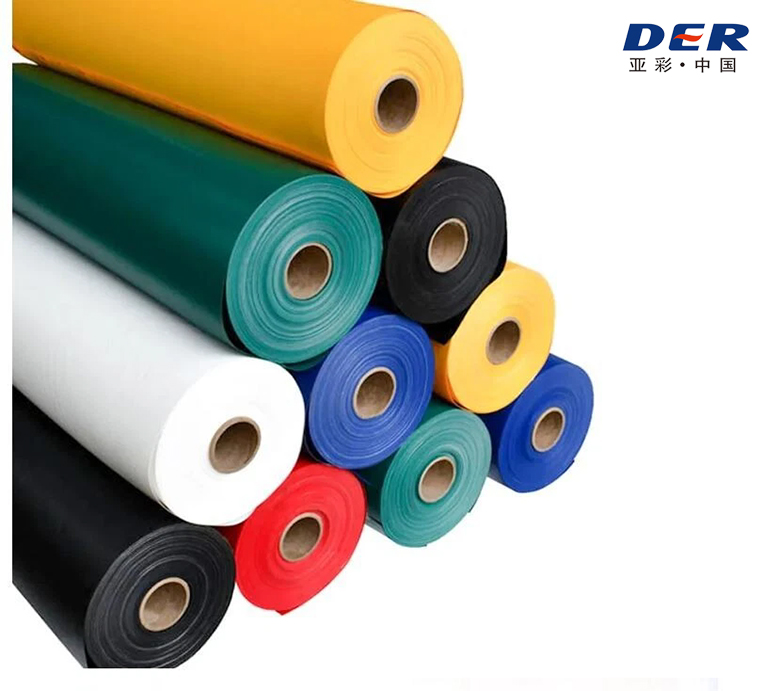
DERFLEX PVC tarp fabric rolls in multiple colors for vinyl tarp weight and denier selection
PVC coated tarp roll goods for converters, fabricators and OEM tarp programs.
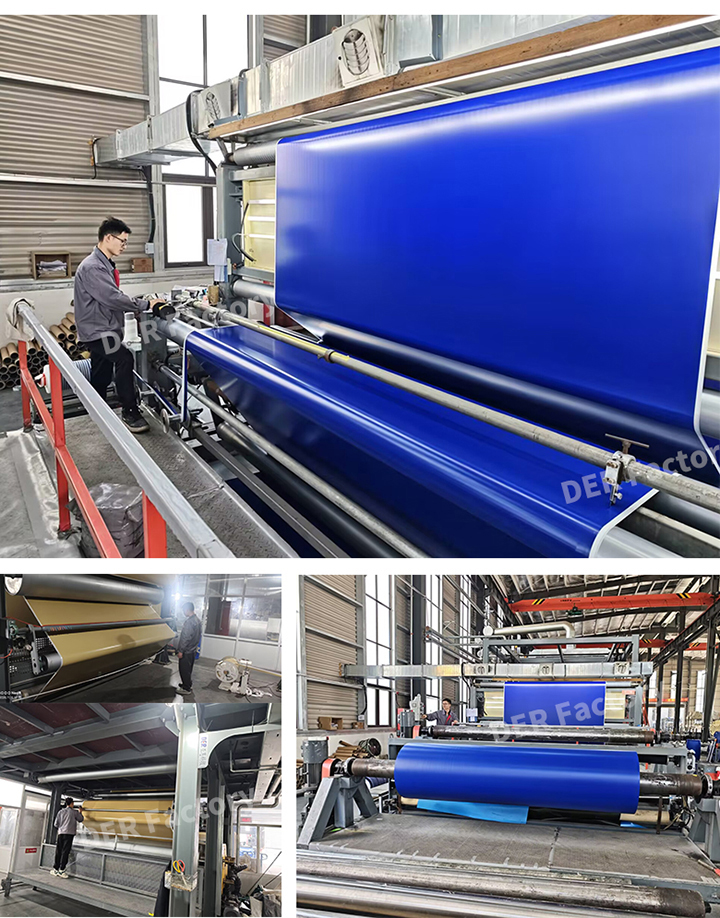
DERFLEX PVC coated fabric production for custom vinyl tarp specifications
Coating and roll-production capability used to control fabric structure, surface and repeat-order consistency.
Common Procurement Mistakes

Five Specification Shortcuts That Create Expensive Mismatches

A clear RFQ prevents suppliers from quoting products that look equivalent on one number but behave differently in use.

1. Converting Oz Directly to Mil

Area weight and thickness are different properties. Request both instead of using a fixed conversion chart.

2. Treating Denier as Strength

Higher denier means higher yarn mass, not a guaranteed tensile, tear or seam result.

3. Buying the Heaviest Grade

Extra mass can increase cost, freight, lifting effort and stiffness without fixing the real failure point.

4. Ignoring Finished Size

Cut size and finished size may differ after hems and seams. Put finished dimensions and tolerances on the order.

5. Leaving Hardware Undefined

Grommet material, inside diameter, spacing, edge offset, webbing and corner details should be part of the drawing.

6. Skipping the Production Sample

Approve the exact material, color, surface, weld, reinforcement and packing reference before repeat bulk orders.

RFQ Checklist

What to Send DERFLEX for a Useful Vinyl Tarp Quotation

A complete request makes it easier to compare cost, performance and manufacturing feasibility on the same basis.

1

Define the finished use

Truck tarp, equipment cover, industrial enclosure, agricultural cover, clear curtain, roll material for conversion or another finished product.

2

Give the target material direction

Preferred oz/yd² or GSM, mil / mm if thickness matters, base-fabric denier / weave if known, color and surface finish.

3

Describe exposure and failure risks

Wind, UV, rain, cold, abrasion, chemicals, frequent folding, dragging, tension, sharp edges or long-term outdoor storage.

4

Map fabrication details

Finished size, seams, hems, webbing, rope, corner patches, grommets, D-rings, straps, pockets, printing and packaging.

5

Add commercial information

Quantity, sample requirement, repeat-order plan, branding, destination and any required test method or compliance document.

Buyer Questions

Vinyl Tarp Weight, Mil & Denier FAQ

Direct answers to the questions that commonly cause confusion when comparing supplier quotations.

Is a 10 oz vinyl tarp the same as a 14 mil tarp?

No universal rule makes them the same, because ounces measure area weight and mil measures thickness. However, current North American market listings commonly sell some 10 oz vinyl coated polyester tarps at about 14 mil. For procurement, request both values plus the base-fabric specification.

Is a 13 oz vinyl tarp usually an 18 mil tarp?

Some commercial 13 oz vinyl tarp lines are listed at approximately 18 mil, but this is a product pairing rather than a direct unit conversion. The coating ratio, textile reinforcement and formulation can change thickness at the same finished weight.

What is the difference between an 18 oz and 22 oz vinyl tarp?

18 oz is about 610 GSM and 22 oz is about 746 GSM. A 22 oz construction uses more finished material mass per area and is often thicker, but actual durability still depends on yarn, weave, coating, abrasion, seam and reinforcement. The heavier grade is most useful when the extra material addresses a real wear or load problem.

Should I use a 20 mil clear vinyl tarp or 30 mil clear vinyl tarp?

20 mil (0.508 mm) is a practical starting direction for many supported patio, porch and partition panels. 30 mil (0.762 mm) adds body and may be considered for colder, windier or more demanding enclosures. Panel dimensions, supports, fastening and cold flexibility should decide the final grade.

Is a 1000D vinyl tarp stronger than a 500D tarp?

It can have greater heavy-duty design potential, but not simply because the number is twice as large. 1000D yarn has twice the linear mass of 500D yarn for the same length. Finished strength depends on fiber grade, weave density, coating, adhesion, tensile / tear performance, seams and reinforcement.

Is 1680D always better than 1300D or 1000D?

No. 1680D provides higher yarn mass and can create a more structured fabric, but it can also add weight, stiffness and processing difficulty. A 1000D or 1300D construction may be more suitable when folding, rolling, welding and daily handling are important.

What information should I provide for a custom DERFLEX tarp recommendation?

Provide the application, finished size or roll format, target oz/GSM or mil/mm if known, preferred base fabric, exposure conditions, reinforcement and hardware details, color, quantity, destination and any required test method. A drawing, reference sample or current technical sheet is especially useful.

Build the Specification Before You Compare the Price

Send DERFLEX the application, dimensions, target oz/GSM or mil/mm, base-fabric direction, exposure, finishing details, quantity and destination. The team can review a practical PVC tarp construction for sampling and quotation rather than forcing your project into a generic stock grade.

Consulting Services
+86-021-54361792 / 54361798
Email
sales@derflex.com