Glamping Tent Fabric for Safari Lodges & Resort Shelters
Specify the envelope around the guest experience. DERFLEX supplies PVC coated polyester for hospitality tent shells, with material selection based on weather exposure, light control, seam construction and the intended service environment.
For tent fabricators, safari lodge developers and resort procurement teams, this guide separates the outer cover, interior lining, blackout function and thermal layer—so each part of the fabric package has a clear job.
Roll goods · Project-specific color and finish review · Sample-led approval
The envelope, considered as a systemA separate outer canopy and inner enclosure allow different materials to serve different functions.
Weather shellCoating, strength, welds and drainage
Guest environmentPrivacy, daylight and interior finish
Project approvalAgreed samples, tests and supply scope
What is glamping tent fabric?
Glamping tent fabric is the textile or coated membrane used in the roof, walls and internal layers of hospitality tents. A PVC coated polyester shell provides a water-resistant barrier; a separate lining, blackout treatment and insulation package address appearance, light and heat transfer. The correct specification depends on the complete tent assembly and its location.
“Hotel tent material” can describe several different products. Identify the role of every layer before comparing GSM or price. Some constructions integrate blackout into the outer membrane; insulation usually remains a separate assembly.
01
Outer shell
Rain / Sun / Envelope strength
PVC coated polyester combines a woven load-bearing base with a continuous coating. Specify roof and wall exposure separately, including surface finish, UV requirements, flexibility and the planned welding method.
Check before approvalWarp and weft strength, coating adhesion, water resistance and welded seam performance for the selected grade.
02
Interior lining
Finish / Privacy / Access
The guest-facing liner controls texture, appearance and concealment of the roof structure. Canvas, polycotton or other textile options need their own specification for cleaning, shrinkage, moisture behavior and fire requirements.
Check before approvalDefine liner supply separately. Confirm removability, attachment spacing, maintenance access and whether a breathable textile is required.
03
Blackout layer
Daylight / Sleep / Visual privacy
An opaque construction limits transmitted light. It can be incorporated within a PVC membrane or supplied as a separate layer. Check the entire room: seams, windows, vents and door edges can still admit light.
Check before approvalAgree a light-transmission requirement and inspect a joined sample. Color alone does not establish blackout performance.
04
Thermal layer
Heat flow / Seasonal comfort
Insulation requires a defined material, thickness, installation and moisture strategy. A reflective surface needs the correct air-space arrangement; a heavier outer skin alone does not establish useful thermal resistance.
Check before approvalAsk for thermal data for the proposed assembly, plus details for condensation, penetrations and continuity around the edges.
Supply scope: This page focuses on DERFLEX coated outer-shell and blackout membrane options. Interior textiles and insulation are system-design considerations; confirm their availability, compatibility and responsibility in the project quotation.
02 / Look closely
Start with real material. Then approve the finish.
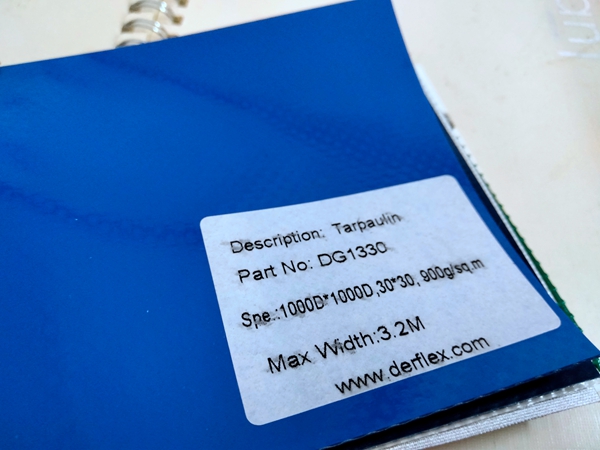
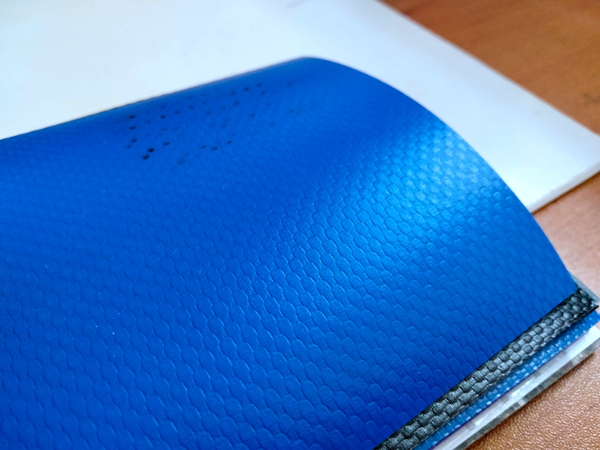
Use a physical swatch to inspect coating texture, flexibility, back-face appearance and color. These photographs come from DERFLEX’s published material library; they illustrate actual coated fabric samples rather than a digital color simulation.
Identify the construction
Record the sample reference, nominal weight and substrate. Retain an approved swatch for production comparison.
Inspect both faces
Assess texture and handling on a real sample. Review a trial weld on the actual coating and finish.
Review the roll format
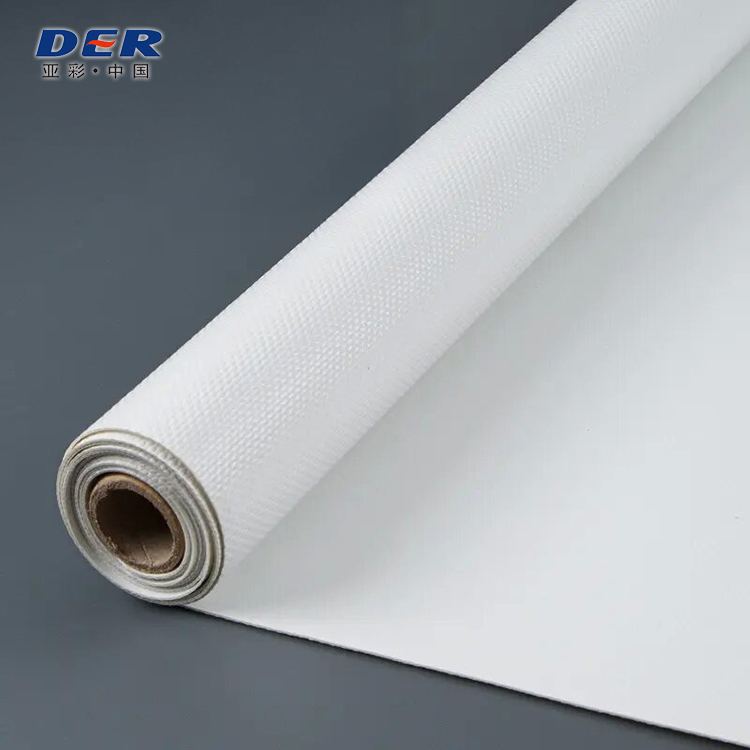
Match usable width to the panel layout. Confirm winding, face orientation and packing for the fabricator.
Photographed colors and sample labels are illustrative. The approved project sample and current technical data sheet govern the order.
03 / Choose the construction route
Canvas character or a coated membrane?
Canvas and membrane are material routes, not tent shapes. A safari tent fabric package can combine a textile inner enclosure with a welded PVC rain roof. Decide which component needs each property.
Decision
Canvas / textile route
PVC coated membrane route
Appearance and role
Suited to a tactile interior or traditional safari aesthetic. Fiber composition, weave and treatment vary.
Suited to a continuous weather shell with a coated, cleanable surface. Finish and gloss need sample approval.
Moisture behavior
Some constructions allow more vapor transfer. Waterproof coatings and finishes can reduce it; check the specific fabric.
Typically provides low vapor permeability. Plan ventilation and condensation management in the assembly.
Joining method
Usually sewn with construction-specific thread, allowances and weather-sealing details.
Compatible grades can be heat welded. Coating, lacquer and equipment settings affect the seam.
Operating care
Review wet storage, drying, cleaning and possible shrinkage against the supplier’s instructions.
Review compatible cleaners, abrasion at supports, folds, repair patches and surface finish.
Structural use
Requires an appropriate frame, pattern and attachment system for the selected textile.
A tensile or prestressed application needs engineering values and suitable details; GSM alone is insufficient.
For engineered tensile applications, review architectural membrane material options. Decorative canvas appearance does not establish structural membrane performance.
04 / Specification starting points
Select a construction. Approve a complete specification.
The examples below are published DERFLEX coated-tarpaulin constructions for initial discussion. They are not an approved specification for every lodge roof. Request current data and confirm the exact grade, finish and intended exposure.
Published reference
Nominal weight
Polyester base / weave density*
Construction to discuss
DG1122
650 g/m²
1000D × 1000D / 23 × 23
Coated tarpaulin outer-cover candidate
DD1122J
720 g/m²
1000D × 1000D / 20 × 20
Coated blockout tarpaulin candidate
G1130
900 g/m²
1000D × 1000D / 30 × 30
Full Panama tarpaulin candidate
*Weave-density notation is reproduced as published; confirm the measurement unit and current construction in the technical data sheet. Weight is not a substitute for tensile, tear, adhesion or seam data.
Specify the roll
Usable width, roll length, nominal weight and tolerances, thickness, surface finish, color reference, face orientation and traceable identification.
Specify the performance
Warp/weft tensile and tear values, coating adhesion, water resistance, UV/weathering requirement, flexibility and compatible seam construction.
Specify the options
Opaque or light-transmitting construction, project color and fire-performance requirement. Confirm availability, test scope and commercial terms for the selected grade.
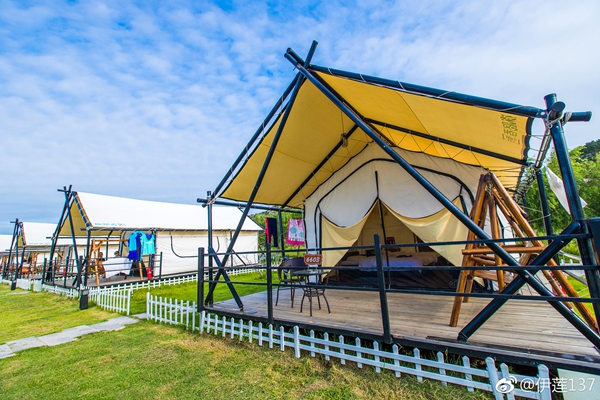
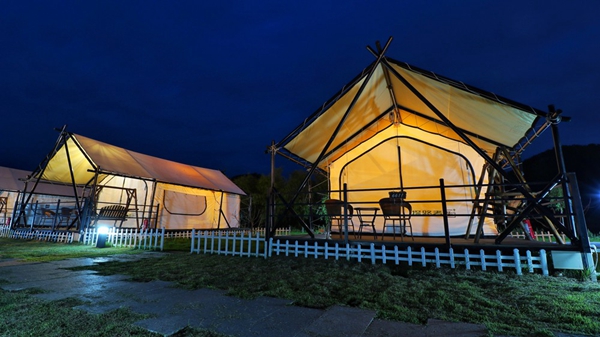
Existing DERFLEX application-library photograph. Project name, location and installed fabric grade are not identified in the public material.
05 / Read the application
The same roof looks different after dark.
Translucent canopies can create an attractive glow. A sleeping zone may need a different result: reduced dawn light, visual privacy and controlled illumination. Approve light behavior as deliberately as the exterior color.
For resort tent membrane procurement, assess a sample under strong backlighting and review a joined mock-up with the intended liner. Include door, window and vent details in the review.
A hotel fabric package should reflect how the tent will be occupied, cleaned and maintained. These are selection priorities for the project team, rather than universal material prescriptions.
Project condition
Material and assembly priority
Evidence to request
Hot, high-sun safari site
Review solar properties, surface color, a ventilated roof gap and shading. Specify blackout separately for the sleeping area.
Relevant solar/light data, weathering requirement and a roof assembly detail.
Humid forest or coastal resort
Prioritize rain drainage, cleanability, drying access and a moisture-management strategy behind the outer skin.
Water and seam evaluations, cleaning guidance and condensation/ventilation details.
Cool-season accommodation
Use a defined insulation system, limit gaps and coordinate ventilation with heating and interior humidity.
Thermal data for the assembly and an installation detail showing continuity.
Exposed, tensioned canopy
Match membrane construction to the engineer’s loads, pattern, prestress and edge connections.
Directional strength/elongation data, seam values and engineered connection details.
Phased resort expansion
Retain approved color, finish and construction references; design replaceable panels with clear identification.
Control samples, agreed batch tolerances, panel drawings and reorder references.
07 / From roll to enclosure
Resolve the details before cutting.
Fabric selection and fabrication belong in the same conversation. The seams, openings and connections determine how a coated cover behaves after installation.
Joining
Trial the weld on the exact finish
Hot-air or high-frequency welding may suit compatible PVC coated fabrics. Establish parameters on the chosen grade, including any lacquer, and evaluate representative lap seams. Agree seam width, overlaps and repair access with the fabricator.
Patterning
Keep warp and weft orientation visible
Mark fabric direction on the panel drawings. Do not rotate panels simply to reduce waste when the design relies on directional behavior. Include curvature, stretch compensation and approved tolerances where the engineered design requires them.
Connections
Design the edges as part of the load path
Pockets, keder edges, webbing, patches and mechanical attachments require coordinated design. Reinforcement dimensions and fastening spacing come from the structure and loading, rather than a generic eyelet pattern.
Interfaces
Make layers serviceable
Separate removable lining and insulation from the weather seal where the design allows it. Detail vents, doors, roof penetrations, runoff and inspection access without creating water traps or uncontrolled light leaks.
Keep acceptance criteria specific to the grade and assembly. A generic brochure, a different color sample or a certificate for another construction cannot settle a project specification.
Material and seam approval
Agree test methods, units, directions and acceptance values for the required properties. Review sample identity, nominal mass and thickness, surface appearance, coating adhesion and representative seams before confirming production.
Fire and thermal documentation
Confirm the applicable requirements with the project team. Request reports identifying the tested material and relevant construction. Evaluate the liner and insulation as well as the shell; thermal performance needs its own evidence.
A useful brief gets a more useful material recommendation.
DERFLEX’s coated fabric range gives tent fabricators a starting point for outer-shell and blockout material selection. Begin with the application, compare the proposed constructions and approve a physical sample before fixing the order specification.
Project and exposure: destination, site climate, intended season and roof or wall position.
Supply scope: roll goods or fabricated-panel inquiry, number of units, fabric quantity and drawings.
Material target: construction, nominal GSM, usable width, color, finish and required light control.
Verification: strength, seam, water, fire or weathering requirements; identify the applicable methods.
System interfaces: liner, insulation, air gap, attachments and replacement strategy.
MOQ, sample arrangements, production lead time and pricing depend on the final construction, finish and order quantity. Request confirmation in the quotation.
Your project brief
Edit the checklist below, copy it, and include it with your inquiry.
Answers for fabricators, lodge developers and hospitality procurement teams.
Which fabric is suitable for a glamping tent outer shell?
PVC coated polyester is a practical option for a welded weather shell. Canvas or other treated textiles may suit a different design. Select the construction against exposure, structural requirements, seam method and the desired appearance; approve current technical data and a physical sample.
Is safari tent canvas the same as PVC tent membrane?
No. Canvas describes a woven textile family whose fibers and treatments vary. A PVC membrane uses a coated substrate to form a continuous surface. The joining, vapor behavior and maintenance requirements differ. A safari lodge can use canvas internally and a separate PVC outer roof.
Does blackout tent fabric also provide insulation?
Blackout controls transmitted light. It does not establish thermal resistance or an indoor temperature reduction. Specify insulation and the air-space arrangement separately, and request thermal data for the proposed assembly.
Will a waterproof shell prevent condensation inside?
No. A water-resistant outer skin can still have condensation on its inner surface when temperature and humidity conditions allow it. Coordinate ventilation, lining clearance, moisture control and insulation with the tent-system designer.
What GSM should I specify for a resort tent membrane?
There is no single GSM suitable for every resort. Begin with roof or wall use, exposure, loads and handling requirements. Compare tensile, tear, coating adhesion and seam data alongside weight. The fabricator or engineer should approve the selected construction for the assembly.
Can I order custom colors, blackout material and bulk rolls?
Submit the required color reference, finish, light-control target, roll dimensions and quantity to DERFLEX. Ask for the available construction, current sample, MOQ, price and production schedule. Confirm liner or insulation supply separately if the inquiry covers more than the coated shell.
Define the layers. Then choose the fabric.
Send your site conditions, panel drawings and material targets. Ask DERFLEX to review a coated shell or blackout construction for your hospitality tent program.