04 / Preliminary dead-load worksheet
Calculate panel mass before comparing track capacity.
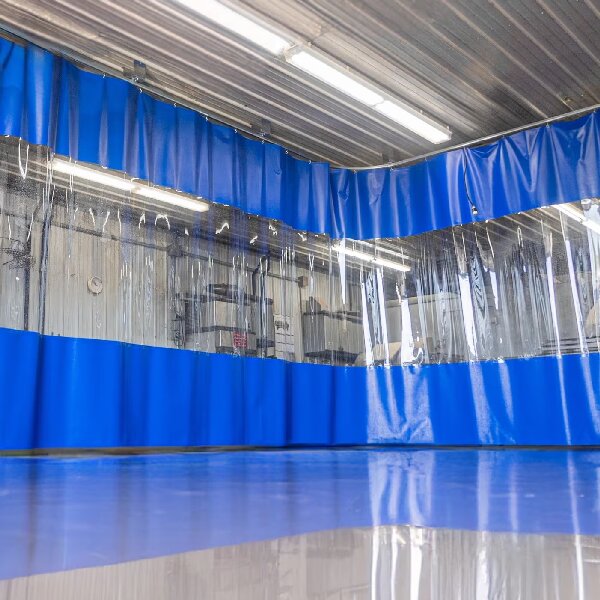
Use finished panel dimensions, including specified overlap. For mixed constructions, calculate each material zone separately and add their masses.
Body mass (kg) = width (m) × height (m) × fabric weight (gsm) ÷ 1,000
Then add reinforcement, window differences, hems, seams, zippers and suspended bottom weights. Use the finished panel’s measured mass when available. If a window replaces body fabric, subtract the replaced body area before adding the window material.
Extended curtain
Review panel load distribution, the manufacturer’s support-spacing limit and the weakest component in the rail-to-building load path. Track and per-carrier ratings describe different parts of the system.
Gathered curtain
Many carriers can collect over a short parking length. Give the supplier the parking position and stack mass so this local load can be checked between the relevant supports.
Moving curtain
Account for opening frequency, pull direction, starts, stops and snagging. Dividing total mass by carrier count gives only an average; it does not prove equal loading or operating capacity.
Exposed curtain
Wind, pressure differences and restrained bottom edges can introduce loads beyond self-weight. These conditions require a project-specific system review.
Mass in kilograms is not interchangeable with a manufacturer’s force or line-load rating. Provide units and the rating basis when comparing kg, N, lb and load per unit length.