Define the Environment
Outdoor duration, sunlight, rainfall, temperature, chemicals, wind, abrasion, hygiene and flame-retardant requirements.



 Industrial coated textile manufacturing
DERFLEX manufactures PVC coated industrial tarpaulins, roll materials and finished covers for equipment, construction, logistics, warehousing, mining, agriculture and OEM supply. The specification is built around the working environment—not selected from a generic size list.
An industrial tarp is a flexible protection system. Its performance comes from the interaction of the base fabric, coating, seam method, edge construction, attachment points and installation—not from weight or thickness alone.
For professional procurement, the manufacturer should translate site conditions into measurable requirements. Rain exposure may determine coating and seam design. Repeated folding may change the preferred weight and cold-flex direction. Sharp cargo may require abrasion zones or replaceable wear panels. High wind loads may require closer fixing points, webbing reinforcement or a different cover geometry.
DERFLEX supports this specification-led process for B2B buyers sourcing industrial tarpaulin sheets, heavy duty tarp covers, PVC tarp rolls and private-label product programs.
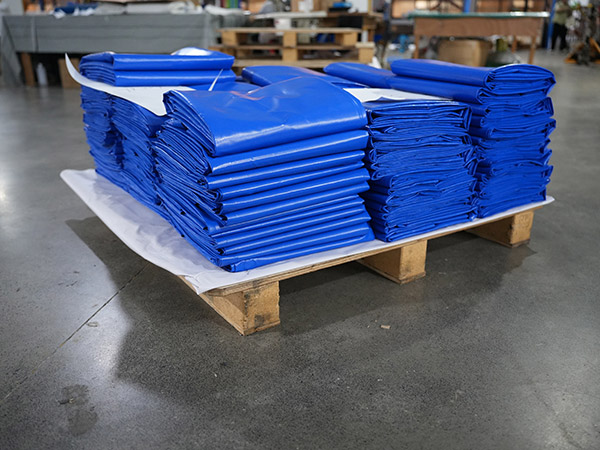
A clearer RFQ reduces over-specification, under-specification and avoidable differences between samples and bulk production.
Outdoor duration, sunlight, rainfall, temperature, chemicals, wind, abrasion, hygiene and flame-retardant requirements.
Cover geometry, tension points, sharp edges, movement, folding frequency, attachment method and access requirements.
Base fabric, coating route, GSM, finish, welded panels, reinforcement layout, hardware and printing.
Technical data, color reference, dimensional drawing, golden sample, inspection points and packing standard.
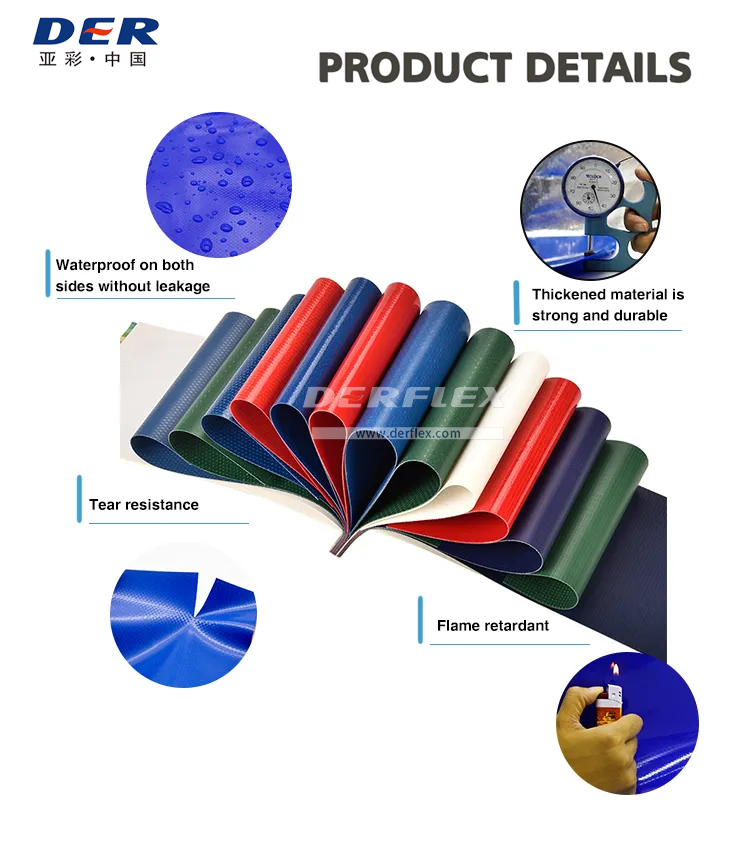
PVC formulation and optional lacquer influence weathering, cleaning, abrasion behavior and weld preparation.
Adhesion supports repeated folding, seam performance and resistance to delamination during use.
Yarn denier and fabric density contribute to tensile strength, tear behavior and dimensional stability.
The polyester scrim carries mechanical load while the PVC layers create the protective surface. The same nominal GSM can perform differently when yarn structure, coating balance, adhesion, plasticizer package, surface finish or production method changes.
This is why industrial tarpaulin procurement should compare technical data and construction—not only a sample's hand feel. For repeated outdoor use, buyers commonly review tensile strength, tear strength, adhesion, low-temperature flexibility, UV direction, abrasion exposure and seam compatibility.
Coated fabric is often selected when controlled coating penetration, adhesion and durable fabrication performance are priorities. Laminated fabric can be suitable for cost-sensitive or specific finished-product programs. The correct route depends on duty level, handling and commercial target.
“Chemical resistant” should not be treated as universal. Provide the substance, concentration, temperature, contact time and cleaning method so material compatibility can be evaluated for the actual environment.
The table is a practical discussion framework. Values shown are typical directions, not a fixed promise for every product.
| Product direction | Industrial PVC tarpaulin, heavy duty tarp cover, PVC tarp roll or fabricated cover | Choose roll goods for local conversion, or finished covers when dimensions and hardware are defined. |
|---|---|---|
| Base fabric | High-tenacity polyester; common 500D, 840D, 1000D, 1300D, 1680D or 2000D directions | Yarn size must be considered together with fabric density and coating construction. |
| Total weight | Approx. 450–1200 gsm; lighter or heavier project structures can be discussed | Higher GSM does not automatically solve poor reinforcement, geometry or attachment design. |
| Surface | Glossy, matte, embossed, acrylic lacquer, anti-fouling or project-specific finish | Confirm weld preparation and repair method when special topcoats are selected. |
| Color | Standard industrial colors or custom matching by approved reference | Define allowable color tolerance and whether the requirement applies across repeat batches. |
| Width & panels | Roll widths according to structure; wider finished panels can be produced by welding | Panel orientation and seam placement should be shown on the drawing for large covers. |
| Performance options | Waterproofing, UV stabilization, anti-mildew, cold-flex, anti-static or flame-retardant directions | Standards, test methods and acceptance values should be agreed before ordering. |
| Fabrication | Hot-air or high-frequency welding, sewing where appropriate, hems, webbing, rope edges and reinforcement | Seam design depends on water barrier, load direction, production geometry and repair needs. |
| Hardware | Grommets, D-rings, buckles, straps, hooks, zippers, access flaps and labels | Specify hardware material, spacing, pull direction and corrosion exposure. |
| Supply & branding | Bulk rolls, folded tarps, cartons, pallets, labels, logos and private-label packaging | Final packing should be checked against container planning and customer handling requirements. |
Final product data, tolerances, compliance claims and testing arrangements should be confirmed in the quotation, technical data sheet and approved sample.
No tarp material is automatically the correct choice for every industrial use. The comparison below helps procurement teams narrow the starting point.
A durable fabric can still fail early if seams, corners and fixing points are not designed for the applied load.
Hot-air or high-frequency welding can create joined panels for waterproof cover systems. Seam width, overlap and process settings should match the fabric structure.
Corner patches spread local stress around high-load fixing points. Patch geometry and orientation should follow the actual pull direction.
Folded hems, webbing and rope edges can distribute tension along the perimeter and support repeated installation or removal.
Hardware spacing should be calculated from load, wind, cover size and installation method rather than copied from a standard retail tarp.
Flaps, zippers, sleeves, vents and inspection openings can be integrated where maintenance or loading access is required.
Logo printing, product labels, folded dimensions, carton marks, barcodes and pallet configuration can be prepared for OEM and distributor programs.
Each environment places a different load on the fabric, seams and attachment system.
For generators, production machines, maintenance assets and outdoor equipment. Consider drainage, abrasion points, ventilation and service access.
For scaffold protection, temporary partitions, stored materials, ground coverage and weather barriers. Wind loading and flame requirements may be critical.
For road spray, rain, repeated folding and cargo movement. Reinforcement, abrasion zones, fasteners and handling weight require balance.
For pallets, steel, timber, bulk materials and temporary storage. Cover geometry should avoid water pooling and uncontrolled uplift.
For machinery, stockpiles, site divisions and process areas where abrasion, dust, chemicals or flame-retardant requirements need project review.
For hay, equipment, feed storage and shelter components. UV exposure, mildew direction, cover tension and seasonal handling affect material choice.
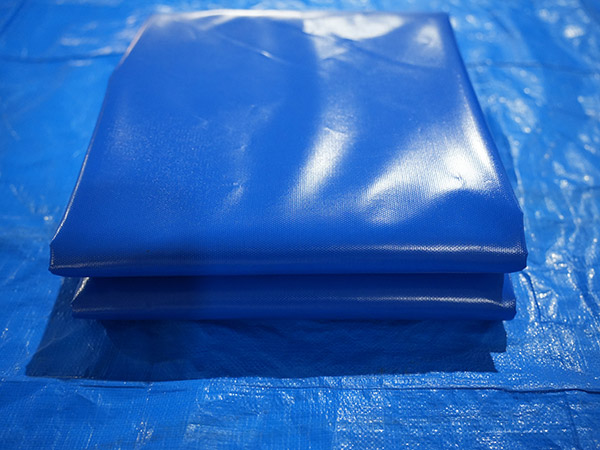
Industrial buyers often need the second and third production batch to behave like the approved first batch. A repeatable program therefore needs documented inputs, sample approval and practical inspection points.
Confirm yarn structure, density, appearance and production identification before coating or lamination.
Monitor weight, coating balance, appearance, color reference, adhesion direction and roll consistency.
Check finished dimensions, seam layout, hems, hardware position, reinforcement and workmanship against the drawing.
Verify labels, quantities, folded size, carton marks and pallet requirements before release.
A useful RFQ describes the use condition and acceptance requirement, not only “heavy duty” or “waterproof.”
This example illustrates the decision process without promising a universal service-life result.
The original generic cover showed wear around corners and fixing points after repeated wind movement and maintenance access.
Increasing GSM alone would add handling weight but might not address corner abrasion or concentrated tie-down forces.
Define reinforced corners, webbing paths, hardware location, welded panel layout and a practical access opening.
Approve dimensions, material, fabrication and installation method using drawings or a sample before repeat manufacturing.
Use these six related pages to compare materials, finished-cover routes and application-specific tarp programs.
Include the following information where available. DERFLEX can then discuss a suitable material and fabrication route for quotation.
Clear answers for distributors, contractors, fabricators, fleet operators and industrial procurement teams.
An industrial tarpaulin is a flexible protective sheet or fabricated cover designed for equipment, transport, construction, storage, agriculture or process-site use. It may be made from PVC coated polyester, woven polyethylene, treated canvas or mesh. The correct material and fabrication depend on the working environment.
Provide the application, exposure conditions, finished dimensions or drawing, preferred material or target GSM, color, reinforcement, hardware, seam method, quantity, packaging and any testing or compliance requirement. Photos of the installation can also help clarify wear and fixing points.
No. Higher weight can provide more material, but durability also depends on base-fabric structure, coating adhesion, UV formulation, seam quality, reinforcement, cover geometry and installation. A heavier tarp with poorly positioned fixing points can still fail locally.
Yes. DERFLEX can discuss PVC tarpaulin roll supply for fabricators, cut or welded panels, and finished covers with hems, grommets, D-rings, webbing, straps, printing and packaging. Availability depends on the selected material, dimensions and order plan.
Grommet spacing should reflect cover size, wind load, pull direction, installation tension, hardware strength and perimeter reinforcement. Standard spacing can be a starting point, but large or wind-exposed covers should be reviewed as a load-distribution system.
Flame-retardant directions can be discussed for selected PVC coated fabrics. The buyer should state the required standard, test method, application and documentation. Compliance should be confirmed for the exact product construction and production batch rather than assumed from a general material description.
Custom color matching, logo printing, labels and packaging can be discussed for OEM and distributor programs. Color reference, tolerance, print artwork, packing layout and minimum production conditions should be approved before bulk manufacturing.
Identify the chemical, concentration, temperature, contact duration, cleaning process and whether exposure is splash, intermittent contact or immersion. A general “chemical resistant” claim is not sufficient for every substance or operating condition.
Share your drawing, exposure conditions, quantity and finishing requirements for a specification and quotation discussion.