Leading Edge
Check the first contact zone as the tarp travels over the load. Edge curl, abrasion or tearing can indicate the need for wear strips, different webbing or improved corner transition.



DERFLEX supplies custom refuse truck tarp covers and tarp materials for roll-off trucks, recycling fleets, transfer operations, hook-lift applications and waste equipment programs. Choose breathable heavy-duty mesh where airflow matters, or a waterproof PVC-coated polyester structure where rain, road spray and wet material require a non-porous cover surface.
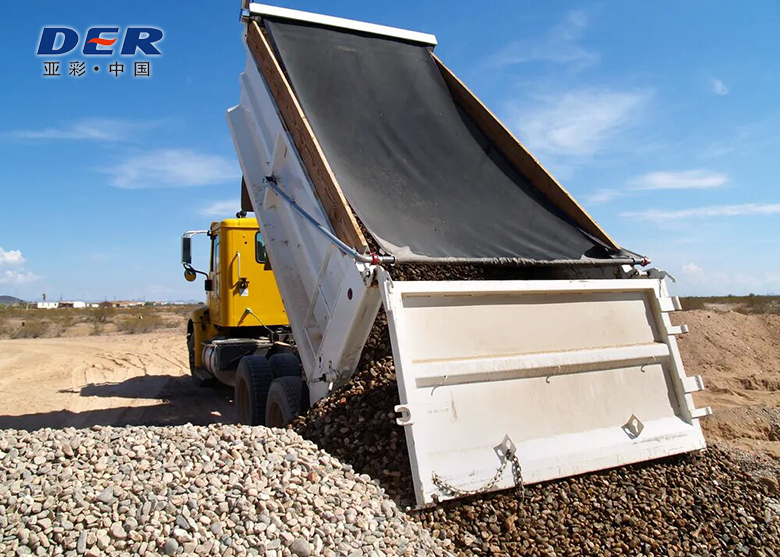
Refuse hauling is a high-cycle application. The tarp is repeatedly pulled, rolled, folded, dragged over uneven material, exposed to wind and sunlight, and brought into contact with rollers, arms, bars, container edges or hardware. That means a useful specification cannot be reduced to “heavy duty” or a single fabric weight.
For a fleet buyer, tarp shop or waste-equipment distributor, the better question is: where does the current tarp wear first, and what causes that wear? A custom refuse truck tarp can then place the right structure at the right location—rather than adding unnecessary weight across the entire cover.
If an old tarp already fits the system, send its finished dimensions, pocket sizes, attachment layout and clear photos of the damaged areas. Wear marks are useful engineering information: they show where extra webbing, abrasion panels, edge reinforcement or a geometry change may be worth discussing.
The goal is not to make every area equally heavy. It is to strengthen the places that receive repeated mechanical stress while keeping the cover practical for the truck’s deployment system.
Check the first contact zone as the tarp travels over the load. Edge curl, abrasion or tearing can indicate the need for wear strips, different webbing or improved corner transition.
Roller pockets, inserted bars and pull areas see repeated bending and concentrated force. Pocket diameter, seam orientation and reinforcement should match the existing hardware.
Grommets, straps, arm interfaces and fasteners can create local tearing if force is concentrated in a small area. Webbing and patch design can spread the load.
Side rails, container rims and irregular refuse can abrade the cover during movement. Zoned reinforcement can be more efficient than simply choosing the heaviest available sheet.
A refuse truck tarp manufacturer should match the material to load behavior and deployment method. Mesh and solid PVC solve different operating problems; neither should be treated as a universal replacement for the other.
Suitable for many dry, bulky or wind-sensitive loads where reducing air pressure and cover weight is useful.
A practical direction when wet loads, fine material, rain exposure or easier surface cleaning are more important than airflow.
Useful where specific contact areas need more protection but the whole tarp should not become heavier or less flexible.
Refuse fleets use different ways to cover open loads. Finished dimensions, pocket geometry, reinforcement and fabric flexibility should be reviewed together with the actual deployment hardware.
DERFLEX focuses on tarp material and fabricated cover solutions. Motors, hydraulic components, arms, rollers and other mechanical hardware should be specified with the relevant tarp-system or equipment provider unless separately confirmed in quotation.
Use this table to prepare an RFQ. It is intentionally presented as a discussion guide rather than a fixed catalog model, because the correct construction depends on the truck, system, waste stream and duty cycle.
| Specification Item | Available Direction | Why It Matters | What to Send DERFLEX |
|---|---|---|---|
| Material | Heavy-duty mesh, PVC-coated polyester, or project-specific zoned construction | Controls airflow, weather barrier, handling weight and abrasion behavior | Waste type, rain exposure, wind sensitivity and current tarp material |
| Solid PVC Weight | Approx. 500–900 g/m² is a common heavy-duty discussion range; other structures can be reviewed | More weight can add robustness, but excessive weight may affect rolling and operator handling | Duty cycle, mechanism type, present GSM if known and failure history |
| Finished Size | Made to drawing, measured replacement tarp or approved sample | Incorrect length or width can cause drag, poor coverage, over-tension or incomplete closure | Finished length, width, flap dimensions and clear measurement method |
| Pockets / Sleeves | Custom pocket width, depth, orientation and reinforcement | Pocket geometry directly affects rollers, bars and pull interfaces | Bar or tube diameter, pocket dimensions and close-up photos |
| Edge Reinforcement | Webbing, double-layer zones, wear strips and custom hem structures | Edges often see more concentrated stress than the center panel | Photos of worn edges, rails, contact points and attachment layout |
| Attachment Detail | Grommets, straps, webbing loops, reinforced patches or system-specific interfaces | Force needs to be distributed so attachment zones do not become early tear points | Hole spacing, hardware position, dimensions and system photos |
| Surface / Color | Project-dependent color, finish, logo or identification marking | Supports fleet identification, private label and repeat inventory control | Color reference, artwork, print size and location if required |
| Packing | Individual folded packing, labels, cartons, private-label marks or program-specific packing | Important for dealer stock, replacement programs and refuse truck tarp wholesale supply | SKU logic, barcode/label requirement, carton marks and units per pack |
All ranges are procurement reference points. Final material, dimensions, tolerances, performance requirements, MOQ and lead time should be confirmed in the project quotation or approved specification.
A replacement program is easier to manage when the approved construction is documented by dimensions, materials and wear-zone details instead of relying on informal descriptions such as “same as last time.”
Photograph the whole cover, both sides, all pockets, fasteners and damaged locations before removing or discarding it.
Record finished size, pocket geometry, bar diameter, attachment spacing and any allowance needed for rolling or overlap.
Mark abrasion, tears, seam separation and stretch zones so reinforcement can be reviewed where it adds value.
Confirm material route, reinforcement, color, logo, packing and first-article or sample requirements before bulk production.
Use an approved drawing or specification code so later fleet replacements and wholesale orders can follow the same construction.
DERFLEX can discuss different supply formats depending on whether you are replacing a few worn covers or building an organized B2B product line.
A refuse truck tarp supplier serving fleets and distributors needs to control the approved material and fabrication details across repeated orders. DERFLEX combines coated-fabric manufacturing capability with custom tarp fabrication support for B2B projects.
DERFLEX's published company profile describes an integrated manufacturing base for coated fabrics and industrial textile solutions. These company-scale figures are presented from the current DERFLEX profile and should be retained only while they remain internally verified.
The fastest way to reduce back-and-forth is to send the mechanical interface and the operating conditions together. A truck model alone usually does not define the finished tarp.
These six pages connect refuse truck tarp sourcing with adjacent waste hauling, roll-off, transfer and truck tarp applications.
Heavy-duty mesh and PVC-coated polyester are two common directions. Mesh is useful when airflow, reduced wind pressure and lighter handling are important. Solid PVC-coated polyester is more suitable when the application needs a non-porous weather barrier, easier cleaning or stronger protection from rain and road spray. The final choice should follow the waste stream and cover mechanism.
Yes. An existing tarp can be used as a useful reference if it fits correctly. Send the finished dimensions, pocket and attachment details, plus photos showing wear or failure areas. DERFLEX can then discuss whether the replacement should copy the old construction or adjust specific high-wear zones.
A solid PVC-coated polyester tarp can be specified with a waterproof sheet structure. However, the water resistance of the finished installed cover also depends on seams, holes, overlaps, hardware and how the tarp interfaces with the truck. Breathable mesh tarps are not waterproof by design.
DERFLEX can discuss the tarp cover and material for front-to-back arm systems, roll-off or gantry systems, roller-pocket designs, side-roll covers and other replacement programs. Provide finished dimensions and interface details so the tarp can be matched to the existing mechanism. Mechanical hardware is normally handled separately unless specifically confirmed.
DERFLEX can discuss repeat-order, OEM and wholesale programs for distributors, equipment companies, tarp shops and private-label buyers. Options can include repeatable sizes, custom color, logo printing, labels, SKU identification and program-specific packing. MOQ, lead time and commercial terms depend on the approved construction and order quantity.
Send the finished tarp size, truck or container type, cover mechanism, waste type, preferred material, pocket and reinforcement details, , attachment layout, color, quantity, destination and packing needs. Photos, drawings and failure images can make the review more useful.
For a custom refuse truck tarp quote, include the finished size, cover mechanism, waste stream, material preference, reinforcement layout, quantity and destination. DERFLEX can review a practical mesh, PVC-coated or zoned construction for replacement, OEM or wholesale supply.