Waste Stream
Light recyclables, municipal refuse, demolition waste, green waste and scrap create different wind, puncture and abrasion demands.



Specify the tarp around the truck, the cover system and the waste stream—not around a generic catalog size. DERFLEX supplies custom waste truck tarp solutions in breathable mesh, waterproof PVC-coated polyester and hybrid constructions for daily hauling, replacement programs and OEM supply.
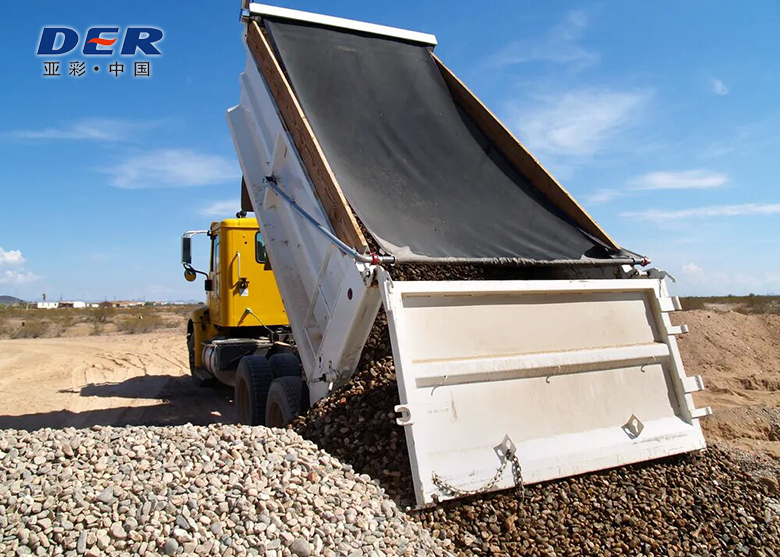
Waste hauling exposes a tarp to a combination of wind, dirty surfaces, repeated deployment, hardware contact and irregular load profiles. A suitable tarp therefore has to be selected as part of the truck’s operating system.
For municipal refuse, construction and demolition debris, landscaping waste, recyclables and transfer-station loads, the same tarp specification does not fit every route. A light dry load may benefit from mesh because airflow reduces ballooning and handling weight. Wet or fine material may call for a waterproof waste truck tarp made from PVC-coated polyester. Sharp or abrasive debris can require heavier construction and deliberate reinforcement around the edges and attachment zones.
DERFLEX positions this page specifically for buyers looking for a waste truck tarp manufacturer, fleet replacement source, equipment-integrated tarp supplier or repeat wholesale program. Instead of treating “waste truck tarp” as a single SKU, the selection process is organized around five questions: what the truck carries, how the tarp moves, where stress concentrates, what weather it sees and how often it cycles.
Send the finished tarp dimensions, truck or container type, deployment method, load description, expected quantity and photos or drawings of the attachment points. This usually leads to a more useful recommendation than providing only the truck model.
A practical specification balances containment, handling and service life. These are the variables procurement teams should define before comparing unit prices.
Light recyclables, municipal refuse, demolition waste, green waste and scrap create different wind, puncture and abrasion demands.
Front-to-back arms, roll-off systems, side-roll mechanisms, cable systems and manual covers need different pockets, edge details and flexibility.
A tarp deployed many times per shift accumulates flexing and edge wear faster than a cover opened only a few times per week.
Strong UV, cold weather, rain and long outdoor storage influence coating choice, low-temperature flexibility and finish requirements.
Hems, roller pockets, grommets, arm connections and corners commonly fail before the center panel if reinforcement is poorly specified.
Fleet replacements, dealer stock, private label, OEM integration and waste truck tarp wholesale programs each require different packaging and repeat-order controls.
The right material depends on whether the priority is airflow, weather protection, abrasion resistance or a balance of those properties.
Mesh is often selected for dry waste, landscaping debris, recyclables and loads where reduced wind lift and lower handling weight are important.
PVC-coated polyester is the practical direction when the job requires a waterproof barrier, easier wash-down and stronger protection from rain and road exposure.
Some applications benefit from combining materials or changing reinforcement by zone rather than increasing the weight of the whole tarp.
These are procurement reference points rather than a single fixed model. Final values should be confirmed against the truck system, load, drawing or approved sample.
| Specification Item | Available Direction | Why It Matters on Waste Trucks | What the Buyer Should Confirm |
|---|---|---|---|
| Material | PVC-coated polyester, heavy-duty mesh, or project-specific hybrid construction | Controls weather protection, airflow, handling weight and abrasion behavior | Waste type, rain exposure, airflow need |
| PVC Fabric Weight | Common heavy-duty discussion range: approx. 500–900 g/m2 | Higher weight can support more demanding service, but excessive weight may affect system operation | Duty cycle, system torque, target service profile |
| Finished Size | Made to drawing, measured replacement tarp, container or system dimensions | Incorrect finished dimensions can cause poor tension, drag, incomplete coverage or premature edge stress | Finished length/width, flap dimensions, bow height if relevant |
| Edge Reinforcement | Webbing, folded hems, double layers, wear strips and localized patches | Edges carry repeated pull loads and hardware contact | High-wear zones and attachment method |
| Pockets / Sleeves | Roller pocket, pipe pocket, cable sleeve or custom sewn/welded geometry | Interfaces the fabric with the deployment hardware | Pocket circumference, insertion direction, closure detail |
| Attachment Hardware | Grommets, D-rings, straps, rope, webbing loops or system-specific fittings | Attachment zones concentrate mechanical stress | Spacing, hardware material and reinforcement around each point |
| Surface / Functional Options | UV-resistant, anti-mildew, low-temperature, lacquered or flame-retardant options where required | Extends material suitability for climate or project requirements | Applicable standard, test request and operating environment |
| Branding & Packing | Logo printing, labels, private-label cartons, roll packing or individual folded packing | Supports distributor and waste truck tarp wholesale programs | Artwork, barcode, carton marks and packing quantity |
Reference ranges are for quotation discussion. Material data, finished dimensions, treatments and test documentation should be confirmed in the final specification or approved sample.
A waste truck tarp supplier should ask how the cover moves before recommending construction. The deployment system determines pocket geometry, flexibility, reinforcement and finished length.
Common on refuse and roll-off trucks. The tarp needs clean tracking, stable edges and correctly reinforced arm interfaces.
Dimension control and roller-pocket design are important for smooth repeated deployment over containers of different heights.
Used on certain transfer and bulk-hauling bodies. Tarp weight and roll behavior should match manual or powered operation.
Wear points along cables, runners and hems should be identified so reinforcement is added where movement actually occurs.
For replacement programs, the old tarp, a drawing or a measurement sheet can be used to reproduce size and attachment logic.
Many tarp failures begin at interfaces: where fabric meets hardware, where the tarp changes direction, or where repeated tension is applied. A heavier center panel alone does not solve these problems.
For a heavy duty waste truck tarp, DERFLEX can discuss reinforcement at the roller pocket, front and rear edges, corners, side hems, grommet zones and any point that rubs against arms, bows or container edges. The objective is to create a balanced construction that remains practical for the operating system.
The final pattern should follow the actual system. These zones are common areas to review during design.
DERFLEX supports distributors, tarp shops, truck body builders, waste-equipment companies and fleets that need a repeatable custom specification rather than a one-time generic cover.
Waste and recycling fleets, roll-off service companies, truck accessory distributors, tarp system builders, container suppliers, private-label brands and regional wholesalers.
If your project sits within a broader hauling category, DERFLEX also provides a dedicated truck tarp manufacturer page covering transport tarp sourcing across multiple vehicle types.
Truck/container type, waste stream, route environment and number of daily cycles.
Finished size, pockets, flaps, hems, attachment points and any system-specific interface.
Mesh for airflow, PVC for waterproof coverage, or a customized combination for special requirements.
Webbing, wear zones, grommet spacing, logos, labels and private-label packing.
Use drawing, sample and agreed inspection points so later wholesale or fleet replenishment is easier to reproduce.
Send a drawing or measured old tarp, photos of the truck system, material preference, quantity and delivery market. DERFLEX can use those details to discuss a practical production specification.
For a repeat program, consistency is more useful than broad marketing claims. The specification should make the measurable details clear enough to reproduce from batch to batch.
Confirm agreed material type, surface, color and project-specific functional options before fabrication.
Review the finished length, width, pockets and flaps against the drawing or approved sample.
Verify webbing, patches, hems and high-stress zones are positioned according to the construction specification.
Check grommet spacing, loops, rings, sleeves or other hardware interfaces before packing.
Inspect welded or sewn areas for continuity, appearance and application-appropriate finishing.
Review obvious coating defects, contamination, printing alignment or other visible issues.
Confirm labels, folding/rolling method, carton marks and private-label requirements for distribution.
Where required, align requested test or compliance documentation with the selected material before order confirmation.
The same truck may carry very different loads. Material selection should reflect what can blow, cut, soak, rub or accumulate against the tarp.
Daily collection routes require repeat deployment, manageable handling and a construction that tolerates dirty, outdoor service.
Container-height variation and arm or gantry motion make finished geometry and pocket design especially important.
Mixed debris can be abrasive or sharp, so localized reinforcement and tear-resistance priorities increase.
Cardboard, plastics and other low-density recyclables can create wind lift, making breathable containment an important option.
Branches, brush and mulch often favor mesh coverage, provided the load does not require full weather sealing.
Longer routes and mixed loads can require more deliberate choices around waterproofing, reinforcement and system compatibility.
For B2B purchasing, compare the supplier’s ability to control the specification, not only the price of the first tarp.
| Buyer Question | What a Project-Ready Supplier Should Clarify | Why It Affects Total Cost |
|---|---|---|
| Can you match my system? | Ask for truck/container details, deployment method, drawing or old tarp dimensions. | Reduces fit problems, drag, poor coverage and avoidable rework. |
| Why mesh or PVC? | Explain the tradeoff between airflow, waterproofing, weight and abrasion exposure. | Prevents paying for properties the application does not need—or missing ones it does. |
| Where is it reinforced? | Show hems, webbing, pockets, grommets and local wear zones in the specification. | Many real failures begin at edges and interfaces rather than the center panel. |
| Can repeat orders be reproduced? | Use stable drawings, approved samples, labels and inspection points. | Important for fleet standardization, dealer stock and warranty/claim control. |
| Can you support my brand? | Confirm logo, labels, barcode/carton marks and private-label packing. | Helps distributors turn a custom waste truck tarp into a repeatable product line. |
| What information is needed to quote? | Finished size, material, quantity, reinforcement, hardware, packing and destination. | A complete RFQ reduces revision cycles and makes commercial comparison more accurate. |
These six related pages connect waste-truck procurement with broader truck tarp, roll-off, dumpster and heavy-duty material decisions.
Answers for fleet managers, distributors, tarp fabricators and OEM buyers comparing waste truck tarp suppliers and custom options.
Use the load behavior as the starting point. Heavy-duty mesh is useful when airflow, lower weight and debris containment are priorities. PVC-coated polyester is the more suitable direction when you need a waterproof barrier, easier cleaning and stronger protection from rain. Mixed or high-wear applications can use customized reinforcement or hybrid construction.
Yes, a custom project can be discussed using finished dimensions, a technical drawing, an existing tarp sample, or a measurement sheet supported by photos of the deployment system. Pocket, flap, hem, webbing and attachment details should be included wherever possible.
They can be specified in waterproof PVC-coated fabric. Mesh tarps are breathable and are not designed to provide full waterproof coverage. For a waterproof finished tarp, seam construction, holes, attachment points and the way the tarp interfaces with the truck also need to be considered.
DERFLEX can discuss tarps for front-to-back arm systems, roll-off gantry systems, roller/pocket designs, side-roll covers, cable systems and replacement tarp programs. The buyer should provide system dimensions and interface details so the material and finishing can be matched accordingly.
Yes. Wholesale and OEM projects can include repeatable sizes, custom colors, logo printing, labels, branded packaging and defined inspection points. MOQ and lead time depend on material, finished construction, quantity and packaging requirements and should be confirmed during quotation.
Send the finished tarp size, truck/container type, cover mechanism, preferred material, load description, edge and pocket details, hardware/grommet requirements, color, quantity, branding/packing needs and destination. Photos, drawings or an old tarp measurement can make the quotation more precise.
Whether you are replacing tarps across a waste fleet, developing a private-label line, supplying roll-off equipment or sourcing finished covers in volume, DERFLEX can discuss a specification based on material, system geometry, reinforcement and repeat-order requirements.
Finished size ? waste type ? tarp system ? material preference ? reinforcement ? attachment detail ? quantity ? delivery market
