


 Transport Tarp Engineering · Custom & Bulk Supply
Transfer Trailer Tarp for Waste, Debris & Bulk Hauling
DERFLEX develops custom transfer trailer tarp covers and tarp materials for refuse transfer trailers, recycling routes, construction debris, bulky waste and other open-top hauling programs. Choose breathable heavy-duty mesh for load containment and airflow, or solid PVC/vinyl structures when weather protection and a water barrier are more important.
What Is a Transfer Trailer Tarp?
A transfer trailer tarp covers the open top of a long refuse, waste, recycling or bulk-hauling trailer while the vehicle is in transit. In daily operation, the cover may be rolled, pulled, flipped or carried by a powered mechanism, so the tarp is repeatedly exposed to wind, abrasion, folds, hardware contact and uneven loads. For this reason, a transfer trailer tarp should be specified as part of a working system rather than selected only by nominal fabric weight.
Waste transfer operations often handle bulky and irregular material. A tarp may pass over bags, branches, recyclables, construction debris or mixed refuse, and these loads can create localized pressure points. The cover also has to remain manageable across a large opening. That makes edge reinforcement, pocket construction, attachment layout and dimensional repeatability important for both fleet operators and replacement-tarp distributors.
DERFLEX supplies the tarp material and fabricated cover side of these programs. Mechanical components such as arms, rollers, motors, bows, cables or hydraulic assemblies are normally selected and supplied as part of the trailer tarp system. For buyers developing complete programs, our truck tarp system material guide explains how the cover specification changes with manual, electric, side-roll, pull-style and other common mechanisms.
If your fleet uses waste transfer trailers, roll-off containers and dump bodies at the same operation, material standardization may also reduce replacement complexity. DERFLEX can support adjacent programs such as roll-off tarps for waste hauling while keeping material, edge and packaging specifications organized by application.
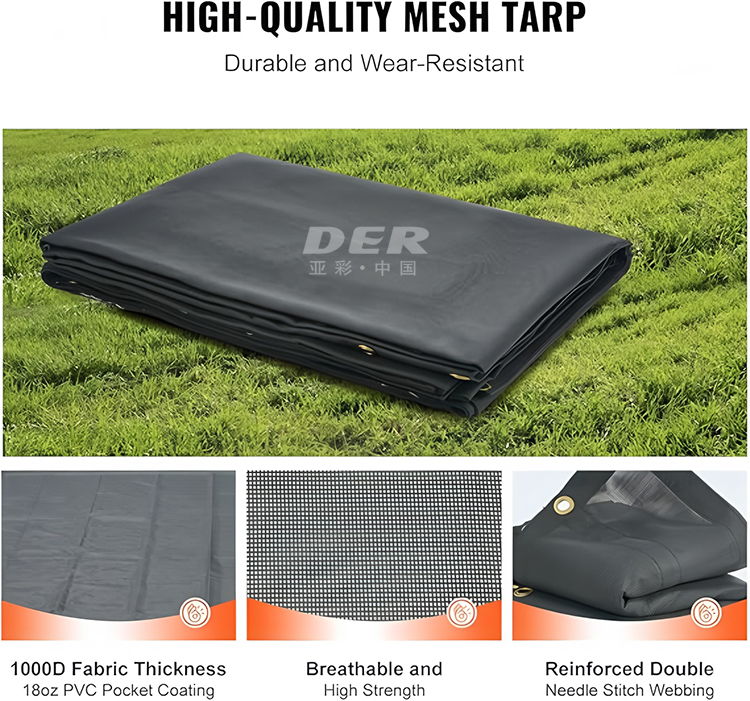
Heavy-Duty Transfer Trailer Tarp Built Around Real Hauling Conditions
Transfer trailer coverage is usually a balance between containment, airflow, handling weight and weather protection. Heavy-duty coated mesh is often practical for refuse and debris because air can pass through the surface, which can reduce billowing compared with a solid sheet. Solid PVC-coated polyester is a different solution: it is selected when a waterproof surface, dust control or protection from rain and road spray matters more than ventilation.
The right choice is not automatically the heaviest material. A tarp that is too stiff or unnecessarily heavy can become harder to roll, pull or deploy. A tarp that is too light for abrasive waste may wear prematurely at hems, attachment points or areas that repeatedly contact system hardware. The specification should therefore start with cargo and operation, then move to material and reinforcement.
Mesh vs. Waterproof Transfer Trailer Tarp
The material decision should follow the cargo. Mesh and solid vinyl solve different problems, and treating one as a universal substitute for the other can create unnecessary handling, wind or weather issues.
Match the Tarp to the Deployment Method
Transfer trailers use several tarp-system layouts in the market. DERFLEX focuses on the cover and material side, so the most useful starting point is identifying how the current tarp moves and where it is attached.
Side-Roll Systems
Require stable width, balanced flex, durable side reinforcement and correct roller or pocket details so the cover can roll consistently across the trailer.
Flip / Lid-Style Systems
Use the tarp as part of a moving lid assembly. Stress locations, frame contact and attachment positions should be copied accurately from the existing configuration.
Pull, Cable or Semi-Automatic Systems
Need controlled weight, flexible handling and reinforcement where cables, pulls, bows or moving components repeatedly contact the cover.
Replacement Tarp Programs
Should be developed from the finished tarp dimensions and attachment geometry, not only from the nominal trailer model or body length.
Custom Transfer Trailer Tarp Specification Framework
The values below are sourcing directions rather than blanket performance promises. Final construction should be confirmed against trailer geometry, cargo, operating frequency, climate and the existing tarp mechanism.
| Specification Item | DERFLEX Available Direction | Why It Matters on Transfer Trailers |
|---|---|---|
| Material | Heavy-duty woven/coated mesh; solid PVC/vinyl coated polyester; project-based reinforced builds. | Controls airflow, weather barrier, handling weight, abrasion behavior and system movement. |
| Solid PVC Duty Range | Typical heavy-duty DERFLEX truck tarp structures are available in roughly 550–1100 gsm directions, with final grade selected by project. | Higher weight can add robustness but also increases finished tarp mass and may affect operation. |
| Finished Size | Made to drawing, old tarp dimensions, trailer opening dimensions or approved sample. | Fit accuracy affects overlap, containment, rolling behavior and wear at moving hardware. |
| Edge Construction | Reinforced hems, webbing, double-layer zones, stitched or welded details according to material and design. | Edges are frequent failure locations because they carry pull load and contact system components. |
| Pockets / Sleeves | Custom roller, pull-bar, pipe or chain pocket directions based on the existing mechanism. | Incorrect pocket diameter or position can interfere with deployment and increase localized stress. |
| Hardware Integration | Grommets, D-rings, webbing loops, chain edge, rope edge or application-specific attachment details. | The tarp must connect to the trailer system without concentrating loads in weak areas. |
| Color & Branding | Commercial colors, project-based color matching, labels, logo printing and private-label packaging where applicable. | Useful for fleet identification, distribution programs and aftermarket branding. |
| Supply Format | Finished tarp, cut panels, semi-finished components or roll material depending on order structure. | Supports fleets, local fabricators, tarp-system dealers and wholesale distributors with different conversion capabilities. |
| Repeat-Order Control | Approved sample, drawing revision, packaging specification and repeat production reference. | Reduces size drift and finishing changes across fleet replacement cycles or channel orders. |
From Worn Tarp to Repeatable Replacement Program
A strong custom transfer trailer tarp program begins with reverse-engineering the working cover: where it attaches, where it rolls, where it touches the frame and where failures repeatedly occur. That information is more useful than simply asking for “heavy duty.”
DERFLEX supports buyers who need custom finished tarps as well as material-level supply. This makes the page relevant to fleet operators, aftermarket distributors, tarp-system service companies, converters and OEM buyers evaluating a transfer trailer tarp manufacturer or transfer trailer tarp supplier for repeat requirements.
For broader transport sourcing, the DERFLEX truck tarp manufacturer page explains the wider material and OEM platform behind trailer, dump, flatbed and bulk-hauling tarp programs.
Document the current system
Photograph the trailer open and closed, show the roller or lid hardware, and identify stationary and moving edges.
Use finished tarp dimensions
Record length, width, pocket sizes, attachment spacing and reinforcement locations. Do not rely only on trailer model names.
Choose material by cargo
Select mesh for breathable containment or solid PVC when weather-barrier protection is needed; then confirm duty level and handling goals.
Strengthen real wear points
Use webbing, ad, ditional layers or revised pocket construction where the old tarp shows repeat abrasion or tearing.
Confirm a drawing or sample
For recurring orders, freeze the construction after approval so dimensions and finishing can be referenced consistently.
Build a replacement cycle
Standardize SKU naming, packing, labels and revision control for fleets, dealers or wholesale transfer trailer tarp programs.
Where Transfer Trailer Tarps Are Commonly Specified
The same trailer can haul very different material over its service life. A procurement specification should describe the dominant cargo and the conditions the tarp sees most often, especially if the program is being standardized across multiple trailers.
Bulky, irregular loads can create pressure points. Heavy-duty mesh is often useful where airflow and containment are priorities.
Containment-firstRough edges and repeated loading increase abrasion risk, so hem reinforcement, webbing and wear-zone design deserve attention.
Abrasion-awarePaper, plastic, packaging and other low-density material can be wind-sensitive; breathable coverage may help manage wind load while retaining material.
Airflow-focusedBranches and landscaping debris may snag or press against the cover, making tear behavior and localized reinforcement important.
Flexible handlingWhere rain exclusion is a procurement requirement, solid PVC/vinyl is usually more appropriate than open mesh, subject to system and seam design.
Weather barrierWhat to Send for a Faster Transfer Trailer Tarp Quote
A custom transfer trailer tarp quote becomes more meaningful when the supplier can see the actual operating geometry. A short list of dimensions without system photos often leaves important questions unanswered: which edge is fixed, which edge moves, where the roller sits, how the tarp overlaps, and which areas carry tension.
If an existing tarp fits correctly, it can be used as a reference for replacement development. If it fails too early, do not simply duplicate the old construction. Mark the failure areas and explain the duty cycle so reinforcement can be considered at the right locations. This is particularly useful for fleet buyers and transfer trailer tarp wholesale programs where the same design will be repeated across many units.
Buyers comparing a waterproof transfer trailer tarp should also explain what “waterproof” means in the application. Is the goal to keep a moisture-sensitive cargo dry, reduce rain entering the trailer, control fine material, or simply use a non-porous surface? That answer determines whether solid PVC is appropriate and how seams and hardware should be treated.
Practical RFQ format
“Transfer trailer / system type / finished tarp size / mesh or solid PVC / pocket & edge details / cargo / quantity / destination / photos attached.” This gives the technical team a much better starting point than the phrase “send price for heavy duty tarp.”
Why Buyers Use DERFLEX for Custom & Wholesale Transfer Trailer Tarps
The value of a transfer trailer tarp supplier is not only the first shipment. For fleets, dealers and OEM channels, consistent dimensions, repeatable finishing and a clear replacement specification are central to total procurement performance.
Coated Fabric Manufacturing Background
DERFLEX works across PVC-coated polyester and transport tarp materials, allowing the project to start from fabric behavior rather than only from finished-cover appearance.
Drawing- and Sample-Based Development
Size, pockets, webbing, hems, grommets and reinforcement can be developed around the existing trailer system or a buyer-approved reference.
Mesh and Solid PVC Directions
Buyers can choose breathable mesh for refuse and debris containment or solid PVC/vinyl where a weather barrier is more important.
OEM & Private-Label Support
Custom labeling, packing and repeat-order documentation can support dealers, distributors, service networks and aftermarket product programs.
Specification Control for Reorders
Approved drawings or samples help keep key dimensions and finishing details consistent when the same transfer trailer tarp is ordered again.
Broader Truck Tarp Capability
Transfer trailer programs can be coordinated with roll-off, dump truck, mesh and waterproof truck tarp sourcing instead of treating every cover as an unrelated item.
Compare Related DERFLEX Transport Tarp Solutions
These six pages are the closest adjacent resources for buyers specifying transfer trailer tarp material, waste hauling covers and replacement programs.
Transfer Trailer Tarp Questions
Answers are framed for fleet buyers, tarp-system service companies, trailer builders, distributors and OEM buyers sourcing custom or replacement covers.
What material is commonly used for a transfer trailer tarp?
Can DERFLEX make a custom transfer trailer tarp from an old tarp?
Is a waterproof transfer trailer tarp available?
Does DERFLEX supply complete electric or hydraulic transfer trailer tarp systems?
What information does a transfer trailer tarp manufacturer need for a quotation?
Can DERFLEX support transfer trailer tarp wholesale and OEM programs?
How should a heavy duty transfer trailer tarp be specified?
Send the Trailer Geometry. We’ll Help Define the Tarp Specification.
Share your system photos, finished tarp dimensions, cargo, material preference, reinforcement details and quantity. DERFLEX can review a suitable mesh or solid PVC/vinyl direction for custom transfer trailer tarp, replacement, OEM and wholesale requirements.
Old tarp photos · trailer opening dimensions · pocket/bar measurements · grommet/webbing layout · current material · failure photos · target quantity.
Request A Quote