News
Company News

Hot-Air Welded vs RF Welded vs Sewn Tarp Seams | DERFLEX

Update:2026/8/2 17:41:08 Views:
DERFLEX logo PVC Tarpaulin Seam Engineering

Hot-Air Welded, RF Welded or Sewn Tarp Seams: Which Construction Will Keep Water Out?

A waterproof tarp is only as dependable as its seams, corners and fastening points. This buyer-focused guide compares hot-air welding, high-frequency welding and industrial sewing so you can specify the right construction for PVC tarps, truck covers, equipment covers, construction protection and OEM tarpaulin programs.

Will the tarp leak? A qualified welded seam can create a continuous water-resistant joint without needle holes, but “welded” alone is not a guarantee. Incomplete fusion, narrow overlap, contamination, corners, grommets, water pooling and poor installation can still create leakage. A sewn seam contains needle penetrations and normally needs a compatible sealing method when reliable rain protection is required.
Four Construction Paths

Start with the Function of Each Seam, Not a Blanket Rule

Large tarp panels, fitted corners, webbing, hardware and field repairs do not all carry load or shed water in the same way. One finished cover may need more than one joining method.

01

Hot-Air Welded PVC Tarp

Heated air softens the overlapping PVC surfaces; pressure rollers consolidate the joint as the coating cools. The method is adaptable to long straight seams, large panels and varied dimensions.

Best fit: long flexible production runs
02

High-Frequency / RF Welded

Electromagnetic energy heats compatible polar thermoplastics such as many PVC and TPU structures from within the joint. Tooling and pressure help create repeatable sealed shapes.

Best fit: controlled PVC sealing programs
03

Industrial Sewn Seam

Needle and thread mechanically join the layers. Sewing accommodates mixed materials, canvas, tight curves and multilayer attachments, but stitch holes interrupt the waterproof surface.

Best fit: complex geometry and attachments
04

Hybrid Seam Architecture

Water-shedding panel joins are welded while webbing, straps, pockets or selected reinforcement zones use sewing or another engineered attachment method.

Best fit: heavy-duty custom covers

A seam can leak in more than one place

Leak-Path Analysis

Why a Waterproof Fabric Can Still Become a Leaking Tarp

Base fabric waterproofness is only one layer of the finished-cover system. The following details often determine whether rain stays outside.

1

Incomplete weld fusion

Insufficient heat, RF energy, pressure, dwell time or surface activation can leave channels inside an apparently closed overlap.

2

Overheating or coating damage

Too much heat may distort the surface, thin the coating, damage the scrim or create a brittle transition next to the seam.

3

Sewn needle penetrations

Thread may occupy much of the stitch hole, but water can still travel through the penetration or along the stitch line unless it is sealed or covered.

4

Corners and seam transitions

Cross-seams, folded corners, cut-outs and changes in layer count can concentrate stress or leave small gaps outside the main straight weld.

5

Grommets, D-rings and attachments

Every penetration and rigid hardware zone needs its own reinforcement and sealing logic; strong panel seams cannot compensate for weak fixing points.

6

Water pooling and installation

A cover intended to shed rain can be overloaded when it is installed flat, sags between supports or holds standing water for long periods.

Technical Comparison

Hot-Air Welding vs High-Frequency Welding vs Sewing

The correct method depends on material chemistry, seam geometry, production volume, water demand, loading direction and how the product will be maintained.

Decision Factor Hot-Air Welding HF / RF Welding Industrial Sewing
Joining principle External heated air softens compatible surfaces before roller pressure forms the bond. Electromagnetic energy generates heat within compatible thermoplastic layers under an electrode. Thread mechanically locks layers together through needle-made penetrations.
Typical material fit Many PVC, PU, PE and coated thermoplastic fabrics, subject to process trials. Especially suitable for compatible polar thermoplastics such as many PVC and TPU constructions. Broad range of coated and uncoated textiles, canvas and mixed-material assemblies.
Waterproof seam potential High when the material, overlap and process window are qualified. High for compatible structures and controlled tooling; suitable for demanding sealed joints. Not inherently waterproof because the needle creates holes; secondary sealing may be required.
Best geometry Long straight joins, hems, continuous panels, changing dimensions and selected curves. Repeat shapes, precise seams, patches, valves, formed details and controlled production layouts. Tight curves, three-dimensional fitted covers, multilayer attachments and complex assemblies.
Production flexibility Flexible and relatively easy to adapt to different seam lengths and panel sizes. Highly repeatable after tooling and settings are established, but tooling can constrain geometry. Highly adaptable for short runs and design changes when skilled operators are available.
Field repair Possible with compatible patch material and suitable hot-air equipment after cleaning and preparation. Factory-style repair may require RF equipment or a qualified alternative patch process. Restitching is familiar to many workshops, although waterproof resealing may still be needed.
Main process risks Temperature, airflow, pressure and speed variation; contamination; overheating or underheating. Incorrect energy, dwell, electrode pressure, tooling alignment or material incompatibility. Thread wear, skipped stitches, tension errors, perforation tear-out and leakage through holes.
Commercial fit Long tarp seams, tents, awnings, truck curtains, covers and variable custom production. Repeat PVC programs, inflatables, containment products and seams needing precise sealed shapes. Canvas tarps, fitted equipment covers, webbing zones, straps, pockets and mixed constructions.

Important: A claim such as “RF is stronger” or “hot air is waterproof” is incomplete without the actual fabric grade, seam width, loading direction, machine settings and acceptance test. Compare an approved seam sample, not only the process name.

Fast Selection Guide

Choose by the Dominant Failure Risk

The method should answer the most important question first: what must this part of the tarp prevent or carry?

Choose hot-air welding when…

You need practical continuous seams in weldable coated fabric with frequent size changes or long panel joins.

  • Large PVC tarp panels exceed roll width
  • Long seam speed and production flexibility matter
  • Portable or on-site equipment may be useful
  • The factory can control heat, airflow, speed and pressure

Choose HF / RF welding when…

The material is RF-compatible and the project benefits from repeat tooling, defined seam shapes or stringent sealing.

  • PVC or TPU structure has been confirmed compatible
  • Airtight or liquid-barrier performance is central
  • Repeat production justifies equipment and tooling
  • Consistent shaped welds, patches or multilayers are needed

Choose sewing or hybrid when…

The design contains non-weldable materials, demanding curves, heavy webbing or details that must remain easy to repair.

  • Canvas or mixed textiles cannot be welded reliably
  • Straps, pockets, sleeves and hardware transfer local load
  • Complex fitted geometry changes direction frequently
  • A sealing tape, flap or welded cap strip can protect stitch holes
DERFLEX custom PVC tarps showing reinforced hems, seams and grommets
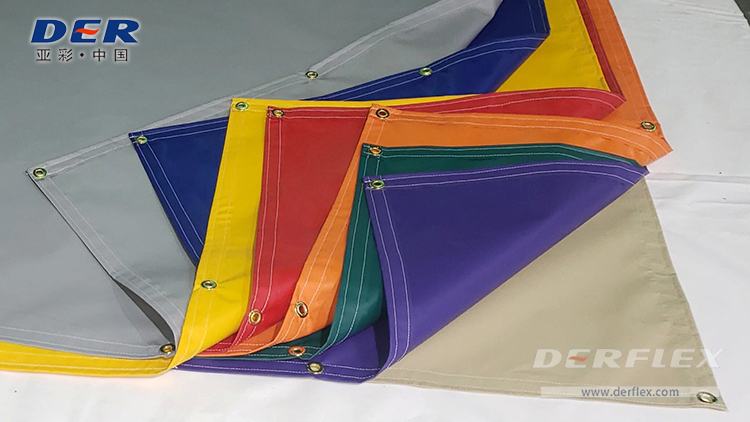
DERFLEX PVC coated polyester tarps can be supplied as roll goods, cut panels or finished covers with project-specific seams, hems, reinforcement and hardware.
DERFLEX Manufacturing Support

Build the Seam Plan Together with the Material Specification

Weldability is not an isolated finishing feature. PVC coating formulation, surface treatment, base scrim, fabric weight, thickness, stiffness and the intended welding equipment all influence the process window and finished seam.

DERFLEX supports B2B buyers, converters, distributors and OEM brands with PVC tarpaulin material selection, cut-panel planning and custom finished-cover discussions. The objective is to match the material, joining process and reinforcement layout before repeat production begins.

PVC coated polyester Hot-air weld direction HF / RF weld direction Sewn & hybrid details Custom hems & webbing OEM color & packaging

Available project formats can include continuous tarp rolls for local fabrication, cut panels, pre-welded components and finished custom tarps. Final feasibility and performance are confirmed against the approved material, drawing, sample and agreed inspection method.

Send Your Tarp Drawing
Application Engineering

Recommended Seam Architecture by Tarp Use

These directions help procurement teams start the specification. The final design should be verified with actual material, dimensions, loads and installation conditions.

Truck, Trailer and Cargo Tarps

Moving air, repeated folding, cargo-edge abrasion and tie-down loads place different demands on the panel field and perimeter.

Typical direction: welded main panels + reinforced hems + engineered webbing, straps and hardware zones.

Construction and Outdoor Storage Covers

Rain shedding, wind uplift, irregular objects and temporary installation make drainage and edge restraint as important as the central seam.

Typical direction: hot-air welded overlaps for PVC panels; protected corners and reinforced fixing points.

Equipment and Machinery Covers

Fitted shapes may need curves, access panels, vents, zippers, pockets or abrasion patches around projecting parts.

Typical direction: hybrid fabrication combining welded weather zones with sewn or welded shaped details.

Tents, Shelters and Industrial Curtains

Long roof or wall panels favor continuous welding, while doors, reinforcement strips and suspension hardware may require different attachments.

Typical direction: welded panel joins; application-specific treatment at zippers, suspension points and intersections.

Liquid, Air or Gas Containment

Containment places greater demand on seam continuity than ordinary rain covers and may require pressure, leakage and material-compatibility tests.

Typical direction: qualified HF/RF or another validated welding process; do not rely on unsealed sewing.

Canvas or Breathable Tarps

Non-thermoplastic textiles may not provide a weldable interface and can be selected specifically for breathability or traditional handling.

Typical direction: sewn seams with suitable lap geometry; add sealing only where the fabric and application allow.
Sample Approval

What to Check Before Mass Production

A seam sample should represent the production material, machine, operator or tooling, overlap, reinforcement and actual loading direction.

1. Visual continuity

Check straightness, wrinkles, scorching, exposed scrim, skipped weld areas, open edges and consistent seam width.

2. Peel and shear behavior

Evaluate how the seam behaves when force tries to peel layers apart and when load is carried along the overlap.

3. Water or leakage check

Use a method appropriate to rain shedding, spray, standing water, air retention or liquid containment—not one generic “waterproof” test.

4. Cross-seam and corner review

Inspect intersections, changes in layer count, folded corners and transitions that may not match straight-seam performance.

5. Hardware pull zone

Confirm the grommet, D-ring, webbing or strap is supported by the correct hem and reinforcement rather than only the surface fabric.

6. Flexing and environmental direction

Consider repeated folding, UV, temperature, abrasion, cleaning and the aging of thread, seam tape or coating around the joint.

Procurement Checklist

How to Request a Quote That Prevents Seam Ambiguity

“Waterproof PVC tarp with strong seams” is not a complete specification. Give the supplier enough information to design and quote the finished construction rather than guess.

  1. Application and water demand: rain cover, road spray, outdoor storage, pooled water, dust barrier, airtight product or liquid containment.
  2. Material direction: PVC, TPU, PE, canvas or reference sample; target w, eight, thickness, color, width and surface finish where known.
  3. Finished dimensions and drawing: include seam direction, curves, cut-outs, doors, windows, pockets and dimensional tolerance.
  4. Load map: wind exposure, tie-down tension, cargo movement, sharp edges, repeated folding, dragging and abrasion points.
  5. Joining method: hot-air, hot-wedge, HF/RF, sewing or supplier-recommended hybrid; provide machine information when buying roll goods.
  6. Edge and hardware details: hem type, webbing, rope edge, grommet spacing, D-rings, straps, buckles and reinforcement patches.
  7. Acceptance criteria: approved sample, appearance, seam width, leakage check, seam-strength direction, hardware pull and packing method.
  8. Commercial program: quantity, repeat-order frequency, logo, label, carton or bale requirements, destination and documentation needs.
Buyer FAQ

Questions About Waterproof Tarp Seam Construction

Is a hot-air welded PVC tarp seam waterproof?
A correctly designed and qualified hot-air welded overlap can provide strong water resistance because the PVC surfaces are fused without a stitched penetration line. Final performance still depends on material compatibility, overlap, heat, airflow, pressure, speed, cleanliness, corners, hardware and installation.
Is high-frequency welding better than hot-air welding?
HF/RF welding can produce highly repeatable sealed joints in compatible PVC or TPU structures and is useful for precise shapes and demanding airtight or liquid-barrier products. Hot-air welding is often more flexible for long seams, changing dimensions and varied coated materials. “Better” depends on the product and production model.
Will a sewn tarp seam leak?
Sewing creates needle holes, so an untreated stitch line is not normally the first choice for a rain-critical primary seam. Leakage can be reduced with compatible seam tape, sealant, a covered lap, welded cap strip or water-shedding flap, but the complete treatment should be tested for flexing and weather exposure.
Why are some heavy-duty tarps both welded and sewn?
Different tarp zones perform different jobs. Welded panel seams support waterproof continuity, while webbing, straps, pockets and complex hardware areas may benefit from sewing or multilayer mechanical attachment. A hybrid plan can balance water protection, load transfer, fabrication and repair.
Are all PVC tarp materials suitable for RF welding?
No. PVC is generally associated with RF weldability, but coating formula, thickness, reinforcement, lacquer, surface treatment and the actual equipment influence results. The selected production material should be tested on representative machinery before the specification is approved.
What seam should I specify for a truck tarp?
For many PVC truck tarps, welded main panel joins are practical, while the perimeter, corners, webbing, straps, D-rings and abrasion zones require separate reinforcement decisions. Provide the cargo shape, wind exposure, tarp system, folding frequency and tie-down layout for a more reliable recommendation.
Can DERFLEX supply both weldable tarp rolls and finished covers?
DERFLEX can discuss PVC tarpaulin roll goods, cut panels, pre-fabricated components and custom finished tarp projects. Available details can include welded or hybrid seams, hems, webbing, grommets, D-rings, straps, pockets, printing, labels and OEM packaging, subject to project confirmation.

Not Sure Whether to Use Hot Air, RF Welding or Sewing?

Send DERFLEX the material, tarp dimensions, seam locations, application, water requirement, reinforcement layout and expected quantity. The team can review a practical construction direction for sampling and quotation.

Technical performance varies with material, seam geometry, processing parameters, workmanship, testing method, installation and service environment. Confirm final requirements through an approved specification and representative sample.
Consulting Services
+86-021-54361792 / 54361798
Email
sales@derflex.com