Test method and endpoint
Ask whether the result follows ISO 811, AATCC TM127 or another defined procedure. “Waterproof 10,000 mm” without a test method, test report or specimen description is incomplete.



 Technical Tarp Selection Guide
A hydrostatic-head rating tells you how much water pressure a tarp fabric resists in a controlled test—not how long every finished tarp will remain leak-free in every installation.
This guide helps procurement teams, tarp converters, outdoor brands and industrial buyers translate water-column numbers into a practical specification covering fabric, coating, seams, reinforcement, use conditions and test documentation.
A 2,000 mm fabric resists the pressure generated by a two-metre water column in the stated laboratory test; 8,000 mm corresponds to eight metres, and 10,000 mm to ten metres. Those figures are approximately 19.6, 78.5 and 98.1 kPa respectively. They compare the fabric's resistance to water penetration, but the finished tarp still depends on seams, welding, eyelets, edge reinforcement, surface angle, abrasion, UV ageing and how long water remains pooled.
In a hydrostatic-pressure test, a fabric specimen is clamped into a test head and exposed to steadily increasing water pressure. The reported value represents the pressure at which the specified leakage endpoint is reached. The result is commonly written as millimetres of water column, mm H₂O, or simply “mm.”
ISO 811 and AATCC TM127 are two commonly referenced methods for measuring resistance to water penetration under hydrostatic pressure. A serious procurement specification should name the method rather than listing only a number, because test equipment, pressure increase rate, specimen preparation and endpoint rules can influence the result.
The table below is an application-selection guide, not a universal pass/fail rule. Final suitability should be confirmed using the same test method, representative production samples and the finished-product construction.
| Hydrostatic head | Pressure equivalent | Practical meaning | Typical procurement direction | What still needs checking |
|---|---|---|---|---|
| 2,000 mm2 m water column | ≈ 19.6 kPa ≈ 2.84 psi |
A meaningful waterproof benchmark for many coated tarp fabrics exposed mainly to rain, provided the coating is continuous and the finished cover drains correctly. | General truck covers, equipment covers, temporary weather protection, sloped canopies and standard outdoor PVC tarpaulin programs. | Welded or sealed seams, no long-term ponding, adequate UV package, correct tensioning and sufficient tear strength around fixings. |
| 8,000 mm8 m water column | ≈ 78.5 kPa ≈ 11.38 psi |
A much higher water-pressure margin for fabric that may experience contact pressure, repeated wet use or more demanding waterproof-product expectations. | Dry-bag material, higher-grade tent floors, marine covers, industrial enclosures, demanding storage covers and premium reusable tarp lines. | Flex-cracking after folding, abrasion resistance, coating adhesion, weld compatibility, low-temperature flexibility and ageing after UV exposure. |
| 10,000 mm10 m water column | ≈ 98.1 kPa ≈ 14.22 psi |
High hydrostatic resistance for buyers seeking a larger safety margin against penetration through the coated fabric. | High-spec waterproof covers, ground-contact barriers, containment-oriented fabric systems and applications where pressure or prolonged moisture exposure is a major concern. | Whether the complete product is designed for containment; seam and fitting tests; chemical compatibility; puncture risk; field installation and drainage strategy. |
Pressure conversions are rounded. Actual acceptance criteria should be written into the purchase specification together with the test method and sampling plan.
Hydrostatic head is valuable because it is measurable. It becomes misleading only when it is treated as the complete description of a tarp.
Ask whether the result follows ISO 811, AATCC TM127 or another defined procedure. “Waterproof 10,000 mm” without a test method, test report or specimen description is incomplete.
PVC coating weight, formula, pinhole control, base-fabric coverage and coating adhesion affect whether the rating remains stable after folding, welding and outdoor use.
Needle holes, poorly set welding parameters, unsealed overlaps and fittings can become leakage paths even when the flat fabric has a high laboratory rating.
A sloped, correctly tensioned tarp sheds water. A loose cover creates pockets where water accumulates, adding weight and sustained pressure at low points.
Cargo corners, ground contact, kneeling, straps and repeated dragging can damage the coating locally. High tear and abrasion resistance often matter as much as the initial water-column value.
Sunlight, plasticizer migration, cold flexing, heat and cleaning chemicals can change coating performance. Buyers should distinguish initial test data from aged-performance requirements.
Start with the real service condition, then determine the required pressure margin. Higher is not automatically better when it adds weight, stiffness or cost without solving the actual failure mode.
Rain exposure, wind, tension, abrasion and repeated handling dominate. Seam welding and tear strength are critical.
Common starting direction: 2,000 mm+Drainage slope, fastening, wind uplift and puncture risk may govern field performance more than an extreme rating.
Common starting direction: 2,000–8,000 mmFlysheet and roof panels see falling rain, while floor panels experience body and ground pressure.
Typical direction: roof lower, floor higherFolding, welding, splash, repeated wet contact and pressure against contents require a more demanding fabric system.
Common starting direction: 8,000 mm+Standing water, puncture, fittings and seam integrity require application-specific engineering and finished-product testing.
Direction: 10,000 mm or project-defined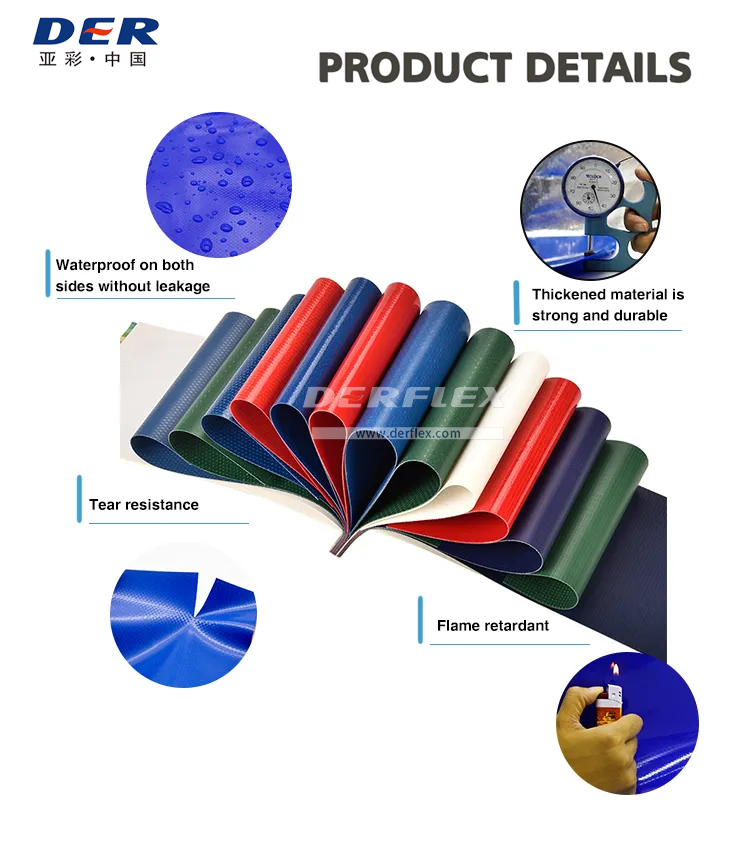
DERFLEX supplies PVC-coated polyester fabric for tarps, covers, shelters, dry bags, logistics, construction and industrial conversion. Depending on the project, a buyer can discuss 2,000 mm, 8,000 mm, 10,000 mm or another verified hydrostatic-pressure target together with the base cloth and finished-product requirements.
The objective is to create a repeatable production specification that balances water resistance with tensile strength, tear resistance, flexibility, weldability, abrasion performance, UV exposure and commercial processing.
A complete inquiry reduces sample rounds and makes quotations easier to compare across manufacturers.
Name ISO 811, AATCC TM127 or the agreed customer method, including the acceptance value and whether the test applies to initial or aged material.
Define PVC-coated or laminated polyester, base-fabric denier, yarn density, total GSM, thickness, coating side and surface treatment.
Include tensile strength, tear strength, adhesion, abrasion and flex resistance where the tarp will be tensioned, folded or dragged.
State whether panels will be hot-air welded, high-frequency welded, sewn and sealed, fitted with eyelets, reinforced with webbing or supplied as finished covers.
Describe UV exposure, temperature range, wind, chemicals, saltwater, cleaning method, ground contact, ponding risk and intended service duration.
Request a representative sample, technical data sheet, test report and agreed lot-inspection plan. For critical projects, test the completed seam or finished assembly as well as the flat fabric.
These six pages connect hydrostatic pressure with material selection, finished-cover construction and bulk PVC tarpaulin sourcing.
Clear answers for buyers comparing waterproof ratings and preparing a custom tarp inquiry.
It can be suitable for many rain-cover applications when the PVC coating is consistent, seams are correctly welded or sealed, the tarp is tensioned and water can drain. It may not be the right target for prolonged ponding, ground pressure, containment or heavily abraded surfaces.
It means the tested fabric resisted pressure equivalent to an eight-metre column of water before reaching the stated penetration endpoint. That is approximately 78.5 kPa or 11.38 psi. The test value applies to the specimen and method reported, not automatically to every seam and fitting in the finished product.
Not automatically. A higher rating provides a larger water-pressure margin, but the best material must also meet weight, flexibility, weldability, tear, abrasion, UV, temperature and cost requirements. For a sloped truck cover, improving edge reinforcement may create more value than specifying an unnecessarily high hydrostatic head.
ISO 811 and AATCC TM127 are commonly referenced hydrostatic-pressure methods for textiles. The purchase order should identify the agreed method, acceptance level, specimen condition and whether third-party or factory test evidence is required.
Yes. Leakage may occur through stitched seams, damaged coatings, poorly welded joints, eyelet areas, punctures or water pockets even when the flat fabric has a high laboratory rating. Finished-product design and fabrication remain essential.
DERFLEX can discuss application-specific PVC tarpaulin structures, including coating construction, GSM, polyester reinforcement, width, finish, UV package, flame-retardant direction and hydrostatic-pressure targets. Final values should be confirmed through sample testing and an agreed production specification.
Send DERFLEX your application, target test method, fabric weight, roll width, color, quantity, fabrication process and environmental requirements. The team can help organize a practical PVC tarpaulin specification and sample route for your program.