


 Coated textile sourcing · Industrial OEM
Neoprene-Coated Nylon Fabric for Industrial Tarps & OEM Covers
Build a more reliable industrial tarp specification around the exposure, not a generic “oil resistant” label. Neoprene-coated nylon combines woven nylon reinforcement with a chloroprene rubber (CR) surface. For converters, equipment-cover brands and OEM buyers, the critical decisions are grade-specific liquid compatibility, flex behavior, weathering evidence and a seam process that suits rubber-coated fabric.
Discuss roll goods, pre-cut panels or fabricated-cover requirements with DERFLEX. The feasibility of a specific CR formulation, supply format and performance target is reviewed project by project.
What Is Neoprene-Coated Nylon — and What Does the Coating Actually Do?
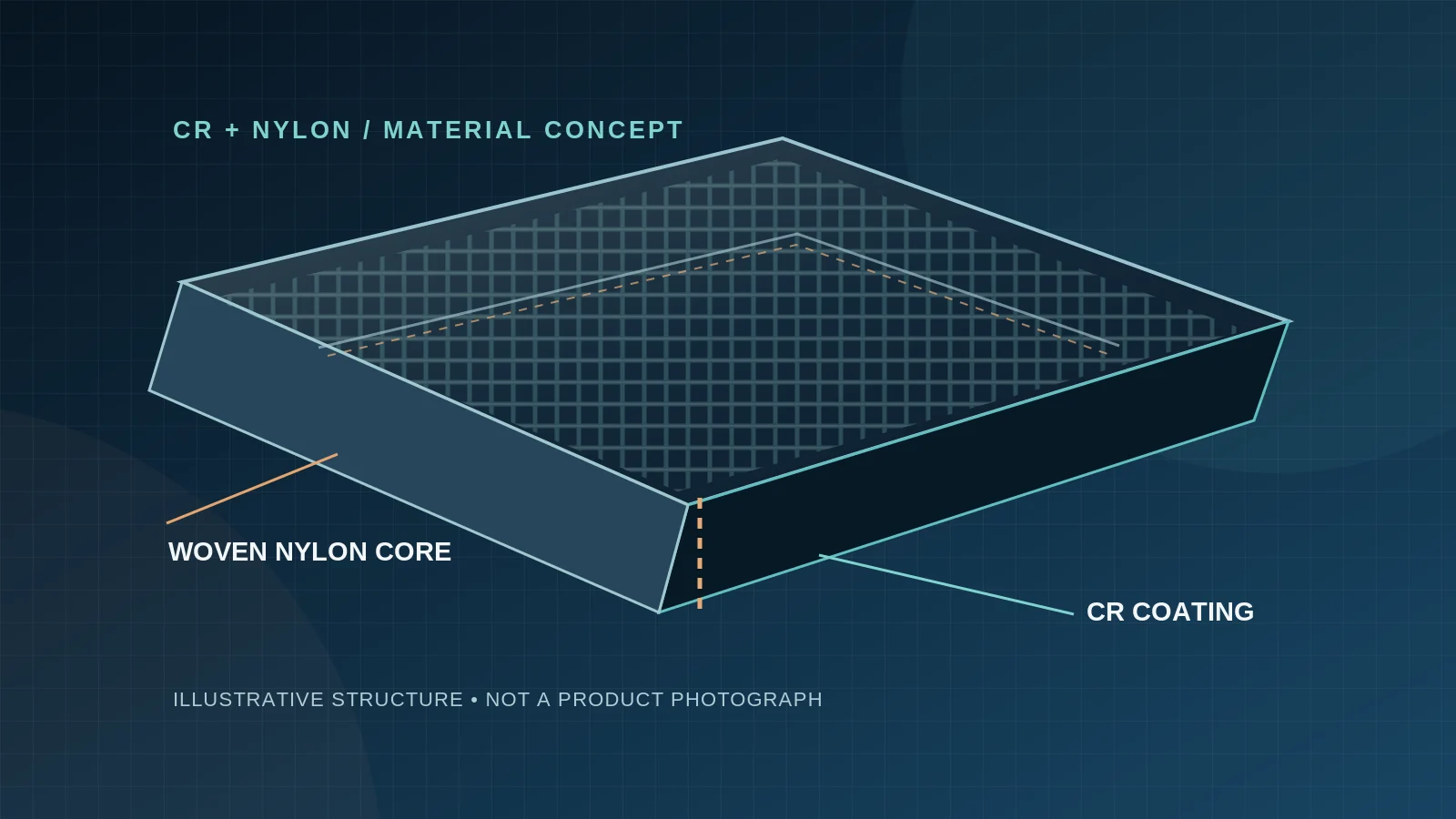
Neoprene-coated nylon is a textile composite made by combining a woven nylon substrate with a chloroprene rubber coating. In industry, “neoprene” is commonly used for the CR elastomer; it is not the same thing as neoprene foam sheet or the chlorosulfonated polyethylene (CSM) family. For tarp manufacturing, the substrate and coating must be evaluated as one engineered structure.
Reinforcement that carries the load
Yarn construction, weave, direction and tear propagation affect mechanical behavior. Request warp and weft results with the exact test method; a high base-fabric rating does not automatically validate the coated composite.
The exposed protective surface
Coating formulation, coat weight and curing influence weathering, grip, surface abrasion, liquid uptake and adhesion. Oil and chemical behavior needs the actual exposure medium and conditions.
Edges and seams determine serviceability
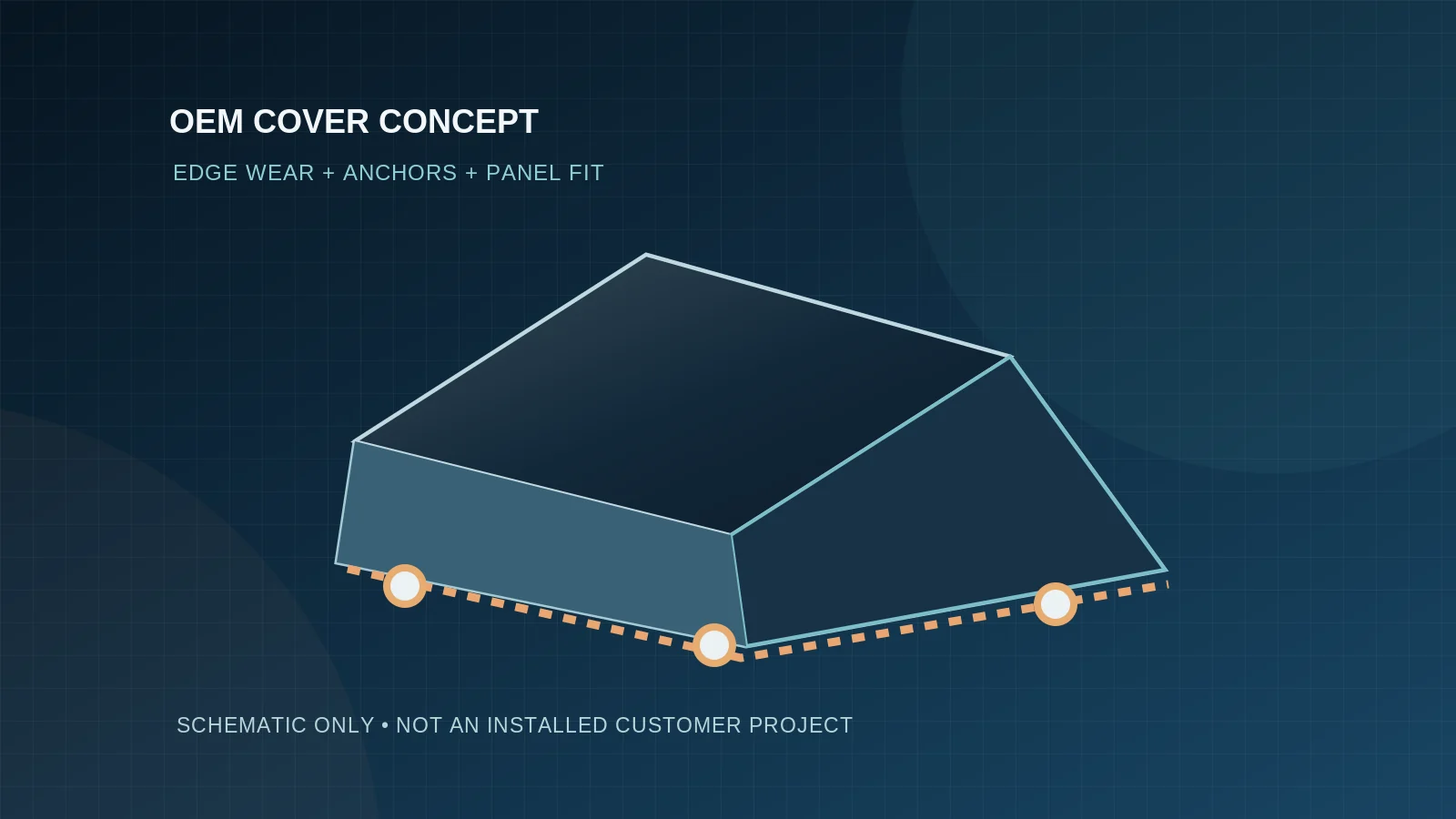
Even when fabric passes a test, stitched seams, adhesive interfaces, grommet penetrations and wear patches may govern leakage or premature damage in the finished cover.
Specify a Fabric System, Not Just “Neoprene Tarps”
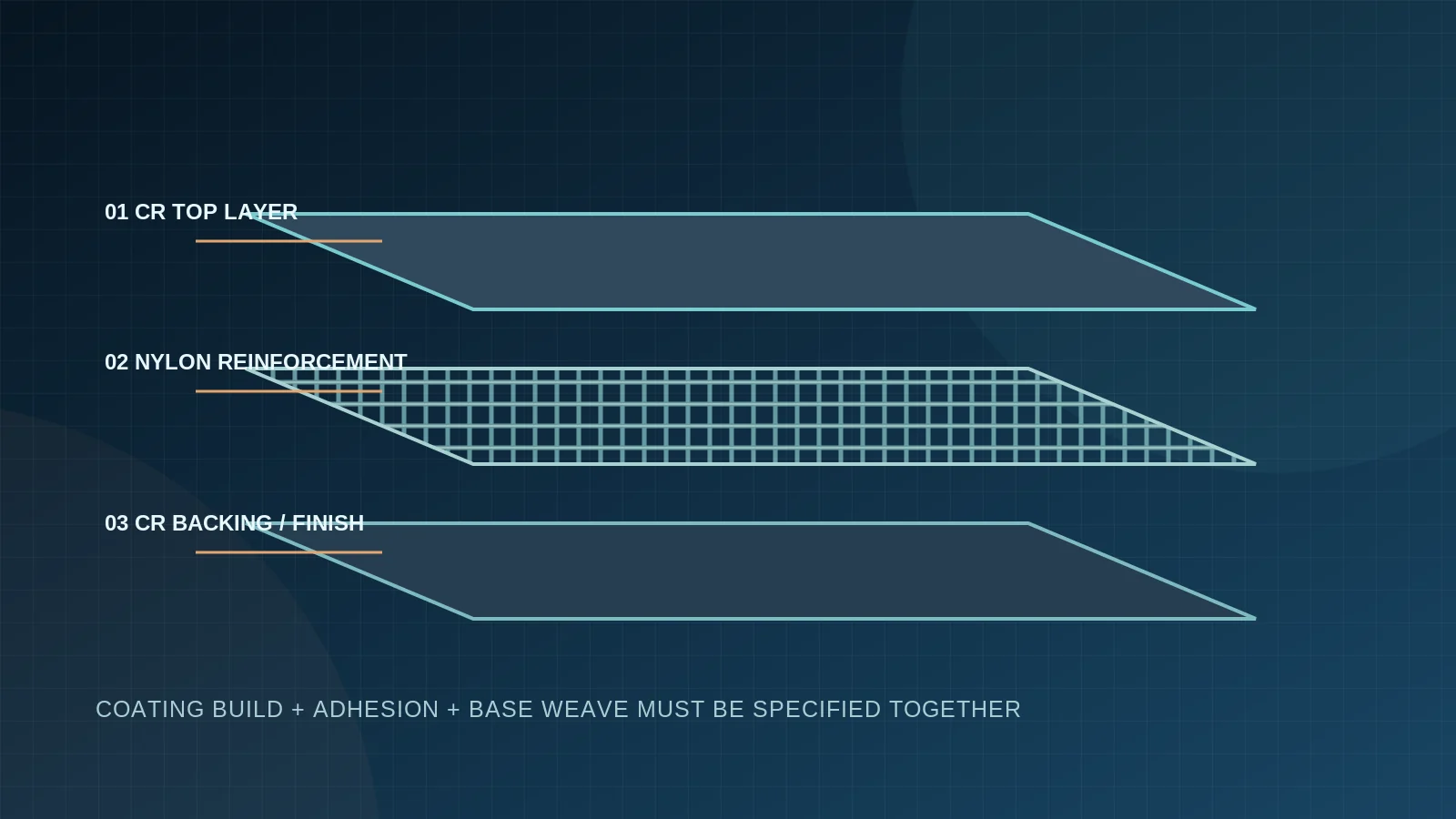
Commercial CR-coated nylon may use single-sided or double-sided treatment and different surface preparations. Buyers should identify whether the exposed face must slide over machinery, resist scuffing, accept adhesive, or withstand repeat folding. A surface treatment that simplifies handling may change bond preparation for seams or patches.
Ask the supplier to identify the base weave, coating on each side, total mass per unit area, thickness, nominal width, finish and accepted tolerance. For repeat OEM supply, add roll orientation, color reference and batch traceability requirements.
For a wider material-family overview, see DERFLEX nylon tarpaulin material options and custom coated fabric solutions. Those pages describe other material routes; they do not establish CR grade stock availability.
The Details an Industrial Tarp Converter Should Put on the RFQ
Before requesting a price, agree on what is being specified. The following fields are a buyer-ready checklist, not a DERFLEX stock list or a published technical data sheet. No unsupported GSM, tensile strength, working temperature or chemical-resistance rating is assigned to this material here.
| Specification field | What to state or request | Why it matters |
|---|---|---|
| Polymer and substrate | Chloroprene rubber (CR) coating; woven nylon grade and construction | Prevents substitutions with PVC, PU, TPU, CSM or neoprene foam. |
| Construction | One-sided or two-sided coat; coating mass; finish and surface preparation | Affects wear, fold behavior, adhesion and bonding. |
| Mass and thickness | g/m² or oz/yd²; millimeters or mils; tolerances; measuring method | Weight cannot be converted to thickness without the actual construction. |
| Width / roll format | Usable width, roll length, core, winding direction and packing | Determines panel layout, seams and shipping. |
| Mechanical requirements | Tensile / tear method, unit, warp / weft values and conditioning | Allows repeatable comparisons between trial and bulk batches. |
| Liquid contact | Named fluid, concentration, temperature, duration and acceptance limits | “Oil resistant” alone cannot qualify chemical service. |
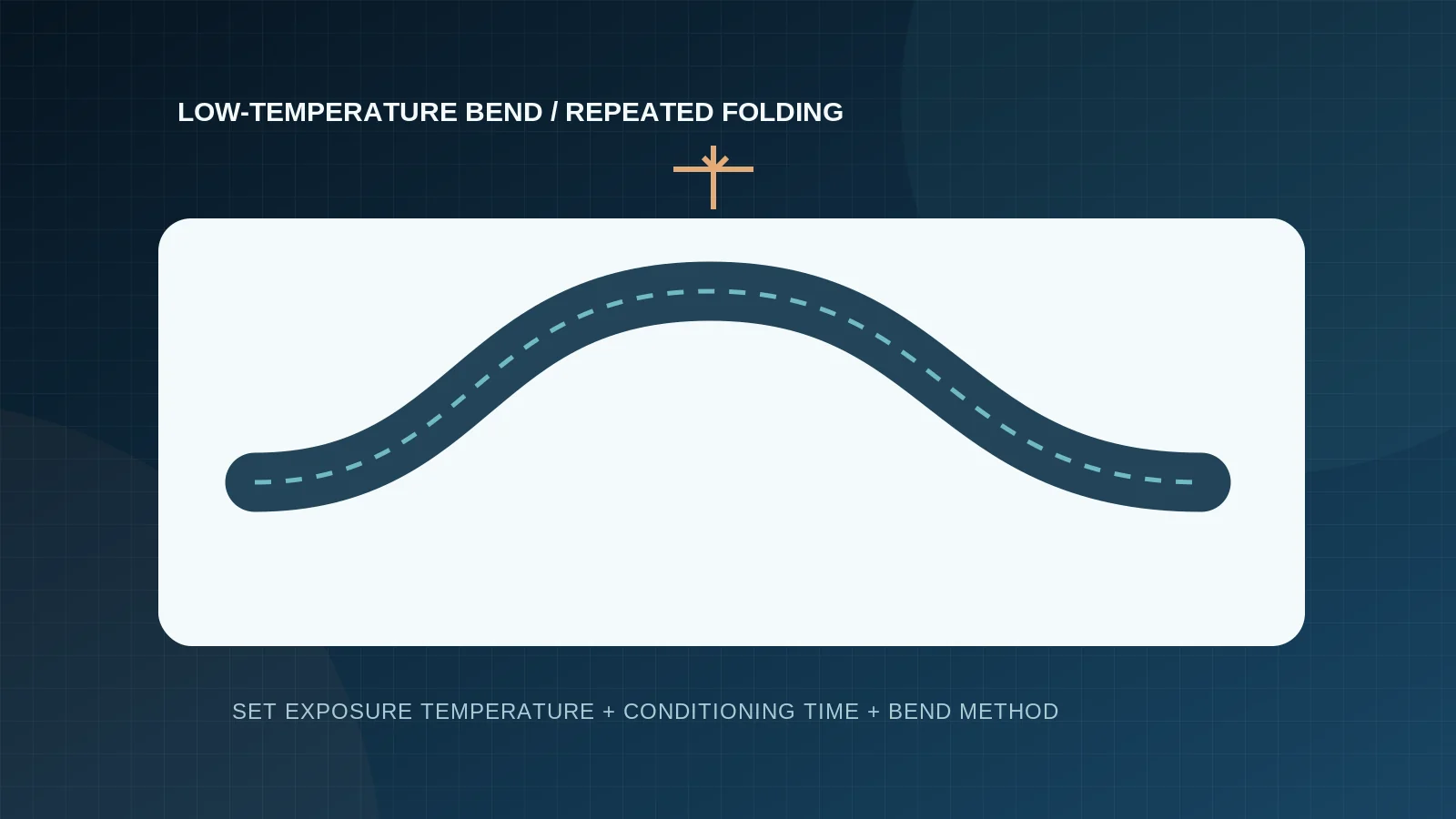
| Cold handling | Lowest fold temperature, exposure time, bend method, cycle plan | Distinguishes flexibility claims from service validation. |
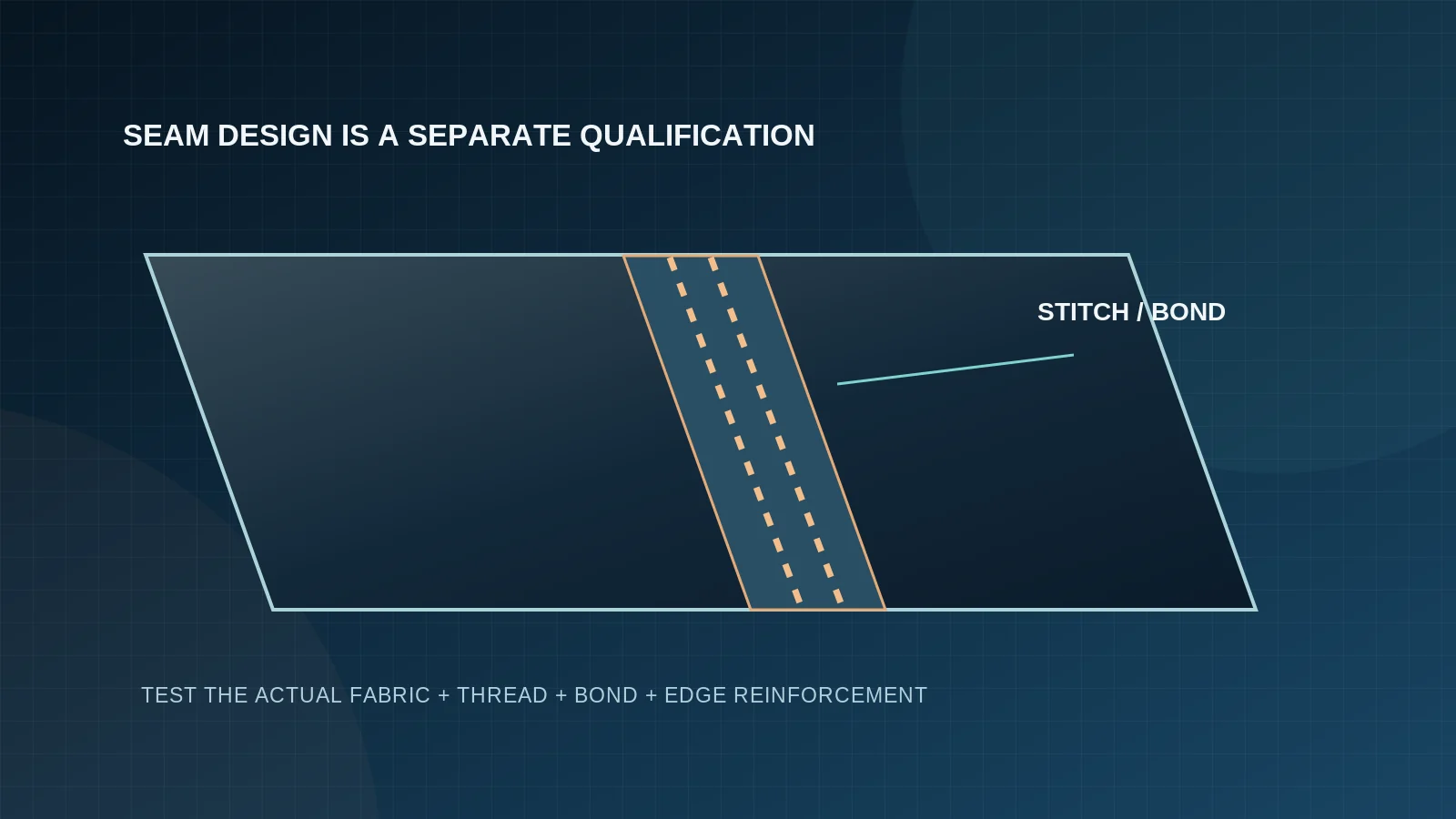
| Fabrication | Stitching, adhesive bonding, seam overlaps, patches and fittings | Material performance does not validate a finished seam. |
| Supply approval | Sample revision, lab reports, acceptance criteria, lot record | Supports OEM reorder consistency. |
Unit reminder: 1 oz/yd² ≈ 33.906 g/m²; 1 mil = 0.0254 mm. Neither figure is a specification of a DERFLEX CR-coated nylon grade.
Where CR-Coated Nylon Can Be Evaluated for Tarp Manufacturing
A material shortlist is not an application approval. Match the exposure and failure mode to a measurable fabric-and-seam requirement, then test representative samples before committing to production.
Machinery and service covers
Useful for assessing a flexible fitted cover exposed to dust, lubricants, abrasion and repeated removal. Define oily contact zones, hot components, corners and access points; avoid trapping heat or obstructing ventilation.
Special-purpose cargo tarp panels
Review CR-coated nylon where road exposure, cold handling or repeated tie-down is relevant. Confirm load restraint separately: tarp fabric and grommets are not a certified cargo-securing system.
Splash shields and removable barriers
Selected oil mist or intermittent splash scenarios may justify a CR trial. For continuous fuel immersion, hazardous spills or regulated containment, require compatibility testing and engineered system approval instead.
Flexible curtains, sleeves and cover assemblies
Potential uses include protective enclosures and replaceable sleeves where flex fatigue and bondability matter. Specify movement frequency, edge rubbing and the attachment geometry.
If your project is instead a conventional waterproof PVC cover, explore industrial PVC tarpaulin options. For transport-specific construction, see truck tarp manufacturing requirements.
Oil, Weather and Cold-Flex Claims Need a Grade-Specific Test Plan
A laboratory method identifies how a property is measured; citing its name does not demonstrate that any particular fabric has passed it. Build the approval plan around the service scenario and the actual batch or candidate sample.
| Decision | Potential reference method | Evidence to ask for |
|---|---|---|
| Liquid-contact behavior | ASTM D471 for applicable rubber compositions or rubber-coated specimens | Exact fluid, test temperature and period; mass / volume changes, visual state, retained properties, seams where relevant. |
| Low-temperature bend | ISO 4675:2017 where within its material and thickness scope | Conditioning and test temperature, time, thickness, bend observation; separately define dynamic fold cycles. |
| Coating adhesion | ISO 2411:2024 | Coating side, sample preparation, test conditions and recorded adhesion result. |
| Tensile and elongation | ISO 1421:2016 | Warp / weft results, method, specimen and unit; retained properties after conditioning if specified. |
| Repeated flexing | ISO 7854:1995 | Selected flexing method, cycle count, visible damage and functional retest. |
Methods listed are candidate references for purchaser–supplier agreement, not certifications or completed DERFLEX test results. Standard applicability and edition should be checked against the final construction.
What a meaningful oil-exposure report includes
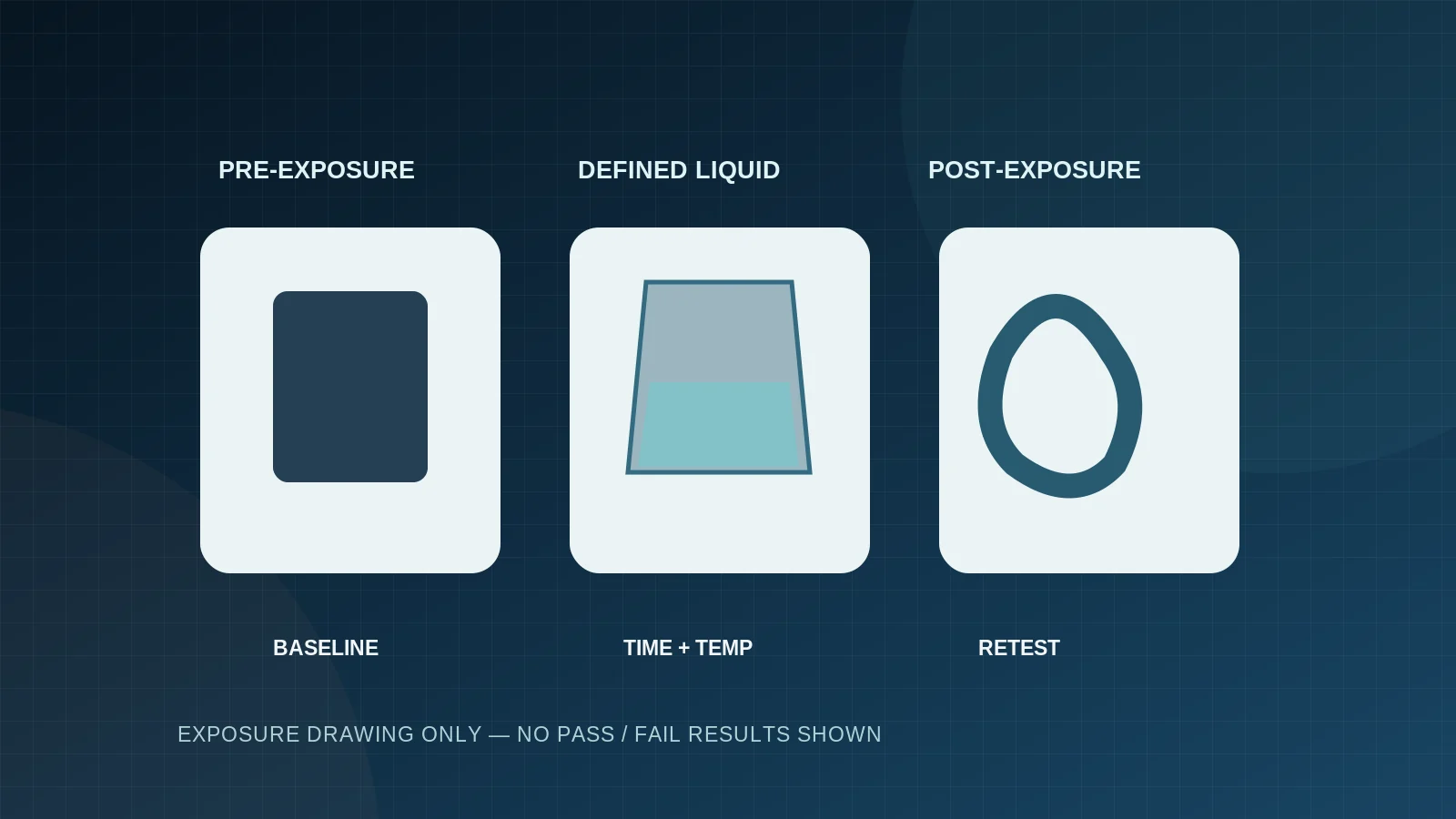
Before testing, document the liquid identity (for example, a particular hydraulic oil rather than simply “oil”), concentration, immersion or one-sided splash exposure, temperature, duration, specimen orientation and acceptance criterion. Review swelling, tackiness, coating separation and retained strength where appropriate. Testing only a bare rubber sample does not prove the woven composite or its stitched seam is fit for the same service.
What “cold flexible” must mean in service
Ask whether the tarp will merely remain stationary in winter, be unfolded occasionally after storage, or roll and flex every shift. These are different demands. Agree on a temperature and conditioning interval, choose a bend test, and then add a representative cyclic-fold and seam inspection program if the finished cover will move repeatedly.
A low-temperature laboratory result is not a guaranteed outdoor service temperature, and an accelerated-weathering test cannot be converted into a fixed lifetime without supporting evidence. For related PVC-only considerations, review the cold-resistant tarp material guide.
Do Not Copy PVC Tarpaulin Welding Settings to Neoprene-Coated Nylon
For many conventional neoprene-coated nylon products, sewing or appropriate adhesive bonding is used rather than radio-frequency welding. That does not mean every CR fabric or every adhesive behaves alike: the textile finish, surface preparation, polymer recipe and cure state all affect bond strength. A demonstrated joining method must be part of the approved specification.
Plan panel orientation, folded hem design, needle and thread compatibility, local reinforcement and seam exposure before fabric cutting. In a water-shedding cover, locate joins away from standing-water paths where possible. For oil splash shields, assess exposed cut edges, stitched penetrations, adhesive soak and cleaning solvents. Test representative seams after any relevant aging or liquid exposure.
For conversion partners, DERFLEX can review drawings and the required supply format; feasibility of a CR-coated nylon assembly should be explicitly confirmed rather than assumed from DERFLEX's separate PVC welding capability.
CR-Coated Nylon vs. PVC, TPU and CSM: Compare by the Job
No coating family is automatically superior for every tarp. Compare fluid exposure, seam process, fold cycles, material weight and documented performance. A coating name by itself cannot predict all those properties.
| Material route | Why it enters a shortlist | Critical check before selection |
|---|---|---|
| CR / neoprene-coated nylon | Rubber-coated reinforcement for specialty protective covers with weather, wear or selected liquid exposure concerns. | Specific CR formulation, liquid-contact report, seam-bond approach, cold handling. |
| PVC-coated polyester | Broad availability for waterproof industrial covers; well-developed thermal-welding routes for suitable grades. | Oil or solvent compatibility, plasticizer behavior, seam strength, UV and cold-flex rating. |
| TPU-coated fabric | Potential for flexible engineered products where abrasion, folding or fluid-contact behavior needs review. | TPU chemistry, hydrolysis, liquid compatibility and joining process. |
| CSM-coated textile | Different specialty rubber family considered for particular chemical, ozone or outdoor exposures. | Grade-specific compatibility and processing; never assume CR and CSM are identical. |
For an adjacent sourcing decision, see DERFLEX oil-resistant tarp material selection, which focuses on broader tarp material families rather than this CR-and-nylon construction.
From Material Inquiry to a Repeatable OEM Cover Specification
Define exposure and failure modes
Share service liquid, ambient and surface temperatures, fold frequency, sunlight exposure, load path, abrasion points and failure history. Attach photos or an existing approved sample where available.
Confirm the material route
Determine whether a CR-coated nylon candidate is feasible and commercially available for the project. Document width, finish, mass, thickness and construction before a cost comparison.
Approve fabric and seam samples
Compare identified samples against jointly agreed test conditions. Include seams, folded corners, fittings and cleaning procedures if the finished assembly depends on them.
Freeze the revision for reorder
Specify acceptable dimensional tolerances, surface appearance, testing basis, roll labeling, traceability, packaging and change-control steps before volume procurement.
What Determines an OEM Neoprene Tarp Fabric Quotation?
Cost inputs worth clarifying early
- CR compound and coating build, including one- or two-sided treatment.
- Nylon weave, mass, width, tolerances and surface preparation.
- Required sampling, exposure testing and trial-conversion work.
- Roll goods versus cut panels; seam construction, reinforcement and fittings if fabricated.
- Batch volume, color control, roll packing, freight mode and destination.
Without an approved grade and quantity, a published “price per square meter” can mislead more than it helps.
Acceptance evidence to request
- Grade identification and approved reference sample.
- Coating and fabric specification sheet tied to that grade.
- Applicable testing data with method, units and date.
- Roll labeling, lot reference and visual inspection plan.
- Seam or finished-cover first-article report when included in supply.
A quote should make clear which tests are already available, which would require new testing and which applications are outside the offered scope.
Continue the Material Selection Where It Matters
Questions Buyers Ask Before Approving CR-Coated Nylon
What is neoprene-coated nylon fabric?
It is a woven nylon reinforcement coated with chloroprene rubber (CR), also called neoprene in commercial use. The nylon provides textile reinforcement while the rubber coating influences weather protection, surface behavior and liquid exposure response. Final performance depends on the exact formulation and construction.
Are neoprene-coated nylon tarps resistant to oil and chemicals?
They can be considered for selected oil, grease and chemical splash environments, but resistance is not universal. Buyers should identify the actual fluid, concentration, temperature, contact duration and acceptable change in mass, swelling, adhesion and strength before approving a grade.
Can CR-coated nylon be heat welded like PVC tarpaulin?
Not by default. Many conventional neoprene-coated nylon grades are sewn or adhesively joined rather than RF-welded. The selected material, adhesive, thread and proposed joining process must be tested on representative seams before a fabrication specification is approved.
How do I evaluate cold-weather flexibility?
Define the minimum handling temperature, preconditioning time, bend or fold method and pass/fail criteria. ISO 4675 provides a low-temperature bend method for coated fabrics within its stated scope; any repeated-folding or full-cover test should be specified separately.
Can I order rolls, cut pieces or complete tarps?
Begin by specifying the required supply format: CR-coated nylon roll goods, pre-cut panels or a fabricated cover. DERFLEX can review the request, but availability of a specific CR grade and any finished-cover capability must be confirmed in the quotation and sample approval process.
What information is required for a neoprene-coated nylon fabric quotation?
Send the application, contact media, minimum and maximum temperatures, required width, target mass or thickness, panel drawing, quantities, joining method, target test methods, destination market and any current material sample or approved specification.
Need a Specialty Rubber-Coated Tarp Fabric Reviewed?
Send a material reference or drawing, the operating environment, required roll or finished dimensions, target quantity and any test specification. DERFLEX can review the project and confirm what material or supply route can be quoted.
Include “Neoprene-coated nylon / CR fabric” in your inquiry subject or description.