


 Request a Quote
Vinyl Awning & Canopy Tarp Fabric for OEM Manufacturers
PVC-coated polyester fabric for awning and canopy manufacturers who need repeatable roll specifications, waterproof surfaces and dependable conversion into fitted roof panels. DERFLEX helps OEM buyers evaluate coating, panel orientation, seam processing, color, frame geometry and the evidence needed before bulk orders. Supply discussions can cover fabric rolls and selected fabricated components; the finished frame, site drainage design and structural approval remain separate responsibilities.
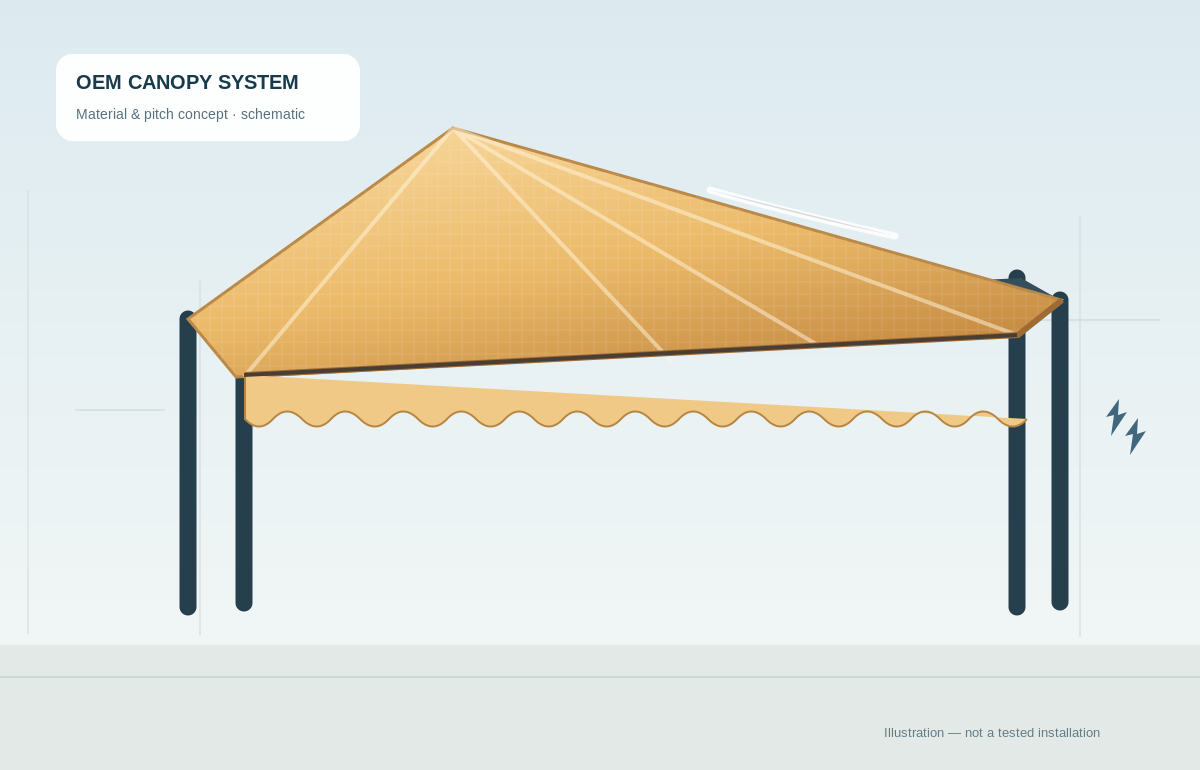
What Is Vinyl Awning & Canopy Tarp Fabric?
It is a reinforced textile with a PVC coating selected to create weather-resistant roof, shade or enclosure panels.
In this context, vinyl refers to a flexible PVC coating or PVC laminate, usually combined with a woven polyester reinforcement. The polyester scrim contributes dimensional and mechanical behavior; the vinyl layer contributes the closed, cleanable, weather-facing surface. The resulting roll goods may be converted into canopy tops, fixed awning panels, pergola covers or replacement roof covers.
Material selection cannot be reduced to “waterproof” or “heavy duty.” An OEM must also establish the expected span, roof pitch, roll direction, seam design, deployment cycles, local exposure and finished-cover tolerances. A waterproof sheet can still fail as a canopy if the frame allows water to pool or the fixing points pull out.
For the broader family of roll-fed awning textiles, see DERFLEX awning tarp fabric. This page concentrates on production engineering, evidence and repeat-order control for OEM manufacturers rather than repeating a general product catalog.
Choose by Canopy Design — Not by GSM Alone
Different cover systems impose different demands. Use the matrix to define what must be tested and agreed before selecting a grade.
| OEM product | Priority material properties | Design risk to investigate | Approval item |
|---|---|---|---|
| Fixed storefront awning | Exterior appearance, color repeatability, coating integrity, seam finish | Localized sagging and perimeter water run-off | Installed panel sample and seam layout |
| Retractable awning | Flexibility, folding behavior, roll-set, crease appearance | Repeat cycles, roller tension, wet retraction | Cycle test on production construction |
| Pergola or patio roof | Water barrier, dimensional stability, joint compatibility | Low pitch, blocked drainage and ponding | Drainage geometry and assembly trial |
| Event canopy / market shelter | Handling durability, tear strength, edge reinforcement | Frequent erection, wind effects, tension loss | Fastening and repeated setup evaluation |
| Branded OEM replacement canopy | Cutting consistency, color matching, packability | Fit over old frames with variable dimensions | Approved fit template and master sample |
For alternative weatherproof cover formats, compare the adjacent canopy tarp range. Breathable sunscreen mesh may be preferable where airflow takes priority over rain exclusion; it is not a substitute for a closed waterproof roof.
Technical Fields That Belong on an OEM Purchase Specification
Use a grade-specific technical data sheet and the approved sample. The fields below are a procurement framework, not unverified values for a single DERFLEX SKU.
| Field | What the buyer should specify | Acceptance basis |
|---|---|---|
| Material construction | PVC-coated or laminated polyester; base weave and coating on each side | Approved cross-section or grade description |
| Mass per unit area | Nominal g/m² and permitted tolerance; DERFLEX’s broader awning collection describes approximately 450–900 g/m² options | Actual offered grade TDS and order tolerance |
| Roll width / usable width | Required cutting width, edge trim and lay-plan allowance | Measured usable width on delivered rolls |
| Strength / extension | Tensile and tear values in warp and weft, plus extension conditions where relevant | Named method, direction, specimen and report |
| Dimensional change | Conditioning or heat exposure, measurement direction and permitted change | Agreed test procedure and pass limit |
| Surface and color | Matte / gloss, solid / stripe, lacquer, target shade and color tolerance | Signed physical color reference; agreed lighting |
| Water and weather | Water-penetration criteria, UV / aging target, coating adhesion, cleaning needs | Grade-specific test evidence and intended exposure |
| Joining and packaging | Hot-air or high-frequency weld trial, seam overlap, roll length, core and label | Finished seam coupon and packing inspection |
When thickness is requested
Request an actual thickness specification in millimeters. GSM measures mass per area, not thickness; one cannot be converted into the other without material density and construction information.
When a fire rating is required
Name the market, assembly use and applicable test method before specifying a flame-retardant grade. A certificate for one material construction does not automatically cover other colors, variants or complete structures.
Canopy Water Pooling: The Critical Design Question
A waterproof fabric keeps water out of its intact surface; it cannot by itself prevent standing water from accumulating on a low or sagging roof.
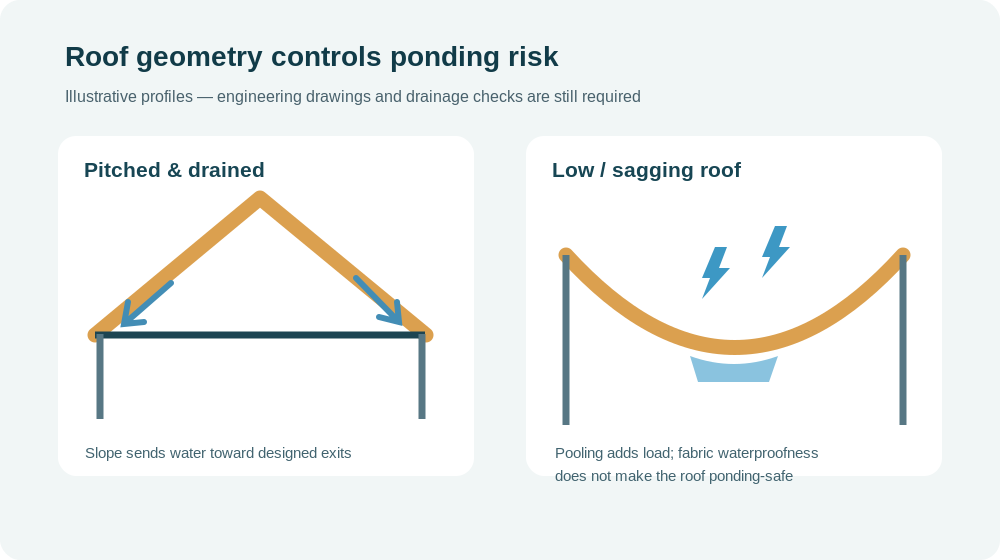
What to check before approving fabric
- Roof pitch: establish the usable fall under installed tension, not only the nominal drawing angle.
- Support spacing: check that panel sag under wet loading does not reverse the intended slope.
- Drainage paths: identify gutter, edge or outlet locations and how debris will be cleared.
- Seam placement: avoid detailing that creates dams, channels water inward or traps ponding at overlaps.
- Site exposure: have a qualified designer check rain, wind and snow actions where relevant, including local code requirements.
Do not specify a universal “safe pitch” from a fabric brochure. The required geometry depends on the whole engineered system and drainage design.
Dimensional Stability Begins with Warp, Weft and Panel Layout
Two sheets with the same nominal GSM can behave differently when cut, stretched, welded, folded or exposed to temperature.
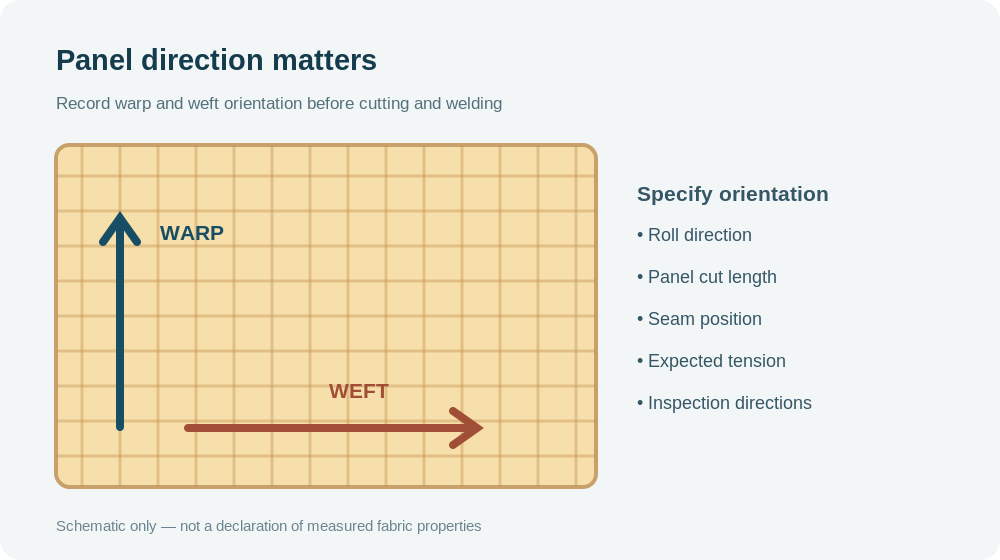
Keep material orientation traceable
State which direction of the roll follows the principal panel length. Record warp/weft orientation on cutting drawings so tear, extension and dimensional-change results can be interpreted correctly. A fabric’s strength result in one direction must not be silently applied to the other direction.
For large canopies, a cut panel may change size because of relaxation after unrolling, welding heat, seam shrinkage, mechanical tension or weather conditioning. Final-cover fit therefore requires material allowance + seam allowance + installation tension to be reviewed together.
Use the existing awning fabric material guide for broad material-family differences; the OEM drawing must still define its own dimensional tolerances.
Measure
Record sample dimensions after agreed conditioning, with a consistent measuring method and instrument.
Process
Repeat measurements on trial-welded panels, where heat and overlap can change the finished fit.
Install
Fit the sample to a real reference frame or fixture with specified tension and fixing details.
Lock
Approve the pattern, grain direction, tolerances and sample as a controlled repeat-order reference.
Specify the Finished-Panel Details That Matter
Water resistance at the fabric surface is not proof of leak-free seams, reliable attachment or correct assembly behavior.
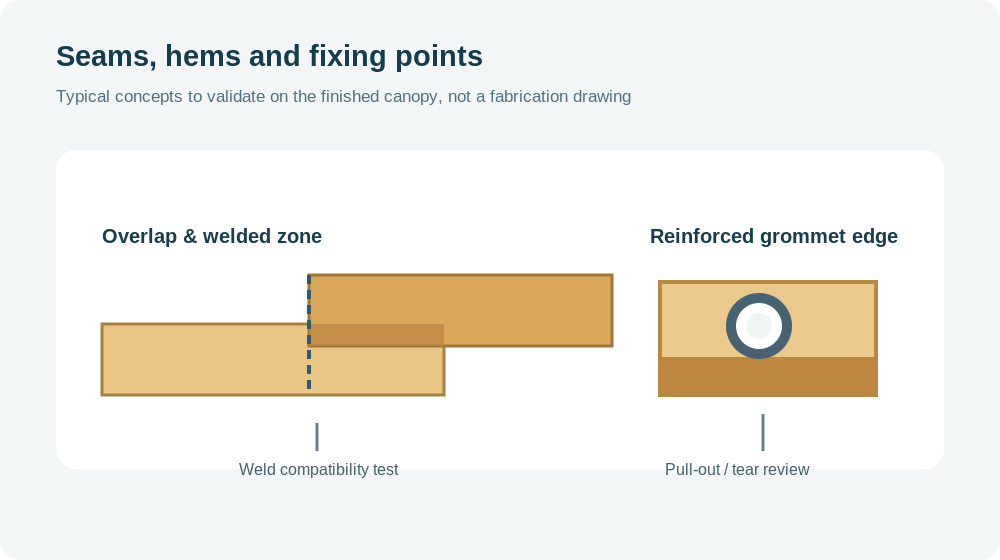
Translate the material into buildable details
Heat-welded joins: trial the chosen material with the fabricator’s equipment. A strong sheet does not prove a strong seam; compare weld appearance, failure mode and peel or shear performance to an agreed acceptance requirement.
Hems and corners: specify local reinforcement, edge pockets, radius details and the relationship between panel seams and load paths. Do not assume an eyelet spacing that is adequate for one frame will suit another.
Appearance: agree how stripe repeat, gloss direction, color change across welds and printed graphics are evaluated on an assembled sample.
For PVC roll structures beyond awnings, see PVC-coated fabric materials and compare joining and surface treatment by grade.
Request the Right Proof — for the Right Grade and the Right System
Specifications become reliable only when linked to a named material, test method, conditions and inspection record.
| Performance question | Evidence to request | What the evidence cannot establish alone |
|---|---|---|
| How strong is the coated fabric? | Warp/weft tensile and tear results with specimen and method identification; EN ISO 1421 is an example of a coated-fabric tensile test method | Wind resistance of a complete anchored awning |
| Will the coating stay attached? | Coating adhesion method, direction, test conditions and accepted grade value | Every weld process or service environment |
| Does it exclude rain penetration? | Material water resistance test and welded-panel leak check if needed | Drainage effectiveness or resistance to ponding loads |
| Will panels maintain fit? | Warp/weft dimensional change under agreed conditioning or heat cycle | Finished-cover fit without validating the seam pattern and frame |
| Will color and finish endure? | Exposure protocol, duration, color and surface assessment criteria | Guaranteed outdoor life in every climate |
| Is it suitable for regulated public use? | Applicable test report for the nominated grade, market and assembly | Fire approval of the full installed system |
When comparing coated materials with other tarp constructions, DERFLEX’s vinyl tarps product overview covers the wider protective-cover family; use this page to set the acceptance criteria for a particular awning OEM program.
From Trial Roll to Controlled Repeat Supply
Documented decisions help an OEM avoid redesigns between sample approval and replenishment orders.
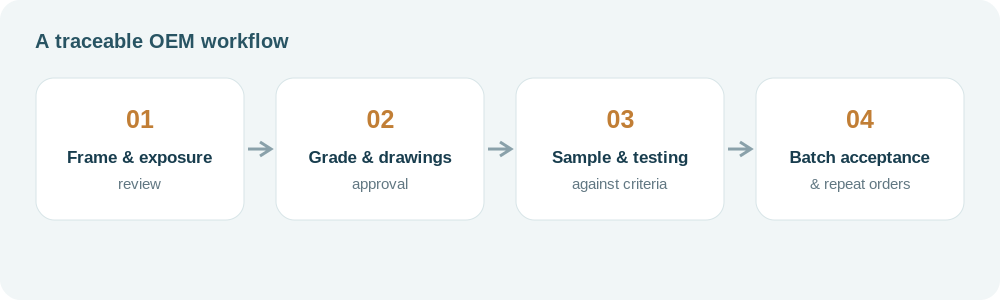
Supply formats to discuss
Roll goods: for converters cutting and welding their own panels. Confirm usable width, roll length, coating orientation and packing.
Cut material or joined panels: available scope must be confirmed against the drawing, equipment and quantity before a fabrication commitment is made.
Complete finished awnings: a cover and a structural awning mechanism are different deliverables; frame design and installation are not included merely because a fabric is quoted.
Repeat-order checkpoints
Keep a signed grade reference, original color swatch, tested joining coupon, approved panel layout, named tolerances and agreed packing description. Use the same agreed definitions on quotations, order confirmations and inspections.
On repeat orders, review any change to coating recipe, finish, yarn construction, manufacturing width or color before substituting material. Record a new approval if the change affects the customer’s finished product.
This procurement logic is particularly useful for private-label and replacement-canopy brands, where customer complaints often begin with small differences in fit or appearance rather than gross fabric failure.
Send a Drawing, Not Just a Fabric Weight
You do not need a finished technical data sheet to start a discussion. Application photos, a sketch and expected quantity are useful first inputs.
OEM quotation & sample checklist
- Finished use: retractable awning, fixed canopy, pergola, shelter or replacement top
- Frame plan: spans, slope, seams, fixings and desired drainage outlets
- Environment: sun, rain, wind exposure, temperature and cleaning conditions
- Material preferences: target mass, color, surface, opacity and roll width
- Processing: welding, sewing, edging, grommets, pockets or printed branding
- Approval: sample size, fit trial, test methods and acceptance tolerances
- Commercial details: annual or first-order volume, packing, destination and preferred date
Frequently Asked Questions
Practical answers for canopy brands, awning fabricators and purchasing teams.
Is PVC-coated polyester suitable for a waterproof awning roof?
It can be suitable when the nominated grade has the needed water-resistance, seam compatibility and outdoor performance. The roof also requires appropriate slope, support, drainage and attachment design; waterproof fabric alone does not make a finished awning watertight or safe.
Can a heavier vinyl tarp eliminate canopy water pooling?
No. Higher mass may change strength and stiffness but cannot correct a roof that sags or lacks a suitable drainage path. The complete frame, pitch, panel tension, support spacing and applicable loads must be assessed.
How should OEM manufacturers control canopy size tolerances?
Record warp/weft orientation, material conditioning, cutting allowances, weld shrinkage, seam layout and a physical frame-fit trial. Approve the final panel pattern and tolerances against a reference sample rather than using nominal roll width alone.
Can DERFLEX supply roll fabric for an existing OEM canopy model?
DERFLEX describes PVC-coated awning roll supply and selected customization capabilities. Send the existing model’s drawings or sample, usable roll-width requirement, finish, quantity and fabrication method so the specific grade and supply scope can be reviewed.
What test documents should accompany a commercial awning fabric order?
Ask for the nominated grade’s current technical data sheet and agreed test evidence, including directional strength, coating adhesion, water behavior, dimensional change and any required fire or weathering documentation. Confirm that the report applies to the offered construction.
Is flame-retardant awning fabric automatically approved for public canopies?
No. Flame-retardant performance depends on the exact material and test method. A public installation may have additional requirements for seams, components and the full assembly; the local authority or project designer must establish which approvals apply.
Specify Your Next Awning Fabric with Confidence
Share your frame geometry, intended climate, fabric finish and target supply format. DERFLEX can review PVC-coated fabric options and discuss a sample and quotation path appropriate to your OEM program.