



Industrial textiles / acoustic project planning
Industrial Noise Control Curtains & Acoustic Barrier Fabric
Plan flexible noise-control barriers around machinery, production cells and maintenance areas with a clear specification for the fabric face, acoustic layers, panel interfaces and supporting evidence. DERFLEX offers PVC-coated industrial curtain materials and custom panel discussions; the scope and performance of any proposed acoustic assembly must be confirmed for your project.
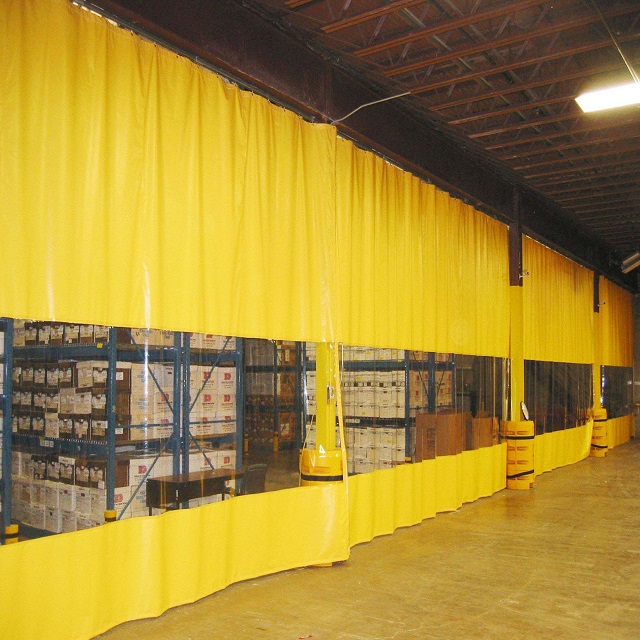
A practical starting point
What is an industrial noise control curtain?
An industrial noise control curtain is a flexible panel arrangement placed between a noise source and a receiving area. An acoustic design may use a dense barrier layer to reduce transmission and an absorptive layer to reduce reflected sound. A durable coated fabric can serve as a facing or structural skin. Whether the arrangement achieves a useful reduction depends on the complete assembly, frequency, coverage, openings, flanking paths and installation.
Material and fabrication
Discuss coated-fabric faces, panel dimensions, reinforced edges and attachment details. Confirm whether a proposed supply covers rolls, fabricated panels or additional components.
Acoustic performance
Specify the required test evidence for the exact assembly and its installation. Plain PVC-coated fabric alone is not proof of an acoustic rating or a particular site reduction.
01 / Choose the objective
Separate transmission, reflection and exposure
| Project concern | Design direction | Evidence or limit |
|---|---|---|
| Sound traveling through a partition | Review a purpose-selected barrier layer and continuous coverage. | Frequency-dependent transmission-loss report for the proposed assembly. |
| Reflections within a machine enclosure | Consider an appropriate absorber facing the noise source. | Absorption report and the mounting conditions; a sealed skin can change absorption. |
| Noise at a worker or nearby receiver | Address direct paths, top and sides, flanking transmission and access. | Comparable before-and-after site measurements; laboratory values are not guaranteed site results. |
| Vibration or structure-borne sound | Review vibration isolation and structural paths with a specialist. | A hanging airborne-sound curtain is not a stand-alone vibration solution. |
Start with the existing industrial acoustic curtain overview for broader material and fabrication considerations.
02 / Build the specification
Define each layer and its job
Outer facing and reinforcement
A PVC-coated textile can provide a cleanable outer face and a substrate for hems or attachment interfaces. Specify face fabric, coating, color, cleaning exposure, tensile demands and seam compatibility. Consult the industrial PVC coated fabric guide.
Barrier and absorber
A dense flexible barrier is one possible component; a separate porous absorber may be selected for reflections. Identify each layer, orientation, thickness, areal mass, joining method and protection from contamination. Availability and integration require confirmation.
To estimate a simple panel’s fabric or composite mass, multiply finished covered area in m² by the corresponding full-construction kg/m². Add overlaps, reinforcements, seams, closures and hardware separately. The result is an estimate for discussion, not a track or structural design load.
03 / Read the evidence
What should an acoustic test report show?
Request the complete report rather than a promotional value alone. Match the tested specimen to the construction being offered and to the purchasing specification.
Match the specimen
Check product or construction identification, layer sequence, materials, thickness, area mass, dimensions, sampling and whether the proposed panels are equivalent.
Identify the test
For laboratory airborne transmission, ASTM E90 is one possible method and ASTM E413 provides a classification route for STC. ASTM C423 addresses laboratory sound absorption. State the actual edition and report conditions.
Read the bands
Compare the available frequency-band data with the source spectrum. The STC single-number rating summarizes a defined range; it does not describe every frequency or predict the reduction at a particular workstation.
Check the assembly
Look for specimen mounting, edge sealing, joints, sample orientation and the lab’s stated limitations. A continuous laboratory specimen may not represent a curtain with a door, windows or unsealed edges.
Transmission loss, STC, absorption coefficients and in-situ noise reduction describe different things. Ask the supplier and acoustic consultant which metric is relevant to the project. A report from another product or supplier cannot be transferred to a DERFLEX construction.
04 / Frequency and source
Choose around the noise you need to control
Two machines with the same overall dBA reading can have different spectra. Low-frequency energy can be difficult to control with a lightweight, open-topped barrier; higher-frequency sound may also escape through small openings. Obtain octave- or third-octave-band measurements when needed and record the source operating condition. A qualified acoustic specialist can compare the spectrum, geometry and proposed test data.
| Application | Plan around | Check before purchase |
|---|---|---|
| Compressors and generators | Ventilation, service clearance, hot surfaces and low-frequency content. | Cooling and exhaust design, enclosure access, support and site acoustic assessment. |
| Production and packaging cells | Operator visibility, changing shifts and frequent material movement. | Panel coverage, access closures and the combined effect of openings. |
| Workshop maintenance | Removable panels, cleaning and intermittent noise sources. | Exposure to contaminants, handling weight and installation details. |
| Outdoor equipment areas | Weather, wind load, attachment and durability. | Separate structural and weather review; confirm each material and assembly for exterior use. |
05 / Installation details
Close the paths around the panel
Top and side returns
Draw the extent of the curtain relative to the source and receiver. Consider sound traveling over or around the barrier and the connection to adjacent walls. Coordinate any roof with ventilation, maintenance and fire protection.
Panel joints and corners
Specify panel overlap, closure type, fastening continuity and the closed operating position. At corners, show how layers meet without a direct gap; verify the effect of repeated opening and wear.
Bottom edge
Measure floor variation and decide whether a sweep, flexible extension or deliberate clearance is appropriate. A bottom contact detail does not prove an airtight or acoustically rated seal. See industrial curtain floor seals.
Openings and movement
Plan windows, personnel access, cable routes and sliding stack space. Any opening can create a bypass. Confirm the weight and capacity of rails, anchors and building structure with the responsible engineer.
For existing tracks, see replacement panel measurements. A replacement must also match the acoustic construction and closure details required by the project.
06 / Procurement and acceptance
Make the quotation and inspection comparable
- Noise brief: equipment, operating cycle, measurements, frequency spectrum where available, receiver location and desired result.
- Layout: dimensioned plan and elevation, panel breakdown, required coverage, roof, doors, windows, access routes and services.
- Construction: layer-by-layer description, facing and total area mass, finished thickness, approved sample, closures, reinforcements and tolerances.
- Evidence: relevant laboratory report for the proposed construction, frequency data, fire documentation when required and agreed acceptance criteria.
- Scope: distinguish material rolls, finished panels, hardware, design, acoustic assessment and installation; identify the party responsible for each.
- Commercial details: quantity, destination, packaging, expected schedule, replacement panels and labeling requirements.
At receipt, compare panel identification, dimensions, visible seams, attachment positions and documentation against the approved order. Any acoustic field acceptance should specify who measures, the instrument and calibration, operating state, positions, background conditions and criteria before installation.
For broader partition details see industrial curtain options and warehouse curtain-wall layouts. For a dust-related objective, review dust containment curtains separately.
Questions and answers
Industrial acoustic curtain FAQ
Do industrial noise control curtains block all sound?
No. A curtain can reduce some airborne sound, but sound can travel through openings, over the barrier and through surrounding structures. Actual results depend on the source, frequency, assembly and installation.
Does a heavier PVC fabric have a guaranteed STC rating?
No. Surface mass is relevant to barrier design, but a fabric weight alone does not establish an STC or a field noise reduction. Request a report for the complete proposed construction.
What is the difference between sound absorption and sound blocking?
Absorption reduces sound reflected from a surface. A barrier reduces sound transmitted through it. A composite may address both, but each property requires its own test evidence.
Which frequencies should the acoustic report include?
Ask an acoustic specialist to identify the important source frequencies and compare them with the tested frequency bands in the report. A single-number rating may conceal weak low-frequency performance.
Can panels have openings or clear windows?
Openings and viewing sections can be designed into a layout, but their materials, joints and closure state can change performance. They should be evaluated as part of the complete assembly.
Can the curtains be installed on a sliding track?
A sliding arrangement may be possible if the track, supports and fasteners are designed for the complete moving load. Confirm track supply, stack space, gaps and access with the project team.
Are flame-retardant fabric and a fire-rated enclosure the same?
No. A material test or classification does not automatically establish a fire-rated enclosure. The project team must determine applicable requirements for the complete installed system.
What information should I send for a quotation?
Share a dimensioned layout, source and receiver positions, noise measurements or target, operating environment, access and mounting details, quantity, delivery destination and required test documentation.
Start a project
Share the noise problem and the working layout
Send your drawings, source details, exposure conditions and documentation requirements. DERFLEX can review the industrial curtain material and panel brief, then clarify the scope and available evidence for your project.
Request a project quote