


PU Leather Meaning: What PU Leather Means, How It Is Made, and Why It Matters for Sourcing, Quality, and End-Use Performance
When buyers search for pu leather meaning, they are usually not looking for a dictionary sentence alone. They want to understand what PU leather is, what the material is made of, how it performs, where it can be used, how it compares with real leather and PVC leather, and whether a PU leather supplier or PU leather manufacturer can support stable OEM and custom production. This page is built for that real buying journey. It explains the commercial meaning of polyurethane leather, clarifies common misunderstandings, and helps importers, brands, converters, furniture factories, bag makers, automotive trim buyers, and upholstery sourcing teams evaluate PU leather from both a technical and purchasing perspective.
DERFLEX supports buyers who need more than a basic definition. We help customers turn product ideas into workable material programs with attention to surface finish, thickness, hand feel, backing, color consistency, abrasion performance, hydrolysis resistance, flame options, packaging detail, documentation, lead time, and long-term supply coordination.
What Is PU Leather?
The simplest answer to what does PU leather mean is this: PU leather is a synthetic leather material made by applying a polyurethane layer or polyurethane resin system onto a base material such as fabric, split leather, microfiber, or another engineered backing. In commercial use, the phrase can refer to several different constructions. Some PU leather products are completely synthetic and fabric-backed. Some are made over split leather to create a leather-finished composite. Some high-performance versions are built on microfiber bases for better dimensional stability, smoother appearance, or improved premium feel.
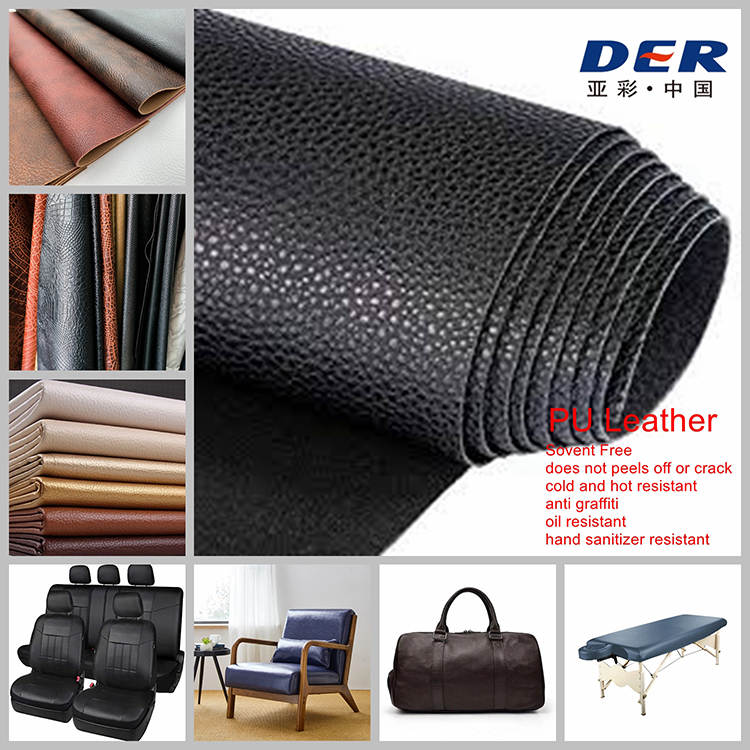
That is why pu leather material meaning can never be reduced to one sentence alone. A buyer needs to know the structure behind the name. Two products may both be called PU leather, but they may differ greatly in softness, durability, cost, thickness, hydrolysis behavior, cold crack resistance, appearance, or recommended application. One may be suited to a casual bag program. Another may be designed for upholstery seating. Another may target automotive interior trim or hospitality seating where appearance retention and abrasion performance matter more.
Commercial Meaning of PU Leather
In real sourcing conversations, pu leather fabric meaning usually refers to a leather-look coated fabric that uses polyurethane as the main surface system. It is selected because it can offer a cleaner and more controllable finish than many natural materials, while also allowing broader design options. Buyers can request smooth, matte, semi-gloss, napa-like, lychee grain, saffiano, carbon texture, suede-touch, or customized embossed surfaces depending on the product target.
PU leather is often chosen when brands want a more uniform appearance, scalable production, easier color matching, or a price point that does not depend on natural hide variation. It is widely used in sofas, chairs, wall panels, headboards, handbags, wallets, notebooks, decorative coverings, fashion accessories, gym equipment coverings, medical seating, and some transportation interiors.
Why the Meaning Matters to Buyers
- It helps distinguish PU leather from real leather, PVC leather, and microfiber leather.
- It prevents specification mistakes during sourcing, development, and quotation review.
- It clarifies which performance properties should be discussed before sampling.
- It helps buyers compare material cost against appearance, touch, and service expectations.
- It improves supplier communication when discussing custom surface effects and backing options.
- It reduces the risk of choosing a material that looks right in a sample but fails in the real application.
If your team is evaluating faux leather material, vegan leather material, or synthetic leather supplier options, the same principle still applies. Words in the market can overlap. What matters in the end is whether the material delivers the required appearance, durability, processing behavior, and compliance pathway for the intended product.
Key Features Buyers Expect from PU Leather
Good PU leather is not defined by one single attribute. It is a balance of look, touch, structure, stability, and processing logic. A competitive PU leather manufacturer should be able to explain which feature matters most for your application and why one formulation is more suitable than another.
Soft Hand Feel
PU leather is often selected because it can achieve a softer, less plastic touch than many low-end alternatives. This matters for upholstery, handbags, fashion accessories, and consumer products where tactile quality directly affects the buying impression.
Wide Surface Design Range
Color, grain, gloss, matte level, topcoat feel, and embossing can be adjusted to target different market positions. A custom PU leather program can be built for minimalist furniture, premium handbags, contract seating, or automotive trim concepts.
Consistent Appearance
Because PU leather is engineered rather than natural hide dependent, brands can often achieve better batch consistency in color, texture, and roll-to-roll appearance, which is important for large production runs and repeat orders.
Process Flexibility
Depending on formulation and backing, PU leather can be cut, sewn, laminated, wrapped, quilted, embossed, or bonded into different end products. Converters value materials that behave predictably across production steps.
Scalable Cost Control
Compared with natural leather, PU leather can help brands manage price positioning, yield predictability, and design repeatability, especially when color continuity and production scale are more important than natural hide variation.
Custom Performance Pathways
For project-oriented supply, the right PU leather supplier should be able to discuss abrasion level, hydrolysis resistance, cold crack behavior, flame pathway, anti-scratch finish, anti-mildew support, and cleaning performance based on end use.
It is also important to understand that PU leather does not mean the same quality in every factory. Low-cost grades may prioritize visual similarity and initial softness but perform poorly under humidity, friction, or repeated use. Better-developed grades can offer improved resilience, better topcoat stability, cleaner embossing, stronger backing adhesion, and more reliable processing behavior. That difference is why buyers often move from price-led inquiry to value-led supplier selection after the first sampling round.
Technical Specifications Buyers Usually Review
A page about pu leather meaning becomes much more useful when it translates the meaning into specification language. A sourcing team does not order “meaning.” It orders thickness, width, base, finish, color, and performance level. The table below shows the types of commercial parameters buyers commonly discuss. These are typical reference ranges, not one single fixed standard, because different PU leather programs are built for different markets.
| Item | Typical Commercial Range | Why It Matters |
|---|---|---|
| Surface System | PU coated / PU resin / multi-layer PU finish | Determines touch, appearance, scratch behavior, cleanability, and visual depth. |
| Backing | Knitted fabric, woven fabric, nonwoven, microfiber, or split leather base | Affects dimensional stability, tensile behavior, softness, sewing response, and application suitability. |
| Total Thickness | Approx. 0.5 mm to 2.0 mm or customized | Influences drape, firmness, wrapping behavior, seat feel, and product positioning. |
| Width | Custom production widths; often around 54 in / 137 cm or project based | Important for cutting efficiency, yield calculation, and export packing planning. |
| Surface Finish | Matte, semi-matte, gloss, napa, lychee, smooth, suede-touch, embossed grain | Directly affects market image and end-product design identity. |
| Color Matching | Pantone, swatch-based, buyer sample based, or standard collection | Critical for brands that require repeatable shade control across multiple orders. |
| Abrasion Level | Application dependent, from decorative to heavy-use seating grades | Helps determine whether the material is suitable for bags, home use, contract seating, or transport interiors. |
| Hydrolysis Resistance | Standard, enhanced, or project-focused development | Very important for humid markets, upholstery programs, and long service life expectations. |
| Cold Crack / Flexing | Standard export grade or upgraded according to climate/end use | Useful for transportation, colder climates, and products exposed to repeated movement. |
| Compliance Pathway | Project-based document and testing support | Buyers often need alignment with requested market or project compliance requirements. |
| Packaging | Roll packing, inner protection, outer wrapping, label customization | Protects appearance and supports customs, warehouse, and distribution efficiency. |
| MOQ / Lead Time | Depends on color, finish, custom development, and order structure | Key to program planning, launch timing, and purchasing risk control. |
For a commercial buyer, this is where the true meaning of PU leather becomes actionable. A well-developed material is not only attractive in appearance. It is technically aligned with the conversion method, sales channel, product promise, and after-sales risk profile. That is why a serious synthetic leather supplier should discuss not only the sample itself but also the use environment, cleaning expectation, stitching behavior, wrapping radius, foam lamination need, and packaging route before mass production begins.
Applications: Where PU Leather Is Commonly Used
One reason buyers search for pu leather meaning is because the same material family can appear in many industries. Below are the most common application directions and what buyers usually care about in each one.
Furniture & Upholstery
Upholstery PU leather is widely used in sofas, dining chairs, office seating, recliners, wall panels, and hospitality furniture. Buyers focus on touch, abrasion performance, hydrolysis behavior, seam appearance, and easy-clean surface quality.
Automotive Interior Programs
Automotive PU leather may be selected for seat inserts, door trims, dashboard wrapping, steering-related trim covers, or decorative panels. Here the priorities shift toward color stability, odor control, flex behavior, heat resistance, and a cleaner premium finish.
Bags, Wallets, and Accessories
Bag PU leather material is often chosen for fashion lines that need specific grain, softness, fold behavior, and controlled price structure. Brands care about surface elegance, sewing behavior, edge appearance, and marketable texture options.
Contract & Commercial Seating
For public seating, office environments, entertainment venues, and waiting areas, buyers usually need a balance of appearance, easy cleaning, repeatability, and suitable wear resistance. Material stability matters more than a low initial quote.
Decorative Panels & Interior Coverings
PU leather can be used for wrapped panels, acoustic elements, decorative boxes, notebook covers, case goods, and premium display surfaces where a leather-like visual is required without the variability of natural hide.
Fitness, Medical, and Special-Use Covers
Some projects require materials that are easy to clean, visually controlled, and suitable for repeated contact. In these cases the exact finish and performance pathway should be discussed carefully before approval.
These applications also explain why two buyers can ask for PU leather and still need very different material solutions. A soft bag grade may not work for a hospitality seating program. A visually attractive decorative grade may not survive transport interior demands. A premium-looking upholstery roll may still fail if humidity resistance is overlooked for tropical markets. That is why application-first discussion is more useful than product-name-first discussion.
How Buyers Should Match Application to Material
- For furniture, ask about abrasion, hydrolysis, cleanability, and long-run color consistency.
- For bags and accessories, focus on touch, fold lines, edge appearance, embossing character, and cut behavior.
- For automotive trim, prioritize stability, odor control pathway, heat behavior, and premium visual consistency.
- For decorative surfaces, discuss wrapping radius, adhesion compatibility, and surface uniformity.
- For contract projects, review repeat-order capability, testing route, and documentation readiness.
Why Choose DERFLEX for PU Leather Supply
Buyers looking up pu leather supplier or pu leather manufacturer are often overwhelmed by similar product pictures and similar promises. The real difference usually appears in technical communication, sample matching, consistency, documentation, and delivery discipline. DERFLEX focuses on supporting purchasing teams with a more structured process.
OEM & Custom Development
We support custom PU leather programs based on thickness, grain, color, backing, touch, and target use. This matters for buyers who need brand-specific material identity instead of standard stock only.
Application-Oriented Recommendation
Different uses need different constructions. We aim to recommend material by real end-use conditions, not by a one-size-fits-all catalog shortcut.
Lead Time Planning
Commercial buyers care about launch schedules and repeat purchase timing. Material planning, color confirmation, and production coordination all affect delivery reliability.
Quality Consistency Focus
Sample approval is only the beginning. Roll-to-roll stability, backing consistency, embossing accuracy, and shipment quality all matter when orders scale up.
Export Communication
International supply requires clear quotation language, specification alignment, packaging detail, and practical response speed. These reduce sourcing friction and approval delays.
Certification & Testing Coordination
Project and market requirements vary. DERFLEX can support discussion around requested quality documents, test expectations, and compliance-related pathways according to the buyer’s program.
In practice, the best supplier relationship is built before the purchase order is placed. It starts with asking the right questions: What is the true end use? Will the material be sewn, wrapped, vacuum formed, laminated, or quilted? What climate will it face? What is the expected service life? Is the target a budget SKU, a premium line, or a mid-market program? Does the buyer need a stock color quickly or a fully customized embossed range? When these points are clarified early, sourcing becomes more predictable and total cost becomes easier to manage.
That is also why many professional buyers prefer a partner that can bridge both the technical and commercial sides of the discussion. A quote without structure may look fast, but it often creates hidden cost later through color mismatch, inconsistent feel, edge cracking, weak backing, insufficient hydrolysis resistance, or unsuitable packaging. A disciplined development process is usually the better route.
Comparison: PU Leather vs Real Leather vs PVC Leather
Another major reason people search for pu leather meaning is that they want to compare it with other materials. The right answer depends on your price point, product positioning, visual goals, consistency requirements, and service environment.
| Factor | PU Leather | Real Leather | PVC Leather |
|---|---|---|---|
| Surface Character | Can be soft, refined, modern, and highly controllable in texture and gloss. | Natural grain and unique variation; premium but less uniform. | Can be strong and cost-effective, but may feel stiffer or more plastic in some grades. |
| Appearance Consistency | Usually strong for repeat runs and color matching. | Natural hide variation is part of the material. | Generally controllable, depending on production grade. |
| Design Flexibility | High range of embossing, color, feel, and finish options. | Limited by natural material characteristics. | Also flexible, though aesthetic preference varies by market. |
| Touch | Often softer and more leather-like than lower-end alternatives when well developed. | Natural feel with strong premium perception. | Can be firmer depending on construction. |
| Price Positioning | Often between natural leather and low-end synthetics, depending on structure. | Usually higher and more variable. | Often cost-competitive for volume uses. |
| Uniformity for Mass Production | Strong advantage for branded repeatable programs. | Less uniform because natural hides vary. | Often suitable for repeatable industrial runs. |
| Typical End Uses | Furniture, bags, accessories, panels, contract seating, some vehicle interiors. | Premium upholstery, footwear, luxury goods, heritage products. | Industrial covers, seating, entry-level upholstery, commercial applications. |
The phrase pu leather vs real leather is common in online search, but from a buyer’s perspective the more useful question is this: what outcome are you trying to achieve? If your project needs natural character and premium hide identity, real leather may be the right direction. If your project needs design control, scalable repeatability, engineered appearance, and manageable cost structure, PU leather may be the better fit. If the project is strongly cost-driven and can accept a different feel profile, PVC leather may also deserve evaluation.
There is no universal winner among these materials. There is only a better fit for the product, market, and commercial objective. That is why structured comparison is more valuable than generic ranking language.
Case Study: Representative Custom PU Leather Program for a Furniture & Bag Buyer
The following is a representative sourcing scenario that reflects the type of support buyers often need when moving from “What is PU leather?” to “Which PU leather should we actually order?”
Buyer Situation
A distributor serving both furniture workshops and accessory factories needed a PU leather range that could cover two sales directions. One group of customers wanted a soft-touch upholstery grade for dining chairs and lounge seating. Another wanted a more structured grain for bags and decorative accessories. The distributor had used generic synthetic leather before, but repeat customers complained that the rolls looked good at first yet performed inconsistently during conversion.
The main issues were unstable color from batch to batch, weak hand-feel consistency, and a mismatch between marketing description and practical use. In other words, the material had a name, but not a clearly defined application pathway.
DERFLEX Approach
- Separated the inquiry into two end-use categories instead of one blended request.
- Reviewed target thickness, surface preference, and backing need for each category.
- Recommended a softer upholstery-focused PU leather for furniture use.
- Recommended a grain-controlled, shape-friendly grade for bags and accessory covers.
- Aligned sample comments around practical processing points, not only visual approval.
- Prepared production planning around repeat-order consistency and export packing detail.
Outcome
Once the two uses were separated and defined correctly, sample approval became faster and the distributor could present each material with more confidence to its own customers. The furniture line sold on softness, visual neatness, and easier positioning for mid-to-better upholstery programs. The bag line sold on pattern clarity, edge appearance, and more reliable handling during conversion. The important lesson was simple: buyers rarely need a vague PU leather description. They need a material structure matched to a commercial purpose.
That is the difference between basic catalog selling and application-led supply. A product page about pu leather meaning becomes commercially valuable only when it helps the buyer avoid wrong material selection and move toward a more successful final product.
How to Evaluate PU Leather Before You Buy
Buyers who understand the meaning of PU leather still need a practical review method. Below is a simple framework that importers, brands, and factory purchasing teams can use before placing an order.
1. Start with End Use
Ask where the material will live, how it will be processed, and what kind of wear it will face. This defines the correct direction much faster than asking for “best quality” without context.
2. Define the Surface Goal
Do you want soft matte, richer grain, premium napa, anti-scratch touch, or fashion texture? Surface identity is often part of the product’s sales value.
3. Confirm Backing & Thickness
The same color can behave very differently when thickness or backing changes. Structure must match the process route and finished product feel.
4. Review Real Performance Needs
Do not request heavy-duty performance if the product is decorative only. At the same time, do not approve a visual sample for seating without reviewing use-related durability expectations.
5. Ask About Repeatability
A reliable supplier should talk about batch consistency, not just first-order appearance. Repeatability is essential for importers and growing brands.
6. Align Documentation & Delivery
MOQ, production lead time, packing method, labeling detail, and required supporting documents all affect whether a sourcing plan runs smoothly.
This is especially important when comparing offers from multiple factories. One sample may feel softer. Another may quote lower. Another may promise faster delivery. But unless the full structure, performance pathway, and shipment discipline are aligned, the quote comparison may be misleading. A professional faux leather manufacturer should reduce uncertainty, not add to it.
Frequently Asked Questions About PU Leather
These FAQs are designed to help both first-time buyers and experienced sourcing teams answer the most common questions behind the search term pu leather meaning.
1. What does PU leather mean exactly?
PU leather means polyurethane leather. In most commercial contexts, it refers to a synthetic leather material made with a polyurethane-based surface system over a fabric, microfiber, split leather, or another engineered base. The exact structure can vary by manufacturer and application.
2. Is PU leather real leather?
Usually, when buyers say PU leather, they mean a synthetic leather product rather than full natural leather. Some constructions can be made over split leather, but many commercial PU leather products are fully synthetic and fabric backed.
3. Is PU leather the same as PVC leather?
No. PU leather uses a polyurethane-based surface system, while PVC leather uses polyvinyl chloride. The two materials can differ in touch, flexibility, appearance, formulation pathway, and suitability for certain uses.
4. Where is PU leather commonly used?
PU leather is widely used in furniture upholstery, dining chairs, office seating, hospitality seating, automotive trim programs, handbags, wallets, notebook covers, wall panels, and decorative consumer goods.
5. Why do buyers choose PU leather instead of real leather?
Buyers often choose PU leather when they want more controllable appearance, broader color and embossing options, easier repeatability, scalable production, and a different cost structure than natural leather.
6. What should I ask a PU leather supplier before ordering?
You should ask about structure, backing, total thickness, width, embossing, color matching, abrasion pathway, hydrolysis expectations, MOQ, lead time, packaging, and application suitability. The right questions help avoid ordering a visually attractive but functionally unsuitable grade.
7. Can PU leather be customized?
Yes. A custom PU leather program can often include specific thickness, grain, gloss level, backing, color, hand feel, and packaging detail depending on the supplier’s development capability and your order structure.
8. How do I choose the right PU leather manufacturer?
Choose a supplier that understands your end use, communicates clearly about structure and performance, supports consistent production, and can coordinate sampling, documentation, and delivery with fewer surprises.