



Replacement Covers · OEM Programs · Bulk Supply
Replacement Tarp Built to Match the System You Already Have
DERFLEX supplies custom replacement tarp solutions for trucks, trailers, roll tarp systems, industrial frames and repeated OEM programs. Instead of treating replacement as a simple size reorder, the specification can be rebuilt around the existing mounting points, wear zones, seam direction, material duty and operating environment.
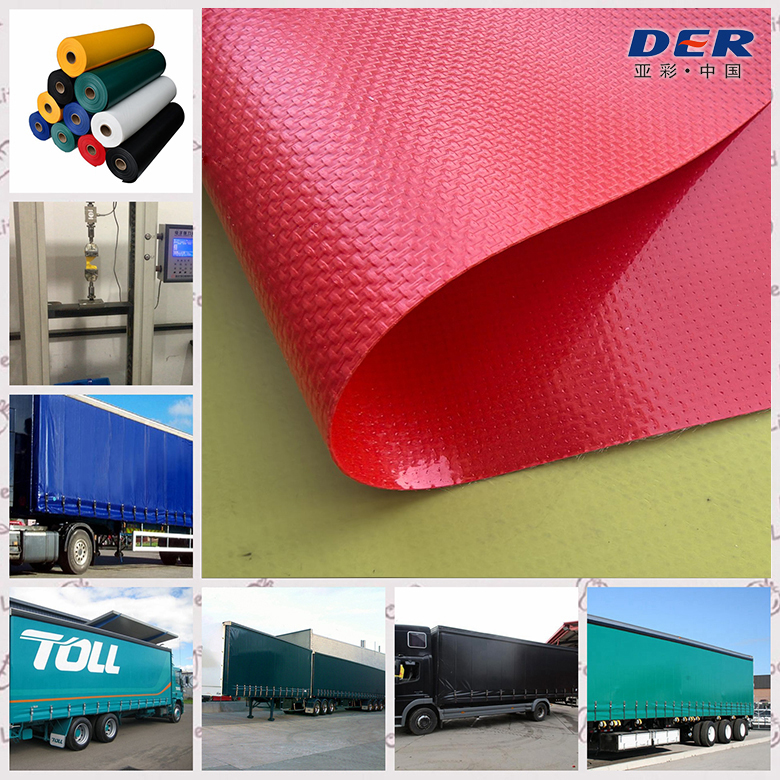
Do Not Copy the Old Tarp Blindly—Reconstruct the Working Specification
An old tarp may have stretched, shrunk, torn around grommets, lost coating or been modified in the field. Copying every old dimension can reproduce the same fit problem. A more reliable replacement process starts by identifying what must stay compatible and what can be improved.
For a replacement tarp custom project, DERFLEX can work from drawings, measurements, photos, old-cover samples or equipment information. The objective is to keep the replacement compatible with the existing installation while matching the material and reinforcement to the next service cycle.
Two common replacement routes
- Like-for-like replacement: reproduce size, pockets, fastening positions and basic construction when the old design worked well.
- Corrective replacement: preserve system compatibility while adjusting reinforcement, fabric weight, seam layout or hardware details where repeated wear has occurred.
Replacement Tarps for Systems That Still Have Useful Hardware and Frames
The tarp body often wears before the rest of the system. Replacing only the fabric component can be a practical route when the frame, roll mechanism and mounting hardware remain suitable for service.
Roll Tarp & Dump Trailer
Replacement covers for roll tubes, dump trailers, grain bodies and open-top hauling where the mounting layout must stay compatible.
Flatbed & Transport
Replacement truck tarp panels and covers for freight protection, fleet standardization and repeated transport use.
Sliding & Curtain Systems
Custom tarp bodies for systems that depend on track, roller, buckle, strap or curtain-side geometry.
Industrial Frames & Covers
Replacement fabric for selected shelter, canopy, machinery and fixed-frame applications after frame condition is checked.
Specify the Replacement Around Use Conditions, Not Only the Old Color
Material selection should account for handling frequency, wind exposure, abrasion, rolling/folding, water protection, temperature and fastening stress. The ranges below are selection starting points; final specifications should be confirmed for the actual application.
| Design Item | Typical Direction | Why It Matters in Replacement Work |
|---|---|---|
| Base material | PVC coated polyester; mesh where airflow is required | Balances waterproofing, strength, flexibility, airflow and fabrication method. |
| Material weight | Common heavy-duty PVC programs can be specified within project-appropriate ranges | Heavier is not automatically better; weight affects handling, rolling and system load. |
| Seams | Hot-air / HF welding or sewing depending on structure | Seam placement influences water control, flexing and local stress. |
| Edges | Hem, webbing, rope or reinforced strip | Edges carry repeated tie-down and rolling forces. |
| Hardware | Grommets, D-rings, straps, pockets, hook-and-loop or project hardware | Center-to-center position is often more important than the hardware type alone. |
| Surface options | Matte / gloss, selected UV, cold-flex, FR or mildew-resistant directions | Options should be matched to local operating and compliance needs. |
| Branding | Color, printing, labels and private-label packaging | Useful for fleet identification, distributors and wholesale replacement programs. |
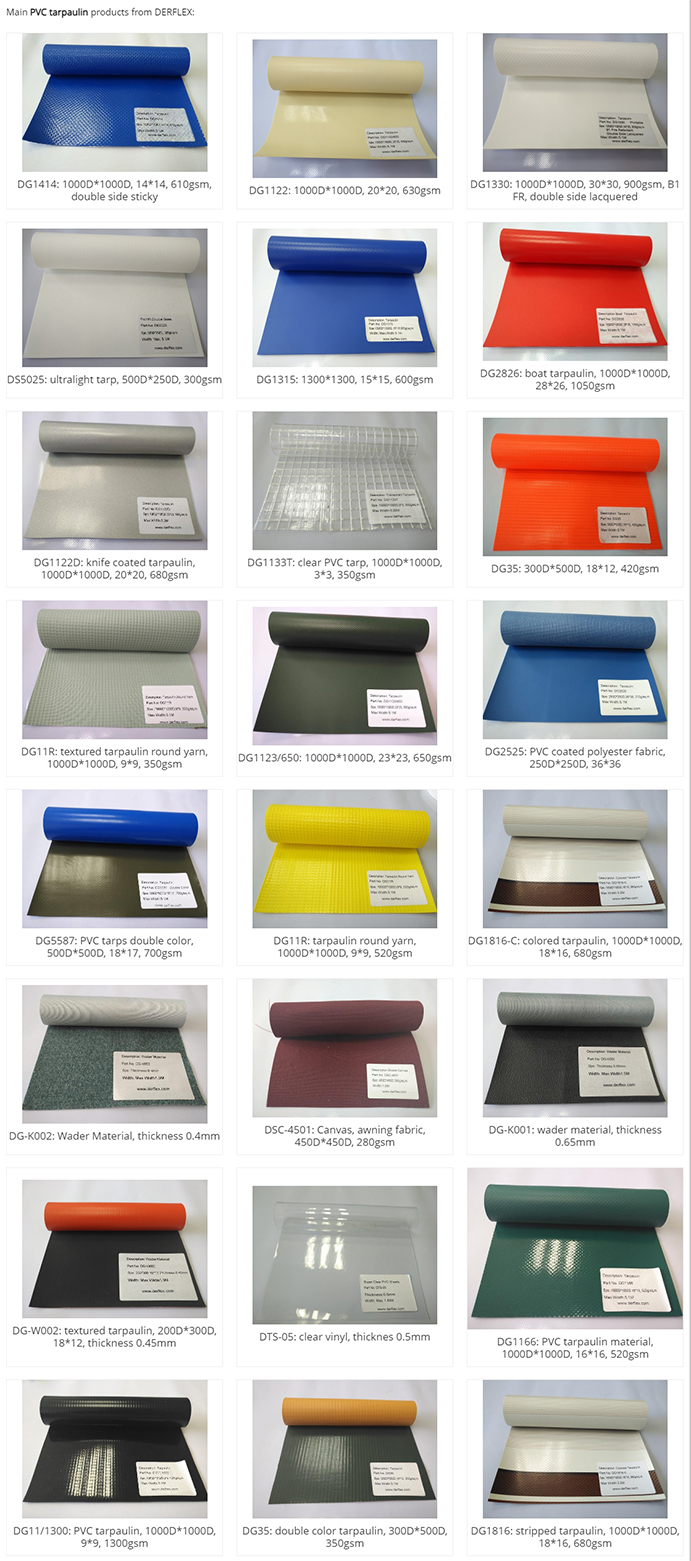
Material selection starts before fabrication
DERFLEX supplies PVC tarpaulin materials in multiple constructions and finishes, allowing the replacement cover to be specified around its real duty rather than treated as a generic sheet.
Use the Old Tarp as Evidence
The most useful part of a worn tarp may be the damage pattern. Photos of the failed cover can show where the next replacement needs extra attention. Rather than adding reinforcement everywhere, reinforcement can be concentrated where operating forces actually occur.
From One Replacement Sample to a Repeatable Wholesale Program
For a replacement tarp supplier relationship, the first order should create a specification that can be repeated. This is especially important for fleets, distributors, fabricators and OEM customers.
Capture the Existing System
Collect model information, dimensions, installation photos and hardware positions.
Mark Failure & Contact Zones
Identify holes, rub points, edge wear, seam damage and overstressed fastening locations.
Confirm Material Direction
Select PVC or mesh construction, weight direction, finish and optional performance treatments.
Define Fabrication Details
Lock finished size, reinforcement, pockets, seams, grommets, D-rings, straps and print.
Approve Sample / Drawing
Use a drawing, sample or golden-sample route according to project complexity and order scale.
Repeat by Controlled Specification
For wholesale replacement tarp programs, keep critical dimensions and construction details documented for reorders.
Repair the Old Tarp, Replace the Fabric, or Replace the Entire System?
The lowest upfront action is not always the most practical. The choice depends on remaining material strength, frame condition, hardware wear and how consistently the system still operates.
Local damage, sound base fabric
Consider repair when damage is limited and the surrounding fabric still has enough strength to hold a patch, weld or reinforced seam.
Fabric worn, hardware still serviceable
A custom replacement tarp can retain the existing frame, roll tube or mounting system while renewing the cover body.
Frame or mechanism also failing
If structural components are bent, badly corroded, unsafe or no longer operate correctly, review the system rather than copying the old fabric.
For framed structures, inspect for burrs, sharp fasteners and other contact points before fitting a new cover; otherwise a new tarp can be damaged by the same underlying cause.
Replacement Tarp Manufacturer Support for B2B Buyers
DERFLEX works from coated material through custom tarp fabrication, which makes it possible to coordinate material structure, reinforcement and finishing within one specification path.
The company supports custom sizes, roll material, finished covers, OEM/private-label requirements and repeat-order programs. DERFLEX's current product pages also describe more than 20 years of coated material manufacturing experience.
Explore Materials and Tarp Systems Related to Replacement Work
These pages help buyers compare the replacement cover with the material, system and truck-tarp categories around it.
Replacement Tarp FAQ
Practical answers for buyers comparing custom replacement tarp manufacturers, suppliers and wholesale programs.
What measurements are needed for a custom replacement tarp?
At minimum, provide the required finished length and width plus any pockets, tube sizes, grommet or D-ring positions, hems, straps and reinforcement locations. For system-mounted tarps, photos and frame or hardware measurements are strongly recommended because an old loose tarp may have changed dimension during service.
Can DERFLEX make a replacement tarp from an old sample?
An old sample can be useful for construction details and hardware locations. Because used tarps may stretch, shrink or deform, the old sample should be checked against the actual equipment dimensions before production dimensions are finalized.
What material is commonly used for heavy-duty replacement tarps?
PVC coated polyester is commonly selected for transport and industrial replacement tarps because it combines waterproofing, strength, flexibility and weldability. Mesh can be considered where airflow and reduced wind pressure are more important than full rain protection.
Can reinforcement be changed on the replacement cover?
Yes, subject to the system geometry. If the previous cover failed around corners, grommets, pockets or contact points, the reinforcement layout can be reviewed instead of automatically copying the damaged construction.
Does DERFLEX supply replacement tarps wholesale?
DERFLEX supports bulk and recurring B2B supply for distributors, fleet programs, trailer or tarp-system suppliers and private-label buyers. Order details, packaging and repeat-order specification control can be discussed according to the project.
How do I know whether to replace the tarp or the whole tarp system?
If the fabric is worn but the frame, roll tube, hardware and mechanism remain serviceable, replacing the tarp body can be practical. If structural or mechanical parts are unsafe, badly worn or no longer operate correctly, those components should be assessed before ordering a replacement cover.
Send the Old Tarp Details Before You Order the New One
Share equipment photos, finished dimensions, fastening layout, damage points, quantity and target use. DERFLEX can use that information to discuss a custom replacement tarp specification and quotation.