


What Does Tarp Mean in Trucking?
In trucking, a tarp is a tarpaulin or flexible cover placed over exposed freight or an open load. Drivers also use the word as a verb: to tarp a load means to cover it, and tarping is the work of positioning, tensioning and fastening that cover for transport.
“Tarp” in trucking usually means the cargo cover itself. “Tarp the load” means cover the freight. “Tarping” means the covering process. The tarp helps protect cargo from weather, road spray, dust and wind-driven debris, and selected tarp systems help contain loose material. It does not replace the chains, straps, blocking or other securement methods required to keep cargo from shifting or falling.
In Trucking, “Tarp” Is Both a Noun and a Verb
As a noun, a tarp is the flexible cover used over freight, a truck body or a trailer opening. On open-deck equipment, it may be a flatbed tarp, lumber tarp, steel tarp, coil tarp, machinery tarp or smoke tarp. On dump trucks, roll-off trucks and trailers, it may be a solid PVC/vinyl cover or an open mesh cover matched to the material being hauled.
As a verb, truckers say “tarp the load” when they mean putting the cover over the freight. “Tarping” is the overall covering job; “untarping” is removing and folding the cover at delivery.
The word is practical rather than material-specific. A truck tarp can be made from PVC-coated polyester, vinyl-coated fabric, mesh or another application-specific flexible material. That is why a commercial buyer should not stop at the word “tarp”: the real specification starts with truck type, cargo geometry, weather exposure, handling frequency and fastening design.
Buyer shortcut: if a carrier says “this load must be tarped,” the first question is not only “what size tarp?” Ask what is being hauled, how tall and irregular the loaded profile is, whether waterproof coverage is required, how the cover will be handled, and where the high-wear edges are located.
What Truckers Mean When They Talk About Tarps
Several common trucking terms sound similar but describe different parts of the cover, the load or the work.
Tarp
The protective sheet or fitted flexible cover used over freight or an open cargo area.
Tarp a Load
To put a tarp over the freight and fasten the cover for the trip.
Tarping
The work of deploying, positioning, tensioning and fastening one or more tarps over a load.
Untarping
Removing, folding and storing the cover before unloading or after weather-sensitive transport.
Drop
The vertical side coverage of a flatbed tarp. Taller freight generally requires more drop than low-profile cargo.
Flap / Tail Flap
An additional panel used to close an end of the covered load; common on lumber-style tarp constructions.
D-Rings & Grommets
Attachment points used with bungees, straps or other cover-fastening methods. Their layout affects fit and tension distribution.
Wind Whip
Repeated flapping caused by loose material in highway airflow. It increases fatigue at fabric, seams and attachment areas.
“Tarp” Does Not Mean One Standard Cover
In flatbed and vocational trucking, the tarp type is usually selected around cargo shape, required coverage, handling method and whether the priority is waterproofing or containment.
| Tarp Type | Typical Trucking Use | Why the Design Is Different | Important Buying Details |
|---|---|---|---|
| Lumber tarp | Tall stacked lumber, plywood, wallboard, palletized building materials and other high-profile flatbed freight. | Deeper side drops and an end flap help cover tall, rectangular loads. | Loaded height, side drop, flap size, D-ring rows, wear points and handling weight. |
| Steel tarp | Steel plate, pipe, rebar, low machinery and other relatively low-profile flatbed freight. | Usually uses less side drop than a lumber tarp, reducing extra material around lower loads. | Finished dimensions, abrasion zones, D-ring layout, edge reinforcement and waterproof requirement. |
| Coil tarp | Selected steel or aluminum coil loads. | A more fitted shape can reduce excess material around cylindrical freight. | Coil orientation, overall dimensions, opening layout and protection around sharp metal edges. |
| Machinery tarp | Construction machinery, industrial equipment and irregular cargo. | Irregular shapes create concentrated wear and difficult tension paths. | Drawing or load profile, reinforcement map, corner protection, access points and overlap. |
| Smoke tarp | Smaller front-area coverage or supplemental protection on selected flatbed loads. | Uses less material than a full load tarp and targets a specific exposure zone. | Coverage dimensions, placement, fastening layout and compatibility with the rest of the tarp set. |
| Dump / roll-off tarp | Aggregate, waste, demolition debris, landscaping material and loose bulk loads. | Often works with manual or powered tarp systems; mesh may be preferred when airflow and containment matter more than waterproofing. | Solid vs mesh, system compatibility, roll direction, perimeter reinforcement and abrasion resistance. |
| Curtain-side tarp | Curtain-side trailers and sliding side-access transport bodies. | Acts as a movable side wall rather than a loose flatbed cover. | Dimensional stability, sliding hardware interfaces, lower fastening details, printing and repeat flexing. |
Trucking naming can be load-based rather than material-based. “Lumber tarp” and “steel tarp” describe common cover styles, but the actual cargo profile still controls the correct drop, panel layout and reinforcement. A steel tarp may cover non-steel low-profile freight, and a lumber-style tarp may be used on other tall loads.
What a Truck Tarp Looks Like in Service
These DERFLEX site images show why truck tarp terminology covers more than one geometry: a full cargo cover and a trailer/curtain configuration impose different demands on the flexible material.
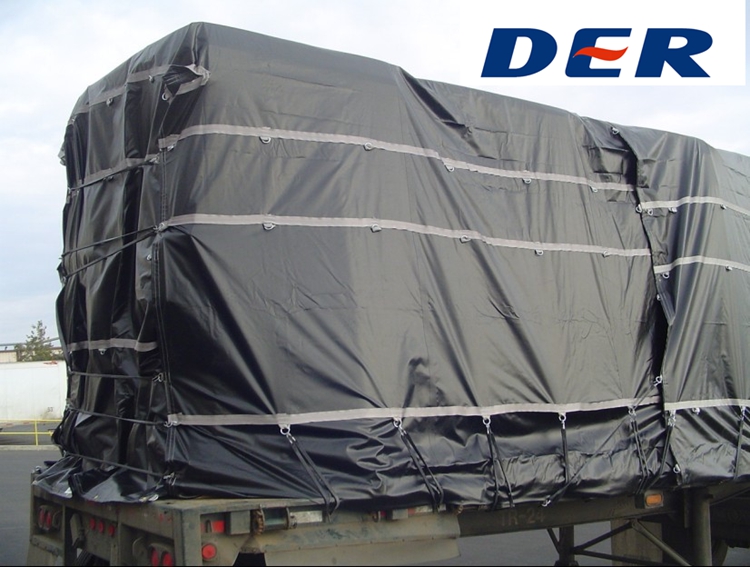
A finished truck tarp must follow the loaded profile while keeping reinforcement and attachment points accessible.
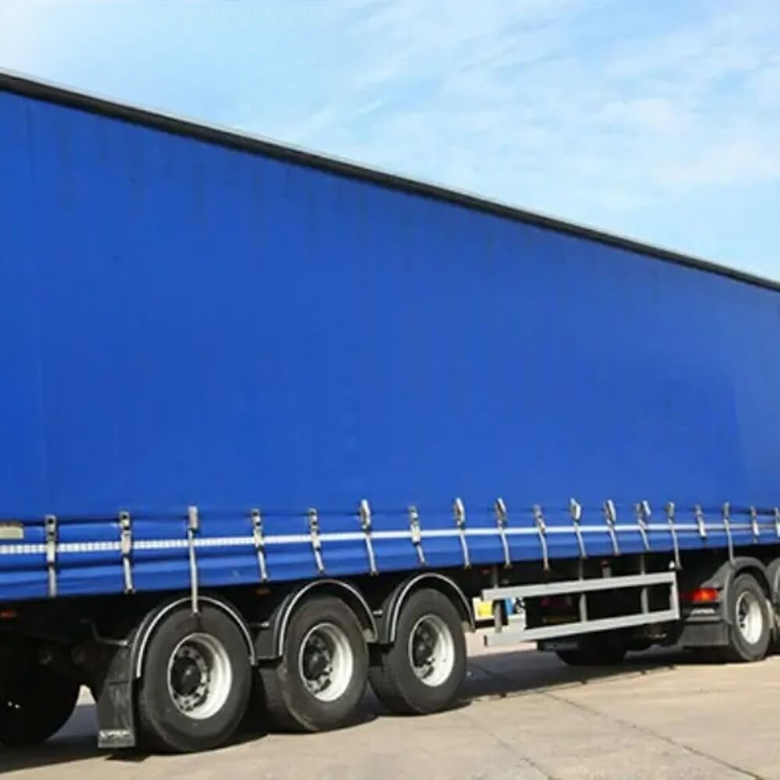
Truck tarpaulin material can also be used in structured trailer systems where dimensional control and repeated fastening matter.
A Tarp Protects the Load; It Does Not Automatically Secure the Load
Trucking language can make “covering” and “securing” sound like the same job. They are not.
What the Tarp Does
A solid tarp can reduce exposure to rain, road spray, dust, sunlight and wind-driven debris. A mesh tarp can provide airflow and help contain selected loose materials while reducing wind pressure.
What Cargo Securement Does
Chains, straps, tiedowns, blocking, bracing and other approved systems are used to immobilize cargo and prevent it from shifting, falling, leaking, spilling or blowing from a commercial vehicle as applicable to the load and regulations.
Why Buyers Should Separate Them
Tarp hardware should be designed around the vehicle and load without assuming that cover attachment points are load-rated cargo securement devices. A tarp specification and a cargo securement plan solve different problems.
U.S. regulatory reference: FMCSA cargo securement rules require cargo to be properly immobilized or secured. Tarping requirements can also depend on cargo, vehicle, jurisdiction and operating conditions. See the official FMCSA Cargo Securement Rules.
How to Interpret “I Need a Trucking Tarp” as a Real Specification
The phrase is only the starting point. The correct cover depends on the protection problem, load geometry and operating method.
| Operating Situation | Likely Tarp Direction | Material / Construction Focus | Questions to Confirm |
|---|---|---|---|
| Tall flatbed freight exposed to rain | Lumber-style or custom deep-drop tarp | Waterproof coated fabric, welded seams, reinforced edges, practical handling weight | Loaded height, drop, flap, overlap, sharp corners, tie-down rows |
| Low-profile steel or compact industrial freight | Steel tarp or custom short-drop cover | Abrasion resistance, waterproofing, edge protection | Load width/length, edge profile, padding, D-ring positions |
| Irregular machinery | Custom machinery tarp | Reinforcement at protrusions, shaped panels, repairability | Drawing/photos, access points, high-wear zones, repeatability |
| Loose aggregate, waste or debris | Mesh or solid dump/roll-off tarp | Containment, system compatibility, rolling behavior, abrasion | Load type, waterproof need, airflow, tarp system dimensions |
| Fleet replacement program | Standardized OEM truck tarp specification | Repeatable color, material, reinforcement, labeling and packing | Vehicle family, approved sample, replacement history, annual volume |
| Local tarp fabricator needs roll goods | Truck tarpaulin fabric rather than finished covers | Weldability, roll width, coating consistency, surface, batch repeatability | Fabrication process, machine width, target finished products, tests |
Why Truck Tarp Performance Depends on More Than Fabric Weight
Commercial trucking creates repeated stress at edges, seams, attachment rows and cargo contact points. A useful tarp specification connects the fabric to the finished cover design.
Loaded Geometry Before Finished Size
Trailer deck dimensions alone are not enough. Measure the loaded length, width and height, then define side drop, end coverage, overlaps and any access openings.
Reinforce the Stress Path
Webbing, wear strips, corner patches and hardware reinforcement should follow real tension and abrasion zones rather than being placed only for appearance.
Control Wind Flapping
Loose cover sections can flutter repeatedly at highway speed. Correct fit, attachment spacing and balanced tension help reduce fatigue and premature damage.
Protect Against Sharp Edges
Steel, machinery and pallet corners can cut or abrade even a heavy tarp. Edge protection and load preparation are part of the real service-life equation.
Balance Durability and Handling
A heavier tarp may improve durability in some applications, but it can also increase lifting, folding and deployment effort. Weight should match the duty cycle rather than be maximized blindly.
Match the Fabrication Method
PVC-coated polyester can support welded seams and reinforced fabrication. Final seam method, hardware and surface treatment should be confirmed against the actual cover design and production process.
Solid PVC/Vinyl Tarp vs Mesh Tarp in Trucking
The main decision is not “which tarp is better?” It is whether the load needs a weather barrier, airflow, containment or a combination of functions.
| Factor | Solid PVC / Vinyl Truck Tarp | Mesh Truck Tarp |
|---|---|---|
| Rain / road-spray protection | Suitable when a properly specified waterproof barrier is required. | Not a waterproof barrier because openings are part of the structure. |
| Airflow | Low airflow through the material. | Allows airflow and can reduce wind pressure compared with a solid sheet. |
| Common trucking direction | Flatbed freight, lumber, steel, machinery, general cargo and weather-sensitive goods. | Dump trucks, roll-off containers, landscaping, waste and selected loose-load containment. |
| Fabrication | Can be welded, hemmed and reinforced depending on material construction. | Edge finishing and system compatibility are important because load is transferred around an open structure. |
| Buyer question | How waterproof, abrasion-resistant and manageable must the finished cover be? | How much airflow, containment and roll-system compatibility are required? |
From the Word “Tarp” to a Repeatable Truck Tarp Program
For fleets, distributors, tarp fabricators and truck-body suppliers, the useful commercial step is converting a general trucking term into a controlled specification.
Material Supply
PVC-coated polyester and other truck tarp material directions can be discussed around waterproofing, weight, width, surface, color and downstream fabrication.
Finished-Cover Details
Projects can define welded seams, reinforced hems, webbing, D-rings, grommets, corner reinforcement, flaps and other truck-specific finishing details.
OEM Repeat Orders
Buyers can standardize size, material direction, color, logo, labels and packaging so replacement tarps and channel programs are easier to reproduce.
What to Send When Asking for a Truck Tarp Quote
A quote becomes more useful when the request describes the real load and operating method rather than only saying “truck tarp.”
Vehicle & Load
- Truck or trailer type
- Cargo type and typical load shape
- Loaded length, width and height
- Required side drop and end coverage
- Sharp edges or known abrasion areas
- Manual, roll-up, sliding or other tarp system
Material & Commercial Details
- Solid waterproof cover or mesh direction
- Target fabric weight / existing reference sample if available
- Color, surface and logo requirements
- Seam, hem, webbing, D-ring and grommet layout
- Quantity, packing and destination market
- Any required test or compliance documentation
MOQ, production time, exact performance values and compliance claims should be confirmed for the selected construction and order rather than assumed from a generic tarp description.
Common Truck Tarp Buying Mistakes
Most problems start before the tarp reaches the truck: the load, hardware and duty cycle were never fully defined.
1. Treating the tarp as cargo securement
Cover protection and load restraint are separate functions. Do not assume tarp attachment hardware replaces approved cargo securement.
2. Ordering from trailer size only
The loaded profile determines drop, flap and overlap. A tarp that fits an empty deck may not fit the actual freight.
3. Buying the heaviest fabric by default
Weight can contribute to durability, but driver handling, folding, deployment and the reinforcement design also matter.
4. Ignoring abrasion and sharp edges
Heavy fabric can still fail against uncovered metal corners, machinery protrusions and repeated rub points.
5. Using solid tarp where mesh is the real need
Waste, aggregate and roll-off applications may prioritize airflow and containment rather than full waterproofing.
6. Leaving reinforcement layout until the end
Grommets, D-rings, webbing and wear strips should be designed around actual tension paths, not added as generic accessories.
Continue from Trucking Terminology to Product Selection
These verified DERFLEX pages form the most relevant topic cluster for buyers moving from “what does tarp mean in trucking?” to a real truck tarp specification.
Truck Tarp & Tarping Questions
Short, direct answers for drivers, fleets and buyers who encounter tarp terminology in trucking.
What does tarp mean in trucking?
In trucking, a tarp is a tarpaulin or flexible protective cover used over exposed cargo or an open truck/trailer body. Truckers also use “tarp, ” as a verb: to tarp a load means to cover it for transport.
What does “tarping a load” mean?
Tarping a load means deploying one or more tarps over the freight, arranging the panels around the cargo profile, and fastening the cover so it provides the intended weather or containment protection during transport.
Does a tarp secure cargo on a truck?
A tarp should not be treated as a substitute for cargo securement. Cargo must be immobilized or secured with the appropriate structures, tiedowns, blocking, bracing or other methods required for the load. The tarp is mainly a protective or containment cover.
What is the difference between a lumber tarp and a steel tarp?
Lumber tarps generally use deeper side drops and often an end flap for tall stacked loads. Steel tarps are commonly sized for lower-profile cargo and therefore use less side material. Actual selection should be based on loaded geometry, not the cargo name alone.
Are truck tarps always waterproof?
No. Solid PVC or vinyl truck tarps can be specified for waterproof cargo protection, while mesh truck tarps intentionally allow airflow and are used when containment and lower wind pressure matter more than a sealed weather barrier.
Why do truck tarps have D-rings and grommets?
D-rings and grommets provide attachment points for fastening the cover. Their spacing, row position and reinforcement should match the truck, load shape and tension pattern so stress is distributed more effectively.
What material is commonly used for heavy duty truck tarps?
PVC-coated polyester is commonly selected for heavy duty waterproof truck tarps because it combines a reinforced textile base with a weather-resistant, weldable surface. Mesh and other materials are used where the application has different airflow, containment or handling needs.
What information should I send DERFLEX for a custom truck tarp project?
Send the truck or trailer type, cargo profile, finished dimensions, side drop, flap requirements, material direction, reinforcement and hardware layout, color, logo needs, quantity, packaging, destination and any required test or compliance documentation.
Turn a Trucking Tarp Requirement into a Buildable Specification
Send DERFLEX the truck type, cargo shape, loaded dimensions, side drop, solid or mesh direction, target material, reinforcement layout, hardware spacing, quantity and destination. The team can review a practical material and fabrication direction for quotation.