News
Industry News

1000D vs 1300D vs 1680D PVC-Coated Polyester Fabric | Selection Guide

Update:2026/7/29 19:47:42 Views:
DERFLEX logo Industrial PVC-Coated Fabric Selection Guide

1000D vs 1300D vs 1680D PVC-Coated Polyester Fabric

Choose the yarn construction that fits the load path, handling cycle and fabrication process—not simply the largest denier number.

This buyer-focused page compares three heavy-duty polyester base-cloth directions for truck tarps, industrial covers, side curtains, tent systems, partitions and reinforced fabric products. It explains where each grade adds value, where extra yarn mass becomes unnecessary, and which test data should be confirmed before bulk production.

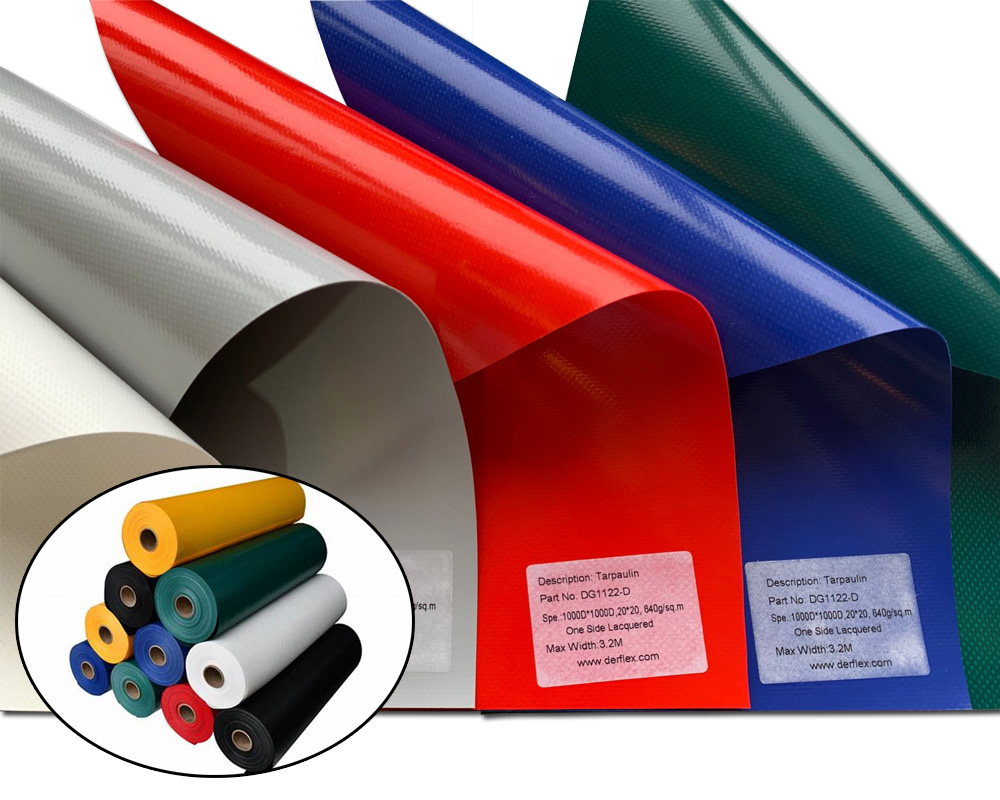
DERFLEX PVC-coated polyester fabric rolls for 1000D 1300D and 1680D project selection
PVC-Coated Polyester Fabric Color, yarn construction, coating weight, finish and roll format can be matched to the application.
Product Display
Decision in 60 Seconds

Which Denier Direction Should an Industrial Buyer Start With?

The answer depends on the complete coated-fabric system. These three starting points make the initial sample discussion more efficient.

Balanced Heavy-Duty Direction

Start with 1000D when handling and convertibility matter.

1000D is often the practical baseline for welded PVC tarpaulins, truck covers, tents and repeat-use industrial covers. It provides substantial yarn size while remaining easier to fold, weld, sew and pack than bulkier constructions. It is usually the first sample route when a buyer needs heavy-duty performance without excessive stiffness.

Intermediate Reinforcement Direction

Move to 1300D when the load or fabric body increases.

1300D can be considered when the panel is repeatedly tensioned, spans are larger, edge loads are higher or the buyer wants more structural body than a standard 1000D construction. It creates a useful middle route between everyday heavy-duty fabric and the weight, stiffness and processing demands associated with 1680D.

High-Bulk / High-Wear Direction

Use 1680D where abrasion zones or structured panels justify it.

1680D brings the highest yarn linear mass of the three. It can suit reinforcement zones, high-contact panels, heavy protective products and applications where body is more important than compact folding. Confirm coating build, seam method, machine capability and fold behavior before specifying it across an entire finished product.

The Number Behind the Yarn

Denier measures yarn linear mass.

One denier equals one gram per 9,000 metres of yarn. Therefore, for the same yarn length, 1300D contains 30% more linear mass than 1000D, while 1680D contains 68% more.

D = grams per 9,000 m of yarn
1.00×1000D baseline
1.30×1300D yarn mass
1.68×1680D yarn mass
Important Procurement Distinction

A 68% increase in yarn mass does not mean 68% more finished-fabric strength.

Denier describes the yarn, not the entire PVC-coated polyester fabric. Real tensile strength, tear propagation, abrasion response, dimensional stability and service behaviour are also shaped by yarn tenacity, warp-and-weft construction, weave density, finished GSM, coating adhesion, surface lacquer and fabrication details.

A tightly woven 1000D base with stable coating adhesion can outperform a loosely constructed higher-denier fabric in the property that matters to a specific project. The reverse may also be true when the higher-denier construction is properly engineered for tension or abrasion.

Buying rule: compare complete technical data and representative samples. Do not approve a material from the “D” number alone.

Side-by-Side Engineering View

1000D vs 1300D vs 1680D PVC-Coated Polyester Fabric Comparison

Use this table to define the first sample direction. Final approval should follow test reports, welding trials and real-use review.

Decision Factor 1000D PVC-Coated Polyester 1300D PVC-Coated Polyester 1680D PVC-Coated Polyester
Relative yarn linear mass Baseline: 1.00× Approximately 1.30× the yarn mass of 1000D Approximately 1.68× the yarn mass of 1000D
Typical material character Heavy-duty but comparatively workable; suitable for folding and regular conversion More body and reinforcement potential while remaining below the bulk of 1680D High yarn bulk and structured hand; can become noticeably stiffer with a heavy PVC build
Handling and packing Usually the most manageable of the three for large finished covers Moderate packing volume and handling effort Higher bulk; packing, rolling and manual handling should be reviewed early
Fabrication direction Hot-air weldingHF weldingSewing Heavy-duty weldingReinforced seamsWebbing systems Equipment checkWider seam studyFold-life trial
Common selection logic Strength-to-handling balance for repeated outdoor and industrial use Additional load capacity, body or span control without defaulting to the heaviest yarn High-contact zones, structural body or severe abrasion direction
Possible application direction Truck tarps, tents, covers, curtains, equipment protection, inflatable structures Side curtains, sound barriers, large industrial partitions, high-tension covers, reinforced transport panels Wear strips, high-contact protective panels, mining and industrial barriers, heavy bags, reinforcement zones
Main specification risk Under-specifying weave density, coating adhesion or reinforcement because “1000D” sounds sufficient Adding yarn mass without confirming whether the actual failure mode is seam, coating or hardware related Paying for unnecessary weight and stiffness when a hybrid reinforcement design would be more efficient
Recommended verification Tensile, tear, adhesion, weld compatibility and outdoor formulation Load direction, dimensional stability, seam efficiency and handling trial Abrasion, fold life, machine processing, seam construction and finished-product weight
Why Denier Alone Is Incomplete

Four Load Paths Decide Whether the Fabric Survives in Service

A coated textile normally fails through a system interaction. A higher-denier base cannot compensate for every weak point.

1

Panel Tension

Wind pressure, tie-down force and long spans create tensile loads. Review warp and weft strength in the actual orientation of the finished product.

2

Tear Initiation

Corners, cut edges, grommets and damaged surfaces concentrate force. Tear data and reinforcement layout may matter more than a denier upgrade.

3

Surface Abrasion

Dragging, rubbing and cargo contact affect lacquer and PVC thickness. High yarn mass helps only after the coating system is matched to the wear mode.

4

Seam and Hardware Loads

Weld width, sewing pattern, webbing, eyelets and corner patches transfer force. The finished assembly should be engineered as one load-bearing system.

Detailed Grade Profiles

How the Three Denier Options Behave in Real Product Design

Each option can be manufactured in different weave counts, coating weights and finishes. The profile below describes its most useful design role.

1000D Heavy-Duty Workhorse

Broadest conversion flexibility

1000D is widely used because it can support rugged PVC-coated constructions without making every finished product unnecessarily heavy. It is compatible with multiple weave densities and finished weights, so the same denier family can be engineered for truck covers, tent fabric, inflatables or industrial curtains.

  • Useful starting direction for most welded tarp programs
  • More practical for frequent folding and field handling
  • Can be upgraded through weave density, coating weight and reinforcement
  • Often easier to source, sample and convert at scale
1300D Controlled Step-Up

More body without the full 1680D penalty

1300D is useful when a buyer has identified a genuine need for more yarn mass: repeated tension, long panels, higher edge loading, large industrial curtains or a more substantial material feel. It should be treated as an engineered step-up, not an automatic upgrade for every heavy-duty product.

  • Middle route for demanding truck and industrial fabric systems
  • Can support increased dimensional body and load direction
  • Suitable for reinforced partitions, barriers and long-span covers
  • Still requires density, adhesion and seam verification
1680D High-Bulk Reinforcement

Reserve it for justified high-wear demand

1680D can add body and abrasion-focused construction potential, but its extra bulk affects roll weight, folding, sewing, welding and logistics. For many finished tarps, the efficient solution is not a full 1680D body; it may be a 1000D or 1300D main panel with 1680D-compatible reinforcement in contact zones.

  • Useful for wear strips, contact zones and structured products
  • Can suit high-abrasion industrial or protective panels
  • Requires stronger attention to fold behaviour and machine settings
  • Hybrid construction can reduce total weight and cost direction
DERFLEX Manufacturing Direction

Configurable PVC-Coated Polyester Fabric Specification

The ranges below are procurement discussion parameters, not a single fixed product. Final values depend on end use, production route and confirmed performance requirements.

Available project variables

Base yarn options1000D, 1300D, 1680D and project-specific constructions
Base-fabric directionHigh-tenacity polyester; warp × weft and density matched to load
Finished weightApproximately 450–1200 gsm project range, subject to construction
Roll widthApproximately 1.02–5.10 m, subject to coating line and specification
Coating structureDouble-side PVC coating, knife coating, hot-melt or laminated direction
SurfaceMatte, glossy, embossed, acrylic lacquered or project-specific topcoat
Functional optionsUV, anti-mildew, flame-retardant, anti-static, anti-scratch or printable direction
FabricationHot-air welding, high-frequency welding, sewing, cutting and custom conversion
Color directionStandard industrial colors and custom RAL / Pantone matching discussion
Supply formatRoll goods, cut panels, welded sections, finished tarps or OEM packing

Application-Based Selection

Match the Denier to the Product’s Failure Mode

Specifying by application is more reliable than specifying by a single headline number.

Truck Covers and Cargo Tarps

Starting direction: 1000D for general heavy-duty use; 1300D when long panels, repeated tension or severe route conditions require more body. Reinforce corners and contact points rather than increasing every panel by default.

Side Curtains and Trailer Systems

Starting direction: 1000D or 1300D depending on span, opening cycles and reinforcement design. Pay close attention to dimensional stability, surface abrasion, printed graphics and attachment hardware.

Large Tents and Temporary Structures

Starting direction: often 1000D with a denser weave and suitable coating weight. Flame-retardant direction, UV package, lacquer and seam efficiency may be more important than simply moving to 1680D.

Industrial Curtains and Sound Barriers

Starting direction: 1300D can be evaluated when panel weight, hanging load, repeated movement or barrier body increases. Confirm suspension design and tear resistance around mounting points.

Mining, Construction and High-Wear Protection

Starting direction: 1300D or targeted 1680D reinforcement where rubbing, dragging or repeated equipment contact occurs. Specify anti-static or flame-performance direction when the environment requires it.

Inflatable and Airtight Products

Starting direction: 1000D is often sufficient when the coating and adhesion system is engineered for airtightness. Higher denier should be justified by pressure, size, reinforcement or abrasion—not assumed to improve air retention by itself.

From Yarn to Approved Roll

How DERFLEX Develops a Project-Matched Fabric

The purpose of the process is consistency between the approved sample and repeat bulk production.

Application Review

Define exposure, load direction, handling cycle, seam type and target lifetime.

Base-Cloth Design

Select yarn denier, tenacity, warp × weft construction and weave density.

PVC Formulation

Match coating weight, flexibility, UV, FR, anti-mildew and surface requirements.

Sample Validation

Review appearance, hand, weldability, tensile, tear, adhesion and application fit.

Bulk Control

Confirm width, weight, color, surface, roll flatness, packing and shipment records.

A More Efficient Buying Strategy

Do not buy the whole tarp at the denier needed only at its worst wear point.

Many large covers fail locally: at corners, around eyelets, over sharp cargo edges, on roof contact lines or at frequently folded zones. Raising the full body from 1000D to 1680D increases roll weight, shipping volume, handling effort and fabrication load—even when only a small percentage of the product experiences severe abrasion.

A hybrid construction can use a workable main body and targeted reinforcement at load concentrations. This approach should be validated through seam design, material compatibility and sample testing, but it often creates a more rational balance between durability, weight and conversion efficiency.

01

Identify the actual failure point.

Is the issue tensile failure, tear around hardware, coating wear, seam failure, cracking or poor weld adhesion?

02

Change the parameter that controls it.

Denier may help, but density, coating, lacquer, reinforcement, hardware spacing or weld design may be the stronger lever.

03

Compare finished samples at equal conditions.

Review same-size samples, equivalent coating directions and the same test method before drawing conclusions.

04

Approve the complete specification.

Record yarn, density, GSM, thickness, surface, color, test values, width, packing and acceptable tolerances.

Buyer FAQ

Questions About 1000D, 1300D and 1680D PVC-Coated Polyester

Answers are written for specification screening. Project data and approved samples remain the basis for production.

Is 1680D PVC-coated polyester always stronger than 1300D or 1000D?

No. 1680D has greater yarn linear mass, but finished strength also depends on yarn tenacity, weave density, warp-and-weft balance, coating adhesion, final GSM and test direction. A well-engineered 1000D or 1300D construction can be more suitable for a particular load or fabrication process.

Which denier is commonly used for heavy-duty truck tarps?

1000D is a common starting direction because it balances strength potential, welding, foldability and handling. 1300D can be considered for higher tension, larger panels or demanding use. Reinforcement layout, coating, lacquer, seam design and hardware should be specified together with the denier.

Does a higher denier automatically make PVC-coated fabric more waterproof?

No. Waterproof performance is mainly controlled by the coating or lamination system, coating continuity, adhesion, pinhole control and seam construction. Denier describes the yarn mass of the textile reinforcement.

What is the practical role of 1300D fabric?

1300D provides an intermediate step when 1000D does not provide enough material body or load direction, but a full 1680D construction would add unnecessary bulk. It can be evaluated for side curtains, industrial barriers, large panels and repeatedly tensioned covers.

Can DERFLEX manufacture custom weave density and finished GSM?

DERFLEX supports project-specific yarn construction, weave density, finished weight, width, color, surface, functional additives and supply format. Availability and tolerances are confirmed according to the selected production route and order requirement.

What sample tests should a buyer request?

Typical review items include finished weight, thickness, tensile strength, tear strength, PVC-to-fabric adhesion, abrasion or surface performance, welding compatibility, flame-retardant direction where required, color and roll consistency. Use the same test method when comparing suppliers.

Need 1000D, 1300D or 1680D PVC-Coated Polyester Fabric?

Send DERFLEX the end use, target weight, width, exposure, welding method and required test direction. The quotation can then be based on a complete construction rather than a denier number alone.

Technical values and application directions on this page are reference information for purchasing discussions. Final specifications, test methods, tolerances and compliance requirements should be confirmed in the quotation, approved sample and order documents.
Consulting Services
+86-021-54361792 / 54361798
Email
sales@derflex.com