

News
Industry News

18 oz vs 22 oz Vinyl Tarps | Industrial Buying Guide

Update:2026/7/28 18:23:23 Views:
Industrial Vinyl Tarp Selection Guide

18 oz vs 22 oz Vinyl Tarps: Which One Should Industrial Buyers Choose?

Choose 18 oz when you need a dependable heavy-duty tarp with easier handling. Move to 22 oz when abrasion, repeated tension, cargo movement or longer duty cycles justify extra material mass. The correct decision still depends on the polyester scrim, coating formula, seams, reinforcement and operating environment—not weight alone.

Buyer conclusion

18 oz is the versatile industrial default; 22 oz is the durability upgrade.

For many industrial buyers, an 18 oz vinyl tarp offers the most practical balance of waterproof protection, strength, flexibility, fabrication and crew handling. It is commonly selected for fleet covers, construction protection, machinery covers, outdoor storage and distributor programs that need a strong professional grade without unnecessary mass.

A 22 oz vinyl tarp is more appropriate when the cover repeatedly rubs against cargo, trailer bows, steel edges or equipment; remains outdoors for longer cycles; or is tensioned, folded and redeployed under demanding conditions. The added coating and total material mass generally provide more abrasion and puncture reserve, but also increase purchase cost, shipping weight and manual handling effort.
Procurement rule: start with the real failure mode. Choose 22 oz when the expected cost of wear, downtime or replacement is higher than the extra cost and handling burden. Otherwise, a correctly engineered 18 oz tarp is often the more efficient specification.
Side-by-side specifications

18 oz vs 22 oz Vinyl Tarp Comparison

Use this table to define the direction of your inquiry. Final technical data should be confirmed against the selected polyester yarn, weave, coating recipe, finish, test method and fabrication design.

Selection factor 18 oz vinyl tarp 22 oz vinyl tarp Procurement implication
Nominal material weight 18 oz/yd², approximately 610 gsm 22 oz/yd², approximately 746 gsm 22 oz uses about 22% more material mass for the same area.
Typical thickness direction Often around 20–22 mil Often around 24–25 mil Thickness varies by construction. Do not treat oz and mil as interchangeable.
Handling Easier to fold and deploy Heavier, stiffer and more demanding on crews Large fleet tarps can create a meaningful ergonomic and labor difference.
Abrasion reserve Strong for broad heavy-duty use Generally higher for repeated rubbing and contact 22 oz is useful where the surface—not the seam or hardware—is the normal wear point.
Tear and tensile performance Depends heavily on scrim yarn and weave Can be higher, but weight alone is not enough Request test values and test methods instead of relying only on the oz label.
Flexibility Usually more convenient for frequent folding Usually less flexible due to added mass Cold-weather formulation may matter more than weight for winter handling.
Typical use cycle Repeated general industrial and transport use High-wear, longer-cycle or severe-duty use Match the grade to the actual replacement interval and operating stress.
Cost direction Lower material and freight cost Higher material and freight cost Compare total lifecycle cost rather than purchase price per tarp.
Common buyer profile Fleet operators, contractors, distributors, general industry Heavy transport, industrial equipment, long-duration outdoor programs OEM buyers can use both grades in one product range for different duty levels.
Important: an 18 oz fabric with a stronger polyester scrim, better coating adhesion and correct edge reinforcement can outperform a poorly specified heavier fabric in critical tests. Ask for tensile, tear, adhesion, abrasion, cold-crack and UV information that matches your application.
Material mass
18 oz baseline
Material mass
22 oz +22%
Handling convenience
18 oz favored
Abrasion reserve
22 oz favored
Crew and freight impact

How Much Heavier Is a 22 oz Tarp in Real Use?

The difference becomes more important as tarp area increases. The example below calculates material weight only; finished hems, webbing, grommets, D-rings, straps, seams and tolerances add more weight.

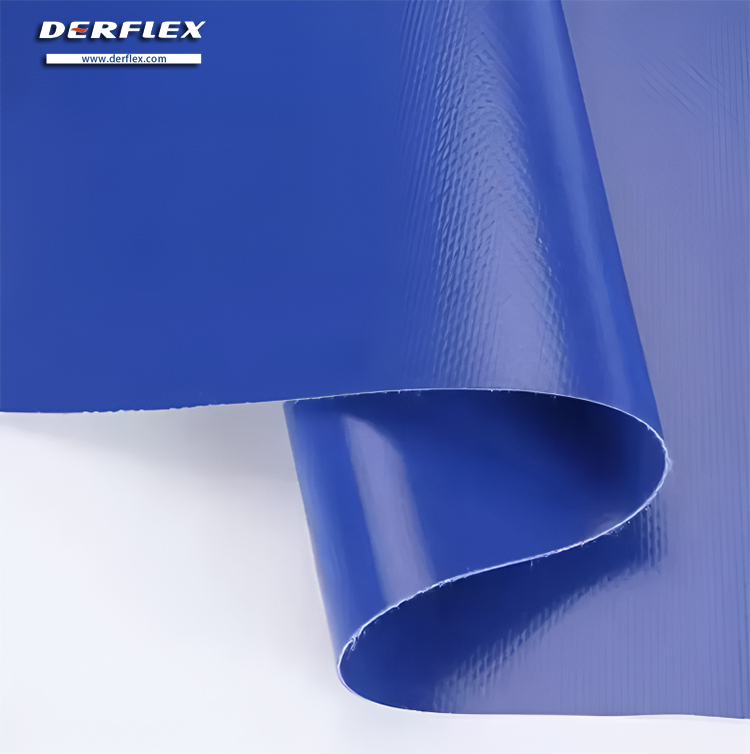
DERFLEX blue PVC vinyl coated fabric for heavy duty tarps
DERFLEX PVC coated polyester fabric product image. Weight, yarn, width, finish and performance options can be matched to the project.

Example: 20 ft × 30 ft finished coverage area

Area = 600 sq ft = approximately 66.67 sq yd.

18 oz material calculation ≈75.0 lb
22 oz material calculation ≈91.7 lb
Material-only difference ≈16.7 lb
On a large manual-deployment tarp, the extra material may affect how many people are needed, how quickly the cover can be installed, and how much fatigue is created over repeated daily cycles.
Application matrix

Which Weight Fits Common Industrial Applications?

These are specification directions, not universal rules. Sharp edges, wind loading, tie-down geometry, chemical exposure, temperature and frequency of use can move the project to a different grade.

Flatbed and General Cargo Covers

For frequent deployment where drivers fold, roll and reposition the tarp, handling efficiency is important.

  • Balanced strength and flexibility
  • Lower tarp mass for manual handling
  • Reinforced corners and abrasion pads where needed
Start with 18 oz

Steel, Scrap and High-Friction Loads

When movement, sharp contact points or repeated rubbing are common, additional surface durability may reduce wear.

  • Specify abrasion zones and sacrificial reinforcement
  • Confirm tear strength and edge protection
  • Review securement and load geometry
Consider 22 oz

Equipment and Machinery Covers

Stationary equipment with moderate handling often does not require the heaviest available tarp.

  • 18 oz for regular outdoor protection
  • 22 oz where corners or vibration create friction
  • Use fitted shapes to reduce wind movement
18 oz or targeted 22 oz

Construction and Temporary Enclosures

The correct choice depends on reuse cycles, attachment spacing, wind exposure and site safety requirements.

  • 18 oz for movable barriers and general covers
  • 22 oz for longer placement and rough site contact
  • Confirm flame-retardant requirements separately
Application dependent

Agriculture and Outdoor Storage

Large covers often make handling weight and tension distribution more important than choosing the highest oz grade.

  • Use adequate slope and drainage
  • Reduce flapping through correct tie-down design
  • Specify UV and anti-mildew direction
Often 18 oz

Permanent or Semi-Permanent Covers

Long placement periods can justify more coating mass if installation is infrequent and wear exposure is high.

  • Higher abrasion reserve
  • Less concern about daily manual handling
  • Review UV, lacquer and cold-crack formulation
Often 22 oz
Beyond the oz label

Eight Engineering Factors That Can Matter More Than Four Extra Ounces

A procurement specification based only on material weight can create inconsistent performance. A professional vinyl tarp manufacturer should help define the complete structure.

1. Polyester yarn and scrim

Denier, yarn quality, weave density and construction affect tensile strength, tear behavior, stretch and dimensional stability.

2. Coating formulation

PVC recipe, plasticizer system, UV package, anti-mildew treatment and cold-flexibility additives influence real outdoor performance.

3. Coating adhesion

Peel strength and coating-to-scrim adhesion influence delamination resistance during folding, welding and repeated mechanical stress.

4. Surface finish

Gloss, matte, lacquer, embossing and anti-fouling treatments change cleanability, friction, appearance and weathering behavior.

5. Seam design

Heat-welded seams, overlap width, weld settings and seam layout affect waterproof continuity and load transfer across large panels.

6. Edge reinforcement

Webbing, folded hems, rope edges, corner patches and local wear pads can prevent the perimeter from failing before the main fabric.

7. Hardware layout

Grommet metal, spacing, D-rings, pockets and strap position should match tension direction rather than follow a generic pattern.

8. Compliance requirements

Flame-retardant, REACH, RoHS or market-specific testing should be defined before sampling because the required pathway varies by use and destination.

Selection workflow

A Six-Step Decision Process for Industrial Buyers

Use the following process before requesting samples or comparing quotations.

Define the failure risk

Identify whether previous tarps failed by abrasion, tearing, grommet pull-out, seam leakage, UV cracking, cold stiffness or incorrect fit.

Map handling frequency

Record how often the tarp is installed, removed, folded, dragged, transported and cleaned. Frequent manual handling generally favors lower mass.

Measure exposure

Note sun, rain, snow, chemicals, grease, temperature range, wind, standing water, sharp edges and contact surfaces.

Set performance values

Request relevant tensile, tear, adhesion, abrasion, hydrostatic, cold-crack or flame-performance values with the test standard.

Engineer fabrication

Define finished size, seam direction, hem construction, reinforcement, grommet spacing, D-rings, straps, pockets and labels.

Compare total cost

Evaluate purchase, freight, labor, downtime and replacement frequency. The lowest unit price is not always the lowest operating cost.

Lifecycle value

Do Not Choose 22 oz Only Because It Sounds More Durable

A heavier tarp can be the economical choice in a high-wear program, but over-specifying every application can raise material, freight and labor costs without solving the actual failure point.

Use total cost per service cycle

TCO = purchase + freight + installation labor + downtime + replacements

If 22 oz materially extends the replacement interval in your environment, the higher initial cost may be justified. If failures are caused by poor fit, weak grommet placement or sharp unprotected edges, extra ounces may not solve the problem.

When 18 oz may deliver better value

  • Crews handle large tarps every day
  • Abrasion is controlled with wear pads
  • The tarp is replaced for hygiene or branding reasons
  • Freight weight is commercially important
  • The cover is used seasonally or intermittently
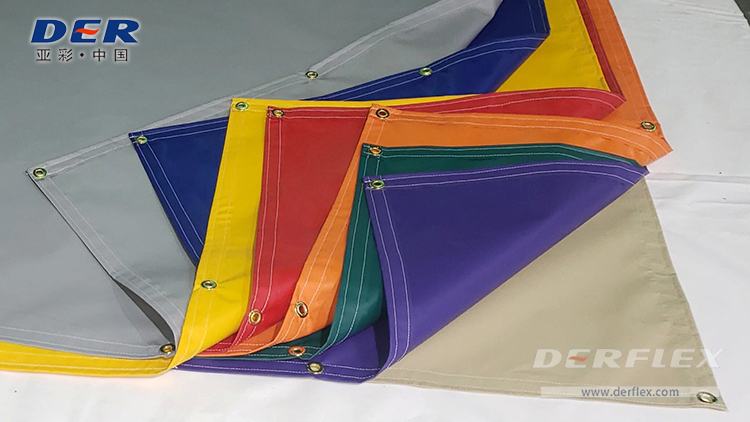
DERFLEX custom colored heavy duty vinyl tarps with reinforced hems and grommets

Product display: PVC vinyl tarps with reinforced edges and grommets. Final colors, size and finishing can be customized.

DERFLEX manufacturing support

Build the Tarp Around the Duty Cycle, Not a Generic Weight Label

DERFLEX supplies PVC coated polyester tarp materials, cut panels and finished tarp solutions for distributors, fabricators, fleets, contractors, importers and OEM programs. Buyers can compare an 18 oz direction, a 22 oz direction or a customized metric specification based on the same application brief.

  • Roll fabric or finished tarps
  • Custom weight and thickness
  • Color and surface finish
  • ,
  • UV and cold-flex direction
  • Optional flame-retardant pathway
  • Heat-welded fabrication
  • Hems, webbing and wear pads
  • Grommets, D-rings and straps
  • Logo and OEM packaging
  • Repeat-order specification control
RFQ preparation

What to Send DERFLEX for an Accurate 18 oz or 22 oz Tarp Quote

A complete brief reduces unnecessary sampling and helps the supplier recommend the right material and fabrication route.

Application and environment

  • What will the tarp cover or contain?
  • Indoor, outdoor, mobile or stationary use
  • Expected temperature and UV exposure
  • Contact with oil, grease, chemicals or sharp edges
  • Daily, weekly, seasonal or permanent installation

Product and commercial details

  • Finished size or roll width and roll length
  • Target weight, thickness, color and finish
  • Hems, grommet spacing, D-rings, webbing and straps
  • Required tests or flame-retardant standard
  • Quantity, packaging, branding and destination market
Procurement FAQ

18 oz vs 22 oz Vinyl Tarp Frequently Asked Questions

Is a 22 oz vinyl tarp always stronger than an 18 oz tarp?

Not in every mechanical property. A 22 oz tarp normally has more material mass and may provide greater abrasion and puncture reserve, but tensile strength, tear strength and dimensional stability also depend on the polyester scrim, yarn, weave and coating adhesion. Compare test data for the selected construction.

What is the typical thickness of 18 oz and 22 oz vinyl tarps?

An 18 oz vinyl tarp is often around 20–22 mil, while a 22 oz tarp is often around 24–25 mil. These are common market directions rather than universal values. Ask the supplier to confirm both finished weight and measured thickness for the exact specification.

Which grade is better for truck tarps?

18 oz is widely used where drivers need a heavy-duty but manageable cover. 22 oz can be appropriate for high-friction, long-cycle or severe transport applications. Load shape, sharp edges, wear pads, reinforcement and handling frequency should be reviewed before selecting the grade.

Are both 18 oz and 22 oz vinyl tarps waterproof?

PVC coated polyester materials in both grades can be designed for waterproof protection. Finished tarp waterproofing also depends on seam welding, panel layout, drainage, hardware penetration and installation.

How much heavier is 22 oz material?

For the same fabric area, 22 oz material is approximately 22.2% heavier than 18 oz material. A 20 ft × 30 ft material area is approximately 75 lb at 18 oz and 91.7 lb at 22 oz before hems, webbing, hardware and fabrication allowances.

Can DERFLEX customize both grades?

DERFLEX can discuss customized weight, width, color, finish, UV direction, flame-retardant options, cold flexibility, welded seams, hems, webbing, grommets, D-rings, straps, logo and OEM packaging. Final capabilities and test values should be confirmed during quotation and sampling.

Still Deciding Between 18 oz and 22 oz?

Send DERFLEX your application, size, handling cycle, wear points, climate, quantity and required finishing. The team can compare a balanced 18 oz structure with a heavier 22 oz direction before you commit to volume production.

Technical values are typical selection directions and should be confirmed against the final product specification, production sample, test method and intended use.
Consulting Services
+86-021-54361792 / 54361798
Email
sales@derflex.com