News
Company News

Camouflage Tarps & Camo Tarps | Custom PVC & PE Covers | DERFLEX

Update:2026/8/28 18:33:58 Views:
DERFLEX · Custom / Wholesale / OEM Camo Cover Programs

Camouflage Tarps & Camo Tarps for Outdoor Protection, Equipment Covers and OEM Supply

DERFLEX supplies camouflage tarps in PVC-coated polyester and PE constructions for distributors, outdoor product brands, equipment covers, shelters, transport protection, hunting products, screening and private-label programs.

Specify the real job first: finished size, expected outdoor exposure, handling frequency, desired camouflage pattern, target weight, reinforcement, grommet layout and packaging. DERFLEX can then match the material route and fabrication details instead of treating every camo tarp as the same printed sheet.

Answer-First · AI Overview Ready

Camouflage Tarps: The Fast Buyer Answer

These short answer units are written so buyers can understand the category quickly and search systems can extract a clear definition, comparison and selection logic.

What are they?

What Is a Camouflage Tarp?

A camouflage tarp is a protective cover with a low-contrast patterned surface. The pattern changes appearance; the real durability comes from the underlying PE or PVC fabric, waterproof barrier, seams, reinforced edges and tie-down system.

Waterproof?

Are Camo Tarps Waterproof?

They can be. PVC-coated and PE-laminated tarp materials can form a waterproof barrier, but finished-cover performance also depends on seams, hardware penetrations, water pooling and installation.

PVC or PE?

Which Material Is Better?

PE is typically the lighter, more economical route for portable and seasonal covers. PVC-coated polyester is usually the stronger route for repeated use, welding, abrasion zones, heavy reinforcement and industrial equipment covers.

Heavy duty?

What Makes a Camo Tarp Heavy Duty?

Heavy-duty performance comes from the complete system: stronger scrim, appropriate coating weight, seam design, reinforced hems, corner patches, hardware integration and load distribution—not from thickness or GSM alone.

Category Definition

What Buyers Mean by “Camouflage Tarps” or “Camo Tarps”

Camouflage tarps and camo tarps are commonly used as interchangeable terms for patterned protective sheets used where weather protection and a subdued outdoor appearance are both desired. Retail searches often focus on stock sizes for camping, hunting or backyard use. Commercial buyers usually need a broader decision framework.

For an importer, distributor, fabricator or equipment brand, the buying decision includes base fabric, coating or lamination, finished weight, pattern repeat, reverse-side color, seam method, edge reinforcement, grommet spacing, UV exposure, packing and repeat-order consistency.

A visual woodland or digital pattern is not a substitute for a technical performance specification. If a project has regulated optical, infrared, NIR, thermal or other signature-management requirements, those functions need a separate test method and acceptance criteria.

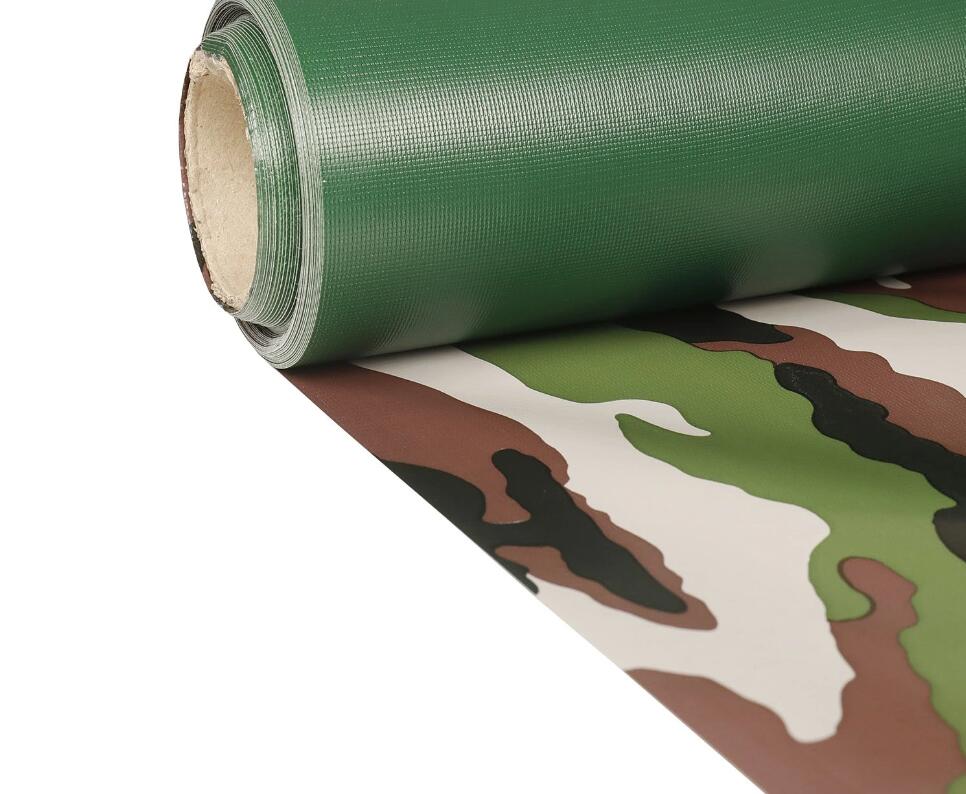
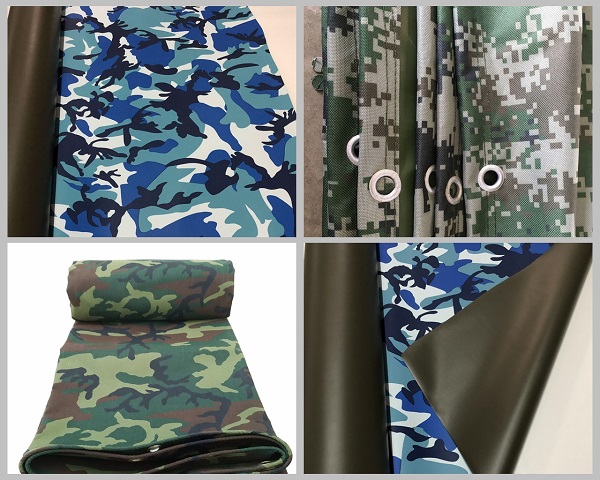
DERFLEX camouflage tarp PVC coated polyester roll with patterned outer face and green reverse side
DERFLEX camouflage PVC-coated tarp material. Pattern, reverse color, weight, surface and finished-cover details should be approved as part of the same specification.
Material Selection Matrix

PVC vs PE Camouflage Tarps: Choose by Use Cycle, Not by Pattern

The same camouflage appearance can be produced on very different tarp constructions. The right route depends on how often the cover is handled, how it is secured, the target service environment and the expected price position.

Decision Factor PE Camouflage Tarp PVC-Coated Camouflage Tarp Buyer Guidance
Typical position Lightweight, economical, portable cover programs Repeated-use, industrial and heavy-duty cover programs Start with required use cycle and handling frequency.
Structure Woven HDPE core with PE lamination Polyester scrim with PVC coating or lamination Ask for the complete construction, not only total weight.
Fabrication Hem, rope, eyelets, corner reinforcement Hot-air / hot-wedge / HF welding routes, hems, webbing, hardware Match seam method to material and finished-cover load.
Handling Usually easier to fold and pack at lighter weights Often heavier but better suited to repeated handling and abrasion Do not over-specify a heavy material for a highly portable product.
Common uses Seasonal cover, camping tarp, temporary screen, economy retail packs Equipment covers, shelters, vehicle covers, industrial screening, premium OEM tarp lines Use application risk to select the material class.
DERFLEX publishes both PE and PVC camouflage tarp references on its website. Final material code, test data, pattern and finished construction should be confirmed on the approved sample and order specification.
Three Starting Points

Match the Camo Tarp Build to the Stress Level

GSM is useful, but only after the load, exposure, folding cycle and fixing system are understood.

01

Portable Outdoor Cover

For buyers prioritizing foldability, pack size and quick deployment.

  • Evaluate lighter PE or PVC constructions
  • Focus on waterproofing and easy tie-down
  • Useful for seasonal shelter, camping products and temporary screens
02

General Commercial Camo Tarp

For a balance of handling, durability, appearance and repeat use.

  • PVC-coated polyester is a common route
  • Prioritize welded seams, hem reinforcement and grommet quality
  • Useful for equipment, storage, hunting products and private-label ranges
03

Heavy-Duty Equipment Cover

For larger covers, stronger tension, abrasive contact or frequent handling.

  • Use stronger scrim and reinforced stress zones
  • Map seams away from high-load corners where practical
  • Review tear behavior, hardware retention and abrasion points together
Published DERFLEX Reference

Camouflage Tarp Specification Framework

The reference data below comes from an existing DERFLEX camouflage tarpaulin construction and is included as a benchmark—not as a blanket guarantee for every camouflage tarp.

Reference Material Data

  • Base fabric: 1000D × 1000D
  • Construction: 20 × 20
  • Total weight: 450 gsm
  • Breaking strength: 2233 N/5 cm warp; 2037 N/5 cm weft
  • Tear strength: 333 N warp; 296 N weft
  • Adhesion: 80 N/5 cm
  • Published temperature reference: -30°C to +70°C

What Can Be Customized for a Commercial Program?

  • Material route: PVC-coated / laminated polyester or PE woven laminated structure
  • Finished size, roll format, panel layout and welding map
  • Woodland-style, digital-style, desert-style or buyer-approved custom pattern
  • Matte, semi-matte, glossy or application-oriented surface direction
  • Hem, rope-in-hem, webbing, eyelets / grommets, corner patches, straps and D-rings
  • UV-oriented, anti-mildew, cold-flexible or flame-retardant formulation subject to required specification and validation
  • Private label, size marking, carton mark, folded pack and export packaging
Engineering Notes

The Tarp Usually Fails at Stress Concentrations Before the Pattern Matters

A buyer can improve field performance by engineering the load path—especially seams, edges, corners and fixing points.

A

Seam Map

Large finished tarps may need welded panels. Place seams with panel width, water flow, folding direction and stress zones in mind rather than choosing the layout only for material yield.

B

Edge & Corner Reinforcement

Reinforced hems, rope, webbing and patches can distribute tie-down load. More overall GSM does not automatically fix a weak grommet zone or sharp equipment contact point.

C

Pattern Approval

Approve color target, repeat size, print direction, reverse-side color and acceptable batch variation before bulk production. Buyers supplying artwork should also confirm they hold the rights needed to use the pattern.

Application Decision Table

Where Camouflage Tarps Are Used—and What to Specify First

Application matters more than the marketing name. The table translates common uses into the material and fabrication questions that should be answered during quotation.

Application Likely Material Direction Priority Details Why It Matters
Camping / temporary shelter Light PE or lighter PVC depending durability target Foldability, waterproof seams, tie-out reinforcement, packed size Portable products must balance protection with handling weight.
Hunting blind / visual screen PE or PVC based on use cycle Pattern, low-glare finish, eyelet layout, panel dimensions Appearance and fixing points can matter as much as fabric strength.
Machinery / equipment cover PVC-coated polyester commonly preferred for repeated use Abrasion patches, seams, corners, straps, grommets, UV exposure Localized contact and tie-down loads often control service life.
Vehicle / transport cover Stronger PVC route where repeated tension and movement are expected Wind load, webbing, D-rings, seam map, edge reinforcement Dynamic loads can expose weak seams or hardware rapidly.
Outdoor storage / industrial screening PE for temporary economy use; PVC for longer cycles Panel size, UV direction, wind exposure, fixing system Large static panels still need adequate anchoring and edge design.
Wholesale / private-label range Market-positioned PE and/or PVC series Size assortment, pattern consistency, labels, packaging, repeat-order records Retail success depends on repeatability, not only the first sample.
Google Images / Image Pack

DERFLEX Camouflage Tarp Image Pack

Multiple real DERFLEX images give search engines and buyers more visual context than a single generic product photo. Hero imagery is loaded normally; below-fold images are lazy loaded.

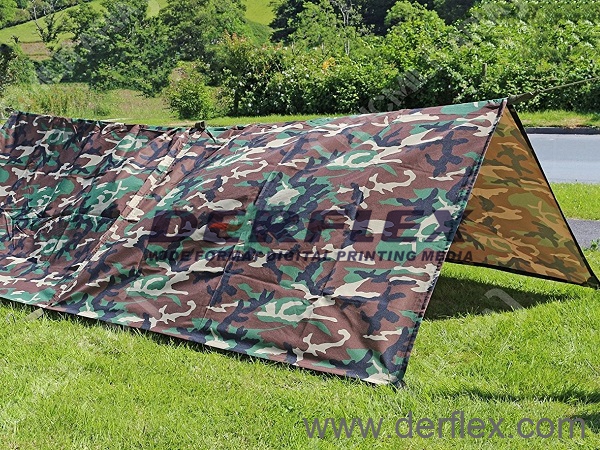
camouflage tarp shelter pitched outdoors on grass for weather protection
Outdoor camo tarp shelter application showing large-format cover use.
PVC camouflage tarp material roll with woodland pattern and green reverse surface
PVC-coated camouflage tarp roll with patterned face and solid reverse side.
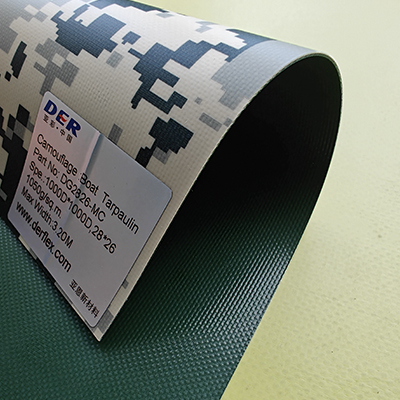
digital camouflage tarpaulin material sample from DERFLEX
Digital-style camouflage tarpaulin sample for pattern and material review.
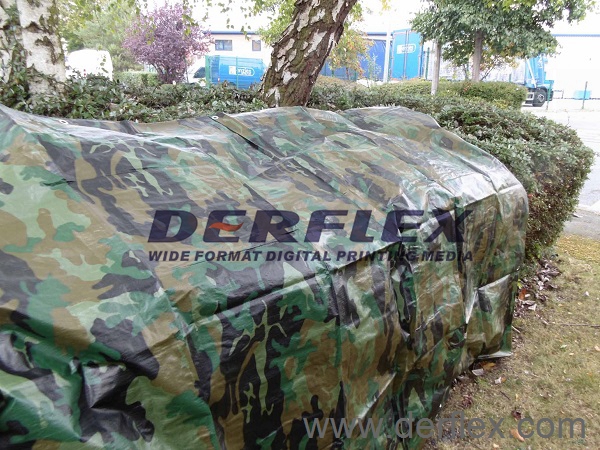
camouflage tarp covering outdoor equipment with finished protective cover
Finished camouflage cover used for outdoor equipment protection.
camouflage tarp pattern options with digital and woodland style PVC materials
Pattern and construction examples for camouflage tarp product development.
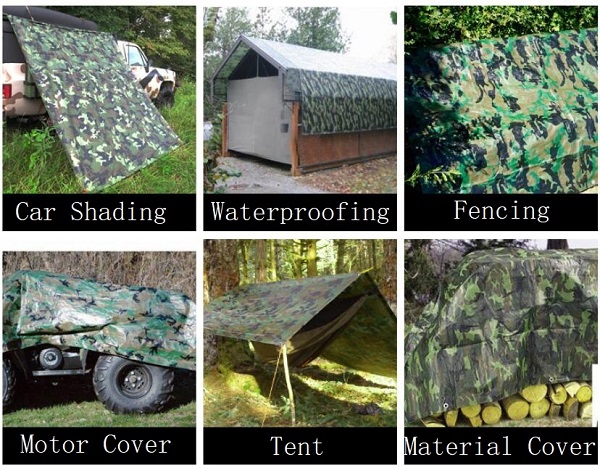
camouflage tarps used for car shading waterproof shelter fencing motor cover tent and material cover
Application examples: shading, shelter, fencing, equipment and general material covers.
B2B Procurement

A Better Way to Source Camouflage Tarps Wholesale

Compare suppliers only after they are quoting the same construction. Pattern and size alone are not enough to make prices comparable.

Step 01

Define Use

Share application, dimensions, climate, handling frequency, exposure and quantity.

Step 02

Select Structure

Choose PE or PVC route, target weight and the performance options that matter.

Step 03

Lock Details

Confirm pattern, reverse color, seams, hems, hardware, reinforcement, labels and packing.

Step 04

Approve Sample

Review appearance, feel, construction, dimensions and applicable material data before bulk approval.

Step 05

Control Repeat Orders

Retain material code, pattern reference, hardware layout and packing specification for future production.

Buyer Checklist

Send These Details for a Cleaner Quote

  • Finished tarp size, panel dimensions or required roll width / length
  • Estimated quantity and whether the program is one-time or repeat business
  • Application, outdoor exposure, climate and handling frequency
  • Preferred PE / PVC construction or current sample specification
  • Pattern reference, color direction, reverse-side color and artwork file if custom
  • Grommet spacing, rope, webbing, D-rings, straps, patches or other hardware
  • Required seam method, finished-size tolerance and packing format
  • Destination market and any specific test method or compliance requirement
Common Procurement Mistakes

What Causes a Camo Tarp Program to Go Wrong?

  • Buying by GSM only: the same weight can hide very different scrim and coating structures.
  • Ignoring finished size: nominal cut size and actual finished size may differ after hemming.
  • Under-specifying tie-down points: grommet zones can fail before the main sheet tears.
  • Approving pattern but not batch tolerance: wholesale programs need repeat color and repeat-size controls.
  • Treating “waterproof” as unlimited: seams, penetrations and ponding still affect installed performance.
  • Assuming visual camo equals specialist camouflage: infrared or thermal requirements require separate validated criteria.
Related Questions / People Also Ask

Questions Buyers Ask About Camouflage Tarps

Short direct answers support both buyer decision-making and SERP / AI extraction without repeating the same keyword unnaturally.

What are camouflage tarps made of?

Common constructions include woven polyethylene with PE lamination and polyester fabric coated or laminated with PVC. PE is often chosen for light, economical covers; PVC-coated polyester is often selected for stronger, weldable and repeated-use products.

Are camo tarps waterproof?

PE-laminated and PVC-coated tarp materials can provide a waterproof barrier. Finished-cover waterproofing also depends on seam construction, hardware penetrations, edge design, water pooling and installation.

Is a PVC camo tarp be, tter than a PE camouflage tarp?

Neither is universally better. PVC is usually better suited to heavy-duty, weldable, abrasion-prone and repeated-use covers. PE is usually lighter and more economical for temporary, seasonal or highly portable products.

What makes a camouflage tarp heavy duty?

Heavy-duty performance depends on scrim strength, coating structure, tear behavior, seam design, reinforced edges, corners and fixing points. A higher GSM can help, but it does not replace good reinforcement or load distribution.

Can DERFLEX make custom camouflage patterns?

Custom pattern directions can be evaluated for OEM programs. Buyers should provide artwork or a pattern reference, define color expectations, approve the sample and confirm they have the rights required to use supplied graphics.

Can camouflage tarps be supplied with grommets and reinforced hems?

Yes. Depending on the design, finished tarps can use reinforced hems, rope-in-hem, webbing, grommets / eyelets, corner patches, D-rings, straps and other fixing details. Spacing should follow the expected tarp size, load and wind exposure.

Do camouflage tarps fade outdoors?

Outdoor UV exposure can affect both the coating and printed pattern over time. State the expected climate, exposure duration and color-stability requirement during product development so the material and print system can be matched appropriately.

Are camouflage tarps “military grade”?

A camouflage print alone does not establish a military or specialist performance grade. If a project requires a government specification, flame-retardant standard, infrared / NIR behavior, thermal-signature control or another regulated property, the exact specification and test method must be supplied and validated.

Turn a Camo Tarp Idea into a Buildable Specification

Send DERFLEX the application, finished size or roll format, target material direction, pattern reference, outdoor exposure, reinforcement layout, grommet spacing, quantity and packaging requirement. The team can review a practical PE or PVC construction for sampling and quotation.

Consulting Services
+86-021-54361792 / 54361798
Email
sales@derflex.com