News
Industry News

How Are PVC Coated Tarpaulins Made? Manufacturing Process | DERFLEX

Update:2026/9/18 18:11:41 Views:
PVC Coated Tarpaulin · Factory Process Guide

How Are PVC Coated Tarpaulins Made? Inside the Manufacturing Process

PVC coated tarpaulin is made by building a strong polyester textile first, applying or combining a flexible PVC system with that reinforcement, using controlled heat to develop the coating and bond, then finishing, cooling, testing and winding the material into rolls. This guide explains what happens at each stage—and which factory controls matter to professional buyers.

Updated September 19, 2026 For importers, converters, distributors, OEM brands & project buyers Focus: coated tarpaulin roll manufacturing
PolyesterCreates the load-bearing reinforcement
PVC systemBuilds the waterproof protective surface
Coat or laminateTwo manufacturing routes for different constructions
Control the processConsistency comes from more than finished GSM
60-Second Answer

How are PVC coated tarpaulins made?

PVC coated tarpaulins are typically made by combining a woven polyester base fabric with flexible PVC. The factory first defines the yarn and weave construction, inspects and prepares the textile, formulates a PVC plastisol or prepares PVC film, then applies the polymer by direct knife coating or by a lamination route. The material passes through controlled thermal processing so the PVC layer gels, fuses and bonds to the reinforcement. Surface finishing, cooling, trimming, testing, winding and labeling follow before the roll is released.

The buyer-relevant point is that the visible PVC surface is only one part of the product. Tensile strength, tear behavior, coating adhesion, flatness, weldability, surface consistency and repeat-order stability come from different stages of the process. A written construction and acceptance specification is therefore more useful than choosing by color or GSM alone.

Material Anatomy

What is actually being manufactured when a factory makes PVC coated tarpaulin?

A PVC coated tarp is a composite technical textile. The reinforcement and the coating do different jobs, and the interface between them is where adhesion must remain stable through converting and use.

Load-bearing core

Polyester base fabric

High-tenacity polyester yarn is woven into a defined warp/weft structure. Yarn size, density, weave geometry, shrinkage and dimensional stability influence tensile strength, tear behavior and how evenly the textile travels through the coating line.

  • Yarn direction influences load paths.
  • Fabric density influences reinforcement and coating support.
  • Web stability influences coating uniformity and roll flatness.
Protective system

Flexible PVC coating

PVC resin is commonly combined with plasticizer, stabilizers, pigments and application-specific additives to create a processable flexible coating system. The formulation has to fit the coating line and the intended end use rather than follow one universal recipe.

Top finish / lacquer: surface protection, appearance, cleanability or processing direction.
Main PVC layer: waterproof barrier, color, flexibility and surface build.
Adhesion layer / interface: connects the PVC system to the textile.
Polyester reinforcement: carries much of the mechanical load.
Back-side PVC / finish: completes the designed face/back construction.
For the broader material definition, available constructions and application positioning, continue to DERFLEX's PVC Coated Polyester Fabric page.
Factory Process Map

9 stages from polyester yarn to a finished PVC coated tarpaulin roll

The exact machine layout and number of coating passes vary by product grade. The sequence below shows the manufacturing logic that buyers should understand when evaluating coated tarpaulin production.

1

Define the target construction

Production starts from the intended application, base-fabric structure, finished weight, width, color, surface, welding or printing method and required performance direction.

Creates: a manufacturable specification before line setup.
2

Prepare polyester yarn and weave

Polyester yarn is organized into warp and weft and woven to the required density and geometry. The base textile becomes the reinforcement skeleton of the coated tarp.

Creates: tensile and tear load paths.
3

Inspect and condition the base fabric

The textile is checked for width, weave defects, contamination, edge condition and dimensional stability, then aligned and tensioned for stable web travel.

Protects: surface uniformity and bond consistency.
4

Prepare the PVC coating system

For direct coating, a PVC plastisol or compatible coating compound is prepared with the required color, flexibility and processing behavior. Film-based routes prepare the PVC film and bonding interface separately.

Controls: rheology, color and functional direction.
5

Apply PVC by coating or lamination

In knife coating, the coating is metered directly on the textile. In lamination, pre-formed PVC film is combined with the reinforcement under controlled heat, pressure and bonding conditions.

Builds: the textile-polymer composite.
6

Gel, fuse and bond with controlled heat

Thermal processing develops the continuous PVC phase and the required textile-to-polymer bond. Temperature, dwell time, line speed and web tension must work together.

Controls: fusion, adhesion, flexibility and dimensional stability.
7

Build the designed face/back layers

Some constructions use multiple passes or different face/back builds to reach the required coating mass, coverage, appearance or downstream processing characteristics.

Controls: total build, coverage and surface balance.
8

Apply finish and cool the web

Depending on the grade, the surface may be gloss, matte, embossed, acrylic-lacquered, PVDF-related or otherwise application-specific. Controlled cooling stabilizes the composite before winding.

Controls: appearance, cleanability and conversion compatibility.
9

Inspect, trim, wind, label and pack

The finished roll is checked against the approved specification, trimmed, wound under controlled tension, identified and protected for storage, export and downstream converting.

Controls: usable roll quality and repeat-order traceability.
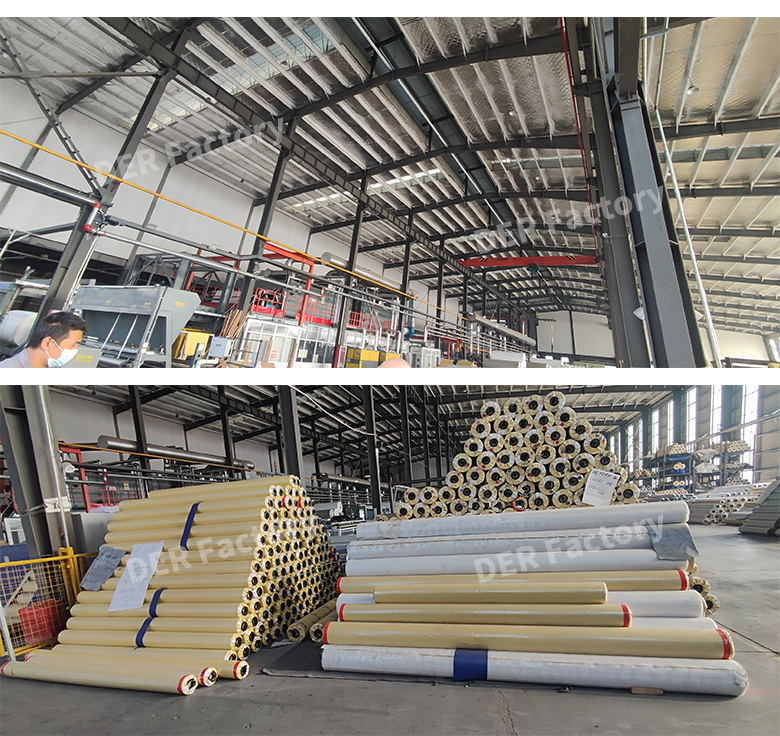
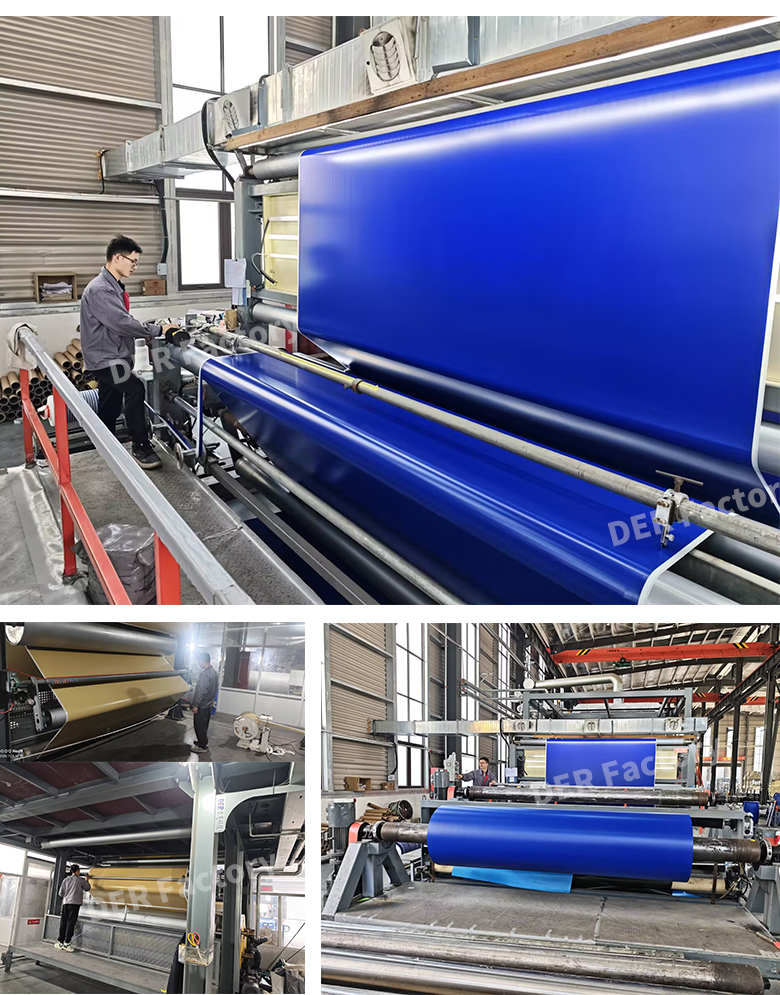
DERFLEX PVC coated tarpaulin manufacturing process with coating equipment, roll inspection, warehouse handling and export loading
From production line to export loading. Manufacturing quality is not created at a single machine: textile preparation, coating, thermal processing, inspection, handling, winding and shipment protection all affect the roll a converter eventually receives.
Direct Coating Deep Dive

What happens during knife coating of PVC tarpaulin?

Knife coating is a metering process. The blade controls how much wet coating remains on the moving textile, while the complete line controls how that layer levels, gels, fuses and bonds.

Before the knife

Stable textile + stable coating rheology

The woven base fabric must enter the coating head flat, aligned and tension-controlled. The PVC plastisol must also be suitable for the required coat build and machine conditions.

  • Unstable web tension can change local coat build and roll geometry.
  • Viscosity and flow behavior influence metering and leveling.
  • Contamination or weave defects can become visible coating defects.
After the knife

Heat history matters as much as blade setting

Once the wet coating is metered, the textile passes through controlled heating. The aim is not simply to make the surface hot; the line must provide enough thermal history for the PVC system to gel and fuse without damaging the textile or destabilizing the finished surface.

  • Temperature and dwell time work together.
  • Line speed changes effective heating time.
  • Additional passes may be used when the designed structure needs more build.
For a route-specific engineering explanation, DERFLEX also publishes a dedicated guide to the Tarpaulin Manufacturing Process, which continues beyond roll goods into finished-tarp converting.
Manufacturing Route Comparison

Knife-coated vs laminated PVC tarpaulin: choose the construction, not the label

Direct coating and film lamination build the composite differently. Neither process name alone proves final quality; the correct route depends on the approved product design and end use.

Direct coating

Knife-coated PVC tarpaulin

PVC coating compound is applied directly to the polyester textile and metered before thermal processing develops the continuous layer and bond.

  • Good fit when controlled coating build and textile integration are important.
  • Multiple passes or different face/back coating structures may be used.
  • Process stability depends on textile, rheology, metering, heat and tension working together.
Film combination

PVC laminated tarpaulin

Pre-formed PVC film is combined with the polyester reinforcement using heat, pressure and the selected bonding interface.

  • Useful when film surface, color or laminate structure is part of the product design.
  • Bond uniformity must remain stable across roll width and length.
  • Final suitability depends on the actual grade, not on the word “laminated.”
Buyer decisionKnife-coated routeLaminated routeWhat to approve
Layer formationWet PVC coating is metered directly on the textile.Pre-formed PVC film is combined with the textile.Exact face/back structure and approved sample.
Bond controlDepends on substrate preparation, coating system and thermal history.Depends on film, interface, heat, pressure and cooling.Agreed adhesion/peel validation where relevant.
Surface directionCan be developed through coating passes and top finish.Can be influenced by the selected film and finishing system.Gloss/matte/embossed/lacquer direction and print/weld trial.
Buyer ruleDo not treat the production route as a quality grade.Approve construction + test direction + sample + packing under one product code.
Process Control Matrix

Manufacturing variable → possible defect → buyer impact

This matrix is useful during supplier qualification because it connects factory process control to problems a converter or end user can actually see.

Process variableWhat can go wrongPossible field / conversion symptomBuyer checkpoint
Base-fabric width, weave or tensionWrinkles, skew, uneven support under the coating.Roll waviness, local weight variation, inconsistent flatness.Confirm textile construction and incoming inspection.
Coating rheology / viscosityPoor leveling or unstable coat build.Surface variation, visible streaking, inconsistent mass.Ask how the coating batch and line condition are controlled.
Knife gap + line speed + web tensionUneven wet-layer thickness.GSM drift, different handling or weld behavior across a roll.Specify finished tolerance and line inspection logic.
Thermal historyIncomplete fusion or excessive heat exposure.Weak surface integrity, bond variation, stiffness or deformation.Evaluate finished material using agreed performance tests.
Adhesion interfaceInsufficient textile-to-PVC bonding.Peeling, bubbling or delamination during flexing or service.Use an adhesion/peel test when the application requires it.
Surface finishNon-uniform lacquer/topcoat, blocking or friction differences.Cleaning, printing, welding or appearance inconsistency.Approve the exact finish and downstream process on the actual grade.
Cooling + winding tensionRoll telescoping, edge distortion or set-in wrinkles.Converter waste, tracking problems and handling damage.Define roll core, winding and packing expectations.
Quality Control

Which tests matter after PVC coated tarpaulin is manufactured?

There is no single universal test package for every tarp. A useful QC plan connects the end use to the material properties that can create field or conversion risk.

QC itemWhat it tells the buyerWhy it matters
Finished weight / GSMWhether total area weight is within the agreed direction.Useful for consistency, but does not reveal textile and coating structure by itself.
Width and roll conditionWhether the converter receives the usable dimensions and winding quality ordered.Affects cutting yield, tracking and handling.
Tensile strengthHow the finished composite carries pulling load in warp/weft directions.Connects the finished material back to reinforcement performance.
Tear strengthResistance to tear initiation/propagation under the selected test method.Relevant where punctures, edges or local damage can grow.
Coating adhesion / peelHow strongly the coating remains associated with the textile structure.Useful where folding, flexing, weathering or fabrication can challenge the interface.
Color and surface consistencyWhether appearance and finish remain stable to the approved reference.Important for branded, printed or visible applications.
Application-specific testsCold-flex, UV, flame-retardant, print, weld or other agreed performance direction.Only meaningful when the method and acceptance criteria are defined for the real project.

Do not compare numbers without the test method

A tensile, tear or adhesion result is only comparable when the test method, specimen direction and conditions are understood.

GSM is not thickness

Area weight describes mass per unit area; thickness is a dimensional measurement. They should not be treated as interchangeable.

Approve conversion behavior

If the roll will be welded, printed or sewn, test the real supplied grade before volume conversion.

Keep the master sample linked

Sample, product code, TDS, color/finish reference and packing instruction should describe one approved construction.

DERFLEX publishes a separate Quality Control System page for buyers who want to review incoming QC, process control, laboratory testing, final roll inspection and traceability in more detail.
DERFLEX Manufacturing Context

Why factory integration matters to coated tarpaulin consistency

A stable repeat order depends on more than a successful laboratory sample. The buyer needs confidence that the base textile, coating/lamination route, process settings, finishing, inspection and packing can be reproduced under a controlled production system.

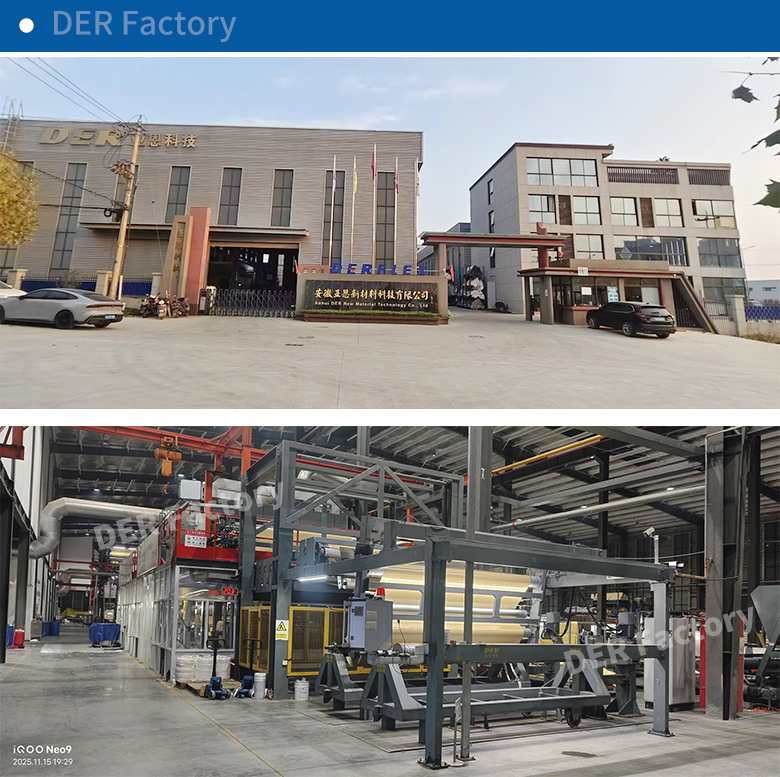
DERFLEX's current Factory Tour publishes the following manufacturing context. These figures describe the production base and equipment system; the actual route for a specific tarpaulin grade still depends on the approved specification.

60,000㎡Published production area
450 + 25Workers + senior engineers
5 / 3 / 5Calendars / coating / lamination machines
1,500,000㎡/dayPublished base-fabric output
DERFLEX factory exterior and PVC coated textile production equipment
Factory evidence is most useful when it is connected to a production question: where the base fabric is controlled, where coating or lamination takes place, how the roll is inspected and how the approved specification is kept traceable.
Real Production Image Pack

Manufacturing images that help buyers understand the process

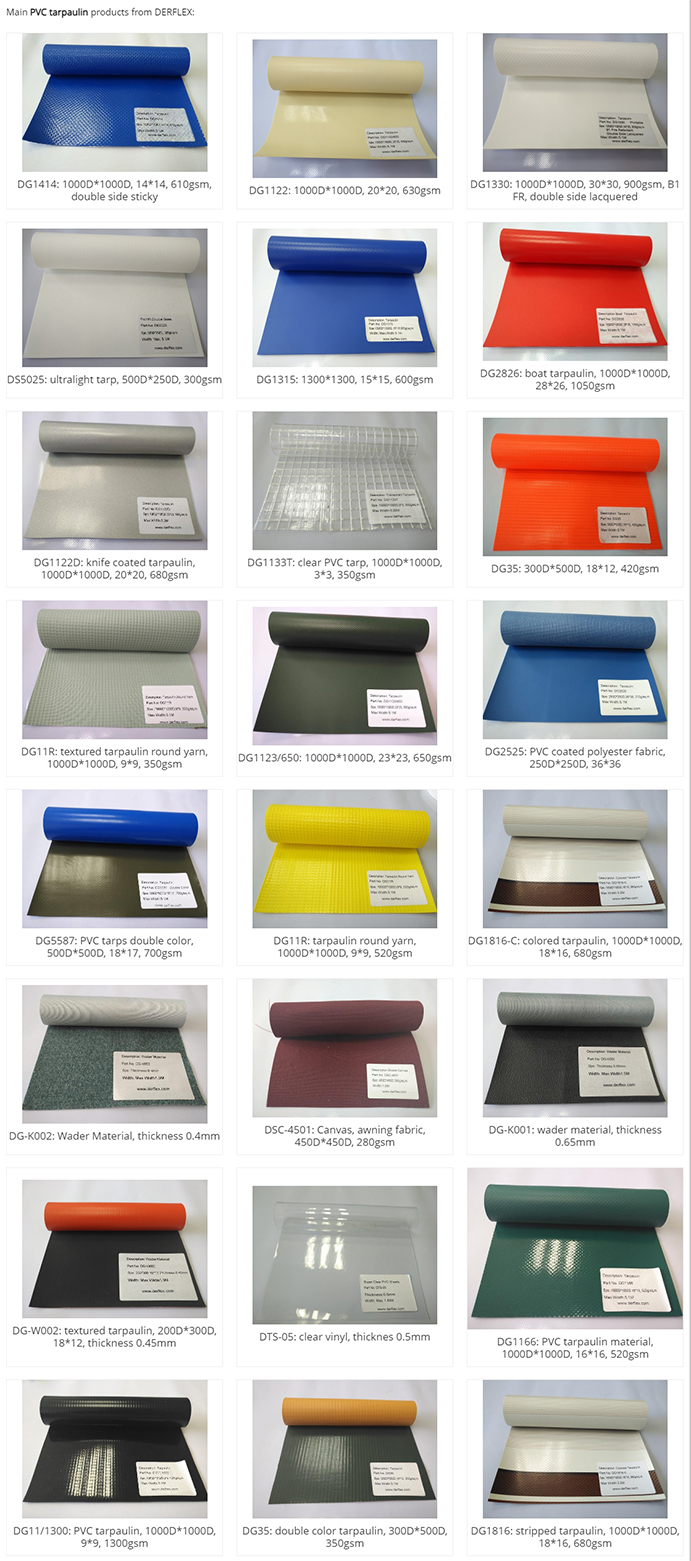
Each image below is a DERFLEX-hosted production or material image with descriptive context rather than a generic decorative photo.

Factory Audit Checklist

10 questions to ask before approving a PVC coated tarpaulin supplier

The goal is to determine whether the factory can reproduce the approved structure, not simply whether it owns coating equipment.

1. What is the exact polyester base-fabric construction?

Record yarn direction, weave/density and how the textile is identified for repeat orders.

2. Is the supplied grade knife coated or laminated?

Ask for the actual route and face/back build for the quoted product.

3. How is PVC coating consistency controlled?

Look beyond one machine setting and ask about coating batch, web tension, line speed and process inspection.

4. How is thermal processing managed?

The relevant question is whether the complete heat history is controlled for the selected construction.

5. How is adhesion validated?

When bond durability matters, define the test method and acceptance direction before production.

6. Which roll tolerances are checked?

Width, GSM, length, surface, color and winding condition can all affect converter yield.

7. How is the approved color and finish referenced?

Use a master sample or agreed color/finish reference for visible applications.

8. Can the exact grade be welded or printed as required?

Ask for a production trial on the approved material when downstream processing is critical.

9. How is each roll identified and traced?

Product code, lot/batch information and roll labeling help manage claims and repeat orders.

10. How is export packing matched to roll handling?

Core strength, wrapping, edge protection, palletization and container loading affect arrival condition.

RFQ Checklist

What to send a PVC coated tarpaulin manufacturer for an accurate quotation

A useful RFQ tells the factory what the material has to do, how it will be converted and which values must be controlled.

RFQ fieldWhat to provideWhy it helps
ApplicationTruck cover, tent, industrial curtain, agricultural cover, liner, fabricated tarp or other use.Guides the material construction and performance priorities.
Reference constructionCurrent TDS, sample, known yarn/weave, target GSM or comparable product.Reduces ambiguity when matching an existing material.
Roll requirementsWidth, length, quantity, core, packaging and labeling.Allows production and logistics planning.
Surface / colorColor reference, gloss/matte direction, embossing or lacquer requirement.Aligns visual and processing expectations.
Conversion methodHot-air welding, HF welding, sewing, printing or other downstream process.Helps select a surface and structure compatible with fabrication.
Service environmentOutdoor exposure, temperature, abrasion, flexing, humidity or chemical contact.Helps define which performance direction is actually relevant.
Required standards / testsNamed test method and acceptance value when your project specifies one.Prevents comparison of non-equivalent test data.
DestinationCountry/market and any packaging, documentation or compliance needs.Improves quotation and shipment planning.
For roll-goods sourcing and converter-oriented supply questions, review DERFLEX's Tarpaulin Roll Supplier page. For the broader product family, see PVC Tarpaulin.
Related Questions

Frequently asked questions about PVC coated tarpaulin manufacturing

Short answers first, followed by the qualification that matters in sourcing and production.

What is PVC coated tarpaulin made of?

PVC coated tarpaulin is commonly made from a polyester textile reinforcement combined with flexible PVC on one or both sides. The polyester carries much of the tensile and tear load, while the PVC system provides the continuous waterproof surface, color, protection and thermoplastic behavior used in many welding processes.

How is PVC applied to tarpaulin fabric?

In a direct knife-coating process, a formulated PVC plastisol or coating compound is applied to the moving polyester textile and metered with a blade before thermal gelation and fusion. In laminated constructions, pre-formed PVC film is combined with the textile under controlled heat, pressure and bonding conditions.

What is the difference between PVC coated and PVC laminated tarpaulin?

They are different manufacturing routes. Direct coating forms the PVC layer on the textile during the coating process; lamination combines pre-formed PVC film with the reinforcement. Neither name alone defines the final quality level, so buyers should approve the actual construction, sample and test direction.

Why is polyester used inside PVC tarpaulin?

The polyester textile provides the reinforcement structure that carries much of the mechanical load. Yarn denier, weave density, geometry and dimensional stability influence tensile strength, tear behavior and roll stability before and after coating.

What does gelation and fusion mean in PVC coating?

During controlled heating, the PVC plastisol changes from a wet dispersion into a continuous flexible PVC phase. The useful process window depends on the formulation, coat build, textile and line design, so temperature alone does not describe whether the coating has been processed correctly.

What quality tests should buyers request for PVC coated tarpaulin?

The required test package depends on the application, but common controls include finished weight, width, tensile strength, tear strength, coating adhesion or peel direction, color and surface consistency, plus any project-specific cold-flex, UV, flame-retardant, print or welding requirements. The test method and acceptance criteria should be agreed in advance.

Does a higher GSM automatically mean a stronger PVC tarp?

No. Finished GSM includes the textile, PVC layers and finishing system. Two materials with similar area weight can use different yarn, weave density, coating build and bond quality. Strength should be evaluated from the full construction and measured tensile/tear performance, not weight alone.

What causes PVC coating to peel from tarpaulin fabric?

Peeling or delamination can be associated with the textile surface, coating or bonding system, contamination, insufficient interface development, poor thermal processing, incompatible downstream conversion or field exposure. A useful investigation links the failure back to the approved construction and the relevant adhesion test.

Turn the manufacturing process into a repeatable purchase specification

Send DERFLEX your application, current TDS, reference sample or target construction. The technical objective is to define the base textile, PVC route, finish, critical tests, roll requirements and packing before bulk production.

Consulting Services
+86-021-54361792 / 54361798
Email
sales@derflex.com