



Heavy Duty Tarp SKU and Distributor Range Planner
Build a proposed wholesale tarp assortment before requesting a factory review. Enter each material grade, finished size, color, order quantity and pack format into a working SKU table. The planner counts item variants, totals pieces, groups material-and-color quantities, and exports a sourcing brief you can attach to your inquiry. It is designed for importers, industrial supply distributors and private-label brands planning a repeatable product line—not for estimating freight, prices or supplier capacity.
No sign-in, account or external calculation service. Your entries stay in this browser tab unless you choose to export or copy them.
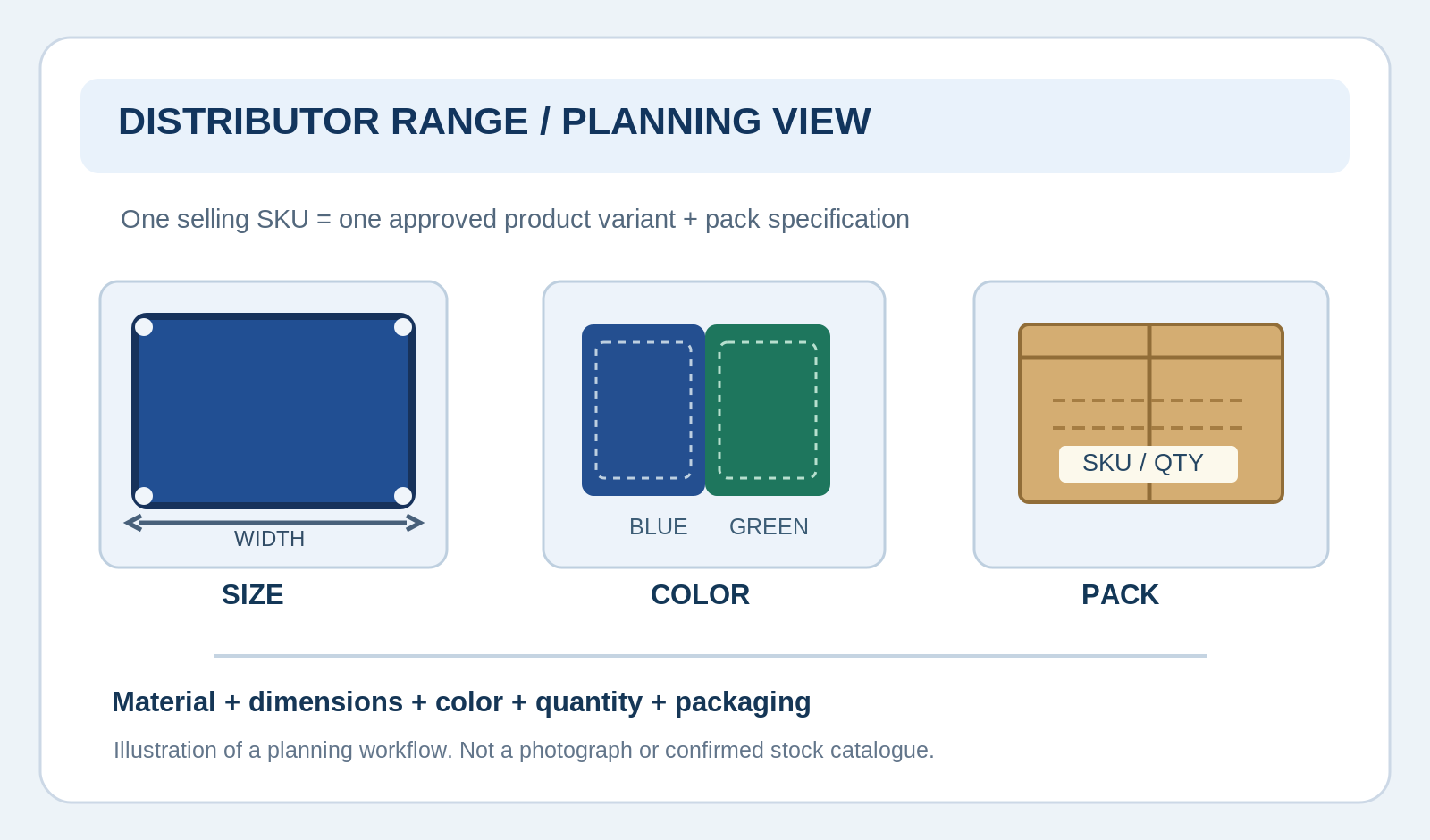
What does a tarp SKU range planner do?
A heavy duty tarp SKU range planner turns a distributor's intended product assortment into a line-by-line purchasing specification. One sellable SKU normally represents one agreed combination of material, product construction, finished dimensions, color and selling pack. Distinct pack configurations may be separate SKUs even when the underlying tarp is identical. An organized range lets a supplier review production groups, sample needs and quotation scope without guessing the buyer's size mix.
Separate the variants
Define the finished size in a stated unit, choose the material construction, enter a buyer material reference and name the color. Avoid vague labels such as “assorted sizes” or “blue tarp.”
Allocate volume
Give every row its own quantity. The same material in two colors is two color runs for review, not automatically one combined factory minimum. Split rows when the selling pack changes.
Make an actionable brief
Export a readable summary and detailed rows. Ask DERFLEX to confirm feasible constructions, size tolerance, MOQ logic, hardware, artwork and packing before the assortment becomes a purchase order.
Create your heavy duty tarp assortment
Use one row per proposed sellable SKU. Type dimensions as finished width × length, not fabric roll width, unless your business is explicitly buying finished cut sizes. Material and packaging choices are requests for discussion, not verified DERFLEX stock codes, current colors, production minimums or package availability.
Program details
On mobile, swipe the table horizontally to edit all columns. Width and length use each row's selected unit. GSM is an optional requested target, not a confirmed supplier specification.
| Buyer SKU | Material / construction | Material ref | Target GSM | Width | Length | Unit | Color | Pieces | Pack type | Pieces / pack | Finishing / notes | Edit |
|---|
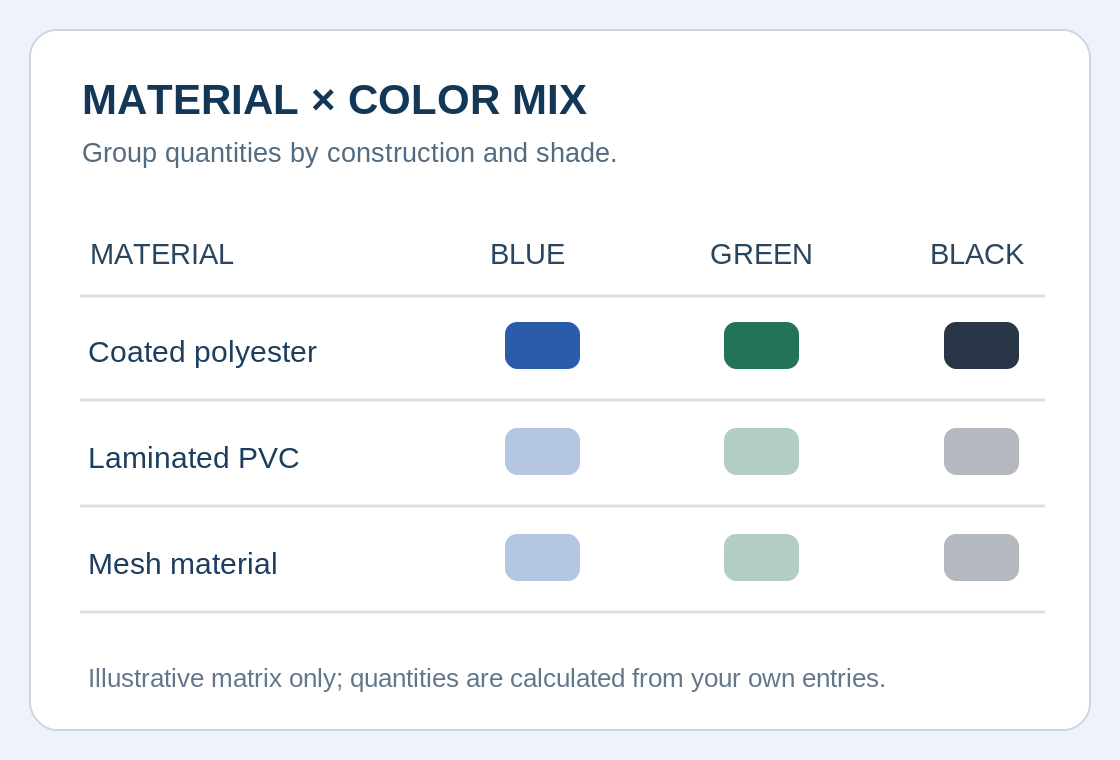
Material × color quantity breakdown
Grouped by selected material, buyer material reference and color. This is a planning total in finished pieces, not an MOQ or raw-material consumption calculation.
| Material / ref | Color | SKU count | Pieces |
|---|---|---|---|
| Complete a SKU row to see totals. | |||
Size and packaging review
Size groups and estimated pack counts are for sales planning; cartons, weights, dimensions and mixed packing require approval.
| Finished size | SKUs | Pieces | Estimated packs |
|---|---|---|---|
| Complete a SKU row to see totals. | |||
Export the proposed distributor range brief
The text brief includes the program details, SKU table, material-color totals, proposed packing and unresolved approval questions. The CSV contains SKU-level rows for a spreadsheet. Both files are created locally from the current entries; no quote or purchase order is sent automatically.
How should a distributor build the right heavy duty tarp size range?
Start with your actual customer jobs and reorder history. A size range should reflect what buyers cover, how often they handle the tarp and what their sales channel can store. Do not copy a retailer's complete size chart simply to create a longer catalogue. A smaller, well-described mix can be easier to test, quote and reorder than dozens of variants with overlapping purposes.
Planning decisions that change the SKU count
| Decision | What to record | Why it matters |
|---|---|---|
| Finished dimensions | Width × length, unit and size tolerance | Prevents confusion between cut size, nominal size and finished coverage. |
| Material grade | PVC coated or laminated construction, target GSM and buyer reference | Different constructions can require separate production and approval groups. |
| Color and finish | Color name plus a physical reference or agreed color standard | Color changes can affect minimum runs, appearance and reorder identity. |
| Construction details | Seams, reinforced hems, corner patches, grommet spacing and attachments | A fabric choice does not fully describe a finished industrial tarp. |
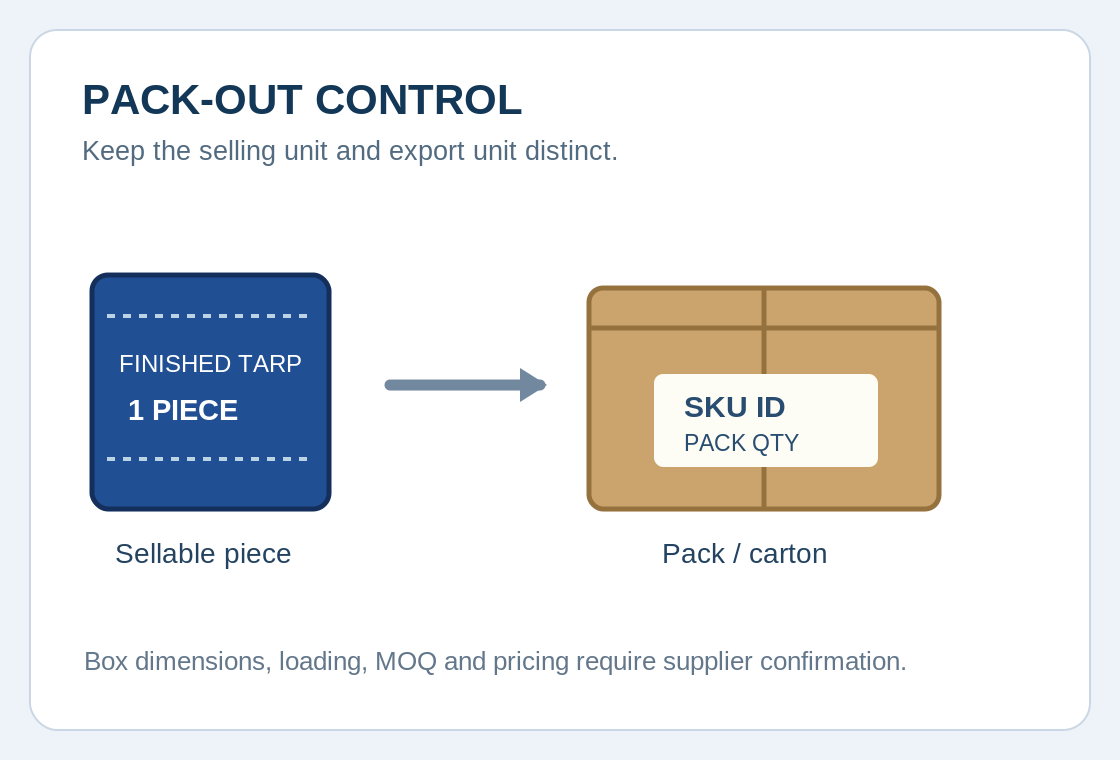
| Retail or bulk packaging | Pack format, pieces per pack, label and artwork reference | Same tarp in a different selling pack may require its own SKU. |
Do not treat the total order as the minimum for each SKU
Some manufacturers assess minimums by base material, color, coating recipe, production run, finishing variant, printed artwork or packaging design. The relevant rule depends on the exact product and process. The planner deliberately does not impose a universal MOQ. A mixed bulk tarp size mix with several colors and printed cartons may need more than one minimum-quantity check even if its combined piece count looks substantial.
Packaging also changes what “quantity” means. Record pieces as sellable finished tarps, then assign pieces per selling pack. The tool calculates an indicative number of packs for each SKU as the piece quantity divided by pack capacity, rounded up. This can include a partially filled final pack; it is not a verified carton loading, shipping weight, pallet count or freight quote.
- Confirm whether each entered material and color can be made in the requested finished size.
- Ask if MOQ applies per material run, color, SKU, artwork or packing variant—and whether combining quantities is permitted.
- Approve packed samples, SKU labels, barcode ownership, carton marks and version-controlled artwork before production.
- Request dimensions and weights of actual packed samples before calculating transport space or landed cost.
What should be confirmed before a proposed range becomes a production order?
The export is a request-for-review document. It helps your purchasing team and DERFLEX discuss one clear buying scope. It cannot establish supplier availability or commercial terms. Use the brief with a reference sample, measurement drawing or the existing material specification where possible.
Material approval
Identify actual supplier product codes, structure, target GSM and tolerance; check performance documents against the selected material and relevant application. Not every grade and color is interchangeable.
Finished tarp approval
Confirm finished dimensions, orientation, welding or sewing route, hem detail, hardware positions, labels and allowed tolerances. Test fit where an exact interface is important.
Commercial release
Verify SKU-by-SKU quantities, unit and pack definitions, applicable minimums, approved artwork, sample sign-off, lead time, inspection scope, packaging and quotation terms.
For the product specification and buying process, see heavy duty tarp material selection, wholesale tarp supply formats and the private label tarp program approval guide. These pages explain supplier services; this planner is the place to assemble and export your own proposed range.
Explore the materials and buying routes behind your SKU plan
Different channel plans need different supporting documents. A converter planning coated fabric rolls should use a material specification rather than treating the roll as a finished retail cover. A distributor ordering finished tarps should specify reinforcement and pack-out in addition to GSM and color.
Heavy duty tarp SKU planning FAQ
What counts as one tarp SKU in a private-label range?
Normally, one SKU is one sellable combination of material construction, finished size, color and packaging configuration. A different label or pack quantity can require a separate SKU even when the physical tarp is unchanged. Use a unique buyer SKU reference for every intended selling item.
Can I combine two colors or materials toward one MOQ?
Not automatically. Minimums can apply to different manufacturing steps and packaging designs. Record quantities separately by SKU and ask DERFLEX to confirm whether any material, color, production or packaging quantities may be combined.
Does this planner show DERFLEX stock sizes, available colors or confirmed products?
No. Its material names and example data are planning inputs only. Final material codes, finished dimensions, production feasibility, color references, packaging and minimum quantities must be confirmed by DERFLEX for the proposed order.
Can I use feet for finished tarp dimensions?
Yes. Each row has a dimension-unit selector for metres or feet. The tool groups dimensions with their own units and does not silently combine unlike sizes. Confirm whether your customer means nominal, cut or finished dimensions before sign-off.
Is the material-and-color quantity the amount of fabric I need?
No. The summary counts requested finished pieces, not fabric square metres, cutting yield or raw-material consumption. Seam allowances, panel layout, roll width, waste and reinforcement can change the material requirement.
How do I send the finished range to DERFLEX?
Download the text range brief or CSV sheet, then open the Request a Quote page and attach or share that file using the contact method provided there. The tool does not transmit your entries or place an order automatically.
Send your proposed tarp range for review
Share the exported SKU table, intended market, application and available material or packaging references. Ask for feasibility, confirmed options, MOQ basis, samples, specifications and commercial terms before approving a full assortment.