



RAW FABRIC / CONVERTER PROCUREMENT
Canvas Drop Cloth Fabric Rolls for Converters and OEM Buyers
Buyers of painters drop cloth rolls need to specify the textile that arrives at the cutting table: verified fiber composition, weave and fabric mass, total versus usable width, roll length, joins, edge quality and packaging. DERFLEX can review a converter-focused canvas sourcing brief alongside its existing industrial textile programs, subject to material and supplier-route confirmation. Build your purchasing request around measurable roll acceptance rather than assuming a stock grade or applying PVC-coated fabric data to untreated cotton canvas.
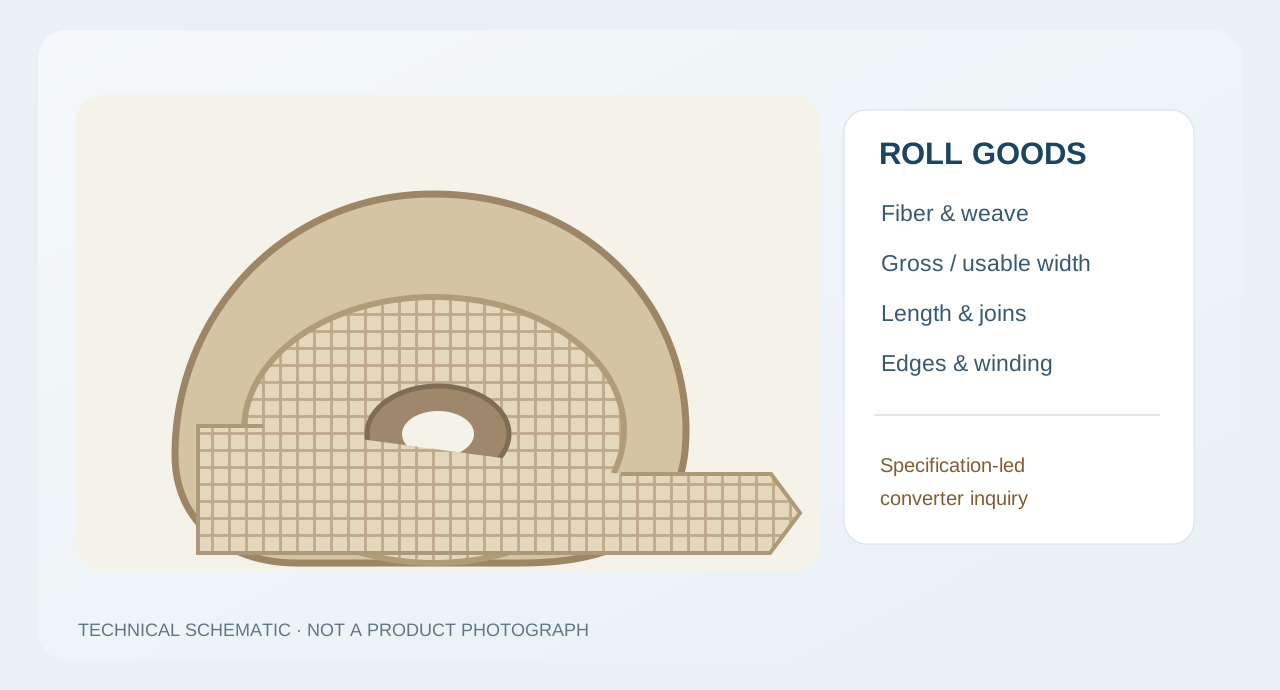
What a painter’s canvas fabric roll actually includes
A fabric roll is a converter input, not the same commercial product as a hemmed contractor sheet.
Woven canvas intended for conversion
A canvas drop cloth fabric roll is supplied before cutting, sewing, folding or branding. Depending on fiber blend and finishing, buyers may use it to convert painter’s sheets, decorators’ dust sheets, furniture protection and narrow runners. Specify the difference between natural uncoated textile and treated material: unbacked canvas absorbs small drops but may leak through when saturated.
Unlike wholesale finished sheets, roll purchasing hinges on what the cutting table can use. The commercial unit may be a full roll or an agreed length; a yard or metre is simply the length measurement, not evidence of a retail cut-service.
For products already hemmed and packed, follow the finished canvas drop cloth range.
Fiber content, weave and mass: define the actual cloth
Record the fiber composition, yarn construction and measured areal mass before comparing prices.
Start with the fabric identity
State whether the proposed cloth is 100% cotton duck, cotton blend or another verified construction. Include yarn count, weave pattern, natural or dyed finish, treatment and intended wash conditions where relevant. “Canvas” alone does not prove fiber percentage or absorbency, and an outdoor treated canvas specification cannot be reused for painters’ dust-sheet fabric.
Weight classes such as 6 oz, 8 oz, 10 oz and 12 oz are common market comparisons. The equivalent masses are approximately 203, 271, 339 and 407 g/m², respectively, using 1 oz/yd² = 33.906 g/m². These figures are conversion examples—not DERFLEX SKU offerings. Ask the supplier for nominal weight, tolerance and test method on the actual lot.
For drop cloth fabric by the yard, material quality depends as much on tight, even weaving and fabric flaws as on the nominal weight label.
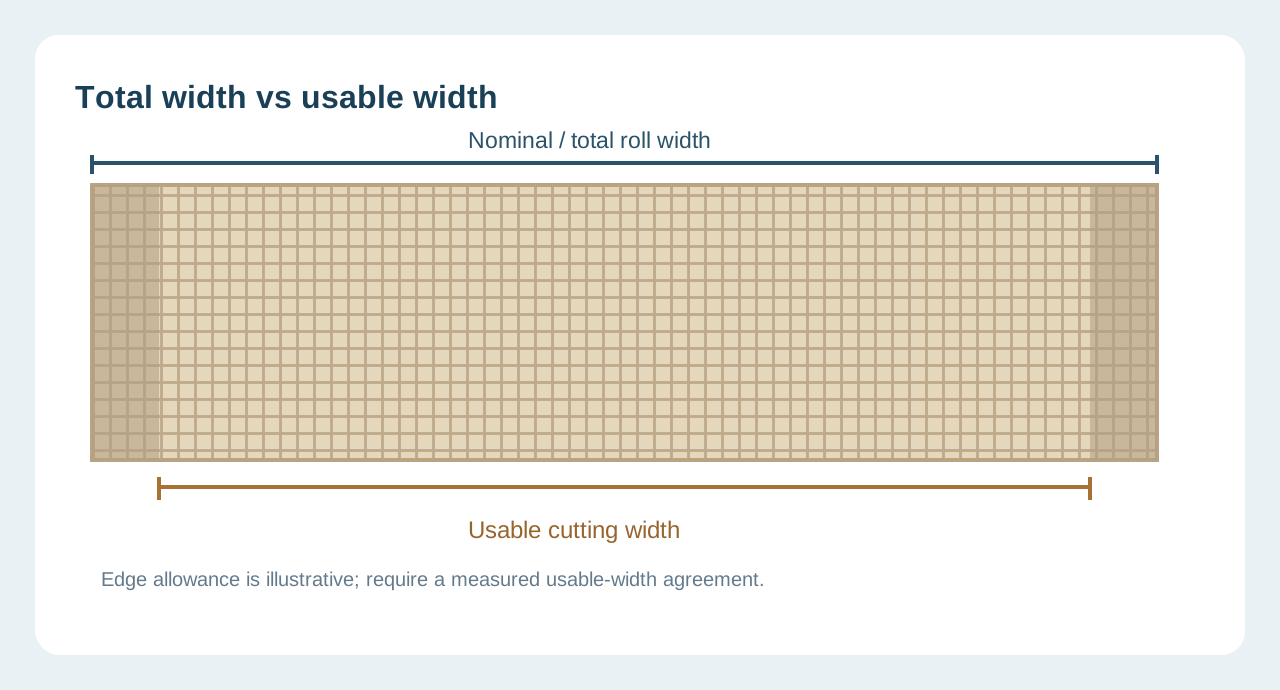
Gross width, usable width, length and edges
A converter buys usable cutting area, not just the nominal width on a price list.
| Control field | What the roll brief must state | Why converters care |
|---|---|---|
| Fiber composition / weave | Actual composition and woven structure; reference swatch and acceptable variation | Affects sewing, dye transfer, strength and liquid uptake. |
| Areal mass | Target g/m² or oz/yd², sampling method and agreed tolerance | Allows like-for-like fabric purchasing; cannot be converted directly to mil thickness. |
| Gross and usable width | Nominal total width; minimum usable width excluding unsuitable edge zone | Determines nesting and attainable finished panels. |
| Length per roll | Net measured length, accepted measuring method, tolerance and direction | Defines purchase quantity and downstream cutting plan. |
| Splices / joins | Maximum count, minimum uninterrupted length and location record | Prevents joins from landing in a critical panel. |
| Selvedge and edge state | Woven selvedge, fraying, distortions and any trim needs | Affects sewing allowance and effective width. |
| Core / winding | Core diameter, face orientation, roll tightness and outer wrap | Supports machine loading, storage and unwinding. |
| Traceability | Roll number, lot code, count, weight and packing label | Enables receiving checks and nonconformance records. |
How do fabric joins affect cutting yield?
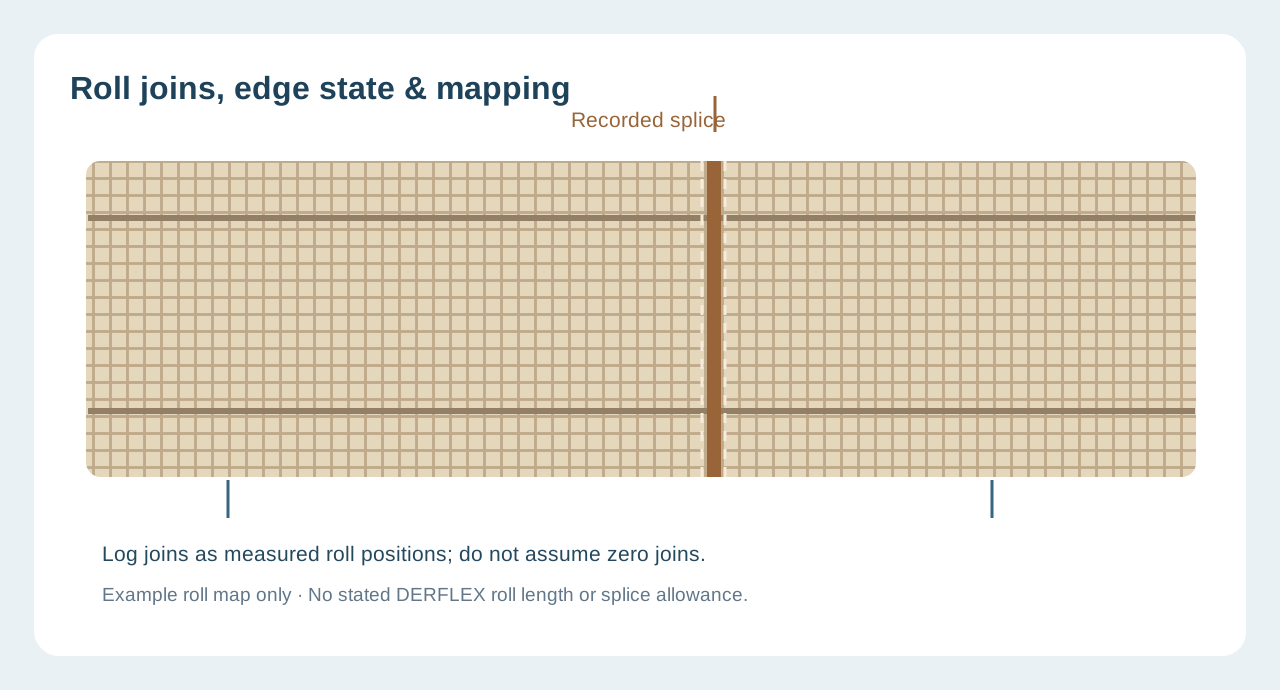
Treat splices as production planning variables: track their measured positions rather than promising zero joins.
Separate three measurements
Net roll length is the accepted linear quantity. Uninterrupted length is the usable piece between approved joints. Cutting yield is the fabric area successfully converted into the specified sheet shapes after edge trims, defects and splice exclusions.
A long nominal roll is not necessarily the most economical if multiple joins interrupt large panels. Ask the mill or supplier to record splice count and position by roll, and agree whether each join is allowed inside a finished sheet. The acceptance rule should describe an exact location convention from one end of the roll.
For higher-impact inspection and sample sign-off, retain a marked roll map with the incoming inspection report.
Calculate cutting utilization before committing to width
Simple nesting arithmetic can reveal avoidable waste before a converter approves a bulk roll.
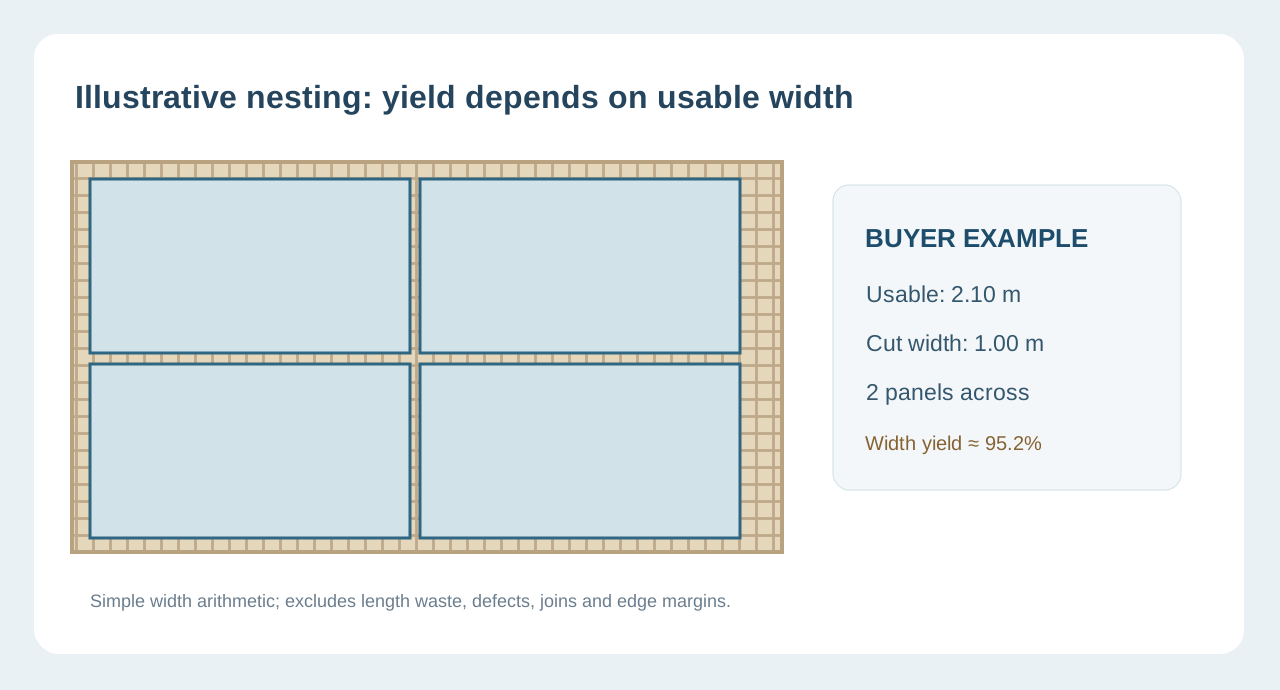
Worked example: hypothetical, not a factory yield claim
Suppose an approved roll offers 2.10 m usable width and your cutting panel is 1.00 m wide. Two panels fit across the roll (2.00 ÷ 2.10), leaving 0.10 m. The simple width utilization is 2.00 / 2.10 × 100 ≈ 95.2%.
This is a width-only illustration. Actual cutting yield will also depend on panel length, seam allowances, grain direction, defects, roll joins, squareness, cutting kerf and operator allowances. You must use real roll and pattern dimensions for purchasing decisions.
For a like-for-like quote, divide delivered usable fabric area by the number of saleable finished panels; include sewing and scrap disposal in your converter cost.
Incoming roll inspection and technical evidence
A real TDS must identify the actual product; a purchasing checklist cannot replace a supplier-issued test record.
Before dispatch
Agree the finished roll specification, fiber declaration, sampling method, tolerances, join allowance and label layout. Request a current TDS tied to the offered grade.
On receipt
Check count, net length, usable width at agreed positions, roll damage, selvedge, visible defects, join markings and lot identity. Record actual results per roll or sampled lot.
Before conversion
Run a short cutting and sewing trial. Examine fraying, stitch performance, color transfer, lint, shrinkage and handling under representative working conditions.
Accept/reject thresholds are not universal. Set them in the purchase specification and record actual observations. A practical converter should keep a Roll RFQ and an Incoming Inspection field record; neither replaces a real supplier-issued TDS or lot report.
Roll label, core and shipment configuration
Packing must let the converter receive, identify, store and load each roll without guessing.
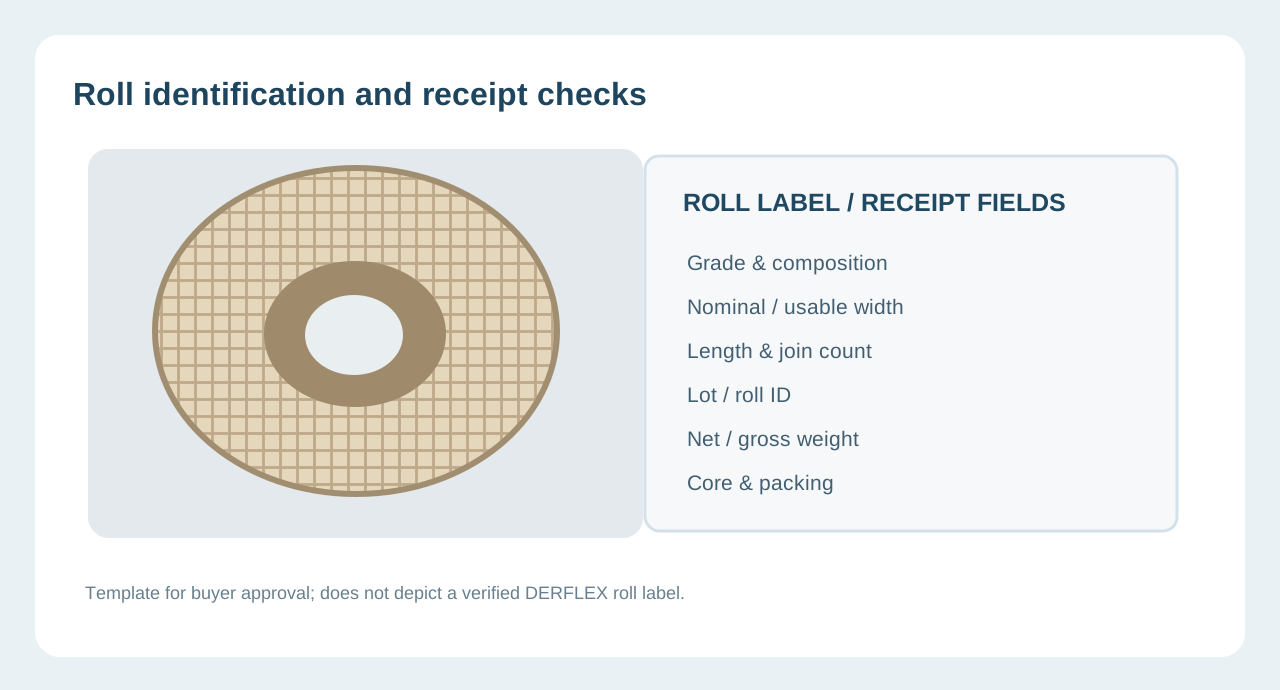
Roll-level packing checklist
Specify the inner core, winding orientation, maximum handling mass, suitable outer protection, roll-end identification, and how rolls are arranged in the shipment. Labels should identify grade, lot, nominal and usable width, net length, roll number, splice count, and any buyer barcode. Do not invent a weight or packing quantity until the proposed roll is measured.
If the converting facility uses automated spreading or narrow slitting equipment, record unwind side and edge configuration before the sample run. Ask whether the selected canvas can withstand the tension and bending in the intended equipment.
Canvas versus PVC-coated paint protection fabric
Choose based on the application: an absorbent working textile is not the same thing as a sealed protective barrier.
| Comparison | Uncoated cotton / blend canvas roll | PVC-coated industrial protection roll |
|---|---|---|
| Primary function | Absorbs incidental drips; can be sewn into soft reusable dust sheets | Coated surface can be specified for liquid-barrier behavior subject to complete system design. |
| Conversion | Cut-and-sew, hems and seams; shrinkage / lint may matter | Cutting and possible welding or sewing depending on actual coated construction. |
| Liquid-through behavior | Not inherently waterproof; needs real paint saturation test | Coated fabric may resist liquid penetration; seams, edges and chemical compatibility still require validation. |
| Buying evidence | Fiber composition, weave, mass, width, joins, swatches and sewing trial | Coating system, substrate, thickness/mass, barrier tests, seam approach and chemical compatibility. |
| Best next step | Send canvas roll and converting brief | Review DERFLEX PVC paint drop cloth fabric. |
Before you order: converter-ready roll RFQ
A precise roll brief reduces rework and makes quotations comparable.
- Use and material: painters’ drop cloth, dust sheet or another textile; fiber declaration, weave, natural / dyed finish.
- Equipment and panel size: finished sheet dimensions, cutting plan, sewing / stitching method, expected shrinkage allowance.
- Roll format: requested total and usable widths, net roll length, permitted joins, core and orientation.
- Acceptance: mass tolerance, width/length methods, defect zones, color lot, traceability and inspection sampling.
- Commercial: trial and annual volumes, delivery destination, intended inspection and required production dates.
When the actual textile grade or supplier path has not been confirmed, begin with a labeled fabric swatch and a limited conversion trial rather than a large volume commitment.
Questions converters ask before ordering
Direct answers to common canvas roll sourcing decisions.
What is the difference between a canvas drop cloth roll and a finished sheet?
A roll is supplied as continuous woven textile for a converter to cut and sew; a finished sheet is already cut, joined if needed, hemmed and ready for its intended protection task. This page addresses roll-level purchasing; finished canvas drop cloth options are covered separately.
Can I buy canvas drop cloth fabric by the yard or metre?
A converter may specify lengths in yards or metres, but the actual sale unit, minimum length, usable width, inspection method and availability must be agreed with the supplier. Request a written roll specification rather than assuming retail cut-by-the-yard stock.
How is usable roll width different from the listed fabric width?
Total width includes edges that may be unsuitable for cutting; usable width is the measured area approved for a particular layout. Record both values and edge defects or trimming allowances on the roll TDS and purchase order.
Does a 10 oz canvas roll have a specific thickness?
No. An ounce-per-square-yard number describes areal mass, not thickness. Weave, yarn and finishing determine thickness and handling. For reference, 10 oz/yd² is about 339 g/m², not a DERFLEX roll-stock claim.
Will canvas fabric stop paint soaking through?
Untreated woven canvas is generally absorbent, not a sealed waterproof barrier. Test representative wet paint exposure and surface compatibility. If leakage must be prevented, consider a documented backing or PVC-coated paint protection fabric.
What roll information should an OEM converter provide for a quote?
Send target fiber content, weave or swatch, areal mass, usable width, length per roll, core diameter, allowable joins, edge condition, winding method, annual and trial quantity, destination and planned converting operation.
What evidence should accompany a bulk canvas fabric roll shipment?
Request the actual supplier-approved TDS, lot and roll identification, sampling record, net length, measured usable width, join map, packaging specification and agreed acceptance criteria. Evidence must relate to the actual lot rather than general brochures.
Continue your material and converter research
Choose related DERFLEX resources according to the role of each page, without mixing PVC roll data into cotton canvas promises.
DERFLEX / B2B SPECIFICATION INQUIRY
Request roll specifications for your converting operation
Send your required usable width, target fiber and gsm, expected roll length, join allowance, conversion process and first-order quantity. DERFLEX can review the intended supply route and the sample and inspection documents needed for a comparable quote.
A quotation or future supply offer is conditional on verifying the actual material, manufacturing route and sample. No fixed price, lead time, MOQ or certification is claimed here.
- Required usable width and panel layout
- Fabric reference / weight / fiber blend
- Roll length, core and joins
- Converter equipment and delivery destination