


 Custom textile specification & OEM inquiry
Custom Canvas Drop Cloths & Private Label OEM Supply
Build a canvas drop cloth product specification around your market: finished-size combinations, fabric construction, stitched edges, logo position, barcode labels and custom packaging.
DERFLEX has related canvas tarp and OEM material programs. For a dedicated custom canvas drop cloth or branded painter's cloth range, the cotton fabric grade, converting process and finished-supply scope are reviewed against your sample and order brief. Start with a controlled SKU, not an unsupported stock claim.
What is a custom canvas drop cloth?
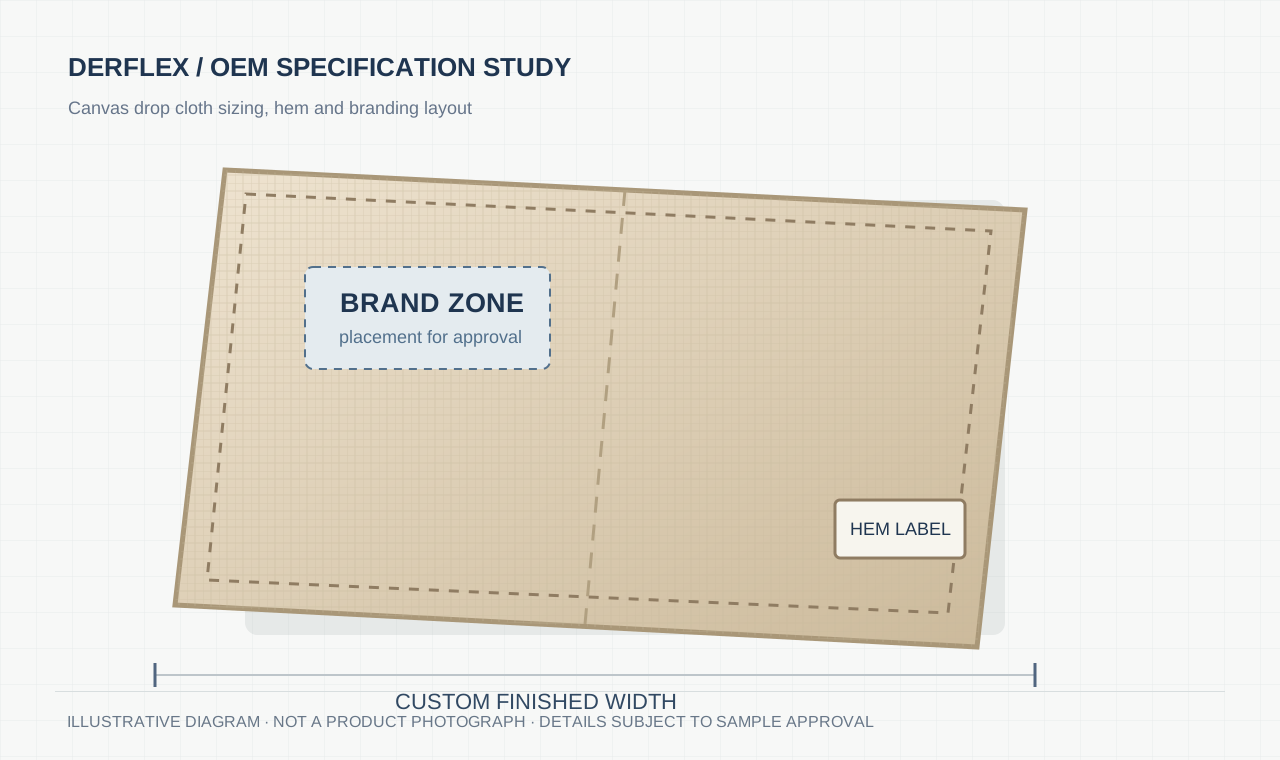
A custom canvas drop cloth is a reusable protective textile sheet specified for a customer's dimensions, construction, edge finish and intended use. A private-label version also includes the buyer's logo, product identification and packing design. For professional painting and retail programs, consistency depends on the actual fabric, completed size, fold pattern and approved physical sample—not simply the product name.
Canvas is not the same as PVC-coated protection
Untreated cotton canvas is commonly selected for absorbency and a soft textile hand, but paint and other liquids can migrate through it. A treated or backed construction may change absorbency, grip, laundering, weight and surface compatibility. Define whether the product should absorb drips, block liquid or protect against dust before choosing the material.
For coated, reusable barrier-style materials, see DERFLEX's industrial paint drop cloth fabric program.
Specify the exact deliverable
- Fabric roll: width, composition, target weight and winding instructions.
- Pre-cut sheet: dimensions and edge state for local conversion.
- Finished drop cloth: hems, labels, printing, folding and packing if confirmed for the order.
Material supply, sewn finishing and retail kitting are separate scopes; ask which production role DERFLEX will perform for the proposed SKU.
Custom size drop cloths: plan a coherent SKU matrix
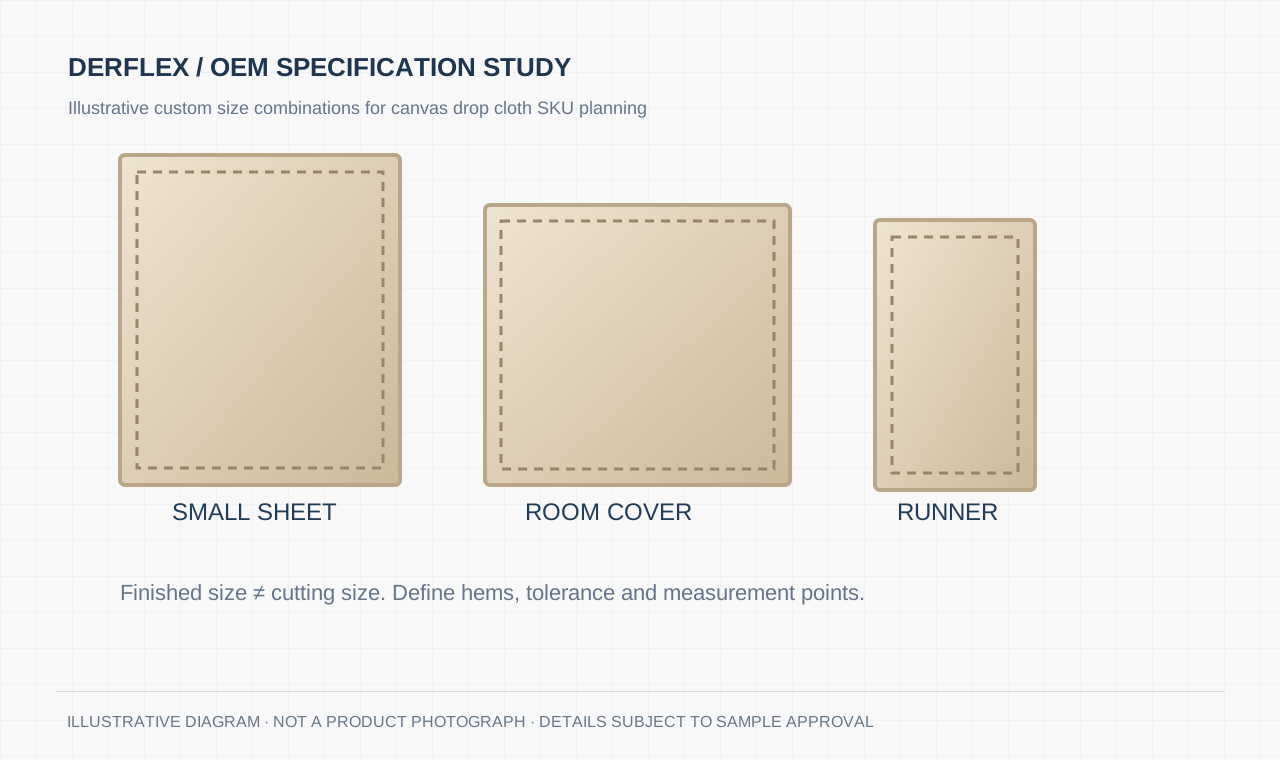
Start with the work zone and expected fold size. A retail brand may combine a room sheet, runner and smaller furniture sheet; a trade importer may prefer fewer sizes and bulk packs. The dimensions below are illustrative planning combinations, not DERFLEX stocked product specifications.
| Example SKU direction | Buyer-defined format | Confirm before sampling |
|---|---|---|
| Furniture / spot protection | 1.8 × 2.7 m (about 6 × 9 ft) | Fold size, portability, edges |
| Room / general painting | 2.7 × 3.7 m (about 9 × 12 ft) | Panel seams, usable width |
| Hallway runner | 1.2 × 3.6 m (about 4 × 12 ft) | Orientation, slipping risk |
| Large workspace | 3.7 × 4.6 m (about 12 × 15 ft) | Fabric width, joins, handling |
Specify whether the PO dimension means finished size after hems or cut size before sewing. Add an acceptable dimensional tolerance, seam layout and measurement method to each SKU. Size labels must reflect the approved measurement convention; a nominal trade size should not silently replace a finished-size commitment.
Buyers comparing other protective covers can consult the wider canvas tarp material and size options before deciding whether an absorbent painter's cloth is the appropriate category.
Choose the fabric, hem and seam as one specification
Describe the requested base cloth with the actual fiber composition, weave, target areal mass in g/m² or oz/yd², usable roll width, color and hand feel. A stated fabric weight alone cannot establish absorbency, shrinkage, thread strength or wash behavior. If the customer needs unbleached cotton, dyed canvas or a cotton blend, identify the choice in both the sample and purchase order.
Ask for the finished cloth's exposure conditions: water-based paint, oil-based paint, dust, dry plaster, surface finishes, repeated folding and laundering. When a barrier is required, treat that as a separate performance request rather than calling ordinary cotton canvas waterproof.
DERFLEX's canvas tarpaulin family covers several canvas and coated constructions; their published parameters should not be treated as approved data for this unconfirmed painter's cloth SKU.
| Specification field | Buyer decision | Acceptance reference |
|---|---|---|
| Base textile | Cotton or blend; weave; proposed fabric weight | Approved fabric swatch and recorded composition |
| Finished dimensions | Width × length for each SKU, tolerances | Measurement drawing after finishing |
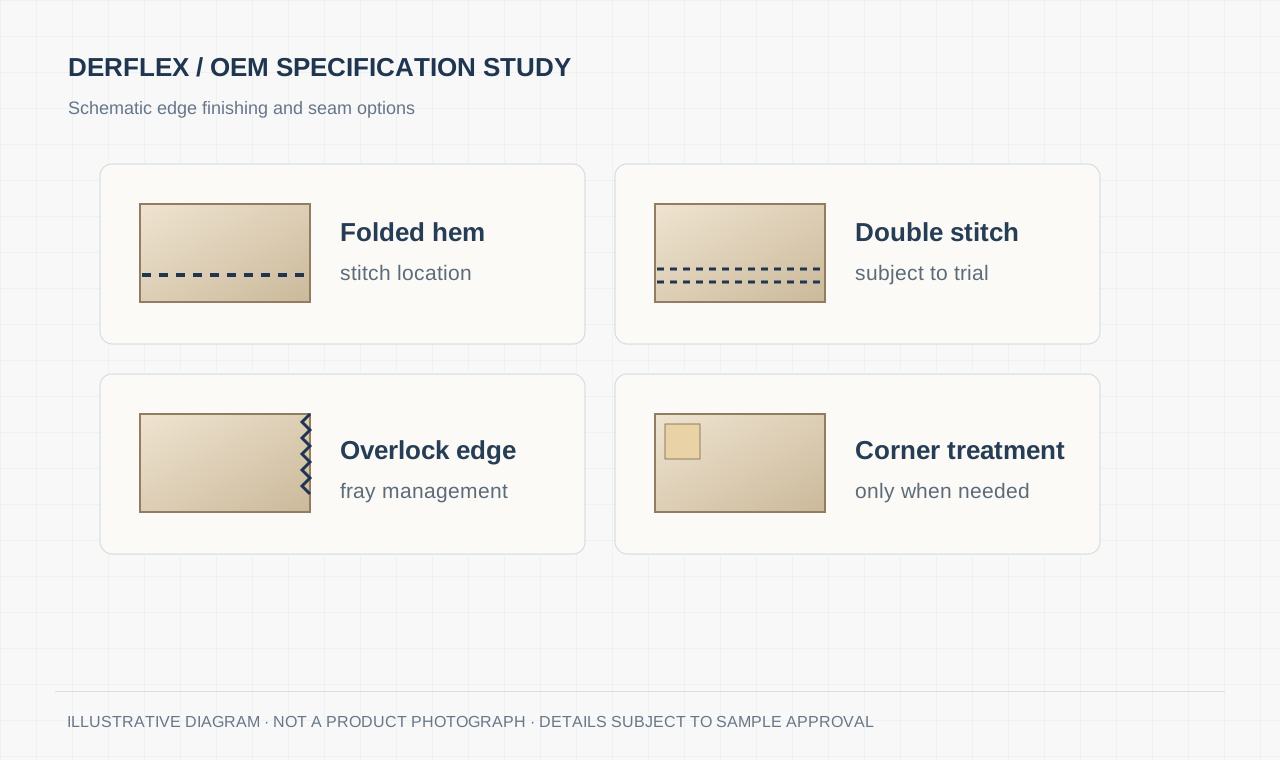
| Edges | Folded hem, overlock or double-stitch concept | Seam sample; agreed edge width and stitch quality |
| Joining | Single piece or joined panel; seam location | Approved seam layout and appearance |
| Surface behavior | Absorbency, shedding, color transfer, shrinkage | Application-specific sample or testing agreement |
| Color / finish | Natural, dyed or project-specific finish | Physical color reference under defined light |
| Branding / labels | Location, artwork revision, label content | Approved placement sketch and marked sample |
Branded and custom printed drop cloths: make placement practical
Three branding surfaces to define
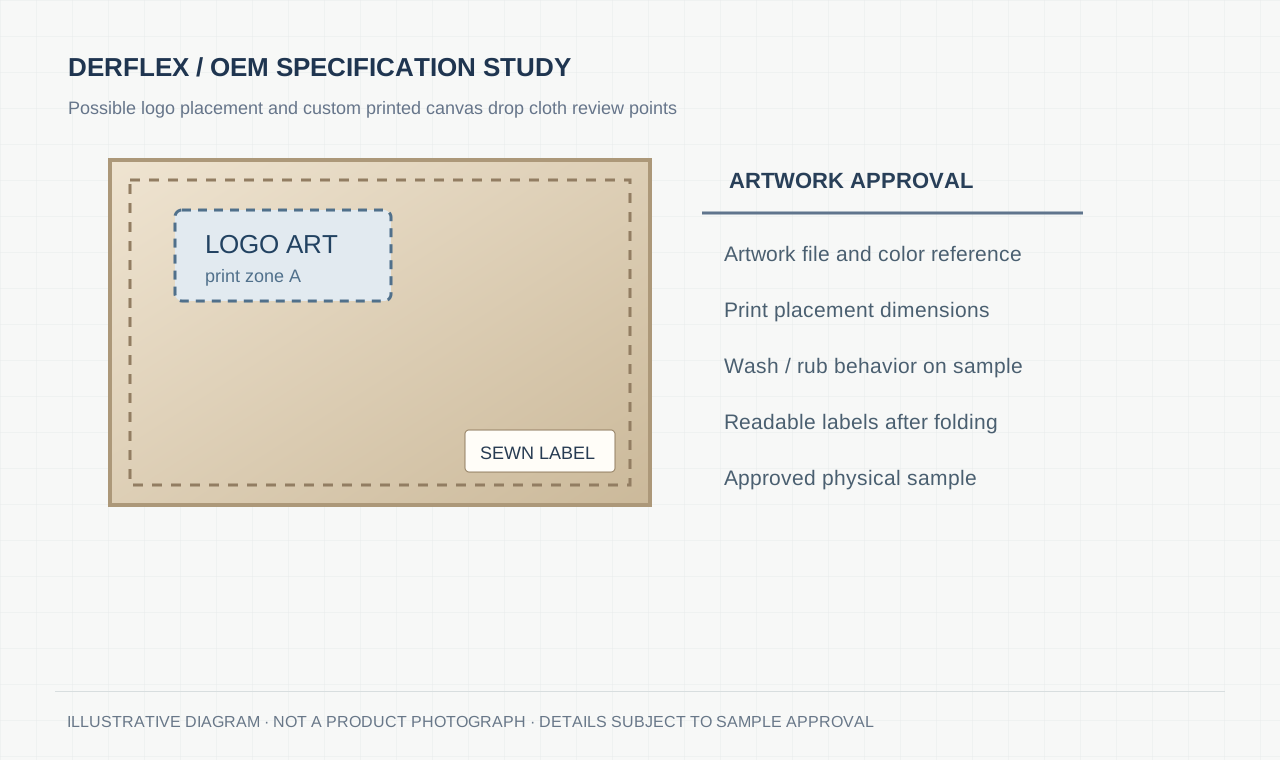
Printed fabric logo: choose a proposed size, orientation and position that remains visible after typical folding and does not dominate a high-contact area. Specify artwork in a vector format with colors and a scale drawing.
Woven or printed sewn label: decide whether the brand label is visible at the edge, internal or removable. Confirm care instructions, fabric composition and local market disclosures with the importer.
Product and carton graphics: connect each printed SKU name, barcode, lot identifier and carton mark to the same specification revision.
The printing method—such as screen printing or another textile-compatible process—must be selected after checking the chosen canvas, ink or transfer system, wash expectations and order scale. A visual mock-up alone is not print durability evidence.
Corner print
Useful for smaller branded trade cloths when unobtrusive identification matters. Confirm visibility once folded.
Edge or hem label
Keep the brand identification separate from the working surface. Validate seam placement and label retention.
Promotional print area
For event or branded-use programs, define a larger print zone and verify folding, ink coverage and intended use.
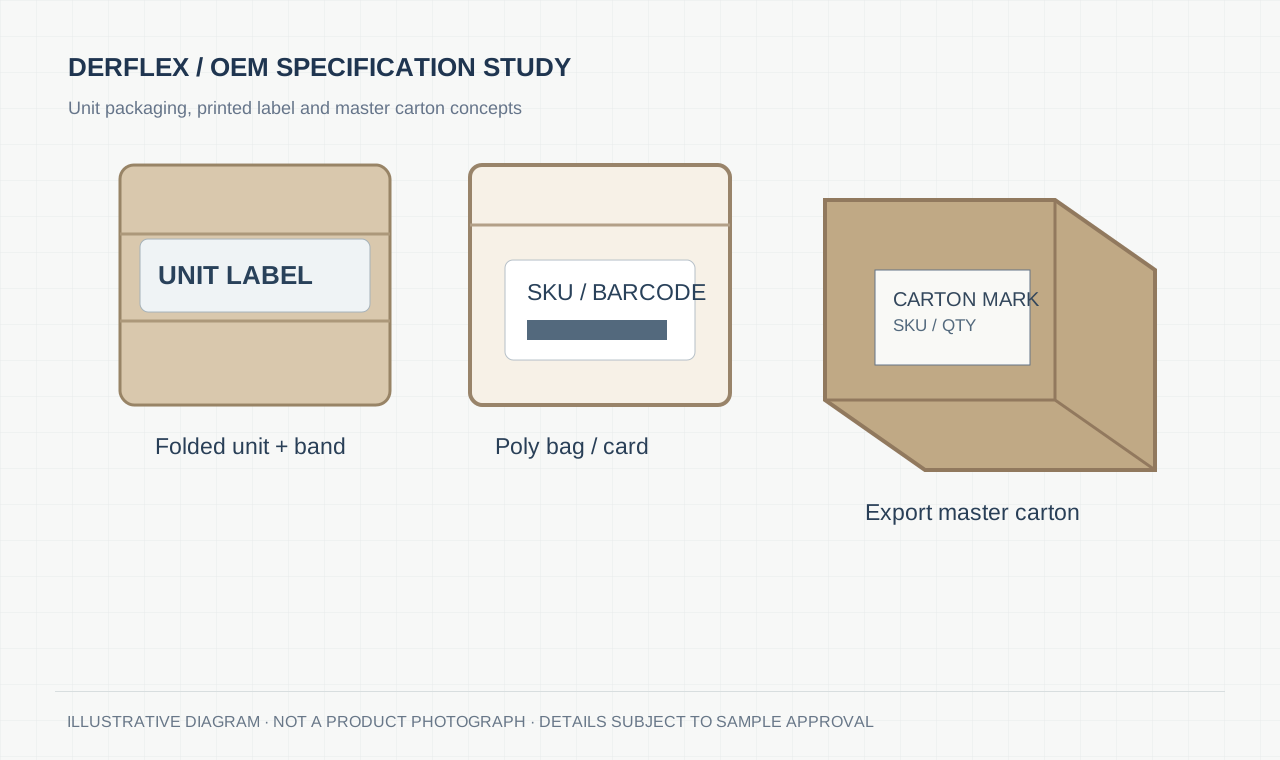
Drop cloth custom packaging is part of the product specification
Packaging should help shoppers understand the product and help the importer receive the correct SKU. Include pack count, folded dimensions, hang-hole requirements if applicable, bag or band material, inserts, barcode position, carton quantity and shipping marks. Product names, country-of-origin information, fiber content and care statements must be reviewed for the destination market; do not copy unverified retail claims.
- Unit format: folded and paper-banded, bagged, or another approved retail style.
- Retail identification: SKU, nominal or finished dimension, fiber declaration, barcode and language versions.
- Bulk format: master-carton quantity, liner if required, gross and net weights, pallet plan and shipment marks.
- Artwork control: link print proof, dieline, label revision and carton mark to the same item code.
Related DERFLEX OEM tarp supplier content describes existing carton, label and repeat-order workflows. Apply them to a canvas drop cloth only after confirming the finishing and packing scope.
Use a golden sample and revision-controlled purchase specification
The common failure mode in an OEM line is not just an incorrect first sample; it is a second or third order that drifts from the first. A practical control plan should preserve material identity, dimensions, brand artwork, finishing, packing and reference measurements across every SKU.
Brief & feasibility
Send the use case, canvas grade, size list, annual plan, destination market and whether the scope is fabric, cutting or finished packing.
Construction layout
Freeze draft dimensions, hems, seams, logo zones, label and packing instructions before sample preparation.
Sample review
Inspect physical fabric, shrinkage concerns, print visibility, stitching, folds and packaging fit; record changes.
Golden-sample approval
Approve the actual item and its revision-coded BOM, measurement sheet, artwork proof and carton specification.
Production checks
Agree inspection points for fabric, dimensions, seams, print, label, fold and master-carton accuracy.
Repeat-order release
Reference the same SKU and approved revision; record any substitute fabric, dye, process or packaging changes for fresh approval.
For broader tarp and finished-cover workflows, see DERFLEX's custom tarps and B2B sourcing guidance.
Standard retail cloth vs specification-led private label program
| Buyer question | Catalog / stock purchase | Controlled OEM inquiry |
|---|---|---|
| Size range | Choose published stock sizes | Define specific finished-size SKUs, seams and tolerances |
| Material identity | Use the listed fabric description | Approve actual composition, hand feel, target weight and reference swatch |
| Edge construction | Accept standard edge type | Record hem, stitch and panel layout by drawing |
| Brand presentation | Usually supplier's packaging | Buyer-specific logo, label and packaging subject to feasible production |
| Reorders | Reorder the catalog item | Use a locked sample, revision-coded artwork and QC acceptance sheet |
| Cost inputs | Published unit selling price | Material utilization, conversion labor, print set-up, pack count and logistics terms |
For an importer, the lowest quoted unit price is not the only variable. Compare material utilization, seam count, print set-up, packing complexity, sampling, freight cube and tolerance risk. DERFLEX's tarpaulin fabric sourcing page provides additional context for material-to-finished-product decisions.
OEM canvas drop cloth RFQ checklist
Send a short, usable purchasing brief rather than only a product name. If you do not know the fabric weight yet, share an existing sample, photograph or intended painting task and describe what matters most.
Product and artwork
- Use: painter's cloth, dust sheet, promotional cloth or other protection.
- Material: cotton or blend; weave and weight target where known.
- Finished width × length and quantity for every size.
- Required hem, seam plan, stitch and acceptable tolerance.
- Logo/vector art, color reference, placement drawing, labeling text.
Commercial and compliance
- Unit fold and packaging style, barcode and master carton quantity.
- Destination market and buyer-required labeling rules.
- Wash, absorbency, bleeding, shrinkage or other required evaluation.
- Sample approval milestones and planned first shipment date.
- Target order quantity and forecast for repeat business.
Before placing a large program order, check fabric suitability on the intended floor and finish, including dye transfer, lint, seep-through, trip or slip risk and care method. A protective cloth is not a substitute for required site-specific safety controls.
Custom canvas drop cloth OEM FAQs
Can canvas drop cloths be made in custom finished sizes?
A custom-size program can be defined using finished width and length, shape, hem allowance and an agreed tolerance. DERFLEX should confirm the available cotton canvas construction and conversion route before the order is accepted.
What is the difference between an OEM and private label drop cloth?
OEM usually means manufacturing to a buyer-defined product specification. Private label adds the buyer’s branding, SKU identity and packaging. A program can include both, but the physical sample and artwork approval must cover each part.
Where should a logo be printed on a canvas drop cloth?
A corner or edge zone can make branding visible while keeping most of the working area unobstructed. The right position depends on folding, use, fabric texture, print process and wash or rub performance; approve the placement on a physical sample.
Can I order custom drop cloth packaging with my barcode?
Specify unit fold, band or bag, barcode data, care label, destination-language text, carton quantity and shipping marks. The exact packaging format, print method and compliance responsibilities should be confirmed in the approved quotation.
Are cotton canvas drop cloths waterproof?
Untreated woven cotton canvas is generally absorbent, not a waterproof barrier. A backing or treatment changes the product and must be checked for absorbency, slip, surface compatibility and any claimed liquid resistance.
How do I keep repeat orders consistent?
Agree a golden sample, controlled SKU specification, finished size and tolerance, fabric and color reference, logo artwork revision, label content, folding pattern and inspection checklist. Keep revision identifiers with future purchase orders.
What should importers send for a custom canvas drop cloth quote?
Provide intended use, fabric composition, target weight, finished size list, quantity by SKU, hem specification, logo files, label and packaging artwork, destination market, delivery timing and any mandatory testing. A reference sample or drawing is helpful.
Build a private-label drop cloth line with controlled details
Tell DERFLEX what you want to buy, how it will be used and what your customers will see on the label. A finished cotton canvas program should proceed only after material, conversion, printing, packaging and sample feasibility have been confirmed.
- Fabric reference or target composition
- Size and quantity by SKU
- Hem and seam construction
- Logo artwork and label requirements
- Packaging, destination and schedule
DERFLEX · Specification-driven B2B inquiry page. Product images on this preview are technical illustrations, not finished product photographs.