News
Company News

Hot-Air Welding vs High-Frequency Welding for PVC Tarps

Update:2026/7/29 19:18:11 Views:
PVC Coated Fabric & Tarpaulin Manufacturing
PVC Tarp Fabrication Guide for Industrial Buyers

Hot-Air Welding vs High-Frequency Welding for PVC Tarps

The strongest seam is not selected by machine name alone. It comes from matching the PVC coating, seam geometry, production volume, waterproofing target and inspection plan to the right welding process.

?

Which Welding Method Is Better for PVC Tarps?

Neither process is automatically better for every PVC tarp. Hot-air welding is usually the more adaptable option for long, continuous seams, wide tarp panels, variable dimensions and repair work. High-frequency welding—also called HF or RF welding—is often preferred for controlled shapes, repeat components and seams where tooling-based precision or air- and liquid-tight performance must be validated.

For many truck covers, tents and industrial tarps, a hybrid production plan is commercially sensible: hot air for long panel seams and hems, with HF welding for reinforcement patches, formed details or repeated high-stress components. The final choice should be confirmed on the actual PVC formulation, surface finish and layer build.

Process Fundamentals

How Hot-Air and High-Frequency Welding Create a PVC Tarp Seam

Both methods combine heat and pressure, but they introduce energy into the PVC layers in different ways. That difference changes equipment, seam geometry, process control and the types of work each method handles efficiently.

External Heat

Hot-Air Welding

A controlled stream of heated air is directed between overlapping PVC-coated fabric layers. As the facing surfaces soften, pressure rollers compress the overlap and the seam cools into a continuous bond. Manual tools, portable automatic welders and fixed production machines can all use this principle.

Overlap Heat Surfaces Apply Pressure Cool & Inspect
  • Adjustable along long, straight or gently curved seams
  • Practical when tarp dimensions or seam positions change frequently
  • Portable equipment can support field installation and repair
  • Results depend strongly on temperature, airflow, speed and roller pressure
Internal Dielectric Heating

High-Frequency / RF Welding

An electromagnetic field excites polar molecules in compatible PVC layers within a shaped electrode area. Heat develops in the weld zone while the press applies controlled pressure. The tooling defines the seam outline, making the process suitable for repeated components and precise localized joints.

Position Layers Clamp Tooling Apply RF Energy Cool Under Pressure
  • Consistent seam boundaries when tooling and material are correctly matched
  • Useful for repeated shapes, patches and multi-layer details
  • Suitable for PVC and other RF-responsive polar thermoplastics
  • Requires more specialized equipment, tooling, calibration and operator control
Side-by-Side Review

Hot-Air Welding vs High-Frequency Welding: Buyer Comparison

This matrix focuses on production decisions rather than claiming one process is universally stronger.

Decision Factor Hot-Air Welding High-Frequency / RF Welding What the Buyer Should Confirm
Heat transfer Heated air softens the contacting surfaces from the outside. Electromagnetic energy creates heat within the compatible weld zone. Confirm the PVC coating formulation and surface treatment respond consistently to the selected process.
Best seam geometry Long overlaps, wide panels, hems and continuous linear seams.Flexible Layout Repeated shapes, formed details, patches and electrode-defined seam outlines.Tooling Precision Send drawings showing seam width, curves, corners, reinforcements and hardware transitions.
Production flexibility High. Operators can adjust seam position, panel length and travel path without a new electrode for every variation. Lower for frequent design changes because tooling normally follows the part geometry. Compare the cost of flexibility against the value of repeatability across the order mix.
Repeatability Good with stable machine settings, guides, operator training and documented parameters. Very good for repeated parts after tooling, power, time and pressure are validated. Request an approved reference sample and define acceptable appearance and performance limits.
Long seam throughput Often efficient for continuous panel joining and large covers. Cycle-based; productivity depends on electrode length, press size, repositioning and part design. Evaluate total handling time, not only the welding cycle itself.
Airtight / liquid-tight work Can produce sealed seams when material, overlap and settings are controlled and validated. Commonly selected for critical sealed zones because the process can create highly repeatable localized bonds on compatible materials. Specify the actual leak-test method, pressure, duration and acceptance limit instead of asking only for “waterproof.”
Tooling and setup Usually lower tooling burden and faster adjustment for new sizes. Requires electrodes, press setup, grounding and more specialized calibration. Include setup cost, changeover time, maintenance and expected production volume in the comparison.
Portable repair Well suited to workshop repair and some on-site work with suitable portable equipment. Normally a stationary factory process rather than a field repair method. Decide whether the product will need serviceable repairs after installation or during fleet use.
Visual finish Can be clean and narrow with proper guides and parameter control; long seams may show more process variation. Tooling can produce sharp, consistent seam boundaries and repeated visual details. Approve seam width, embossing, edge marking and acceptable gloss change on a physical sample.
Typical commercial fit Truck tarps, tent panels, awnings, industrial covers, curtains, banners, membranes and repairs. Inflatables, containment products, shaped tarp details, reinforcement assemblies and repeat components. Match the process to the full product architecture, not just the longest or most visible seam.
Six Decision Gates

How Industrial Buyers Should Select the Welding Method

A process recommendation becomes more reliable when the supplier receives the information below before sampling.

1

Start with the Material

Confirm PVC coating type, coating weight, base fabric, surface lacquer, embossing and any functional finish. Two rolls with the same GSM can have different welding windows.

2

Map Every Seam

Separate long panel seams, curved zones, hems, corners, reinforcement patches, webbing areas, windows and hardware transitions. Different zones may justify different methods.

3

Define the Seal Target

“Waterproof” can mean rain protection, hydrostatic resistance, an immersion check or pressure retention. State how the finished seam will actually be tested.

4

Review Volume and Size Mix

Long runs of identical components can justify RF tooling. Frequent size changes or custom one-off covers may favor flexible hot-air production.

5

Identify Real Stress

Wind flutter, folding, edge tension, abrasion, fluid pressure and repeated installation affect seams differently. Test the failure mode expected in service.

6

Approve a Production Sample

Use the actual fabric, reinforcement and seam geometry. A generic welding coupon is useful, but the finished corner or edge assembly often reveals more.

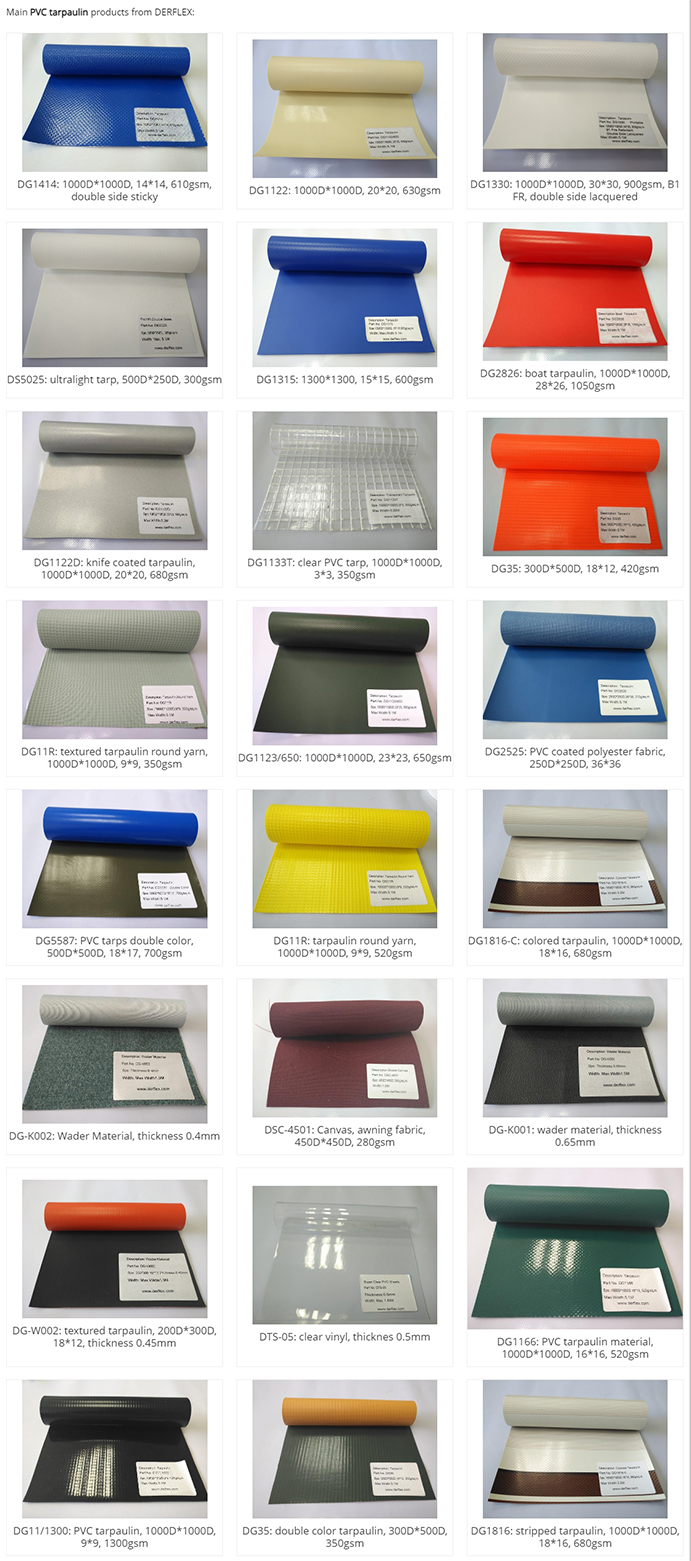
DERFLEX PVC tarpaulin rolls for hot-air and high-frequency welding
Product display: PVC coated polyester tarpaulin rolls for cutting, overlap welding, reinforcement and custom cover fabrication.
DERFLEX Material Support

Weldable PVC Tarpaulin Should Be Specified Around the Fabrication Process

A welding machine cannot compensate for a poorly matched coating, unstable batch or unsuitable surface treatment. DERFLEX supplies weldable PVC tarps and coated polyester materials for converters, truck-cover manufacturers, tent fabricators, distributors and OEM programs. The commercial goal is repeatable processing—not simply a material described as “heat sealable.”

Typical project discussions can include coated or laminated structures, yarn and density selection, custom width, surface finish, cold-flexibility direction, outdoor treatments and supply format. Final parameters remain subject to the customer's equipment, seam construction, approved sample and end-use test.

  • Material StructurePVC coated or laminated polyester fabric
  • Typical Weight DiscussionApproximately 300–1200gsm for many commercial applications
  • Width DiscussionCommon project range from about 1.02m to 5.10m
  • Base Fabric Options500D, 840D, 1000D, 1100D, 1300D and application-led structures
  • Surface OptionsGloss, matte, lacquered, embossed, printable and project-specific finishes
  • Supply FormsRoll goods, cut panels, welded tarps and OEM finished covers
Send Your Welding Equipment & Fabric Requirement
Application Mapping

Which Process Fits Common PVC Tarp Products?

The examples below are practical starting points. Final construction should still be sampled because fabric formulation, seam width, load path and equipment condition can change the result.

01

Truck Tarps and Trailer Covers

Hot air is often efficient for long roof seams, side panels and hems. HF welding may be used for repeated reinforcement parts, shaped patches or logo/detail zones. Material should be checked for fold cycles, abrasion and edge tension.

02

Tents, Awnings and Shelters

Large roof and wall panels frequently suit continuous hot-air welding. HF tooling can add repeatability around windows, reinforcement plates, straps and shaped architectural details.

03

Inflatables and Containment

HF welding is commonly considered when controlled air- or liquid-tight seams, multilayer assemblies or repeated chamber geometry are central to the product. Defined leak testing is essential.

04

Industrial Covers and Curtains

Long divider panels, machinery covers and warehouse curtains may favor hot air for flexible dimensions. A combined process can be useful where attachment points and reinforced openings repeat across the design.

05

Field Repair and Installation

Portable hot-air equipment is generally the practical route when access, installation position or repair location prevents the use of a stationary press. Surface cleaning and overlap preparation remain critical.

06

OEM Repeat Components

When thousands of identical patches, tabs or formed details are required, HF tooling can support repeatable boundaries and controlled cycle production—provided design changes are unlikely.

Seam Acceptance

Do Not Approve a PVC Tarp by Appearance Alone

A smooth seam may still be under-welded, contaminated or weak at a reinforcement transition. Quality review should reflect the actual service risk and the agreed specification.

  1. Material and lot verificationConfirm fabric code, coating route, color, finish, thickness direction and approved incoming lot.
  2. Surface preparation checkRemove dust, moisture, oil, release residue and incompatible marking materials from the overlap zone.
  3. Parameter-window confirmationRecord temperature/airflow/speed/pressure for hot air, or power/time/pressure/cooling for HF welding.
  4. Visual seam reviewCheck alignment, overlap width, edge definition, scorching, wrinkles, trapped contamination and coating distortion.
  5. Peel and shear evaluationUse the agreed seam test method and compare failure behavior, not only the maximum number.
  6. Leak or water-ingress testDefine test area, pressure or water exposure, duration and acceptance criteria before production begins.
  7. Flex and fold checkEvaluate seam behavior after bending, rolling or low-temperature conditioning when the finished tarp will be repeatedly handled.
  8. High-stress detail reviewInspect corners, hems, webbing, grommet zones, windows, straps and transitions where stiffness changes concentrate load.
  9. Production sampling planAgree on start-up checks, in-process frequency, destructive samples and traceability records for the order.
Avoid Hidden Costs

Common PVC Tarp Welding Mistakes in Procurement

Most seam disputes begin before the welding machine starts—when the requirement is incomplete or, the approved sample does not represent mass production.

Buying by GSM Only

Weight does not reveal coating chemistry, adhesion, lacquer behavior, yarn strength or the real welding window.

Asking “Which Is Stronger?”

Seam strength depends on material, overlap, tooling, parameters and load direction. The correct question is whether the finished construction passes the agreed test.

Ignoring Seam Geometry

A long straight seam, a corner, a webbing junction and an inflatable chamber should not be evaluated as the same welding task.

Skipping Production Trials

A small lab coupon may not predict handling, cooling, repositioning and stress concentration on a full-size tarp.

Buyer FAQ

Frequently Asked Questions

Clear answers for buyers comparing hot-air welding, high-frequency welding and weldable PVC tarpaulin supply.

Is high-frequency welding always stronger than hot-air welding for PVC tarps?

No. HF welding can deliver highly repeatable and strong sealed zones on compatible materials, but seam performance still depends on PVC formulation, tooling, pressure, cycle settings, overlap design and the direction of load. A well-controlled hot-air seam can be highly suitable for long industrial tarp joints. Compare approved samples using the same test method.

Can hot-air welding make a PVC tarp waterproof?

Yes, properly executed hot-air overlap welding can create a waterproof seam. Complete water protection also depends on corners, hems, hardware, repair zones and any sewn or punctured areas. Define the water or leak test required for the finished product.

When should a tarp manufacturer use both welding methods?

A hybrid method is useful when one product combines long variable seams with repeated precision details. For example, hot air may join large truck-tarp panels while HF welding forms reinforcement patches or repeated shaped assemblies.

Does every PVC coated fabric work with HF welding?

Not automatically. PVC is generally responsive to RF energy, but coating thickness, additives, lacquer, backing, pigments, reinforcement and layer design can affect the result. Material-machine compatibility should be tested before bulk fabrication.

Which method is better for repairing PVC tarps?

Hot-air welding is usually more practical for repair because portable equipment can be brought to the tarp or installation area. The damaged surface must be cleaned, dry and structurally sound enough to accept a patch.

What information should I send DERFLEX for a weldable tarp quotation?

Send the application, target GSM or current material sample, required width and color, welding equipment, seam type, finished product drawing, performance tests, quantity, packaging and whether you need roll goods, cut panels or finished welded tarps.

From Material Sample to Bulk Production

Match the PVC Tarp to Your Welding Process Before You Scale

Share your machine type, seam drawing, tarp application, target weight, width, finish and order volume. DERFLEX can review a practical material direction and sample route for your fabrication process. Recommendations remain subject to trial welding and agreed performance testing.

Useful inquiry attachments Existing fabric sample, welding machine model, seam photo, drawing, test requirement and annual volume estimate. Request a Quote

Technical values and process suitability should be confirmed against the final material, equipment and application. This page is intended as procurement guidance rather than a universal production specification.

Consulting Services
+86-021-54361792 / 54361798
Email
sales@derflex.com