


Inflatable Water Dams for Flood Control
An inflatable water dam is a portable barrier positioned along a flood-protection line and filled on site to help retain or redirect water. For municipal response teams, industrial facilities and civil contractors, the right system starts with the site: expected flood depth, flow, ground friction, end connections and access to filling water. DERFLEX supports evaluation of reinforced PVC-coated materials and discusses flood-barrier supply options against your project drawing. Final barrier configuration and allowable loading require project-specific confirmation.
- Water-inflated concept
- Portable & reusable design
- Custom project discussion
- PVC-coated reinforcement
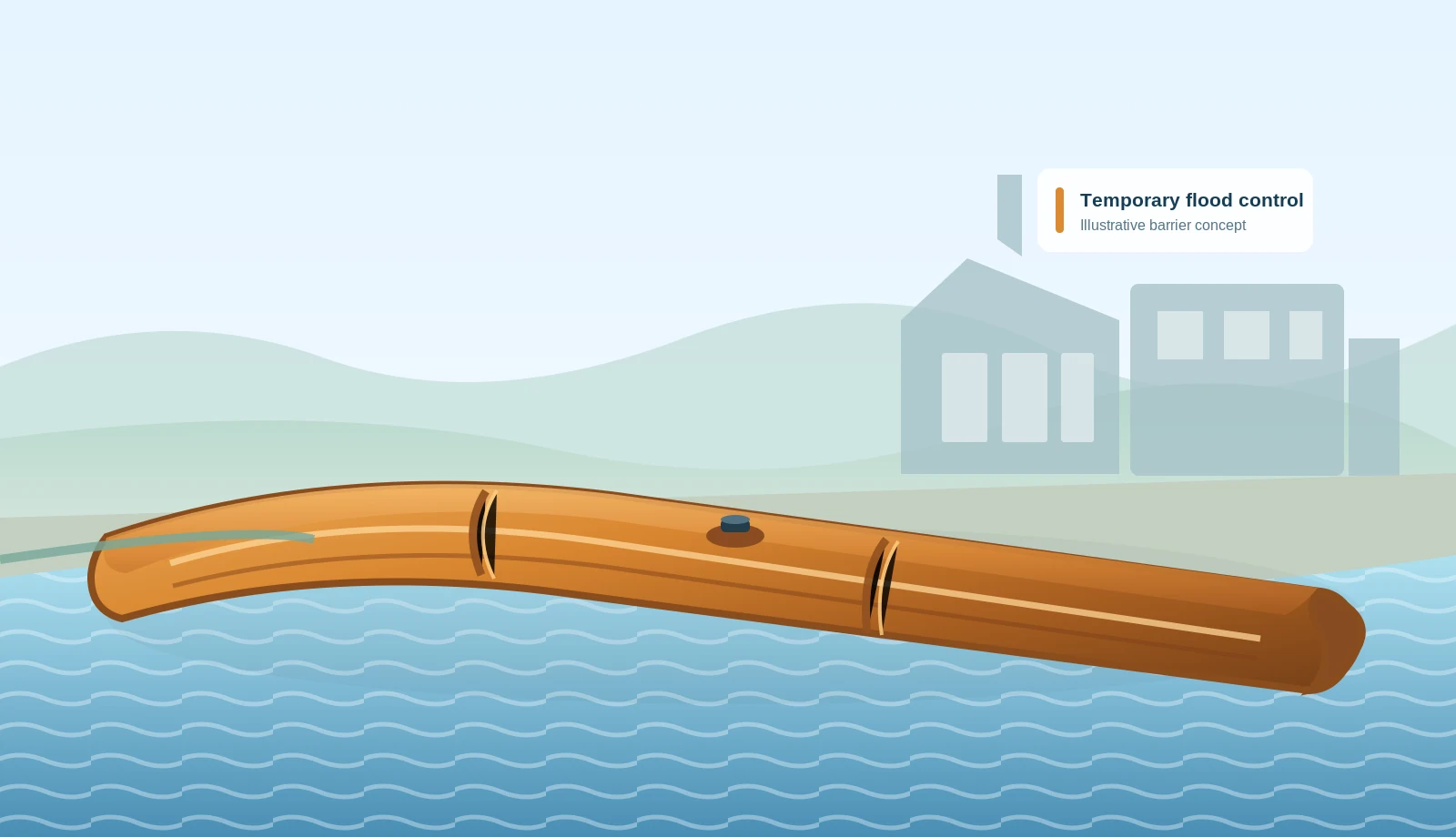
What Is a Water-Inflated Dam?
A water-inflated dam, sometimes called a water-filled flood dam or inflatable dam for flooding, is a flexible temporary structure that is transported without its operating fill. At the protection site, water is pumped into the barrier. The resulting mass, membrane shape, internal geometry and contact with the ground work together to resist incoming water. Once the operation ends, the barrier may be drained, inspected and stored for future use.
Unlike a permanent embankment, this approach is intended for deployable water management. It can serve as a temporary line of defense, but it is not an automatic substitute for an engineered levee. Geometry, friction and continuity at ends and joints determine whether it can work on a particular site.
What the system does
Helps create a temporary hydraulic separation or diversion line where a qualified design and deployment plan permit.
What must not be assumed
A nominal tube diameter is not a certified retaining height; material waterproofing does not prove entire-system flood protection.
How Does an Inflatable Water Dam Work?
The practical sequence has four stages. The exact procedure, equipment, filling pressure and stabilization arrangements must come from the approved system instructions and site plan.
Survey the line
Record the full perimeter, low points, slopes, potential seepage paths and both termination points. Identify inlets, utility covers and emergency access.
Position sections
Prepare the substrate; move and align unfilled sections without dragging across sharp debris. Set end interfaces and approved overlaps or couplings.
Fill and inspect
Use a suitable water source, hose and pump. Follow the supplier's prescribed filling sequence, allowable pressure and stable operating shape.
Monitor and recover
Watch water level, freeboard, movement, seepage, connections and debris. Drain, clean, dry, inspect and repack after the event.
Emergency-response use must be directed by competent personnel. Do not deploy in fast-moving or hazardous floodwater without an approved plan.
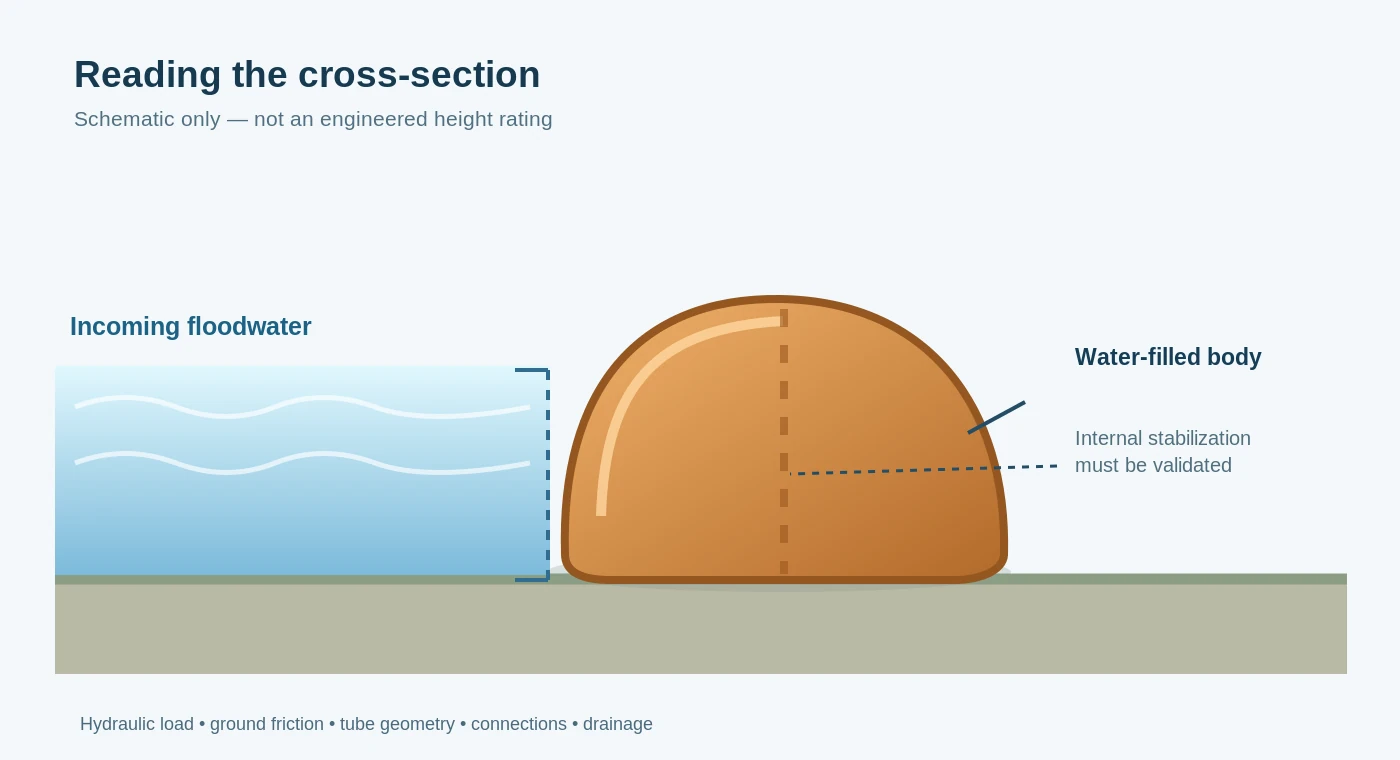
Stability Comes From the Whole System
Floodwater pushes laterally on a barrier. A filled PVC tube gains mass, but resisting sliding, rolling, uplift or overturning depends on more than that mass. The most consequential variables include:
- Design water head and freeboard: the retained depth plus an allowance against overtopping.
- Flow velocity and debris: moving water adds forces and puncture risk that still-water calculations cannot capture.
- Ground friction and slopes: concrete, asphalt, gravel, soft soil and saturated surfaces behave differently.
- Internal restraints and shape: single-tube, multi-tube and baffled designs do not have equivalent behavior.
- Continuity at joints: overlaps, corners, entrance transitions and end terminations require detail drawings.
Ask the system supplier for allowable application conditions, installation instructions and relevant verification evidence. A textile datasheet alone cannot certify a flood barrier.
How to Select an Inflatable Dam for Flooding
Start with the flood scenario rather than choosing by product diameter or advertised “maximum height.” This decision matrix shows what the project team should verify before a purchase.
| Site condition | Critical question | Selection implication | Evidence to request |
|---|---|---|---|
| Standing water | What maximum retained depth and duration are expected? | Check the system's allowable head, freeboard and contact footprint. | Rated installation limits and drawings |
| Moving floodwater | What are the velocities, debris and surge conditions? | Consider dynamic loads, impact and a higher margin. | Project-specific hydraulic review |
| Uneven or soft ground | Are there dips, loose gravel, drains or high slopes? | Investigate underlay, leveling, seepage paths and sliding. | Surface survey and installation method |
| Long protection line | Where are bends, joins, ramps and ends? | Check overlap method, section length and transition pieces. | Plan view and connection details |
| Limited utilities | What water, pump power and crew access exist? | Size filling equipment and plan time for deployment and recovery. | Fill volume, pump schedule, logistics |
| Critical assets | Would overtopping or failure create major harm? | Seek formal engineering review and contingency defenses. | Site-specific risk assessment |
Use this matrix as a procurement checklist, not as a replacement for hydraulic design or a safety certification.
Construction, Materials & Interfaces
Reinforced PVC-coated polyester textiles are commonly used in water-inflated barrier construction because the fabric can combine flexibility, surface water resistance and fabrication potential. A complete dam also needs documented tube geometry, sealed joints and suitable hardware. DERFLEX has published separate information on its inflatable PVC dam fabric and dam-related coated fabrics.
Questions for the material specification
- Base fabric type, weave and reinforcement arrangement
- Coating or lamination construction on each side
- Thickness and fabric mass for the selected grade
- Directional tensile and tear results with test methods
- Weld-seam performance for the chosen process
- Outdoor exposure, flexing, abrasion and cleaning needs
For broader roll-goods selection, explore PVC coated fabrics and waterproof PVC-coated polyester.
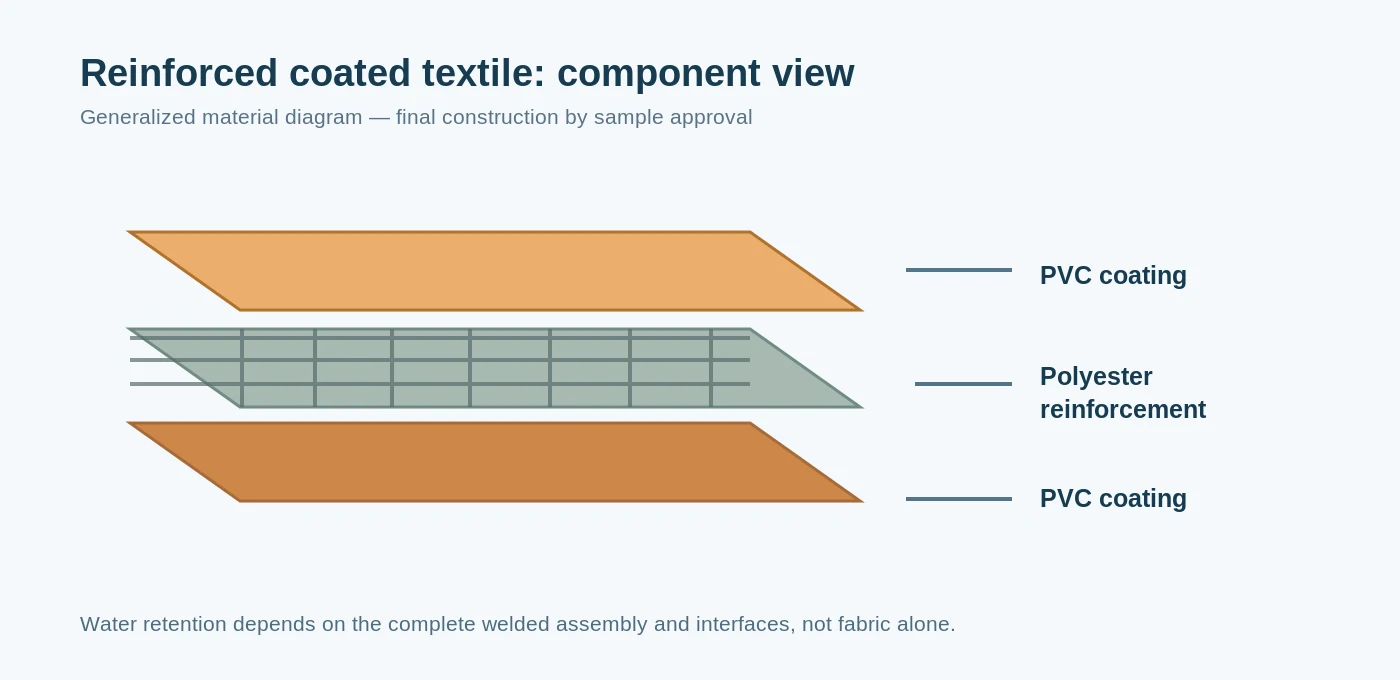
Joint continuity
Specify the bonding method, sampling plan, weld allowance and acceptance procedure. Water-resistant fabric does not make every fabricated seam leakproof.
Fill and drain ports
Confirm valve geometry, hose compatibility, closure security, field access and protected placement to reduce snagging or accidental release.
Inspection and repair
Define visual checks, repair materials, cleaning, fold direction and storage conditions before placing the dam into an emergency inventory.
Plan Sections, Corners & Terminations Before Ordering
The weakest point on a temporary flood line may be a badly detailed corner, drainage inlet or end connection—not the center of the barrier. Provide a plan view and mark the change in elevation and accessible fill points. Layout drawings should show the protected area, not merely the total linear meters required.
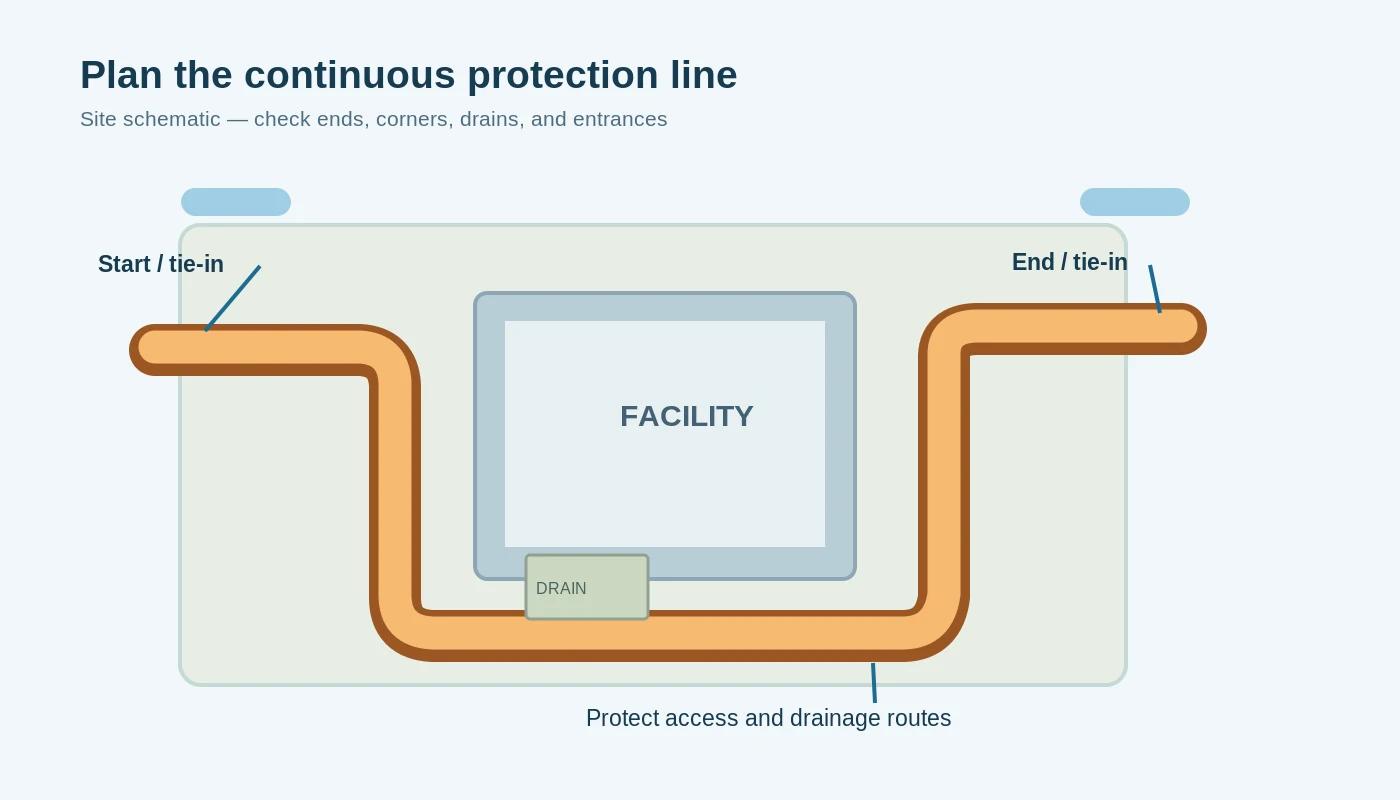
Six details that change the order
- Protection alignment: straight runs and curves influence section selection.
- Connection specification: overlap, end cuff, mechanical joint or supplier-specific interface.
- Existing obstacles: doors, bollards, landscaping, curbs, pipes and gullies.
- Water source: availability and permitted extraction for fill volume.
- Transport and labor: packaging length, lifting plan, hose routing and crew access.
- Contingency drainage: routing rain or pumped water inside the protected area.
Systems supplied as roll material or made-to-order barriers have different responsibilities. A materials-only quote is not a turnkey flood defense.
Water-Filled Dam vs Air-Filled Barrier vs Sandbags
These approaches solve related but different deployment tasks. The right choice depends on the available crew, water source, hydraulic conditions and expected use frequency.
| Approach | Useful characteristic | Primary limitation to check | Common procurement fit |
|---|---|---|---|
| Water-inflated dam | Moves unfilled; water contributes operating mass | Filling resources, ground friction, hydraulic load and connections | Planned temporary diversion and site-specific flood response |
| Air-filled barrier | Lightweight filling medium, potentially fast shape development | Anchoring or stabilization strategy and pressure control | Deployable barriers using an approved air-support design |
| Sandbags | Can be placed in irregular local areas with familiar materials | Labor, seepage, handling, disposal and wall continuity | Small gaps, local reinforcement and supplemental defenses |
| Rigid modular wall | Defined assembly geometry and repeatable modular interfaces | Foundations, posts or anchoring requirements, storage and handling | Pre-engineered facilities with designated deployment routes |
No method offers absolute flood protection. Always verify actual system and site ratings before use.
Where Temporary Water Dams May Be Used
Applications below are planning scenarios, not claims of completed DERFLEX installations or universal suitability.
Municipal flood response
Temporary protection lines around low-lying streets, public assets and utility service zones when evacuation routes and emergency access can be preserved.
Warehouses & industry
Flood diversion at loading yards, manufacturing premises and equipment compounds, subject to surface condition and doorway interface review.
Construction dewatering
Temporary work-zone separation for drainage, culvert maintenance or embankment repairs, with engineered flow bypass and environmental controls.
Commercial facilities
Short-duration defenses for sites with mapped low points and reliable fill-water access; a planned layout reduces improvisation under pressure.
Roads & access points
Selective water routing where traffic management, pavement friction, surface drains and emergency vehicle circulation are addressed.
Event & seasonal reserves
Pre-positioned temporary barriers for exposed locations that can be inspected, stored and redeployed under a written response plan.
Work With DERFLEX on Material and Barrier Requirements
DERFLEX's inflatable flood barrier page describes a finished barrier category. This page focuses on selecting a water-inflated dam against a site's hydraulic and procurement requirements. For component sourcing and fabrication discussions, DERFLEX also publishes inflatable textile material information and PVC tarpaulin roll supply.
Quotation boundary
Clarify whether the supplier's offer covers fabric rolls only, fabricated dam sections, compatible valves and fittings, pumps, testing documentation, or an engineered installed system. These are distinct procurement packages.
For OEM requests, include the expected section layout, branding needs, protective underlay, packaging and recurring inspection plan.
Quality review checklist
Ask for approved drawings, selected-grade material test reports, prototype or seam acceptance evidence, fill-port compatibility and deployment instructions. For critical protection, request the system-level test basis and qualified engineering review appropriate to the site.
Where evidence is unavailable, do not treat a generic material specification as a documented hydraulic capacity.
Prepare a Clear Inflatable Water Dam RFQ
You do not need a complete engineering package to begin the discussion. A site photograph, rough plan and flood-depth target can support an initial scope review; critical system ratings require subsequent verification.
- Country, project location type and intended protection objective
- Total protection line length with corners and tie-in points
- Expected water depth, duration, velocity and debris conditions
- Ground substrate, slope, drainage openings and surface photographs
- Water availability, pumping resources and expected deployment crew
- Proposed number of sections, accessories and ordering quantity
- Delivery destination, schedule and required evidence or test files
What changes the quotation?
Material grade, section geometry, weld complexity, connectors, fill valves, reinforcement, required inspection, packing and delivery terms all affect project cost. A unit price per meter is difficult to compare until the retained-water requirement and included components are equivalent.
Discuss drawings and procurement requirements through DERFLEX's Request a Quote page.
Design the Protection Line Before the Order
Share your site layout and target conditions. DERFLEX can review material and supply possibilities; final hydraulic design and use limitations must be confirmed for the proposed system.
Related DERFLEX Technical Pages
Continue from the complete barrier concept to the materials, fabrication or alternative flood-protection systems that matter to your procurement decision.
Inflatable Water Dam FAQs
What is an inflatable water dam?
An inflatable water dam is a temporary, flexible water-control barrier that is transported unfilled, positioned along a protection line and filled with water at the site. Its usable holding height depends on the complete design, ground conditions and hydraulic loads—not simply the tube diameter.
Is a water-inflated dam the same as an air-filled flood barrier?
No. A water-inflated dam uses water as the main fill medium and stabilizing mass. Air-filled barriers use internal air pressure for shape and may need a different anchoring or support strategy. Some systems combine both media; the actual configuration must be confirmed.
How high a flood can an inflatable water dam hold back?
There is no reliable universal height. The safe retained-water depth depends on certified system geometry, hydraulic loading, freeboard, surface friction, flow velocity, ground slope, end restraints and the manufacturer’s documented installation limits.
Can inflatable water dams be installed on uneven ground?
Minor contours may be manageable with a suitable design, but sharp debris, drains, significant changes in level, slippery surfaces and gaps can cause leakage or loss of stability. A site survey, protective underlay and approved interface details may be necessary.
Does DERFLEX provide dam fabric or complete water-filled barriers?
DERFLEX has published PVC coated fabric and inflatable flood barrier product information. For this project, confirm whether the quotation covers coated fabric rolls, fabricated barrier sections, valves and accessories, pumps, on-site supervision or a complete engineered system before placing an order.
What should I include in a quotation request?
Send the required protection line length, design flood depth, expected water movement, site photographs or drawings, surface and slope conditions, available fill water and pumping power, preferred section layout, order quantity, destination and any project testing or documentation requirements.