



TPU Drop Stitch Fabric Manufacturer for High-Pressure Inflatables
DERFLEX supports TPU drop stitch fabric development for factories building flat, firm and foldable inflatable products. This double wall textile combines two reinforced faces, internal spacer yarns and TPU sealing surfaces. Define panel height, base yarn, TPU chemistry, coating construction, roll format and welding route against your finished product—not a generic pressure claim.
Built for OEM discussions involving boat air decks, inflatable boards, training mats and engineered inflatable panels. Raw DWF supply is distinct from finished chambers, valves and certified inflatable systems.
- TPU on both faces: project review
- High-pressure design: test-led
- 150 mm height: feasibility review
- Converter-focused material supply

What Is TPU Drop Stitch Fabric?
TPU drop stitch fabric, also called TPU double wall fabric or TPU DWF, is a spacer textile whose upper and lower skins are linked by closely distributed internal yarns. After TPU is bonded to the outer surfaces, fabricators can cut and join the material into airtight panels. The yarn connections limit outward expansion and allow a flat inflated profile; the panel's final strength and pressure tolerance still depend on seams, edges and the complete assembly.
More than a coated sheet
Standard TPU coated woven fabric can form flexible air tubes, but it does not automatically become a flat drop stitch panel. True DWF must include the continuous internal spacer system connecting the two faces.
Where the air seal comes from
The TPU faces are the potential barrier and joining surfaces. Airtight performance is not established until the face coating, sidewall package, valve fittings and cooled seams work together in a prototype.
Supply boundary: This page describes material selection and OEM roll-goods discussion. Finished inflatable products and safety-system qualification are separate scopes.
Specify the Complete TPU DWF Construction
A purchase specification should describe the material structure and the finished inflatable's operating conditions. The fields below are selection and enquiry variables, not published tolerances or guaranteed stock grades.
| Specification field | What the buyer should define | Why it matters |
|---|---|---|
| Product architecture | True double wall / spacer yarn structure with TPU on one or both outer faces as required | Controls inflated flatness, sealing and downstream joining |
| Panel height (mm) | Nominal drop-stitch height and allowable tolerance; 150 mm may be submitted for review | Changes chamber volume, stiffness, packing and edge design |
| Base textile | Polyester or nylon, yarn denier, woven face construction and internal-yarn details | Denier alone does not establish pressure rating or spacer stability |
| TPU chemistry | Polyether or polyester TPU, formulation and required wet/folding behavior | Affects aging risks, processing and service suitability |
| Face construction | Coated versus film-laminated surfaces; two-face continuity, bonding and finish | Influences peel, air barrier, marking and weld consistency |
| Working pressure | Proposed operating pressure, test temperature, duration and safety margin | Requires finished chamber validation; cannot be inferred from a swatch |
| Fabrication route | Hot-air, heat sealing or RF/HF welding to be assessed with buyer equipment | Defines compatible joining surface, seam layout and process controls |
| Roll & order | Usable width, roll length, color, surface, quantity, packaging and delivery location | Determines conversion yield, handling and commercial quotation |
A nominal panel height is not the same as single-face coating thickness. A denier specification is not a pressure test. Request a model-specific drawing and test plan before agreeing acceptance values.
150 mm TPU Double Wall Fabric: How to Write a Testable RFQ
For demanding inflatable boat-floor or industrial panel developments, buyers may start with a brief such as 150 mm nominal spacer height, 2000D polyester textile direction and TPU on both faces. This is an example buyer requirement, not an announced DERFLEX standard item or confirmed manufacturable specification.
Confirm the textile architecture
Describe whether the 2000D requirement applies to the face yarns, internal connecting yarns or both. Confirm weaving method, face reinforcement, yarn distribution and feasible 150 mm height tolerance.
Confirm both TPU faces
Separate the TPU chemistry and coating or lamination method from the textile specification. Define where two-face coverage is needed for welding, patching and air retention.
Confirm the assembled pressure goal
Share the product drawing, seam overlap and valve system. Evaluate adhesion, welded coupons and complete panel pressure retention before discussing rated operation.
A sample-approval sequence that reduces ambiguity
- Freeze the written construction and drawing, including height and textile definitions.
- Approve small material swatches for appearance, layer bond and processing feel.
- Build representative welded edge and fitting coupons using real equipment.
- Inflate a finished-size prototype for pressure, shape and leakage review.
- Record acceptance methods, labels and sample references before any repeat order.
What a quotation should separate
Material price is affected by spacer construction, total TPU consumption, usable width, color, roll packing and order size. Testing, development samples, converting and finished-chamber assembly should be identified separately rather than hidden inside an unverified per-square-meter estimate.
Discuss a 150 mm DrawingHow to Validate TPU DWF Before Production
High-pressure capability is a system-level result. Face material, spacer yarns, edge wrap, bonding, welded seams and fittings must be qualified together. The following tests are procurement checkpoints; pass limits and methods must be assigned to the approved grade and application.
| Checkpoint | Evidence to ask for | Common purchasing risk |
|---|---|---|
| Geometry & roll inspection | Nominal spacer height and tolerance, usable width, face alignment, defects, batch identification | Panel height variation or cutting waste |
| Coating / lamination adhesion | Conditioned peel test with test direction, units and failure mode | Surface delamination during folding or inflation |
| Base fabric strength | Warp and weft tensile and tear results on the approved construction | Misleading one-direction or unrelated material data |
| Seam qualification | Weld coupons after cooling, peel or tensile response, leak check | Good swatch, weak joined chamber |
| Pressure / air retention | Defined operating and proof test, inflation duration, temperature, acceptable pressure decay | Unsubstantiated “high PSI” marketing claims |
| Environmental suitability | As needed: wet aging, hydrolysis, fold cycles, abrasion, cold flex and repaired-seam review | Short-term test passes that do not represent use conditions |
The supplier's material test does not certify the finished boat, rescue device or lifting assembly. Safety-critical products require application-specific engineering and applicable independent validation.
High-Pressure Inflatable Products That Use TPU DWF
Select the panel architecture according to the actual loading, abrasion exposure, joining geometry and service environment. These are potential development applications, not claims of certified project deliveries.
Inflatable Boat Air Decks
Flat floor panels for dinghies, kayaks and other boat concepts. Confirm edge seams, impact wear, wet storage, attachment patches and pressure-retention tests.
SUP & Touring Boards
Foldable water-sports boards require balanced weight, board height, dimensional control and reliable joins. Evaluate folding marks and full-board stiffness.
Air Tracks & Gym Mats
Repeated loading demands a stable inflated profile and suitable welded edges. Pressure and fatigue acceptance should follow the equipment's intended use.
Portable Floating Platforms
Inflatable dock and event platform designs need flotation, attachment interfaces, surface grip and load testing of the complete structure.
Rescue & Emergency Panels
Compact air-supported equipment can require rapid deployment and repeated packing. Life-safety suitability must be separately evaluated and certified where required.
Custom Industrial Air Panels
Flat inflatable cushions, partitions and specialist components may use TPU DWF where foldability and a planar shape matter more than a round air tube.
TPU vs PVC Drop Stitch Fabric: Which Should You Specify?
Neither material is automatically stronger or safer. TPU is often evaluated for tailored flexibility, weight and TPU-based joining; PVC offers established conversion routes for many mainstream inflatable products. A fair comparison uses finished-chamber tests and matching construction, not polymer names alone.
| Decision factor | TPU drop stitch direction | PVC drop stitch direction |
|---|---|---|
| Design priority | Selected premium, flexible and potentially weight-sensitive products | Many cost-balanced commercial SUP, mat and platform programs |
| Wet / storage conditions | Polyether TPU may be evaluated for hydrolysis-sensitive use | Depends on PVC formulation, fabric and adhesive construction |
| Joining | Qualify TPU face and seam process with buyer's machine | Qualify compatible PVC welding or bonding process |
| Pressure & air loss | Measured on approved assembled panels | Measured on approved assembled panels |
| Buying criterion | Compare total landed cost, weight, conversion waste and tested performance | Compare total landed cost, production maturity and tested performance |
For general PVC alternatives, see DERFLEX PVC drop stitch fabric. For broader TPU coated rolls without spacer yarns, see TPU coated fabric manufacturing.
Drop Stitch Structure & TPU Surface References
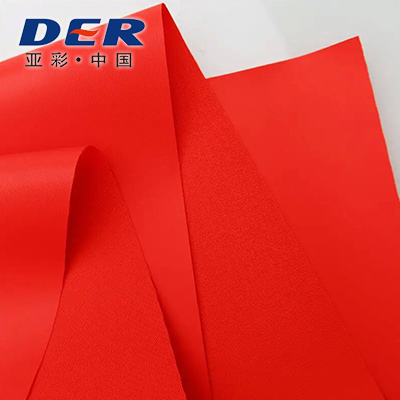
These images are from DERFLEX's existing product directory. Material references are labeled separately so a conventional TPU fabric is not mistaken for a finished TPU drop stitch panel.


Before You Order: Confirm the Material and the System
Buyers can start with a drawing, an existing swatch or a target application rather than a complete material specification. DERFLEX can review the feasible roll-goods direction and the sample confirmation route, but the product manufacturer remains responsible for the finished inflatable design.
From sample request to repeat roll supply
Review the product use and draft construction brief.
Evaluate sample and TPU surface / spacer compatibility.
Test welded coupons and a representative chamber.
Agree the approved bulk specification and roll checks.
Not automatically included: welded finished chambers, valves, drawings certified for marine safety, independent product certification, or fixed production lead times. Quote each requested scope separately.
Send Your OEM SpecificationExplore DERFLEX Technical Textile Resources
Use the adjacent product pages to compare polymer systems and avoid confusing general coated fabric with true drop stitch spacer material.
Frequently Asked Questions About TPU DWF
What is TPU drop stitch fabric?
TPU drop stitch fabric is a double wall spacer textile with two connected fabric faces and internal yarns that control panel height. TPU coating or film lamination provides a sealable air barrier; the completed welded chamber must be tested for the intended pressure.
Is TPU DWF the same as ordinary double-sided TPU coated fabric?
No. Ordinary double-sided TPU coated fabric does not necessarily contain the internal spacer yarns that hold an inflated panel flat. Specify true drop stitch or double wall construction when ordering flat air decks, boards or platforms.
Can I request 150 mm high TPU drop stitch material with 2000D polyester?
A 150 mm panel height with 2000D polyester and TPU on both faces can be submitted as a project specification for feasibility review. It is not a confirmed standard DERFLEX grade until structure, roll availability, adhesion and fabrication trials have been approved.
What inflation pressure can TPU drop stitch fabric withstand?
There is no single safe pressure rating for all TPU DWF. Working pressure, proof pressure and failure behavior depend on the yarn structure, coating bond, seam geometry, valves, panel dimensions and test conditions. Approve pressure from tests on the finished chamber.
Can TPU drop stitch fabric be hot-air or RF welded?
Welding compatibility depends on the TPU grade, layer construction, joining geometry and production machine. Hot-air, heat sealing and RF/HF processes may be evaluated, but the buyer should qualify cooled seam strength and air retention on representative assemblies.
What should I include when requesting a TPU DWF quotation?
Send the finished product application, drawing or panel dimensions, target drop-stitch height, base fabric specification, TPU chemistry and coating side, operating pressure goal, seam method, roll width, quantity, destination and required acceptance tests.
Engineer Your Next Inflatable Material Program
Send the intended application, DWF height, base yarn, TPU face construction, pressure target, joining route and estimated order quantity. Use the approved sample and full chamber test as the basis for bulk specification.
For best results, include a drawing, an existing sample photo and the test conditions you expect the completed inflatable to meet.