



Water Filled Flood Barriers for Temporary Flood Protection
Water filled flood barriers provide temporary flood protection by using water as on-site ballast. For planned municipal, construction and industrial applications, the right configuration depends on expected water depth, ground contact, section joints and filling logistics. Discuss reinforced PVC-coated fabric and water-fill-capable barrier configurations with DERFLEX to align the proposed supply with your drawings and site conditions.
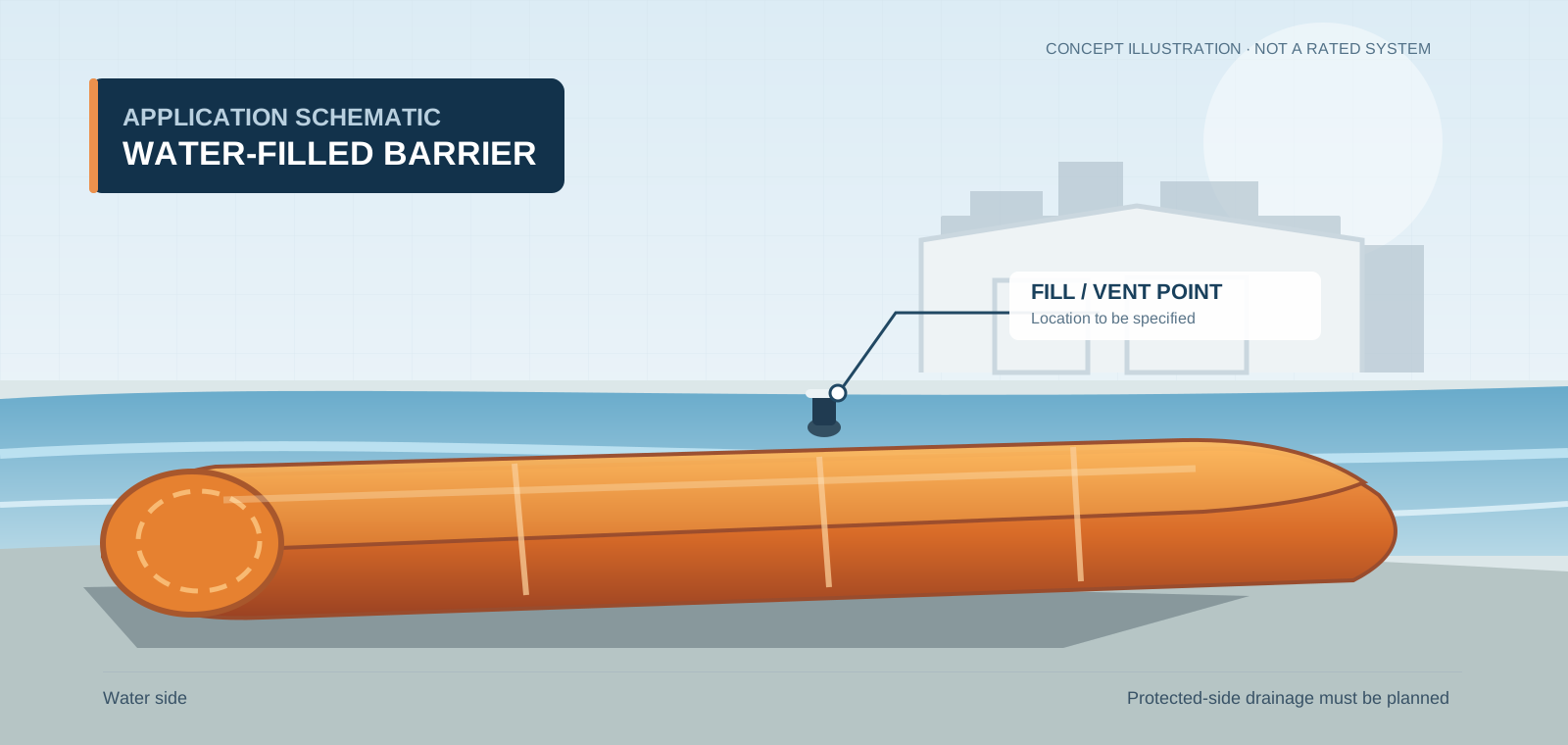
A portable barrier placed along a planned flood-defence alignment and filled with water on site. The mass of the water helps stabilise the structure. Some designs use more than one tube, baffles or anchoring features to limit rolling; these must be specified rather than assumed.
The intended water level, surface friction and slope, barrier footprint, end connections, potential underflow, access to a suitable water source, monitoring and a safe removal plan. A water-tight membrane alone does not make an installed defence flood-tight.
How water-ballasted barriers manage temporary flood risk
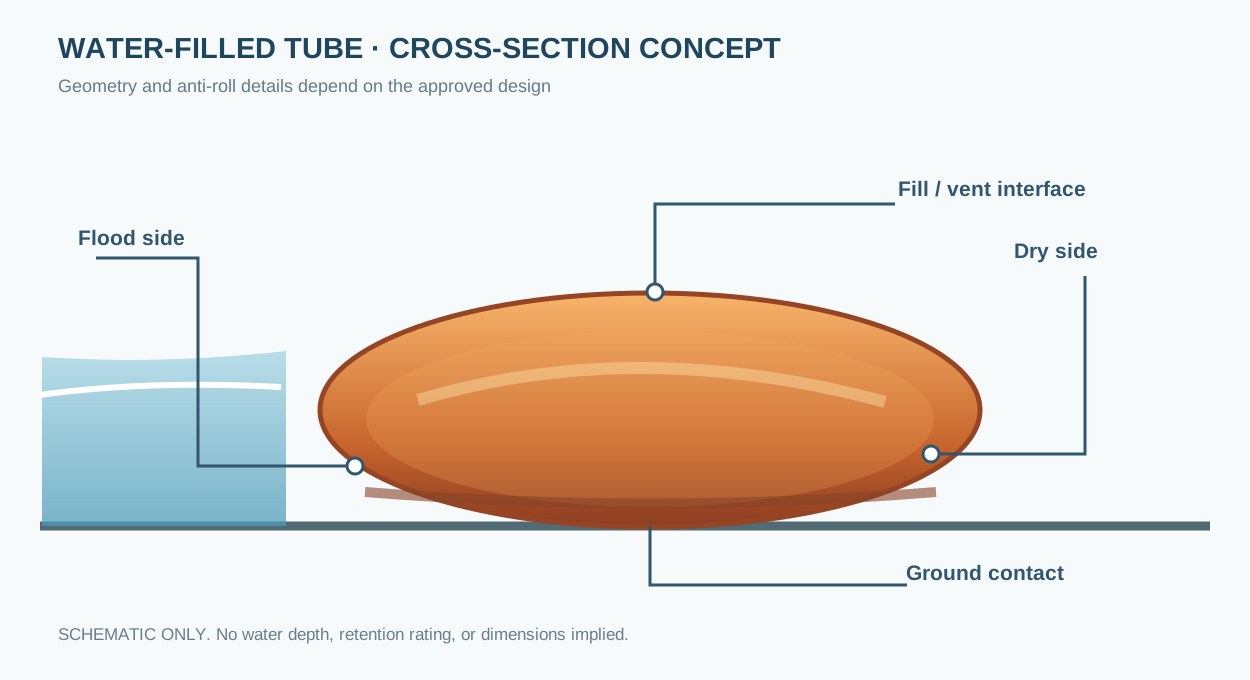
Water is used as ballast inside the flexible enclosure; the barrier line is designed to resist external water while working with the surface underneath it.
Unlike an empty flexible tube, a filled barrier gains considerable mass from its contained water. This makes the geometry, fill level, footprint and ground contact central to stability. An apparently similar-looking water-filled barrier can behave very differently if its internal restraint, connections or base conditions change.
For a sound design review, treat the product as a temporary flood-control system consisting of the flexible skin, water containment, stability features, interfaces, the ground and the deployment procedure. Material tensile strength alone does not establish the system's allowed water depth.
Is a water filled flood barrier suitable for your site?
Use the conditions below to screen a project before discussing barrier dimensions, production or any performance claim.
| Site condition | Selection priority | What to confirm |
|---|---|---|
| Flat paved perimeter | Continuous ground contact; low points and openings | Surface contamination, drainage channels, kerbs, slopes and end returns |
| Rough soil or gravel | Friction, puncture protection and seepage paths | Levelness, debris removal, ground mat requirements and settlement risk |
| Warehouse or equipment entrance | Door thresholds, end seals, protected-side drainage | Exact opening dimensions, access timing, water entering via floor drains |
| Road or utility corridor | Traffic closure, connections and maintenance access | Permits, vehicles, buried services, safe crossing and recovery procedure |
| Riverbank or moving water | Current velocity, erosion, debris and potential overtopping | Site-engineered load cases and approved barrier evidence; do not assume suitability |
| Coastal or tidal surge | Salinity, waves, uplift and additional loading | Dedicated engineering review; freshwater ballast is not automatically adequate for saltwater exposure |
Material construction, seams and filling interfaces
Specify the flexible assembly as carefully as you would specify the flood-defence alignment itself.
Reinforced PVC-coated material
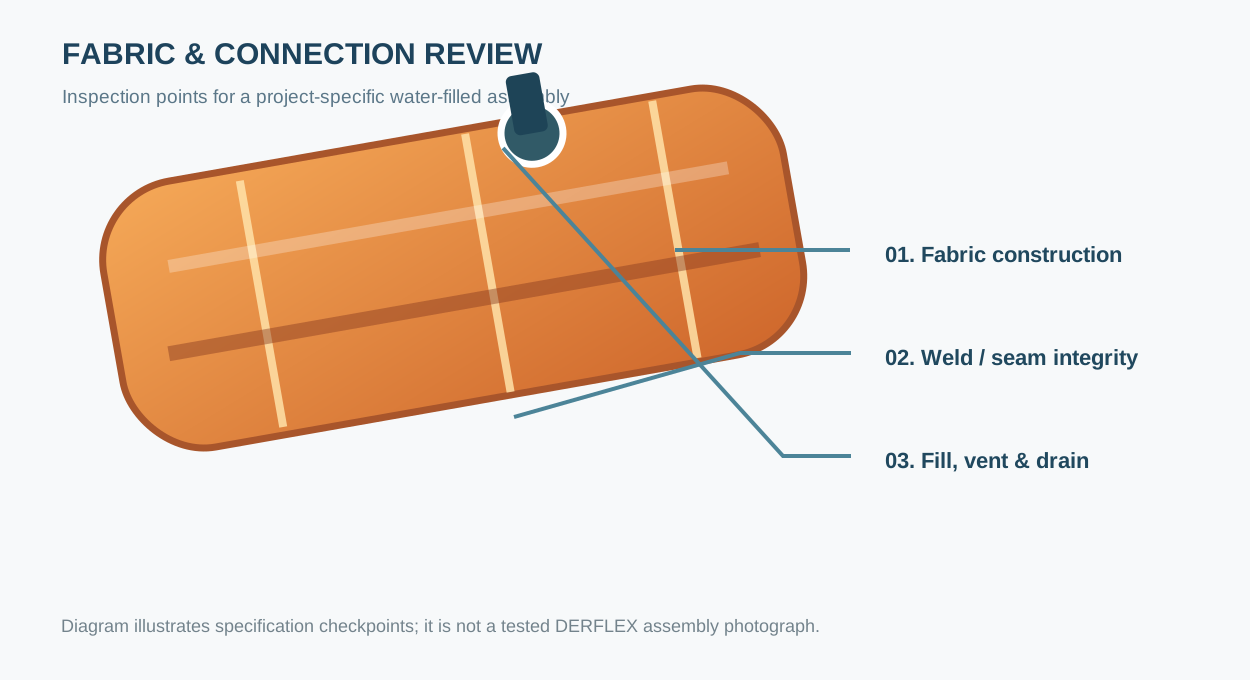
DERFLEX supplies PVC-coated industrial fabrics and PVC tarpaulin materials. For a water-filled application, the material selection must consider hydrostatic exposure, tear propagation, abrasion, folding, temperature and contact with the fill water.
Seams and interfaces
Review the proposed weld process, seam geometry, valve reinforcement, penetrations, repair access and any outer restraint arrangement. Valves must be compatible with the agreed pump connection and must support the actual fill, vent and drain procedure.
Assembly evidence
Where an application requires documented flood performance, specify the finished configuration, the test method, applicable conditions and the report for that exact assembly. A fabric roll certificate or a material test cannot independently validate an installed barrier system.
Technical parameters to agree before production
These are procurement fields, not unverified standard model ratings. The relevant values should be confirmed through the selected design and approved sample.
| Parameter | Customer input | Confirmation at quotation stage |
|---|---|---|
| Defence length | Plan-view route and desired continuity | Section lengths, connection count, corner and end details |
| Design flood condition | Expected retained depth, duration, possible flow or debris | Suitability of proposed assembly and required technical evidence |
| Filled dimensions | Available footprint, access and space restrictions | Actual filled height, width and section weight based on design |
| PVC fabric structure | Exposure, wear and storage requirements | Base textile, coating, thickness/weight and test documents as applicable |
| Seams / restraint | Required construction and maintenance approach | Weld pattern, baffles, anti-roll features and verified method |
| Ports / accessories | Pump hose diameter, water source and drainage plan | Fill/vent/drain position, thread/interface, caps and included accessories |
| Identification / packaging | Asset labels, handling and dispatch needs | Printing, packing, section marking and approved packing list |
Dimensions, flood depth rating, test reports, MOQ, production lead time and exact finished-system supply must be confirmed for the chosen specification; they are not asserted as standard DERFLEX stock data here.
Six-stage planning sequence: from survey to storage
The installation manual for the actual product and the local flood response plan take precedence over this general planning sequence.
Mark the line
Survey heights, low points, utilities, site access, escape routes and protected-side water entry.
Inspect the surface
Remove sharp debris and identify slopes, soft ground, joints and any needed bedding or restraint measures.
Place and connect
Lay out sections without twists and assemble end returns and joints according to the approved drawing.
Use approved ports
Provide the required water source and pump; vent and monitor the fill level using the manufacturer's procedure.
Check the defence
Watch for leakage, rolling, displacement, underflow, overtopping, blocked drains and changing conditions.
Drain and inspect
After the threat passes, empty, rinse, dry, inspect and record repairs before protected storage.
Plan the whole defence, not only the tube
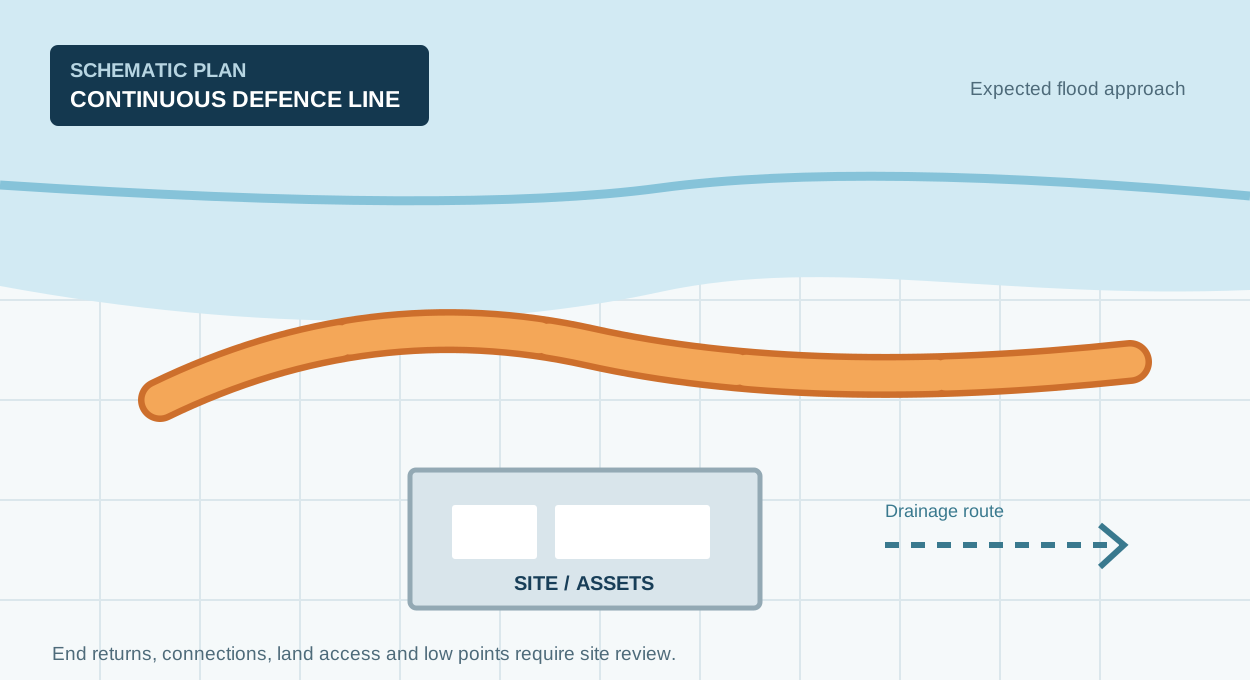
Most site failures arise at the interfaces: a low side route, an unsealed edge, a drain behind the barrier or a section that cannot be safely filled before floodwater arrives. An installation plan should name the crew, deployment trigger, water source, connection sequence, monitoring responsibility and safe removal process.
For critical assets, pre-deployment practice can expose shortcomings in hose reach, pump capacity, access routes and section identification before the flood-warning window closes.
Where water filled flood barriers may be considered
Potential applications require a site-specific fit assessment; the examples below are scenarios, not claims of completed DERFLEX projects.
Municipal & emergency teams
Deployable protection for pre-planned street sections and public assets where an appropriate defence alignment, pumps, storage and crews are available.
Warehouses & industrial facilities
Temporary perimeter management around critical entrances, loading bays and outdoor equipment — with underfloor drainage and utilities included in the plan.
Construction & infrastructure
Short-duration control around work areas and suitable embankments, subject to engineering evaluation of water pressure and surface conditions.
Commercial property programmes
Seasonal response planning around buildings where emergency access, connecting returns and staff training are addressed in advance.
If the procurement concerns the fabric rather than a deployable assembly, compare heavy-duty inflatable dam fabric and PVC-coated fabric for dams. Material suitability and finished-system flood performance are separate approval decisions.
Water filled barriers vs air-filled tubes vs sandbags
The right temporary defence depends on the flood scenario, logistics and validated system design — not a universal ranking.
| Consideration | Water-filled flexible barriers | Air-filled tubes | Sandbag lines |
|---|---|---|---|
| How stability is achieved | Water mass plus geometry, surface contact and restraints | Separate anchoring or approved system stability design required | Weight and placement of individual bags |
| Site inputs | Water source, pumps, hoses, approved connections | Inflation equipment and secure anchoring/design | Sand or other fill, bags, tools and transport |
| Transport before use | Typically compact when drained; design-dependent | Can be compact before inflation | Fill and bags can require substantial handling |
| Re-use | Possible after inspection, cleaning and drying | Depends on membrane and design condition | Depends on material and contamination; often labour intensive |
| Key vulnerability | Joints, underflow, puncture, rolling, overtopping | Anchoring, air loss and movement | Seepage, gaps, settlement and placement quality |
A barrier may also be used with supplementary protection measures, but compatibility must be reviewed as part of the complete site plan. None of these methods should be represented as a guarantee against flooding.
How to review a DERFLEX water-filled barrier enquiry
Procurement confidence comes from specific drawings, agreed material and assembly boundaries, and evidence relevant to the application.
Discuss the supply boundary
Confirm whether the request covers coated fabric rolls, fabricated sections, valves, connection details, repair accessories, or a complete deployable system. Accessories, on-site installation and engineering services should not be treated as included unless specified in the quotation.
Align drawings and samples
Use dimensioned layout drawings, valve locations, welding details and intended handling methods to settle the sample and inspection plan. Changes in a seam or connection design may change system performance.
Request traceable technical evidence
For materials, review the actual fabric construction and applicable test reports. For finished systems, request evidence about the approved assembly, leakage behaviour, seam integrity, stability and the design flood conditions. These records are not interchangeable.
Consider the full lifecycle
Ask about section identification, packing, dry storage, inspection after use, repair methods and parts replacement. Documented maintenance helps buyers make informed repeat-purchase decisions.
What buyers should confirm — and what not to assume
It is essential to match flood-risk conditions to verified product evidence instead of treating PVC waterproofing as an installed flood-defence certification.
- Water depth is not tube diameter: obtain the tested or engineered retained-water rating for the exact configuration and installation conditions.
- Allow for seepage and drainage: joints, uneven ground, water entering from the rear and underground routes may need independent measures.
- Do not assume coastal suitability: saltwater, waves, scour, debris and currents require separate engineering review.
- Plan people and time: a viable pump and fill source are useful only if the barrier can be deployed safely before the expected flood reaches the site.
- Know the boundaries: a water-filled temporary barrier does not replace safe evacuation routes, upstream warning systems or structural floodproofing of buildings.
For reference, see the FEMA guidance on temporary flood barriers and Environment Agency guidance on temporary flood protection. The relevant authority and local project requirements should determine approval.
Send a useful request for quotation
Clear initial site information allows the manufacturing and technical discussion to focus on the actual barrier configuration instead of speculative standard specifications.
Recommended enquiry details
- Site plan or photographs and the proposed defence route
- Total length, turns, returns and interruptions
- Expected flood level, duration and water movement
- Surface type and available installation footprint
- Water source, pump capacity and fill/vent preferences
- Quantity, packaging, destination and target schedule
What to decide during technical review
Agree whether the request is for fabric, fabricated barrier sections or a complete system; confirm design responsibility, the approved drawings, necessary test evidence, accessories, sample arrangements and the inspection scope.
Costs depend on fabric selection, seam and connection complexity, section sizes, hardware, order volume, packing and delivery terms. No unsupported price or minimum-order figure is assumed.
Explore adjacent flood-control materials and systems
These existing DERFLEX pages help distinguish a water-filled flood barrier assembly from related fabric and water-management products.
Water filled flood barrier FAQ
Practical answers about suitability, deployment and procurement boundaries.
What is a water filled flood barrier?
A water filled flood barrier is a portable flexible or modular barrier that is positioned on a planned defence line and filled with water on site. Its weight helps resist movement, but real performance also depends on the barrier geometry, ground friction, joints and the expected flood conditions.
Are water filled flood barriers better than sandbags?
They can reduce the need to transport large amounts of fill material and may be easier to store between deployments. Sandbags can still be useful around irregular details. Choose by warning time, access, ground conditions, staffing, water supply and an approved flood response plan.
How high can a water filled flood barrier hold back water?
There is no universal safe retained-water depth. The allowable depth must be established for the specific barrier design, installed geometry, foundation condition, connections and test evidence. Do not use the inflated tube diameter as a substitute for its approved flood protection rating.
Can water filled barriers be reused?
Many flexible systems are designed for reuse after appropriate draining, cleaning, inspection, drying, repair assessment and storage. Reuse of a particular DERFLEX configuration should be based on the approved material, seam, valve and inspection requirements.
Do water filled barriers stop all floodwater?
No. Underflow, leakage at joints, overtopping, foundation settlement and water entering from drains or behind the defence can still occur. A complete plan must address closure details, seepage pumping, monitoring and safe access.
What details are needed to request a custom water filled barrier?
Provide a site plan, defence length, expected water depth and duration, ground surface, available fill-water and pump capacity, intended connections, required quantity, packing and destination. A sketch or photos are useful for an initial technical discussion.
Plan your temporary flood defence with clear specifications.
Share a sketch, application conditions and target quantity. DERFLEX can discuss a suitable material or assembly direction and clarify the documents and interfaces needed before a commercial quote.