Coating & Surface
PVC coating can be adjusted for selected oil-contact conditions, cleaning needs, flexibility and surface finish. A lacquered or easy-clean surface may be discussed when wipe-down is frequent.



 Coated Fabric & Custom Tarpaulin Supply
Custom PVC coated polyester tarps for machinery, oilfield equipment, maintenance areas, transport operations and industrial covers exposed to lubricants, grease, hydraulic oil or petroleum splash.
DERFLEX supplies roll goods, cut panels and finished oil resistant tarps with application-matched coating, welded seams, reinforced edges, custom hardware and export-ready OEM options. Oil compatibility is reviewed against the actual fluid and working conditions before a specification is confirmed.
An oil resistant tarp is a flexible protective sheet designed to tolerate specified contact with oils, grease or hydrocarbon-based fluids while continuing to function as a cover, curtain, liner or enclosure. For industrial use, the important question is not simply whether the surface is waterproof. Water resistance and oil resistance describe different exposure conditions.
A general-purpose waterproof tarp may soften, swell, become sticky, lose coating adhesion or stain after repeated contact with certain lubricants, fuels or solvents. A properly specified oil resistant tarpaulin considers the coating chemistry, polyester reinforcement, seam design, edge construction and the exact fluid involved.
Different fluids affect coated textiles differently. Diesel, gasoline, hydraulic oil, cutting fluid, transformer oil, animal fats and synthetic lubricants should not be treated as one chemical family. Temperature, contact duration, concentration, cleaning method and mechanical stress can change the result. DERFLEX therefore recommends defining the exposure before selecting the material.
Coating formulation matters, but industrial service life also depends on the textile base, weld quality, reinforcement and the way the finished cover is installed.
PVC coating can be adjusted for selected oil-contact conditions, cleaning needs, flexibility and surface finish. A lacquered or easy-clean surface may be discussed when wipe-down is frequent.
High-tenacity woven reinforcement supports tensile stability, tear resistance and dimensional control when the tarp is tensioned, folded or handled around industrial equipment.
Heat or high-frequency welding can reduce needle holes and create a more continuous barrier than ordinary stitching, subject to the chosen material and finished design.
Webbing, doubled hems, wear strips, corner pads, D-rings and grommet backing help distribute load where wind, tie-down force or contact with steel causes early failure.
Using one broad “oil resistant” label for every application can create unnecessary cost or inadequate protection. A better specification starts with exposure level.
Typical examples include machinery dust covers, workshop partitions and temporary covers near maintenance operations.
Direction: PVC coated polyester with a cleanable surface and application-matched reinforcement may be suitable after compatibility review.Contact may occur during equipment servicing, transport, hose handling or repeated maintenance cycles.
Direction: review coating formulation, surface durability, seam design and cleaning chemicals; use sample testing before bulk production.Gasoline, aromatic solvents and mixed fuels can be more demanding than common lubricants and may require a different coated textile family.
Direction: do not rely on a generic PVC tarp claim. Define the exact fluid, concentration, temperature and contact duration.Spill berms, flexible tanks, oil bladders and liquid liners require seam integrity and long-term compatibility beyond ordinary cover use.
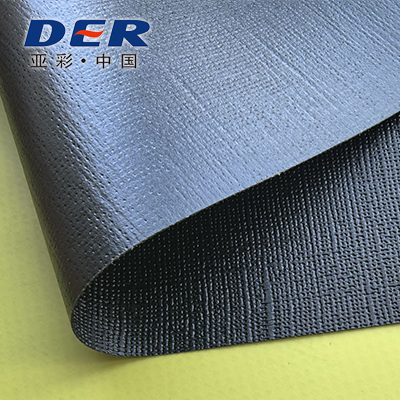
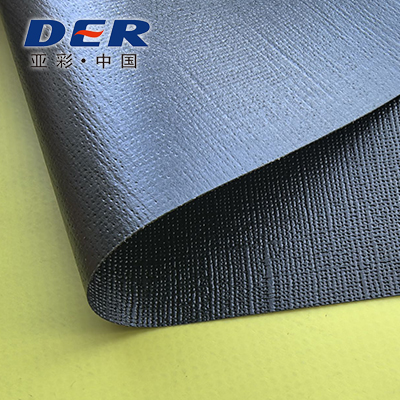
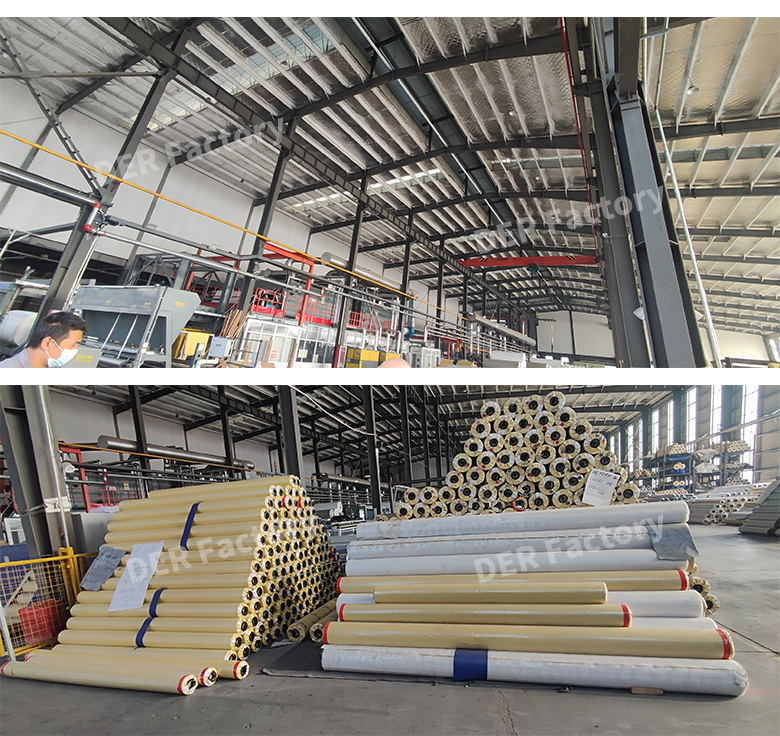
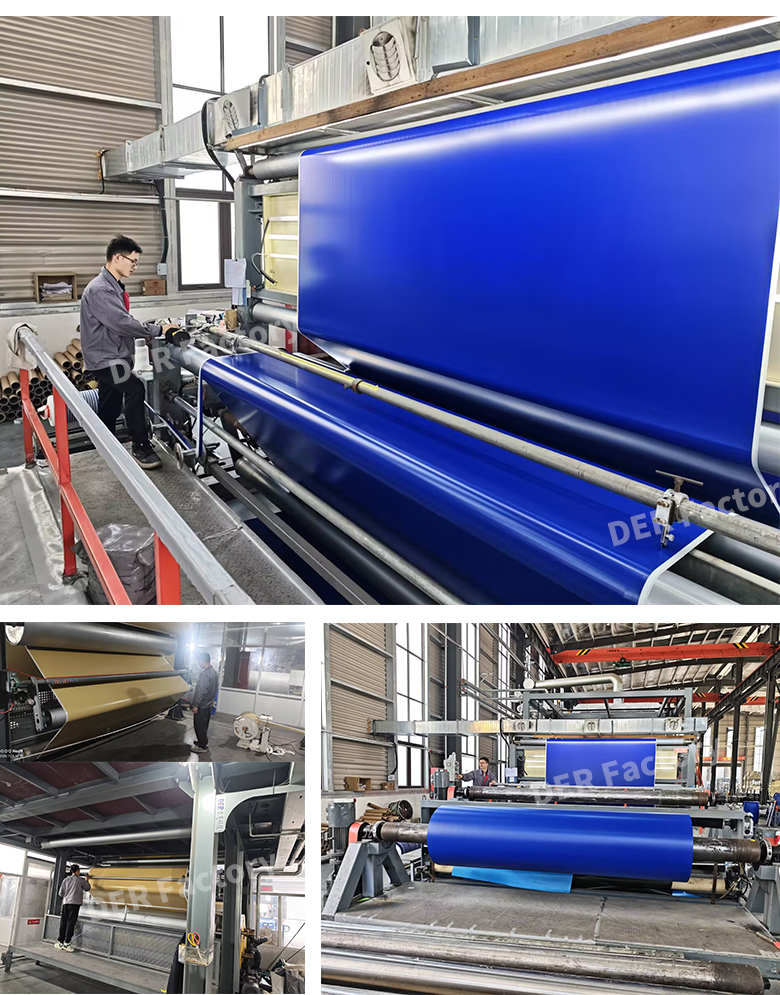
Direction: evaluate TPU or another specialist composite and validate the complete assembly—not only a fabric swatch.Real DERFLEX website images are used below to present the material structure, tarp format and manufacturing capability without external stock photography.

The following values are sourcing directions rather than a universal datasheet. Final construction and performance should be confirmed by sample, agreed test method and order specification.
| Specification Point | Available Direction | Buyer Consideration |
|---|---|---|
| Product Form | Roll goods, cut panels, welded sheets, machinery covers, curtains, enclosures and custom finished tarps | Provide a drawing or finished dimensions for complex shapes and access points. |
| Base Construction | High-tenacity polyester scrim with PVC coating; alternative coated textiles can be reviewed | Yarn, weave and coating balance affect tear, flexibility and dimensional stability. |
| Typical Weight | Approximately 450–1200 gsm, selected by application and construction | Higher weight alone does not prove better oil compatibility or longer service life. |
| Fabric Direction | Common industrial constructions may include 1000D × 1000D polyester; custom structures available | Confirm tensile, tear and puncture requirements for the actual load and hardware layout. |
| Oil Resistance | Formulation reviewed for the named lubricant, grease, hydraulic fluid or hydrocarbon exposure | State concentration, temperature, contact duration and cleaning method. |
| Surface Finish | Glossy, matte, embossed, lacquered or easy-clean direction | Surface selection can influence wiping, blocking, abrasion, printing and appearance. |
| Temperature Direction | Project-dependent cold-flex and operating-temperature options | Low-temperature folding and hot-surface contact should be stated before sampling. |
| Functional Options | UV, anti-mildew, flame-retardant, anti-static, abrasion-resistant and cold-resistant directions | Required standard, market and test documentation must be specified. |
| Fabrication | Heat welding, high-frequency welding, reinforced hems, webbing, grommets, D-rings, pockets and wear patches | Finished-cover performance depends on seam and reinforcement design as well as fabric. |
| OEM Options | Custom color, logo, labels, folded packing, roll packing, cartons and private-label coordination | MOQ and feasibility depend on material, color, finishing and packaging complexity. |
DERFLEX focuses on industrial and B2B uses where material consistency, custom fabrication and repeat supply are more important than standard retail sizes.
Weather covers, equipment enclosures, pump and vessel covers, maintenance curtains and custom panels with planned access points.
Covers for hydraulic systems, presses, generators, compressors and production equipment exposed to oily residue or maintenance splash.
Washable curtains, temporary partitions, floor-protection sheets and splash screens for industrial service or repair areas.
Custom covers for truck maintenance zones, service equipment, parts storage and cargo that may carry oily contamination.
Protective sheets near cutting fluids, lubricants, metal components and production areas requiring frequent wipe-down.
Equipment covers and work-area protection where mixed industrial residue, grease, moisture and outdoor exposure may occur.
A useful inquiry describes the operating problem rather than copying a competitor’s weight or thickness. Two tarps with the same GSM can behave differently because of coating chemistry, scrim, adhesion, finish and reinforcement.
Start with the most severe realistic exposure and identify the failure you are trying to prevent: surface softening, swelling, coating loss, staining, leakage, seam separation, tearing around hardware or abrasion against the covered object.
No single tarp material is the right answer for every oil-contact application. The matrix below helps buyers start the discussion.
Practical for many waterproof industrial covers, grease splash and lubricant-contact applications. Weldable, reinforced and widely customizable. Exact fluid compatibility must be confirmed.
Often reviewed for flexible containment, inflatable structures and low-temperature flexibility. Polymer type and fluid compatibility should be selected for the application.
A specialty direction used for demanding chemical, oil and fuel exposure. It may suit certain industrial covers but differs in cost, weight, fabrication and availability.
<, /article>Lightweight and economical for temporary general covering. Usually selected for price and handling rather than engineered long-term oil-contact performance.
Breathable and useful for selected dry-cover applications, but woven canvas can absorb oily contamination and is generally harder to wipe clean.
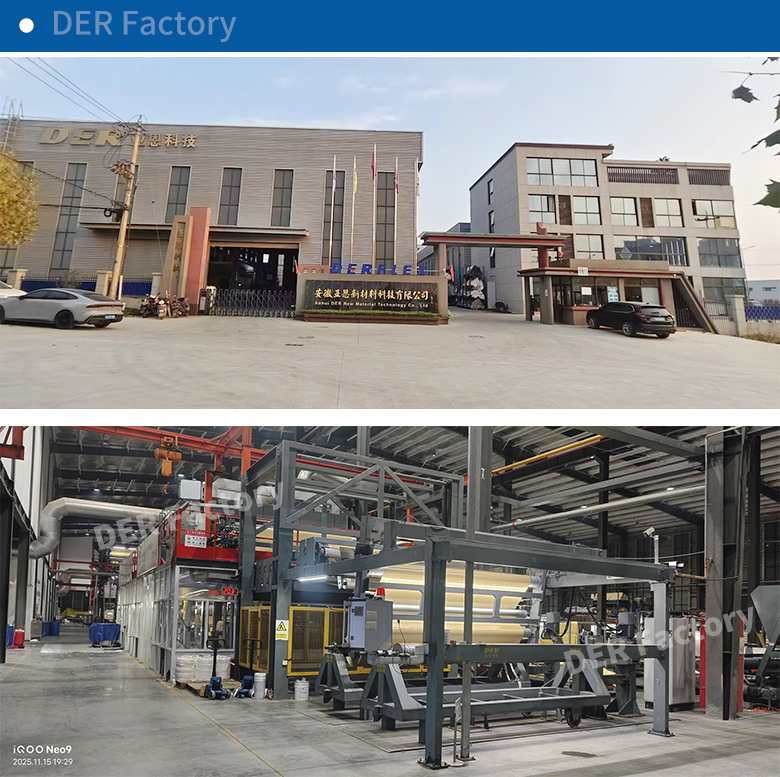
The advantage of manufacturer supply is the ability to connect the exposure requirement with the material and finished-cover construction.
The inquiry can be reviewed by fluid type, exposure, temperature, mechanical stress, finished shape and expected validation rather than by size alone.
Converters may source consistent coated fabric rolls, while project buyers can discuss cut panels, welding, reinforcement, hardware and export packing.
Wear strips, doubled corners, wider hems, webbing and hardware backing can be placed where the cover rubs or carries tie-down force.
Material color, hand feel, welding behavior and oil-contact direction can be reviewed on samples before the bulk specification is finalized.
Custom color, printed logo, labels, packaging and repeated supply can be coordinated for distributors, brands and industrial product lines.
Production, inspection, roll or finished-tarp packing and shipment documents can be organized around the confirmed B2B order.
These six pages form the closest internal topic cluster for industrial tarp buyers comparing material structure, reinforcement and finished-cover options.
Answers below are intended for sourcing guidance. Final suitability depends on the confirmed fluid, exposure and product construction.
PVC coated polyester is commonly reviewed for industrial covers exposed to lubricants, grease, hydraulic oil and general oily contamination because it combines waterproofing, textile reinforcement, weldability and custom fabrication. Neoprene-coated nylon, TPU coated fabric or another specialist composite may be more suitable for demanding fuels, solvents or containment applications. The exact fluid and contact conditions must be confirmed.
Not necessarily. “Oil proof” is often used as a commercial search term, but it can imply universal resistance that no single tarp material provides. A more accurate specification states which oil or hydrocarbon is involved, the contact time, temperature and acceptable material change after testing.
A cover that tolerates incidental splash should not automatically be used as a fuel-storage liner or containment tank. Gasoline, diesel and blended fuels have different effects on polymer coatings. For storage, immersion or spill-containment service, the fabric, seams, valves and complete assembly require compatibility validation.
Yes, subject to design and material feasibility. Buyers can provide finished dimensions, drawings, access openings, straps, hems, webbing, grommets, D-rings, wear patches, logo and packing requirements. Complex covers should identify moving parts, hot surfaces and locations where oily residue accumulates.
Project-specific combinations can be discussed, but adding one function can affect flexibility, welding, surface behavior, cost or compliance. State the required test standard, target market and operating environment before sample development so the material direction can be reviewed as a complete system.
Send the fluid name or SDS, contact type and duration, temperature range, indoor or outdoor exposure, finished size, quantity, target GSM or thickness if known, color, seams, reinforcement, hardware, logo, packing and destination. Photos or drawings of the equipment and wear zones are especially useful.
Send DERFLEX the fluid, contact time, temperature, finished size, quantity and fabrication details. The team can review a suitable material and sample direction for roll goods or finished industrial covers.