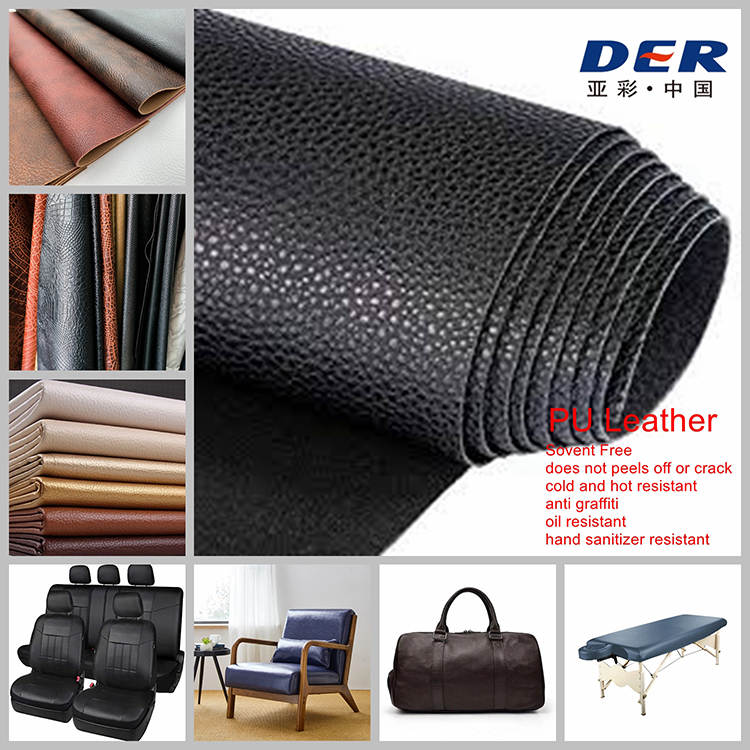
Knitted-Back PU Leather
Useful when the product needs a softer drape, controlled stretch or easier wrapping around shaped components.
- Furniture panels and soft seating
- Automotive trim and seat-cover directions
- Bags, cases and decorative wrapping
Polyurethane surface + engineered textile backing
Develop a leather-look roll material around the way your finished product must cut, sew, wrap, flex, clean and age—not around a color card alone.
DERFLEX supports PU coated fabric leather for upholstery, bags, automotive trim, footwear components, hospitality furniture, decorative wrapping and private-label material programs. Surface grain, gloss, backing, thickness, softness, color and verification direction can be reviewed before bulk production.
“PU coated fabric leather” is commonly used as a sourcing phrase for a leather-look material made by applying or transferring a polyurethane surface system onto a fabric or engineered backing. It is usually synthetic, but the complete layer composition should be confirmed because some PU-coated products use split leather beneath the surface.
Terminology that protects the order
Two rolls may look similar from the face and still behave differently during sewing, wrapping, folding or long-term use. The backing and bonding route influence stretch, tear behavior, dimensional stability, hand feel and how the material responds at seams and corners.
For a fully synthetic program, the material brief can state “PU surface over textile, nonwoven or microfiber backing” and request confirmation that no animal-hide layer is present. When the project intentionally uses split leather beneath the PU surface, that structure should be identified separately for accurate labeling and market communication.
DERFLEX treats the phrase as the beginning of a specification conversation. The goal is to define what the roll is made of, how it will be converted, what the finished article must withstand and which tests matter to the target market.
Material routes
The same polyurethane surface concept can be built over different substrates. Each route creates a different balance of softness, structure, cost, processing and premium feel.
Useful when the product needs a softer drape, controlled stretch or easier wrapping around shaped components.
Selected when dimensional stability, sewing control and reduced stretch are more important than a highly elastic hand.
A practical route for uniform thickness, efficient roll processing and broad consumer-product applications.
Considered when the project needs a denser structure, refined touch or stronger premium synthetic-leather positioning.
Can be discussed when the buyer has a specific formulation, restricted-substance or process preference that must be verified through the selected grade.
A hybrid route using an animal-derived split-leather base with a polyurethane face. It must not be presented as fully synthetic.
Specification framework
The table below is a development framework rather than a fixed catalog promise. Final ranges, tolerances and test methods should be confirmed against the approved sample, order quantity and end-use environment.
| Specification point | Development options | Why it matters to buyers |
|---|---|---|
| Surface system | PU coating, transfer film or project-specific resin route; matte, semi-matte, satin or gloss direction. | Controls touch, appearance, cleanability direction, friction and visual positioning. |
| Backing | Knitted, woven, nonwoven, microfiber or clearly declared split-leather substrate. | Influences stretch, tear behavior, sewing, wrapping, body and finished-product feel. |
| Thickness | Project-defined; approximately 0.6–2.0 mm is a common discussion window for many leather-look applications. | Changes drape, edge profile, sewing settings, folding and perceived substance. |
| Width | Common roll directions around 1.37–1.40 m; other widths reviewed by construction and production plan. | Affects cutting yield, nesting, seam layout and conversion efficiency. |
| Grain & embossing | Nappa, lychee, saffiano, smooth, pebbled, carbon-look, custom plate or reference-sample matching. | Defines brand language and can influence friction, cleaning and visual consistency. |
| Color control | Solid, two-tone, metallic, printed or custom matched by approved standard. | Reduces batch disputes and supports repeat-order collection management. |
| Performance direction | Abrasion, flexing, peel strength, hydrolysis, cold flex, color fastness, stain or cleaning review as required. | Prevents a visually acceptable sample from failing in the actual service environment. |
| Compliance pathway | Restricted-substance, flame, antimicrobial or target-market documentation discussed by exact product and test method. | Avoids vague claims and aligns the material program with the buyer’s market obligations. |
| Supply format | Roll length, core, protective wrapping, labels, palletization, OEM marks and export packing. | Supports warehouse handling, traceability and damage control during transport. |

Performance planning
“Durable” is too broad for a professional material brief. A bag edge, automotive armrest, restaurant chair, shoe upper and medical examination table experience different stress patterns.
The verification plan should focus on the most likely failure modes. Repeated flexing can expose weakness at folds. High humidity and heat can affect some polyurethane systems. Aggressive cleaning agents can change gloss, color or touch. Tight upholstery can place additional demand on backing strength and coating adhesion.
DERFLEX can review the application, conversion method and target market, then help organize a material direction for sampling. The approved sample, agreed test method and production tolerance should become part of the purchasing record.
Applications
Each use case needs its own balance of touch, backing strength, appearance, cleanability and processing behavior.
Review hand feel, stretch direction, seam behavior, abrasion, cleanability and consistency across large upholstered panels.
Consider color stability, backing control, wrapping behavior, repeated contact points and the project’s heat and aging requirements.
Balance surface appearance with folding, edge paint compatibility, sewing, tear behavior, reinforcement and production yield.
Check flex endurance, surface cracking direction, bonding route, thickness, stretch and comfort-related construction needs.
Plan for frequent cleaning, high-use contact zones, batch repeatability and the compliance route required by the installation.
Match the material to vacuum wrapping, lamination, bonding, folding, print or embossing processes used by the converter.
Development workflow
A controlled development path reduces the risk of approving appearance while overlooking processing and performance.
Share the finished product, use environment, target market, process and order plan.
Confirm PU route, backing, thickness, softness, grain and performance priorities.
Review color, hand feel, embossing, backing and conversion behavior on a practical sample.
Agree test methods, tolerances, composition declaration and approval record before bulk.
Lock roll format, labeling, protective packing, shipment details and repeat-order references.
DERFLEX manufacturing support
DERFLEX combines coated-material experience with application review, custom development and export-oriented supply coordination.
For buyers, the practical advantage is not a claim that one PU leather grade can solve every project. It is the ability to discuss different backing systems, surface directions, roll specifications, packaging and verification priorities around the finished product.
The company profile states an integrated 60,000 m² production area, more than 450 employees, over 25 senior engineers, three calender systems, three coating machines, five lamination machines and customers in more than 120 countries and regions. These resources support coated-fabric development and repeat-order coordination for distributors, converters, manufacturers and OEM brands.
Related material guides
Use these related DERFLEX pages to compare terminology, application grades and custom development routes.
Buyer FAQ
Clear answers for importers, product developers, converters, furniture factories, bag makers and OEM sourcing teams.
It is a leather-look material made by applying, transferring or laminating a polyurethane surface system onto a fabric or engineered backing. The backing may be knitted, woven, nonwoven or microfiber. Some products use split leather underneath, so the complete composition should be confirmed.
Most textile-backed PU coated fabric leather is synthetic and is not natural animal-hide leather. PU-coated split or bicast constructions can contain an animal-derived base. Ask for a written composition declaration for the exact grade.
DERFLEX can review reference samples, color standards, grain direction, embossing, gloss, backing and hand-feel targets for custom development. Final matching should be approved through physical samples under agreed viewing conditions.
Structured bags often benefit from stable woven or nonwoven backings, while upholstery may require a softer knit or application-specific backing. Microfiber can be considered for a denser, more refined structure. The correct choice depends on sewing, wrapping, stretch and durability requirements.
Common discussions include abrasion, flexing, peel strength, hydrolysis, color fastness, cold flexibility, cleaning compatibility and restricted-substance testing. The relevant method and target depend on the final product and destination market.
Send the end use, target composition, reference image or sample, grain, color, gloss, thickness, backing, width, quantity, processing method, performance priorities, packaging requirements and destination.
Share the finished application, reference surface, backing preference, thickness, color, processing method and order plan. DERFLEX will review the requirements and discuss a practical , development route for sampling and quotation.