1
PVC Functional Surface
The PVC coating forms the primary waterproof surface. Formulation can be adjusted for flexibility, outdoor exposure, abrasion, color and project-specific performance requirements.



 Engineered Flexible Containment Materials
DERFLEX supplies reinforced PVC tank liner material and custom-fabricated liner systems for steel tanks, concrete tanks, water reservoirs, agricultural storage, aquaculture and selected industrial liquids. Projects can be engineered around tank geometry, liner thickness, reinforcement, seam layout and connection details rather than forcing one generic specification onto every tank.
Buyers searching for a PVC tank liner manufacturer typically need more than membrane rolls. The liner must fit the tank, tolerate hydrostatic loading, remain flexible during installation, form reliable welded seams and stay compatible with the stored medium. Pipe penetrations, drain points, corners, top-edge attachment and substrate condition can be as important as the nominal material thickness.
DERFLEX approaches these projects from the coated-fabric side and the fabricated-product side. The company already manufactures PVC coated polyester used for flexible water tanks and uses high-frequency welding for assembled containment products. That combination enables projects ranging from liner material supplied to local fabricators through to made-to-dimension flexible liner assemblies.
For professional procurement, the useful question is therefore not “Which PVC is cheapest?” but “Which PVC structure, reinforcement and fabrication method matches the liquid, tank geometry and installation environment?”
A reinforced construction combines a liquid barrier with a textile reinforcement so the liner can handle fabrication, installation and in-service mechanical stress more effectively than unsupported film in many large-tank applications.
The PVC coating forms the primary waterproof surface. Formulation can be adjusted for flexibility, outdoor exposure, abrasion, color and project-specific performance requirements.
A woven polyester reinforcement provides dimensional stability and helps carry tensile and tear loads across large panels, welded seams and handling points.
The opposite coated face protects the reinforcement and supports compatible welding and fabrication methods for prefabricated liners, panels and accessories.
Nominal thickness alone does not predict liner performance. A useful tank-liner specification links material properties with the tank and stored medium.
The coating and welded seam system should create a continuous barrier appropriate for the intended water or liquid-storage duty.
Reinforcement matters when the liner is large, suspended, folded for shipment or stressed around corners and attachment points.
Panel layout, weld width, process settings and operator control influence the reliability of prefabricated seams and site connections.
The compound should remain practical for folding, fitting and service at the project's minimum and maximum operating temperatures.
For uncovered tanks, the exposed top zone and any external liner areas need a formulation selected for sunlight and weathering exposure.
Compatibility should be reviewed for the exact liquid, concentration and temperature. Water service and aggressive process chemicals should not share an unverified generic specification.
Rust scale, bolt heads, concrete defects and sharp edges can puncture liners. Surface preparation and protective underlay may be required.
Pipe penetrations, outlets, drains and flanges need reinforcement and sealing details compatible with the liner and the tank hardware.
The table below provides a practical starting point based on DERFLEX's existing reinforced PVC water-tank and coated-fabric capability. Final parameters should be confirmed against the project drawing and stored medium.
| Material Structure | High-tenacity polyester fabric with PVC coating on both sides |
|---|---|
| Common Reinforcement | 1000D × 1000D polyester is available for heavy reinforced water-containment constructions; alternative structures can be evaluated |
| Reference Fabric Weight | 1200 g/m² for an existing DERFLEX flexible water-tank construction; project weight can be customized |
| Reference Thickness | Approximately 0.9 mm for an existing heavy-duty water-tank construction; other flexible-tank materials are available in different gauges |
| Reference Breaking Strength | Approx. 2600 / 2300 N per 5 cm for the referenced 1200 g/m² construction |
| Reference Tear Strength | Approx. 350 / 320 N for the referenced construction |
| Reference Temperature Range | Existing DERFLEX heavy PVC water-tank material is specified for approximately -40°C to +70°C |
| Fabrication | HF / RF welding and compatible thermal fabrication methods; seam design depends on liner geometry |
| Supply Format | Roll material, welded panels, made-to-dimension liners or flexible containment products subject to project scope |
| Color / Surface | Blue, grey, black and other custom colors can be evaluated according to production requirements |
| Accessories | Reinforced openings, flanges, drains, attachment hems and project-specific fittings can be discussed from drawings |
| Compliance | Required REACH, RoHS, potable-water, food-contact or project-specific documentation must be stated before quotation so the correct formulation can be selected |
DERFLEX can support different buyer groups with liner material and fabrication options. The correct formulation depends on the stored medium and exposure conditions.
Flexible internal barriers for bolted or fabricated steel tanks where separating water from the metal shell can reduce direct wet contact and simplify refurbishment.
Prefabricated or site-connected liner systems for water containment where cracks, joints or porous substrates need an independent flexible waterproof layer.
Farm water, irrigation buffer tanks, rainwater collection and selected liquid fertilizer applications after chemical compatibility review.
PVC liner material for fish tanks, circular framed tanks, aquaculture basins and related water-management systems where cleanable flexible surfaces are preferred.
Make-up water, wash water, selected wastewater and non-aggressive process liquids where the PVC formulation has been verified for the duty.
Custom panels and liner structures can be evaluated for pits, bunds or containment zones where flexible welded barriers are appropriate to the site design.
A general-purpose PVC liner may be suitable for many water and mild industrial duties, but concentrated acids, alkalis, solvents, hydrocarbons, oxidizers and elevated temperatures can change the material-selection decision. Before production, provide the exact chemical name, concentration, temperature, contact duration and any cleaning chemicals.
If the medium is drinking water or food-related, identify the applicable regulatory or certification requirement for the destination market. A general industrial PVC liner should not be assumed to meet potable-water requirements without documentation for the specific formulation.
Water type, chemical name, concentration, additives and cleaning media.
Normal operating temperature plus start-up, cleaning and seasonal extremes.
Continuous immersion, intermittent contact, outdoor UV exposure and expected service cycle.
Confirm PVC formulation, reinforcement and accessory materials are compatible as a system.
List required test reports, declarations or market-specific approvals before purchase.
For repeat OEM programs, lock critical parameters and an approved sample where practical.
A controlled design-to-fabrication process helps prevent the common problems caused by ambiguous dimensions, misplaced penetrations and unsuitable seam layouts.
Confirm tank use, stored medium, geometry, operating environment and required documents.
Match PVC formulation, reinforcement, thickness and surface treatment to the duty.
Translate finished dimensions into cut panels, allowances, corners and weld positions.
Fabricate panels and integrate approved reinforcements, openings, drains or attachment details.
Check agreed dimensions and workmanship, then fold and pack to reduce installation confusion.
The practical advantage is the ability to coordinate coated-fabric production, welded fabrication and buyer specifications within one supply program.
Many liner problems begin at the tank surface or interface details rather than in the middle of the membrane.
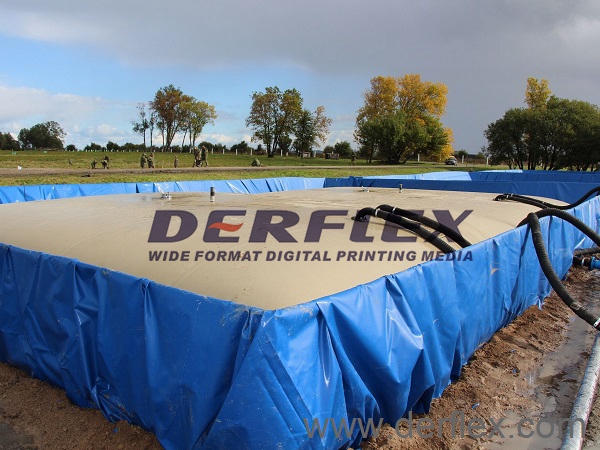
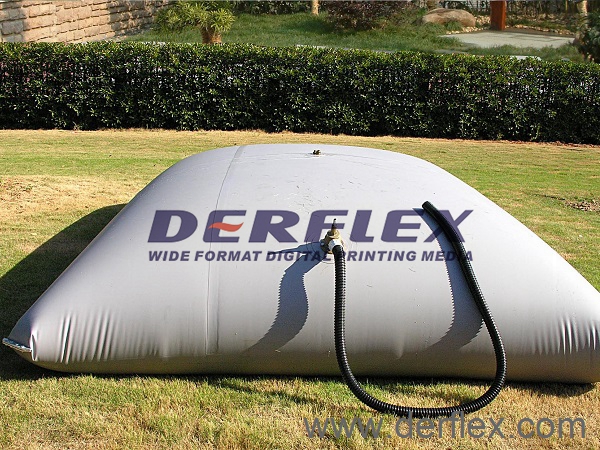
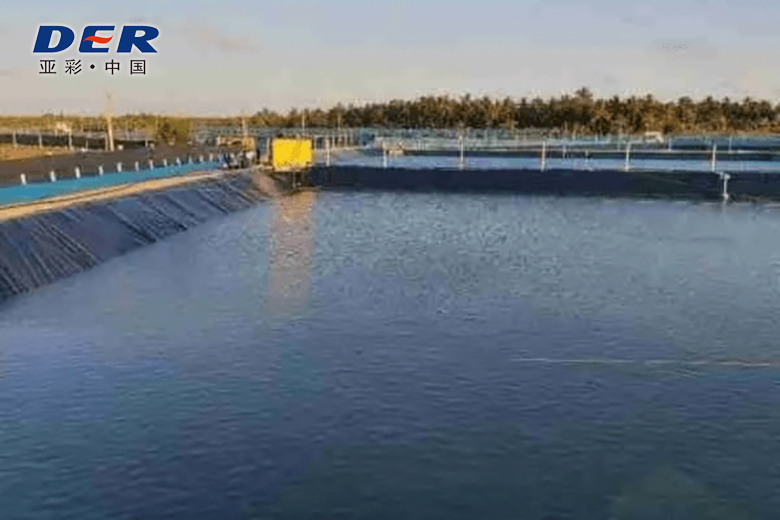
Existing DERFLEX project imagery demonstrates reinforced coated-fabric use across open containment, flexible bladders and aquaculture/water-storage environments.
These related pages help buyers compare finished flexible tanks, pond and aquaculture liners, and the coated-fabric platform used for custom fabrication.
Provide tank shape, finished internal dimensions, stored liquid, concentration if chemical, operating temperature, indoor/outdoor exposure, tank substrate, pipe and drain locations, and any required certifications or test documents. Drawings are strongly recommended for irregular tanks.
DERFLEX manufactures PVC coated material and also has high-frequency welding capability used for flexible water-containment products. Depending on the project, supply can be discussed as roll material, welded panels or a prefabricated liner assembly.
There is no single correct thickness. Tank size, reinforcement, liquid, substrate condition, installation method and service environment matter. DERFLEX has existing heavy water-tank constructions around 0.9 mm / 1200 g/m², but final selection should be project-specific.
Yes, flexible PVC liner systems are commonly used in steel and concrete containment when the material and attachment system suit the application. The tank surface must be prepared to remove sharp features, and protective underlay may be necessary on rough substrates.
It can be suitable for selected chemicals, but PVC is not universally resistant to every medium. Chemical name, concentration, temperature and exposure duration must be checked before confirming the formulation. For aggressive solvents or other incompatible media, a different polymer may be necessary.
Only when the specific liner formulation and supporting documentation meet the potable-water requirements applicable to the project and destination market. Do not assume a general industrial PVC liner is automatically potable-water certified.
For a useful quotation, include dimensions, liquid type, temperature, exposure conditions, fittings and required compliance documents. DERFLEX can then review an appropriate reinforced PVC structure and fabrication scope.