TPO weathering layer
The exposed thermoplastic layer provides the weldable roof surface and outdoor weathering face. Color and surface direction should match the project requirement.



DERFLEX supplies self-adhered TPO membrane direction for commercial flat and low-slope roofs where contractors, distributors and project buyers want a cleaner field workflow with an adhesive-backed sheet, removable release liner and hot-air welded TPO seams. Thickness, reinforcement, roll size, adhesive structure, substrate compatibility, packaging and required project documentation should be confirmed as one coordinated specification before ordering.
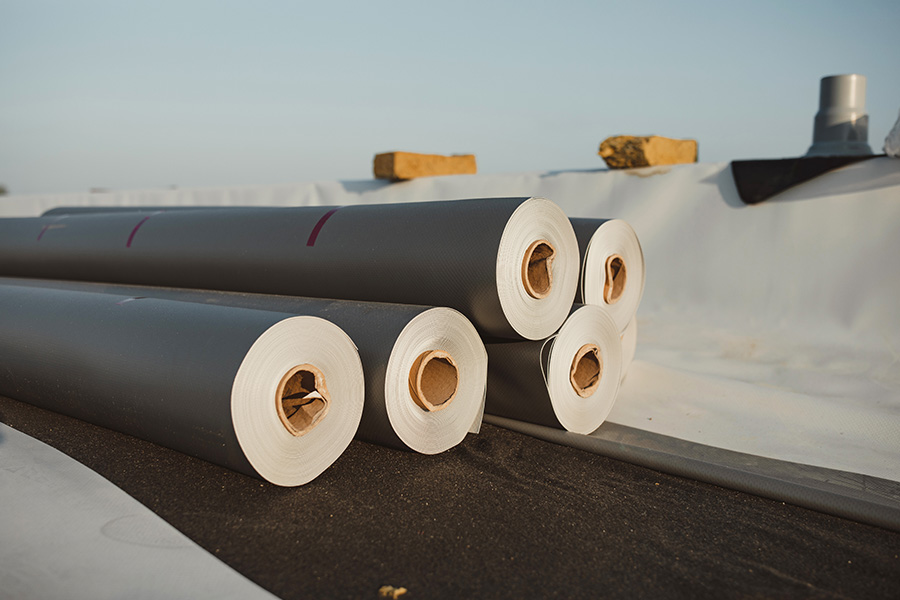
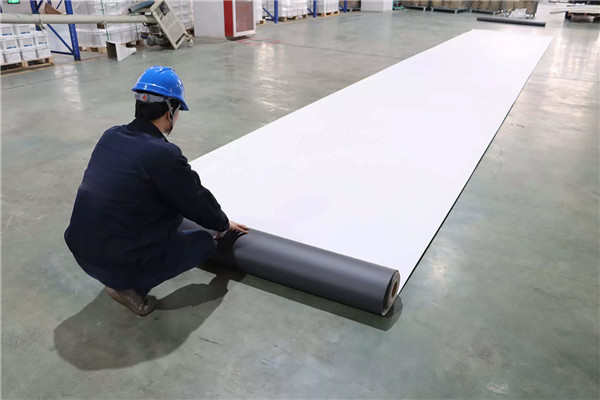
A self-adhered TPO membrane is a thermoplastic polyolefin roofing sheet with an adhesive layer integrated on the underside and protected by a removable release liner. It is also searched as self-adhesive TPO membrane, peel-and-stick TPO roofing or TPO SA membrane. Many commercial SA systems in the market use a factory-applied pressure-sensitive adhesive; the final DERFLEX adhesive construction and approved application conditions should be confirmed for the specific order. During installation, the sheet is positioned over a compatible prepared substrate, the liner is removed in a controlled sequence, the membrane is pressed or rolled into full contact, and the TPO field seams are completed by hot-air welding.
For buyers, “peel-and-stick TPO” should not be treated as a stand-alone roll specification. Adhesive chemistry, reinforcement, membrane thickness, liner design, substrate approval, primer requirement, application temperature, seam configuration and wind-uplift assembly all affect whether the material is suitable for a particular roof.
The procurement risk is usually not the word “self-adhered”; it is an incomplete material and assembly definition. Use the four-part logic below before price comparison.
The exposed thermoplastic layer provides the weldable roof surface and outdoor weathering face. Color and surface direction should match the project requirement.
Commercial self-adhered TPO is commonly specified as a reinforced sheet. Confirm internal reinforcement, nominal thickness and the construction required by the intended roof assembly.
The underside adhesive controls field bonding. Adhesive formulation, coat uniformity, substrate compatibility and permitted application conditions should be established before bulk supply.
The release liner protects the adhesive during storage and handling. Liner design also affects installer workflow, alignment control and clean removal on the roof.
Self-adhered backing bonds the sheet to the substrate; it does not eliminate the TPO-to-TPO hot-air welding step at field laps and details.
The membrane has to work with the deck, insulation, cover board, vapor-control layer, perimeter detailing and project wind / code pathway.
DERFLEX currently publishes common TPO membrane thickness directions from 1.2 mm to 2.0 mm. A self-adhered order needs additional adhesive-backed and substrate information; values not publicly verified by DERFLEX are intentionally left project-specific rather than invented.
| RFQ Item | DERFLEX Direction | Why It Matters | What the Buyer Should Confirm |
|---|---|---|---|
| Material | Thermoplastic polyolefin roofing membrane | Defines the heat-weldable single-ply material family | Required roof standard and project approval pathway |
| Installation concept | Self-adhered / adhesive-backed TPO direction | Reduces separate field-applied roof-field adhesive operations | Approved substrate, primer direction and temperature window |
| Membrane thickness | 1.2, 1.5, 1.8, 2.0 mm TPO direction; confirm final SA structure | Influences durability, handling, specification and roof-system selection | Nominal thickness, thickness over reinforcement if required, local market convention |
| Reinforcement | Available by project structure | Relevant to dimensional stability and mechanical performance | Scrim type / reinforcement direction and required test data |
| Adhesive layer | Project-specific; confirm with DERFLEX | Controls bonding behavior to the approved substrate | Adhesive chemistry, coat direction, peel / bond requirements, aging data |
| Release liner | Project-specific | Protects adhesive and controls installation sequence | Liner construction, split-liner preference, storage / removal behavior |
| Roll width / length | Custom roll planning can be discussed | Changes seam count, crew handling and freight efficiency | Preferred module, roll weight limitations and container plan |
| Color | White, gray, tan and custom TPO directions are listed on current DERFLEX TPO pages | Reflectivity, aesthetics and market SKU planning | Color requirement, MOQ and approval sample |
| Seaming | Hot-air weldable TPO | Creates the thermoplastic field-lap waterproofing connection | Overlap design, welding equipment, test-weld protocol and detail accessories |
| Packaging | Protective roll packing, labels and pallet direction can be discussed | Important for adhesive protection, batch control and export handling | Private label, roll ID, pallet plan, container loading and storage conditions |
This is a planning sequence, not a substitute for the approved installation manual for the final roof system.
Confirm the deck or cover board is accepted for the selected system. It should be stable, clean, dry, smooth and free of contamination that can interfere with adhesion.
Position the membrane and plan seams, drains, curbs, parapets and penetrations before exposing the adhesive surface.
Remove the release liner progressively so the crew can keep the sheet aligned and reduce trapped air, wrinkles or premature adhesive contact.
Broom or roll the sheet using the pressure and method required by the approved system so the adhesive makes consistent contact with the substrate.
Complete TPO-to-TPO seams with the specified overlap, welding temperature, travel speed and pressure. Run test welds when required by the installation procedure.
Review seams, corners, drains, roof edges, penetrations, transitions and any area where adhesive contact or welding could be compromised.
The membrane format should follow the roof assembly and installation constraints, not a one-size-fits-all preference.
| TPO Direction | How It Attaches | Best Procurement Question | Main Watchpoint |
|---|---|---|---|
| Self-adhered TPO | Factory-integrated adhesive bonds the sheet to an approved substrate | Which substrate, primer and temperature conditions are approved? | Surface preparation, adhesive compatibility, liner handling and pressure application |
| Conventional fully adhered TPO | Separate field-applied adhesive system | Which adhesive and coverage rate match the membrane and board? | Adhesive application, flash-off / set-up requirements, weather and jobsite handling |
| Mechanically attached reinforced TPO | Fasteners and plates secure the assembly, with welded seams | What tested fastening pattern and wind-uplift assembly is required? | Fastener density, roof zones, deck attachment and reinforcement |
| Fleece-backed TPO | Fleece backing works with compatible adhesive or recover-system direction | Is fleece backing needed for the substrate or recover condition? | Adhesive compatibility, fleece weight, substrate and recover design |
For broader construction differences, review DERFLEX's reinforced TPO roofing membrane guide.
Existing DERFLEX website images are reused here so the page can launch with real on-domain TPO visuals instead of unrelated stock photography.

| Buying Scenario | What to Prioritize | What to Send DERFLEX | Decision Risk to Avoid |
|---|---|---|---|
| New commercial flat roof | Approved substrate, reinforcement, thickness, seam and wind-uplift assembly | Roof deck, insulation / cover board, roof zones, target standard, area | Ordering membrane before assembly design is settled |
| Occupied school / healthcare / retail retrofit | Installation disruption, field adhesive handling, existing roof condition | Existing roof build-up, moisture survey direction, work-hour constraints, details | Assuming self-adhered automatically makes an existing roof suitable |
| Warehouse / logistics center | Large-area installation planning, roll width, seam count, roof traffic | Roof dimensions, penetrations, crew handling limit, thickness, quantity | Optimizing roll width without checking handling and edge conditions |
| Distributor / private label | Repeatable SKU, roll labels, packaging, documentation and batch consistency | Target market, common thickness, color, roll size, annual demand direction | Launching a SKU without defining substrate / install guidance |
| Cold-weather installation planning | Documented adhesive temperature range and substrate condition | Expected roof temperature, climate, storage method, board type | Using competitor temperature claims as a DERFLEX specification |
| High-wind / code-sensitive project | Tested roof assembly and attachment path | Design pressure, code jurisdiction, deck, perimeter/corner zones | Treating membrane peel adhesion as a substitute for assembly approval |
A complete RFQ produces a more useful quotation than sending only thickness and square meters.
New roof or retrofit; roof area; deck type; insulation; cover board; slope; drainage; roof traffic; parapets and major penetrations.
Target thickness; reinforcement direction; color; preferred roll width / length; field seam requirement; any market-standard dimensional convention.
Approved substrate; expected application temperature; primer requirement; adhesive performance documents; release-liner preferences and storage conditions.
Destination market; applicable ASTM / EN / local standard; roof-system approval path; requested third-party reports or project submittals.
Order quantity; sample request; private label; packaging; pallet requirements; container loading direction; destination port and delivery schedule.
Define sample / golden sample approval, roll identification, batch traceability and the attributes that must remain consistent for repeat bulk orders.
Thickness does not define reinforcement, adhesive, liner or roof-system compatibility. Approve the construction, not just the number.
A good adhesive cannot compensate for a wet, dusty, incompatible or unstable surface. Put substrate information into the RFQ.
Installation speed and low-temperature figures published by another brand should not be copied into a DERFLEX specification without project-specific verification.
Self-adhered backing does not turn the sheet into a seam-free membrane. Field laps and details still need a defined hot-air welding procedure.
Adhesive-backed material deserves disciplined storage, protective roll packaging and clear batch / roll identification for export projects.
Wind, code, drainage, insulation, edge metal, vapor control and details belong to the roof assembly. Membrane sourcing should stay connected to those decisions.
DERFLEX already supplies TPO membrane, reinforced TPO and waterproof membrane directions. For self-adhered TPO procurement, the value is the ability to discuss membrane construction, roll format, packaging and export requirements together rather than treating the product as a generic peel-and-stick sheet.
Buyers can compare general TPO membrane, reinforced structures and adhesive-backed directions within one related product family.
Thickness, roll size, color, reinforcement, adhesive-backed construction, packaging and documentation can be discussed against the actual roof scenario.
DERFLEX supports contractors, project buyers, importers and distributors requiring roll-goods planning, labeling and export documentation direction.
Use these verified DERFLEX pages to compare material structures, commercial sourcing and waterproofing alternatives.
A self-adhered TPO membrane is a thermoplastic polyolefin roofing sheet supplied with an integrated adhesive layer on the underside and a removable release liner. The field membrane bonds to a compatible prepared substrate, while TPO sheet laps are normally completed with hot-air welded seams according to the approved roof-system procedure.
Self-adhered TPO is a type of fully adhered installation concept, but the adhesive is integrated with the membrane rather than applied across the roof field as a separate liquid or spray adhesive. The approved substrate, primer direction, roller pressure, temperature window and detail treatment still have to be confirmed for the selected roof assembly.
Yes, the TPO-to-TPO field seams are normally designed as heat-welded laps. The self-adhered backing attaches the field sheet to the substrate; it does not replace the thermoplastic seam-welding step.
Send the deck or cover-board type, roof build-up, existing roof condition for retrofit work, roof area, target membrane thickness, roll-size preference, climate, installation temperature range, required standards or approvals, quantity, destination and packaging requirements.
Thickness should be selected as part of the roof assembly rather than as a stand-alone number. DERFLEX currently lists common TPO membrane directions from 1.2 mm to 2.0 mm on its TPO product pages; the final self-adhered construction, reinforcement, adhesive layer and tested assembly requirements should be confirmed for the project.
Self-adhered systems can be attractive for occupied or odor-sensitive projects because they can reduce field-applied adhesive handling. Actual suitability depends on the approved roof assembly, substrate condition, detailing, local requirements and the specific adhesive system used.
DERFLEX can discuss project-specific thickness, width, length, surface color, reinforcement direction, adhesive-backed structure, roll labels, packaging and export documentation. Parameters that affect adhesion and roof-system compliance should be confirmed before bulk production.
Send the roof build-up, substrate / cover board, target thickness, reinforcement direction, roll size, application temperature, roof area, quantity, destination and required documents. DERFLEX can review the material direction and prepare a project-oriented quotation.